The Kuwana Ishidori Festival (石取祭) is a two-day summer rite at Kuwana Sosha, better known as Kasuga Shrine, in Kuwana, Mie. In 2026 it ran on 1 and 2 August. Dozens of ornate three-wheeled carts — 39 of the 43 in the official 2026 order — hammer gongs and drums from midnight onward, which is why it is called Japan’s noisiest festival.
At midnight, in the first minutes of the Saturday before August’s first Sunday, a priest in Kuwana strikes a single drum inside a shrine. Within seconds, every neighbourhood in the old castle town answers with gongs and taiko, all at once, in the dark. That is how the Kuwana Ishidori Festival begins — a UNESCO-listed float festival its own organisers advertise as the loudest in the country. The 2026 edition ran on 1 and 2 August, and everything below is verified from the shrine, the preservation society, the Agency for Cultural Affairs, Kuwana City, Mie Prefecture and the railways on 15 August 2026.
Written by Yuu — a Nagoya native of 35 years. Published August 15, 2026.
This article may contain affiliate links. See our affiliate disclosure for details.
All festival details verified from official sources on August 15, 2026.
What Do You Need to Know in One Minute?
The Kuwana Ishidori Festival is held on the first Sunday of August and the Saturday before it. In 2026 that was 1 and 2 August. It centres on Kuwana Sosha in Mie, twenty-two minutes from Nagoya by train.
| Festival | Ishidori Matsuri / Ishidori-goshinji (石取祭・石取御神事), the rite of Kuwana Sosha (桑名宗社), popularly Kasuga Shrine (春日神社) |
|---|---|
| 2026 dates | Saturday 1 August (shingaku) and Sunday 2 August 2026 (hongaku) — the opening drum-strike falls at 00:00 entering the Saturday |
| Annual rule | Hongaku on the first Sunday of August; shingaku on the Saturday before |
| 2027 dates | 31 July – 1 August 2027, per Mie Prefecture’s tourism site. Not yet announced by the organisers |
| Carts | 43 in total; the official 2026 procession order listed 39 towns |
| Where | Kuwana Sosha and the streets of the old castle town, Kuwana City, Mie Prefecture |
| Nearest station | Kuwana Station (JR / Kintetsu / Yoro Railway) — about 20 minutes on foot to the shrine |
| From Nagoya | Kintetsu express: ¥530, 22 min, no transfer. JR Kansai Line rapid: ¥360, 24 min, no transfer |
| Admission | No admission policy is published by any official source — it is a street-and-shrine rite (see the FAQ) |
| Status | Important Intangible Folk Cultural Property of Japan (2007); UNESCO Intangible Cultural Heritage (2016) |
| Organisers | Kuwana Ishidori Matsuri Preservation Society (桑名石取祭保存会) with Kuwana Sosha |
| Official site | kuwana-ishidori.com (has an English page) |
Local tip: Kuwana is in Mie, but from Nagoya it does not behave like another prefecture — the ride is shorter than plenty of trips inside Nagoya itself. This is a night out, not an expedition, which matters because the best part of the festival happens at hours when nothing is running.

What Is the Kuwana Ishidori Festival?
It is the annual summer rite of Kuwana Sosha, a shrine in the old castle town of Kuwana in northern Mie. Neighbourhood associations pull ornate three-wheeled carts through the streets while hammering gongs and a large drum, and each town performs at the shrine gate.
The shrine is unusual before you get near the carts. According to the preservation society, Kuwana Sosha is two shrines sharing one precinct — Kuwana Jinja (桑名神社) and Nakatomi Jinja (中臣神社), both listed in the tenth-century Engishiki register. Locals almost always say Kasuga Shrine, after the second, so expect both names on signs.
The festival is called Ishidori (石取), literally “stone taking,” with the full liturgical name Ishidori-goshinji (石取御神事). It was originally one element inside a larger shrine festival, the Hiyori-sai (比与利祭), and became an independent rite during the Horeki era, the 1750s. Records of it already appear in the Keicho era at the start of the Edo period, and the society’s chairman puts the tradition at more than 400 years old.
The designations, and what they mean
On 7 March 2007 the event became an Important Intangible Folk Cultural Property of Japan as Kuwana Ishidori-matsuri no Saisha Gyoji (桑名石取祭の祭車行事). The Agency for Cultural Affairs’ heritage database records that date, names the preservation society as the protecting body, and adds a detail worth carrying with you: the townspeople are organised into eleven groups (組, kumi), which structure how the two days work.
Then on 1 December 2016 — at 02:02 Japan time, as the organisers’ page records with some pride — the eleventh session of the UNESCO intergovernmental committee, meeting in Addis Ababa, inscribed Yama, Hoko, Yatai, float festivals in Japan (山・鉾・屋台行事) on the Representative List. Kuwana’s cart event is one of the 33 constituent festivals, three of which are in Mie; Mie’s tourism site names the whale-boat event at Toride Shrine and the Ueno Tenjin Festival as the others. Our guides to the Owari Tsushima Tenno Festival and the Inuyama Festival cover two Aichi entries on the same list.
Why “Japan’s noisiest festival”
The nickname is not a translator’s flourish. Both the shrine and the society print it themselves: tenka no kisai (天下の奇祭), “the strangest festival under heaven,” and Nihon-ichi yakamashii matsuri (日本一やかましい祭), rendered on the society’s English page as “Japan’s Loudest Festival.” Its origin is a story the chairman, Kunihiko Hirose, tells carefully, so I will be careful too: the label is said to trace to the late broadcaster Rokusuke Ei, who reportedly judged Kuwana’s the noisiest festival he had seen anywhere. Hirose’s own wording is that this is what he has heard — a well-loved local account rather than documented fact.
Why Is a Festival Named After Picking Up Stones?
Because that is literally the rite. Townspeople go to the Machiya River south of the city, purify themselves in the current, gather clean pebbles and offer them to the shrine to purify its ground. The carts began as the vehicles used to haul those stones.
The shrine offers three competing accounts of how it started and refuses to choose between them: stone divination (石占, ishiura), reading the will of the gods by lifting a stone and judging its weight; repairing the shrine ground, since the precinct sits on low land near the sea and a river; and repairing the yabusame course, because the Hiyori festival included horseback archery.
Then it goes further than logistics, and this is the part I find genuinely interesting. Spreading washed gravel, the shrine writes, was not simply about fixing damp ground: our ancestors regarded stone as something living and growing and believed a divine spirit could descend and reside in it. Under that reading, ishidori is not maintenance — it is preparing a place for a god to arrive.
The offering still happens: at 10:00 on the shingaku day the shrine holds the kenseki-kagura (献石神楽), accompanying the dedication of the stones. And it adds a riddle — these stones have been offered for centuries, yet their number does not increase.
When Was the Kuwana Ishidori Festival 2026, and When Is the Next One?
The 2026 edition ran on Saturday 1 and Sunday 2 August, with the opening drum-strike at midnight entering the Saturday. Mie Prefecture’s tourism site already lists 31 July – 1 August 2027, but the organisers have not published their 2027 programme yet.
It went ahead as programmed: as of 15 August 2026, neither the shrine, the preservation society, Kuwana City nor Mie Prefecture had published any notice of cancellation, postponement or change, and the full 2026 programme, procession order and viewing maps were all still posted.
The rule is fixed and both organisers state it identically: hongaku (本楽), the main day, falls on the first Sunday of August, and shingaku (試楽), the eve, on the Saturday before. For 2026, Kuwana Sosha and the preservation society published the same three lines: 31 July (Fri) tatakidashi · 1 August (Sat) shingaku · 2 August (Sun) hongaku. That first line confuses people: the opening is at 00:00 on the shingaku day — on a clock, the very start of Saturday; in everyday speech, “Friday night.”
Treat Kuwana City’s phrasing, “the first Saturday and Sunday of August,” as unreliable: in 2027 the first Saturday is the 7th while the first Sunday is the 1st, so the two point at different weekends.
The 2026 programme, as the organisers published it
| Day | Time | What happens |
|---|---|---|
| Sat 1 Aug (shingaku) |
00:00 | Tatakidashi (叩き出し) — every cart starts at once |
| 10:00 | Kenseki-kagura and the morning food offering | |
| 11:00 | Formal shrine visit by the young men’s league | |
| 18:00 | Shingaku proper — carts tour their own districts | |
| 01:30 (listed as 25:30) | Opening gong-and-drum rite for the main day | |
| Sun 2 Aug (hongaku) |
02:00 | Second tatakidashi |
| 10:00 | Morning food offering | |
| 13:00 & evening | Carts assemble in the line-up and are pulled out | |
| 17:30 | Evening food offering | |
| 18:10 | Handover of the sacred flame; opening of the tosai | |
| 18:30 | Tosai (渡祭) begins with the hanaguruma, the lead cart | |
| from 21:00 / 22:00 | Hikiwakare (曳き別れ) — the carts part ways (see note) |
One honest caveat about that last row: the organisers’ timetable and the shrine both say 22:00, while the official 2026 hongaku map annotates the same crossing with “from 21:00, four carts at a time.” Mie’s tourism site explains it — the break-up starts at 21:00 in south-market years and 22:00 in north-market years, and 2026 was a south-market year.
What the lead cart is, and how it gets chosen
The order of the tosai is not fixed by seniority. It is drawn by lot at the goshinsen-urainai-shiki (御神籤占式), the year’s first rite, held on the first Sunday of June — for 2026, on 7 June. The town that draws first supplies the hanaguruma (花車), the flower cart that leads. The 2026 sheet, signed by the preservation society, lists 39 towns, from Hagoromo (羽衣) at number 1 to Nishi-Yada-cho (西矢田町) at number 39.
Hold on to that 39, because the numbers quoted elsewhere differ and are all defensible. 43 is the total number of carts in existence, per both the shrine and the society; “up to 40” is the phrasing Kuwana City and Mie Prefecture use; 39 is what the official 2026 order listed. They count different things, and the number taking part varies year to year.
2027, and how far ahead you can plan
Mie Prefecture’s official event page carries a forward line: 2027 is 31 July (Sat) – 1 August (Sun), matching the organisers’ rule since 1 August 2027 is the first Sunday. What it is not is an announcement from the shrine or the society, neither of which had published anything for 2027 as of 15 August 2026 — nothing about the running order exists until the June lottery.
One more trap: the line-up route alternates every year between the north market (北市場) and the south market (南市場, along the old Tokaido). 2026 was the south, so under the stated rule 2027 would be the north — but that is my arithmetic, not an announcement, so do not copy 2026’s viewing spots across.
What Actually Happens at Midnight?
At 00:00 on the shingaku day, the chief priest of Kuwana Sosha strikes the kagura drum inside the shrine. On that signal every cart in every district starts hammering gongs and drum simultaneously. The organisers call the sound a roar, and it is the moment the city has waited a year for.
The shrine’s description of the tatakidashi (叩き出し) says that at the instant it begins the scene is one of unmatched valour, and that this is the start of the festival the townspeople have spent a year longing for. Chairman Hirose is blunter — masani goon desu, “it is quite simply a roar.”
The signal travels: the drum sounds at the shrine, the nearest towns start first, and the noise spreads outward toward the edges of the old town. Mie’s tourism writer, a Kuwana native, describes the tension building from around 23:45 and the release at midnight as the thing that raises goosebumps every year. The burst rolls on for one to two hours. Then it happens a second time: hongaku opens with its own tatakidashi at 02:00.
Local tip: read those two times against the last train, because they are why this festival is awkward to visit from Nagoya. Midnight and 02:00 both fall well outside service, in either direction, on either railway. If the tatakidashi is what you came for, the realistic options are to stay in Kuwana or accept a taxi at unsociable-hour rates — the 18:00 shingaku tour and the 18:30 tosai are the parts that fit inside the last train home.
What Happens on the Main Day?
After the 02:00 opening, the carts assemble from 13:00 in a long line along the old Tokaido, are pulled out from late afternoon, and from 18:30 each town performs in front of the shrine gate in turn. The last cart can finish close to midnight.
Early afternoon: the line-up
From 13:00 the towns bring their carts into position in the year’s tosai order. The official 2026 map describes what you get if you come for this rather than the evening: a stately procession in yukata and haori, forming up along the route. Mie’s tourism site adds that children carry the ishidori rhythms on this leg while the adults pull, and that once the formation is complete there is a lull — the best window for actually looking at the carts rather than being swept past them. In 2026 the official map added a tip tied to that year’s south-market alignment: the tail of the line could be reached in about five minutes’ walk from Masuo (益生), one stop along from Kuwana, between 15:00 and 16:30.
Evening: the tosai
Kuwana Sosha gives the pivot: the hanaguruma is pulled out at 16:30 and the tosai begins at 18:30. In between, the lead cart works toward the shrine via the Kyomachi crossing — and in north-market years the Tamachi crossing too. Mie’s tourism site makes a case for these crossings as the connoisseur’s choice: the young men join up as the carts pass, and the crowds are thinner than at the shrine gate.
The dedication is the centrepiece. From 18:30, each town in turn performs in front of the romon, the two-storey gate of Kuwana Sosha. Mie’s tourism site puts each slot at eight minutes and notes the arithmetic: with that many carts, the final town can finish close to midnight. Work out your last train before the tosai starts, not during it.
One thing about the route is easy to miss: the official map notes that the carts travel a stretch of the old Tokaido with no overhead power lines, so the tall yamagata lantern frame stays upright the whole way — rare in a Japanese city, where floats usually have to fold, tilt or thread.
Night: the hikiwakare
At the Tamachi crossing the carts perform the hikiwakare (曳き別れ), the parting, four at a time — one on each arm of the crossroads, back to back, playing for about twenty minutes. It is the only moment where the sound arrives from every direction at once.
What Makes the Saisha Carts Worth a Close Look?
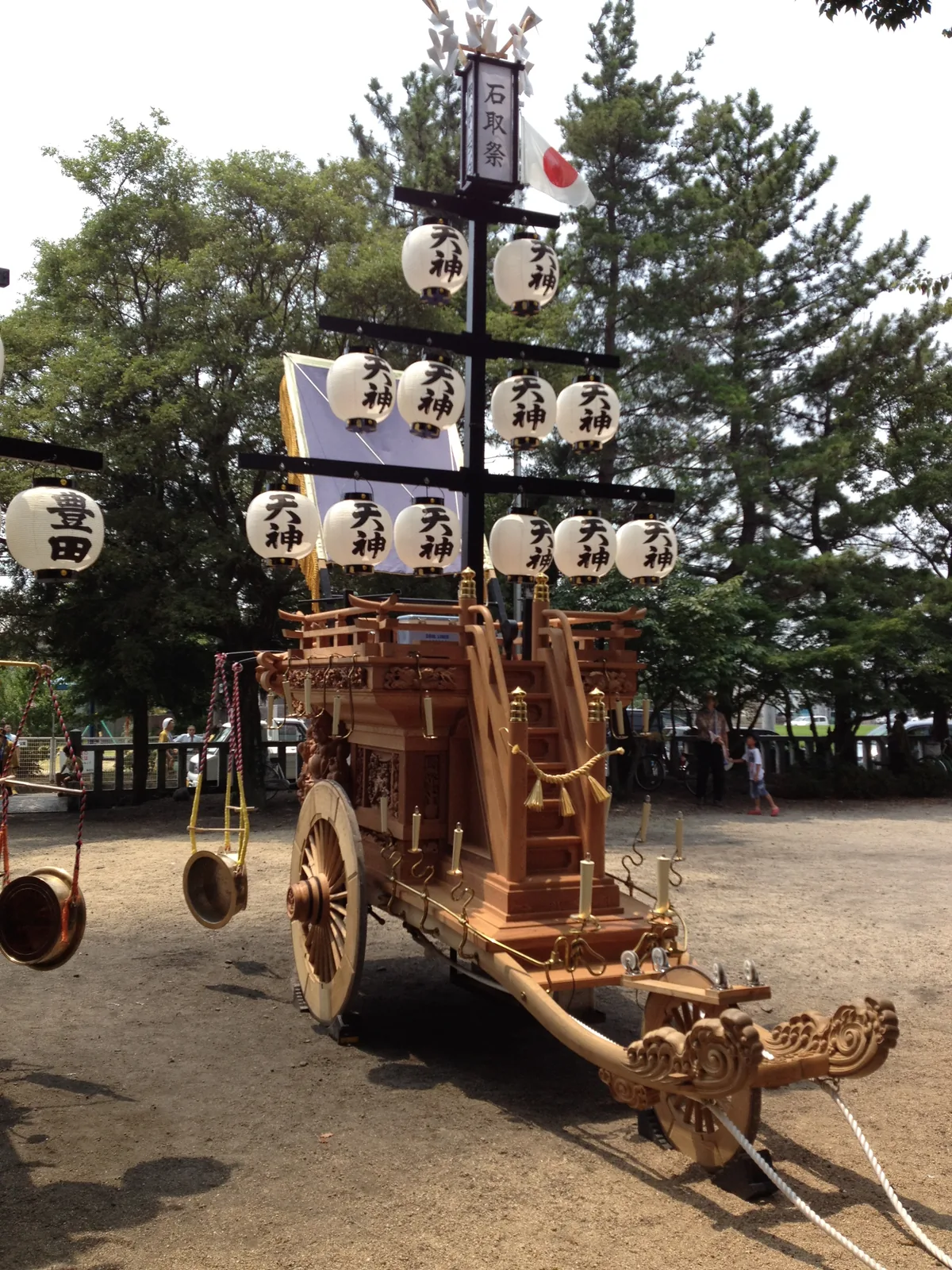
Each saisha is a three-wheeled cart hung with twelve lanterns on a mountain-shaped frame, with gongs and a big drum mounted at the back. Some carry carvings by nationally known sculptors, and the tapestry over the drum stays hidden until the cart’s big moments.
The instruments, and why the noise claim holds up
The saisha (祭車) is a three-wheeled cart, its upper section carrying twelve lanterns in a yamagata (mountain) arrangement — said to represent the twelve months of the year — and its rear fitted with gongs and drum. Kuwana Sosha specifies the ensemble: one large drum of two to three shaku across, roughly 60 to 90 centimetres, and four to six gongs of around 39 centimetres. Kuwana City gives the modern measurements as a drum up to about 82 cm across and gongs of about 39 cm inside diameter. Multiply that by dozens of carts converging on one shrine gate and the nickname stops sounding like marketing.
The rhythms have names. The shrine divides the ishidori-bayashi into two broad families, itsutsu-byoshi (five-beat) and nanatsu-byoshi (seven-beat); Mie’s tourism site splits it three ways and counts roughly ten variants across the districts. There is an annual Ishidori-bayashi championship on Marine Day in July — 2026 was the 54th edition.
The carvings, and the trick of watching for the tenmaku
These are not folk craft in the rough sense. Among the 43, the shrine notes, are carts more than a century old designed by first-rank artists of their day: Takamura Koun, one of the defining sculptors of the Meiji period, carved for the Hagoromo cart in 1923, and the Nishi-Funaba-cho cart carries carving by Tatekawa Washiro Tomishige from 1862. Many others were lost in the 1945 air raid on Kuwana and rebuilt after the war, which is why so many register entries read 1947 to 1961.
My favourite detail is one you would never notice unless told. The tenmaku (天幕) is the woven tapestry mounted above the drum — the cart’s face, as Mie’s tourism writer puts it. For most of the festival it hangs folded down, so the design is hidden; it faces front only at the big moments, the tatakidashi, the tosai and the hikiwakare. The other identifier is the hanten (半纏), the short coat: every participant wears their town’s, and the designs change every few years.
How Do You Get to the Kuwana Ishidori Festival from Nagoya?
Two railways run direct with no transfer. Kintetsu from Kintetsu Nagoya is ¥530 and 22 minutes by express; JR from Nagoya Station is ¥360 and 24 minutes by Kansai Line rapid. From Kuwana Station it is about a 20-minute walk to the shrine.
| Route | Fare | Time | Transfers |
|---|---|---|---|
| Kintetsu Nagoya → Kuwana (Nagoya Line express) | ¥530 adult / ¥270 child | 22 min | None |
| Kintetsu Nagoya → Kuwana (limited express) | ¥530 + ¥520 surcharge = ¥1,050 | 16 min | None |
| JR Nagoya → Kuwana (Kansai Line rapid) | ¥360 | 24 min | None |
The Kintetsu figures come from Kintetsu’s own fare search and its official timetable tool; the JR figure from JR Central’s access search. Note what the limited express buys you: six minutes, for ¥520. On a 22-minute ride, that is not a trade I would make.
Kuwana Station is shared by JR, Kintetsu and the Yoro Railway, so however you arrive you arrive in the same place. Kuwana City and Mie Prefecture both put the walk to Kasuga Shrine at about 20 minutes; the city also lists the Honmachi bus stop as roughly a one-minute walk, bearing in mind that road closures affect bus routing on festival days.
Kintetsu also sells a five-ride digital ticket on this section at ¥400 a trip, which it states is ¥130 below the normal fare. If Nagoya’s own layout is new to you, our guide to getting around Nagoya covers the IC cards and the difference between Nagoya Station and Kintetsu Nagoya.
Ready to book a day trip?
Handy if you want to pair this with other sights the same day.
Driving, and why the organisers would rather you did not
Mie’s tourism site gives about 15 minutes from either the Kuwana or Kuwana-Higashi interchange on the Higashi-Meihan Expressway — a normal-day figure, and this is not a normal day. Both the prefecture and the city ask visitors to come by public transport, and the organisers’ viewing map is blunter: street parking obstructs the carts, so use a car park. For 2026 Mie’s site listed six car-park groups, three of them free, but capacities and prices are not published and the city’s own list was still the 2025 version — treat any parking list as year-specific.
What Should You Know Before You Go?
Three things: it is genuinely dangerous heat, the road closures are long and start early in the afternoon, and the organisers publish specific rules about how close you may get to a cart. None of these is optional reading.
The heat
Mie Prefecture’s event page does not hedge: “Extreme heat is expected, so please come fully prepared for it.” That is unusual copy for a tourism site, and it is correct — early August on the western shore of Ise Bay is the hottest, most humid stretch of the year, and standing outdoors from mid-afternoon into the small hours is the wrong shape for it. The organisers do something practical: the 2026 hongaku map marks cooling shelters, identifiable by a banner outside participating facilities. Our guide to when to visit Nagoya covers what this region’s August does to a day’s plans.
The road closures
From the official 2026 maps:
- Shingaku, Saturday 1 August: vehicle-free zone 17:00–22:30, with additional short closures wherever carts were running
- Hongaku, Sunday 2 August: vehicle-free zone 16:00 through 02:00 the following morning
That second window is ten hours and covers the entire tosai. If you are staying inside the old town, work out which side of the cordon you are on before the afternoon.
The rules the organisers actually print
The official hongaku map carries a short list headed “Notes and requests for watching the Ishidori Festival”:
- Do not touch the carts
- Refrain from stepping over the tow ropes
- Do not go underneath a cart’s tenmaku canopy
- Do not park on the street — it obstructs the carts; use a car park
Mie’s tourism site adds the crowd reality: expect dense crowds until around 21:00, and follow the announcements and the young men’s league, the ones in white hanten. These are working vehicles being pulled by people, in the dark, on public roads. The rules are not decorative.
Food, and what Kuwana is known for
Mie’s tourism site stated ahead of the 2026 edition that stalls would be out on both days, concentrated along Hakkendori (八間通); no official source publishes counts or hours. The town’s speciality is Kuwana clams, hamaguri, famous nationally since the Edo period and embedded in the pun “sono te wa Kuwana no yaki-hamaguri”.
Can You Experience the Festival Outside August?
Yes. The Ishidori Kaikan in central Kuwana keeps a real cart on display year-round, with a hands-on gong-and-drum corner, and admission is free. It is a short detour from the shrine and it answers the question the festival itself never gives you time to ask.
According to Kuwana City, the Ishidori Kaikan (石取会館) at 16 Kyomachi exists specifically to present the cart event as a designated cultural property. It opens 10:00–16:00, last entry 15:30, closed Mondays and Thursdays and from 29 December to 3 January. Admission is free. The cart inside is not a replica: the preservation society describes it as a lacquered saisha from the end of the Edo period, carved in an all-over peony design by Nonogaki Hyosuke, displayed in a building that went up in 1925 as a bank. Striking an actual festival gong at the hands-on corner is the fastest way to understand why dozens of carts doing it at once earns the nickname.
The Kuwana City Museum, a short walk away, programmes festival-related exhibitions around the same dates — in 2026, a show of town happi coats, ¥150 for high-school age and above and free for younger visitors.
How Loud and How Crowded Does It Actually Get?
Kuwana City puts annual attendance at around 400,000, though that figure sits on a page last updated in 2022. The organisers do not publish a crowd number. What they publish instead is a set of instructions that tells you plenty on its own.
I have not been to this one, so rather than invent an evening, here is the official record and where to see it through other people’s eyes.
- Kuwana Sosha on Instagram: @kuwana_sousha._.kasuga_jinja
- Kuwana Sosha on X: @kuwanasousha
- The preservation society’s own English introduction — the only English description written by the people who run the festival
On scale, Kuwana City’s explainer states that around 400,000 visitors come each year — but that page was last updated in February 2022, and neither the shrine, the society nor Mie Prefecture publishes a comparable figure. Take it as the city’s number, of that vintage, not a current count.
On the crowd and the noise, the tell is what the organisers ask of you. A festival that needs to print “do not step over the tow ropes” and that fields a league of young men in white coats to direct spectators is one where people stand very close to moving vehicles in the dark. Mie’s site says the crush lasts until around 21:00 at the shrine and recommends the Kyomachi crossing as the quieter alternative; its writer, who grew up with the festival, reports that their ears ring after they get home. No official source publishes a decibel figure or a current attendance count, so you will not find either invented here.
Frequently Asked Questions
When is the Kuwana Ishidori Festival held?
The main day, hongaku, falls on the first Sunday of August, and the eve, shingaku, on the Saturday before it. In 2026 that was 1 and 2 August. Mie Prefecture’s tourism site lists 31 July to 1 August for 2027, though the organisers have not announced it yet.
Why is it called Japan’s noisiest festival?
Because dozens of carts hammer gongs and drums simultaneously. Kuwana Sosha specifies one drum of two to three shaku across and four to six gongs per cart; Kuwana City gives about 82 cm for the drum and about 39 cm for the gongs. With 43 carts in existence and 39 in the 2026 procession order, the effect is cumulative.
How many carts take part in the Kuwana Ishidori Festival?
There are 43 saisha carts in total, stated by both the shrine and the preservation society. The official 2026 procession order listed 39 towns, led by Hagoromo and ending with Nishi-Yada-cho. Kuwana City and Mie Prefecture describe the festival more loosely as having up to 40 carts.
What time does the tatakidashi start, and can I get there for it?
The first tatakidashi is at 00:00 on the shingaku day, on the signal of the chief priest’s drum, and a second one follows at 02:00 on the hongaku day. Both fall outside train service from Nagoya, so you need to stay locally or take a taxi. The 18:00 shingaku tour and the 18:30 tosai are reachable on the last train.
How do I get to the Kuwana Ishidori Festival from Nagoya?
Both railways run direct. Kintetsu’s official search gives 530 yen for an adult and 270 yen for a child, 22 minutes by express with no transfer. JR Central’s search gives 360 yen and 24 minutes on the Kansai Line rapid, also with no transfer. From Kuwana Station it is about 20 minutes on foot to Kasuga Shrine.
Is there an entrance fee for the Kuwana Ishidori Festival?
No official source publishes an admission policy. It is a rite held on public streets and in a shrine precinct, and neither the shrine, the preservation society, Kuwana City nor Mie Prefecture lists a fee. The only paid element I could confirm was the stamp walk, which required buying the official guidebook.
What happens if it rains at the Kuwana Ishidori Festival?
Nothing official is published either way. The shrine, the preservation society, Kuwana City and Mie Prefecture all state nothing about wet-weather policy; the only weather note on the official maps concerns heat, not rain. Check the organisers’ site before travelling rather than assuming the festival runs or does not.
Where Can You Check Official Information?
Four official channels cover this festival: the preservation society, the shrine itself, Kuwana City and Mie Prefecture’s tourism body. The programme and procession order for each year appear in July, so check in the first half of that month.
- Kuwana Ishidori Matsuri Preservation Society, the organisers: kuwana-ishidori.com — the year’s timetable on the programme page, the cart-by-cart register on the saisha page, plus an English page
- Kuwana Sosha (Kasuga Shrine): kuwanasousha.org/isidori — history, rite description and the annual schedule notice carrying the procession order
- Kuwana City tourism site: city.kuwana.lg.jp — access and contacts, though it can lag a year behind on dates
- Mie Prefecture tourism (Kanko Mie): kankomie.or.jp — where forward-year dates tend to appear first
- National designation record: Agency for Cultural Affairs heritage database
- Enquiries: Kuwana City Product and Tourism Information Office, 0594-21-5416
Details change year to year — the alignment alternates, the procession order is redrawn every June, and the viewing maps are reissued each summer. Check the organisers’ site in July before you travel.
Related Guides
- Central Japan Festival Calendar — every major festival in the region, month by month
- Owari Tsushima Tenno Festival — another of the 33 UNESCO-listed float festivals, in Aichi in July: boats and lanterns instead of gongs
- Inuyama Festival — the Aichi entry on the same UNESCO list, in April, with tiered floats and mechanical puppets
- Kariya Mando Festival — Aichi’s own late-July summer rite, prefecture-designated: 5-metre lit lanterns carried and danced solo, rather than carts hammered through the night
- Kamezaki Shiohi Festival — another of the 33 UNESCO float festivals, five floats hauled onto the low-tide beach at Handa every 3 and 4 May
- Nagoya Summer Festivals — what else runs in the same weeks on the Aichi side
- Ise Grand Shrine Day Trip from Nagoya — the other reason to head into Mie, on the same Kintetsu line
- Setomono Matsuri — a much gentler daytime alternative, in September
- Getting Around Nagoya — IC cards, the subway and the Kintetsu network
- Best Time to Visit Nagoya — what early August feels like before you commit to a night outdoors