The Inuyama Festival (犬山祭) is the spring festival of Haritsuna Shrine in Inuyama, Aichi, held on the first Saturday of April and the Sunday after it. Thirteen three-tier floats carry mechanical karakuri puppets through the castle town by day and candle lanterns by night. It is UNESCO-listed, and no official source publishes an admission charge: you watch from the street.
Most Japanese float festivals give you one or two mechanical puppet performances to look out for. Inuyama gives you thirteen — each a different piece, each from a different neighbourhood, all offered to the same shrine on the same Sunday morning. Then the candles go into the lanterns and the whole thing does it again in the dark. Everything below comes from the preservation society, the shrine, the city, the prefecture, the Agency for Cultural Affairs and the railway themselves.
Written by Yuu — a Nagoya native of 35 years. Published August 15, 2026.
This article may contain affiliate links. See our affiliate disclosure for details.
All festival details verified from official sources on August 15, 2026.
What Do You Need to Know in One Minute?
The Inuyama Festival runs on the first Saturday of April and the Sunday after it, in the castle town below Inuyama Castle in Aichi. Thirteen floats, thirteen karakuri pieces, no published admission charge, 26 minutes by direct train from Nagoya.
| Item | Detail |
|---|---|
| Festival | Inuyama Festival (犬山祭 / Inuyama Matsuri), the annual festival of Haritsuna Shrine |
| Dates | Every year: the first Saturday of April and the Sunday after it |
| 2026 (most recent) | April 4–5, 2026 — the 392nd edition. Finished. |
| 2027 | The rule puts it on April 3–4, but no official 2027 announcement existed as of August 15, 2026 |
| Hours | 8:00–21:45 both days; Aichi Prefecture’s site adds: cancelled in rain |
| Where | Haritsuna Shrine (針綱神社) and the Inuyama castle town — 65-1 Inuyama Kitakoken, Inuyama, Aichi 484-0082 |
| Nearest station | Inuyama Station (犬山駅), Meitetsu Inuyama Line — west exit |
| From Nagoya | Meitetsu Nagoya → Inuyama: ¥630 adult / ¥320 child, 26–37 min, no transfer |
| Admission | No admission charge or paid seating published anywhere official — you watch from the street |
| Floats | 13 three-tier yama (車山) plus 3 nerimono processions, 16 neighbourhoods in total |
| Status | National Important Intangible Folk Cultural Property (2006); UNESCO Intangible Cultural Heritage (2016) |
| Organiser | Inuyama Festival Preservation Society (一般社団法人 犬山祭保存会) — inuyama-matsuri.com |

What Is the Inuyama Festival?
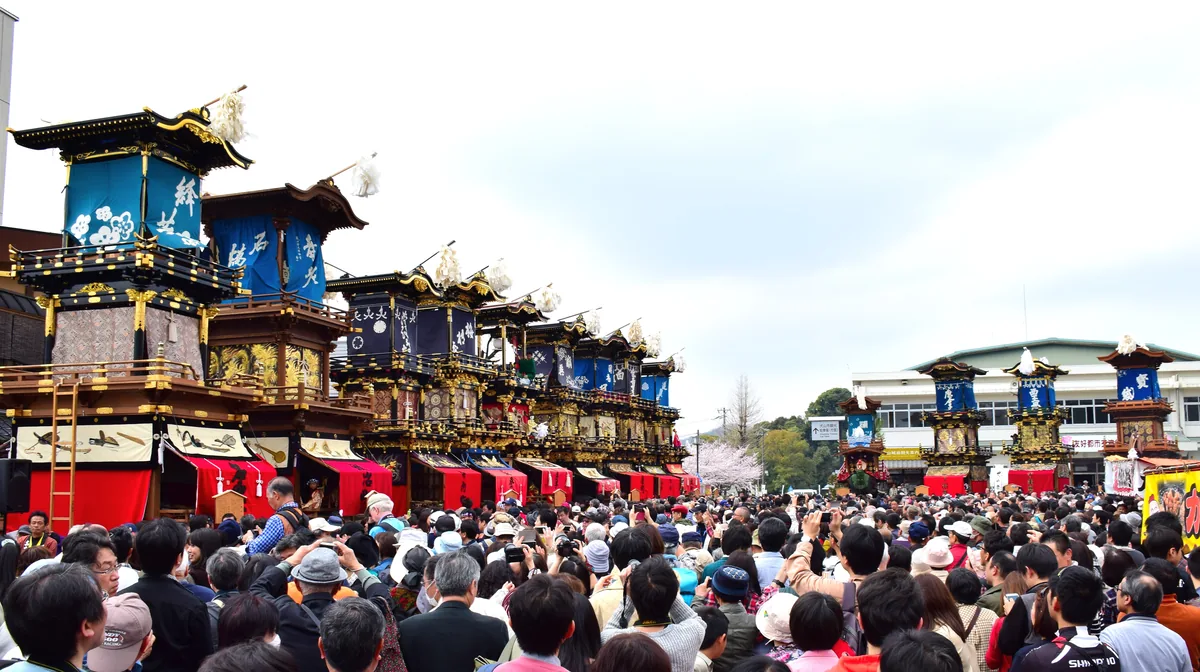
It is the annual festival of Haritsuna Shrine, said to date from 1635. Thirteen neighbourhoods each pull a three-tier float carrying a mechanical karakuri puppet, three more contribute costumed processions, and all sixteen offer their performance to the shrine on the Sunday.
Inuyama sits at the northern edge of Aichi, on the Kiso River, under a small hilltop castle. The festival belongs to Haritsuna Shrine (針綱神社) — a shikinaisha, meaning it appears in the Engishiki register of officially recognised shrines. It once stood near where the castle keep is now; after three relocations from 1537 it settled on its present site in 1882.
Where it came from
The Preservation Society dates the festival to Kan’ei 12 (1635). At the start there were no floats at all: two neighbourhoods each sent a nerimono (練り物) — a costumed procession built around an elaborate prop, one called “the horse tower,” the other “tea picking.” Six years later, in 1641, Shimohonmachi swapped its procession for a wheeled float and, the Society says, was already offering a puppet performance from it. In 1650 the lord of Inuyama Castle, Naruse Hayato-no-shō Masatora, formally encouraged the festival, and neighbourhood after neighbourhood joined. By the middle of the Edo period it looked roughly as it does now.
It was not always a spring festival. Until 1898 it was held in August: the Society records that the main day fell on the 28th of the eighth lunar month, the anniversary of the shrine’s first relocation; when the calendar changed it moved to April 27 and 28, and after several revisions settled on today’s rule.
Thirteen floats, three processions, sixteen neighbourhoods
The count is worth getting right, because guides garble it. Inuyama City puts it plainly: 13 neighbourhoods send floats, 3 send nerimono processions, 16 take part in total, all within Haritsuna Shrine’s parish.
The floats are called yama, written 車山, literally “wheeled mountain.” They are three-tier, four-wheeled structures, and Inuyama City describes the layers precisely: uwayama (上山) on top is the puppet stage, nakayama (中山) below it is where the puppeteers work, shitayama (下山) at the bottom is where the young men and children play the festival music. Twelve of the thirteen are the local “Inuyama type”; one is boat-shaped.
And every one carries a karakuri puppet performing a different piece. Haritsuna Shrine’s own page makes the claim in the careful Japanese way — that all thirteen floats performing a dedicated karakuri offering is “said to be without parallel anywhere in the country.” If you have seen a float festival elsewhere and remember one puppet, this is the version with thirteen.
What the designations actually say
The floats and the event are protected separately, which is why you will see two years quoted:
- 1964 — the thirteen surviving floats designated Aichi Prefecture Tangible Folk Cultural Properties.
- 15 March 2006 — “the float events of the Inuyama Festival” (犬山祭の車山行事) designated a National Important Intangible Folk Cultural Property, per the Agency for Cultural Affairs’ own record, which also names the Preservation Society as protecting body.
- December 2016 — inscribed on the UNESCO Representative List as part of Yama, Hoko, Yatai, float festivals in Japan. Inuyama City records 33 festivals nationwide at the time of inscription, of which Aichi holds five, more than any other prefecture.
One caveat rather than a silence: the list has been extended since 2016 and Aichi’s tourism site now quotes a larger total, which I could not confirm from the national ministries. The only number here is the one for the year of inscription.
What Happened in 2026, and When Is the Next One?
The 392nd Inuyama Festival ran April 4–5, 2026. Rain gutted the Saturday — the organisers cut it short at 7:15 and cancelled the float events from noon. Sunday recovered fully. The 2027 dates fall on April 3–4 by the standing rule, but were not officially announced as of August 15, 2026.
The 2026 edition, as it actually went
Worth reading even if you are planning a future year: it is the clearest official record of what bad weather does here.
On the eve, Friday 3 April, the neighbourhoods held the yoimatsuri (宵祭り) — float sheds opened across the castle town, each district running its own event, with a stamp rally that closed at 21:00.
Then it rained. At 7:15 on the Saturday morning, the Society announced a drastic cut: floats would circulate only near their storage sheds until 10:00, all back inside by then, and from noon the float events were cancelled outright. The road closures lifted at midday. One thing survived — the 15:30 karakuri demonstration at the Inuyama Karakuri Museum went ahead as scheduled.
Sunday was a different day. “The weather has recovered, so we will hold the Hongakusai as planned,” they posted on the morning of 5 April, adding that road closures would start at 8:00. Two days later they closed the year out: the Saturday had been rescheduled by rain, but a great many visitors came and the festival was carried through successfully.
How cancellations are announced — read this part
Most festivals leave you guessing. Inuyama publishes its procedure. The Society decides whether the floats run early on the morning of each festival day and posts the result immediately; the stated deadline is 8:00 that morning, and the announcement goes out on four channels at once:
- the Preservation Society’s own site, inuyama-matsuri.com
- Inuyama Kanko Navi, the tourism association’s site, inuyama.gr.jp
- the Preservation Society’s Facebook page
- the Karakuri Museum’s Facebook page
If you are travelling on a festival morning and the sky looks wrong, that is where the answer will be — before you finish breakfast.
2027 and beyond
The date rule is stated identically by the Preservation Society, Inuyama City and the tourism association: the first Saturday of April and the Sunday after it. Apply it to 2027 and you land on 3–4 April — but I will not print that as confirmed, because as of 15 August 2026 no official page said so. What you can plan around is the publication rhythm:
| What gets published | When it appeared for the 2026 festival |
|---|---|
| Road-closure map (交通規制図) | 1 March 2026 |
| Float route map and schedule | 2 March 2026 (revised 13 March) |
| Pedestrian-flow request | 2 March 2026 |
| Eve-festival (yoimatsuri) notice | 27 March 2026 |
| How cancellation will be announced | 1 April 2026 |
| Go / no-go for the floats | By 8:00 on the morning of each day |
In other words: book travel on the rule, check the detail in early March, and check the weather call on the morning itself.
What Are the Highlights of the Inuyama Festival?
Thirteen different karakuri performances offered to the shrine on Sunday morning; the donden, where crews lift and pivot a three-tonne float; and the yoyama, when candle lanterns go up on all thirteen and the castle town turns amber.
1. Thirteen karakuri pieces, thirteen neighbourhoods
The puppets sit on the top tier, worked from the enclosed level below. Each neighbourhood has its own piece and its own puppet, handed down since the Edo period through repair, restoration and sometimes complete rebuilding.
The distinction the Society draws between the two days matters. On the Saturday the performances are hirō (披露) — facing the street and the spectators. On the Sunday they are hōnō (奉納) — facing Haritsuna Shrine, as an offering. Same puppets, different direction, different atmosphere.
2. Donden and shagiri
A yama stands about 8 metres tall and weighs over 3 tonnes, and castle-town streets were not laid out with turning circles in mind. So the teko crews do it by force: at a corner they lift one side of the float clear of the ground on levers and swing it round, shouting in time. That is the donden (どんでん); the violent hauling that goes with it is shagiri (車切). The Society lists what is up there taking the strain: karahafu gabled roofs (唐破風), balustrades (高欄) and grapevine pillars (葡萄柱). There is a museum in town named after the manoeuvre, which tells you how central it is.
3. Yoyama — the night floats
This is the image that sells the festival, and for once it is accurate. As the light goes, candles are lit one by one in the lanterns banked on every float — the Society calls the result yoyama (夜車山). On the Saturday all thirteen light up from around 17:00; on the Sunday the floats have already split — seven to Sotomachi (外町) and six to Yozaka (余坂), the south and north groups — and both light up from around 18:00 before processing back through town.
Official descriptions all mention cherry blossom, and the castle’s site lists hanami and the festival together as what spring in Inuyama looks like. Be clear what that promise is worth: no official page guarantees blossom in any given year, and early April is exactly the week it can go either way — see our Nagoya cherry blossom guide. For riverside blossom regardless, the Kiso River promenade (木曽川遊歩道) is about three minutes from Inuyama-Yūen Station’s west exit, and the Shiromi walking path (城見歩道) about ten — the one marked as viewable at night.
4. The nerimono, and the children
Three neighbourhoods still send a nerimono — the costumed processions the festival started with in 1635, before anybody built a float. Easy to walk past; the oldest thing in the parade. The Agency for Cultural Affairs names Ukaicho as one of the three.
Watch the children too. The musicians’ children wear kinjuban (金襦袢), under-robes worked in gold and silver thread that the tourism association lists among the things to look out for, saying they add colour to the festival. And the Agency records a custom called hatsuagari (初上がり) — a child or young man riding a float for the very first time, which the neighbourhood makes a considerable fuss of.
5. The mikoshi procession
Once all sixteen neighbourhoods have made their offering on the Sunday, the shrine’s own rite begins: the mikoshi carrying Haritsuna Shrine’s sacred object goes out to the shrine’s former site and its resting place, borne by parishioners who have reached a yakudoshi — an unlucky year — or their sixtieth birthday. The Society records that the streets it passes bow as it goes by.
What Actually Happens, Hour by Hour?
Both days start at 8:00 with the floats leaving their sheds and end at 21:45 when they return. Saturday builds to all thirteen gathering in front of the castle in the afternoon; Sunday front-loads the karakuri offerings at the shrine from 9:20.
The schedule below is the official 2026 programme from the Inuyama tourism association. Treat it as the shape of the festival, not next year’s timings — the association warns on the same page that the schedule is subject to change, and a fresh version goes up each March.
| Time | Saturday — Shingakusai (試楽祭) | Sunday — Hongakusai (本楽祭) |
|---|---|---|
| 08:00 | All 13 floats leave their storage sheds and process through the castle town | All 13 floats leave their storage sheds and process through the castle town |
| 09:00 | — | Floats gather in front of Haritsuna Shrine |
| 09:20 | — | Karakuri puppets and nerimono offered to the shrine, neighbourhood by neighbourhood |
| 10:00 | Floats gather in three separate areas; some neighbourhoods perform karakuri where they stand | After their offering, floats split: 7 to Sotomachi, 6 to Yozaka, and process on |
| 11:30–13:45 | Floats set off for the castle plaza; all 13 assembled by 13:20; from 13:45 the Teramachi restoration unveiling and further karakuri | — |
| 17:00 / 18:00 | 17:00 — lanterns lit on all 13 floats; floats set off again | 18:00 — lanterns lit in both Sotomachi and Yozaka; floats set off again |
| 21:45 | Floats return to their neighbourhoods | Floats return to their neighbourhoods |
If you only care about the puppets, the tourism association answers that in its own FAQ: the thirteen neighbourhoods perform in turn in front of Haritsuna Shrine (the castle plaza) from 13:45 to 14:45 on the Saturday and from 9:00 to 15:30 on the Sunday. Outside those windows, performances happen around the castle town instead. Times and places change: in 2026 the Society announced in March that the Saturday route had been altered and the station-area zone would have no karakuri performances at all, for street-width and safety reasons. Check the March post, not an old blog.
How Do You Get to the Inuyama Festival from Nagoya?
Take the Meitetsu Inuyama Line directly from Meitetsu Nagoya to Inuyama. The railway’s own search returns ¥630 adult and ¥320 child, 26 to 37 minutes depending on the service, no transfer. The castle town begins just outside the west exit.
The train
Meitetsu publishes no static fare table, so these figures come from running its own fare search for the route:
| Route | Fare | Journey time | Transfers |
|---|---|---|---|
| Meitetsu Nagoya (NH36) → Inuyama (IY15) | ¥630 adult / ¥320 child | 26 min (rapid limited express) – 37 min (semi-express) | None |
A note from a Nagoya local: unlike the Seto Line, which catches people out by not running from Nagoya Station at all, the Inuyama Line genuinely does start at Meitetsu Nagoya, downstairs from JR Nagoya Station. You walk down, get on, get off at Inuyama. It is one of the easiest day trips out of this city — which is exactly why the car parks fill before breakfast on festival day. If Nagoya’s private railways are new to you, our guide to getting around Nagoya covers the ticket machines and IC cards.
One note on the faster services: the 26-minute run was a kaisoku tokkyū marked “partly reserved cars.” The ¥630 covers the ordinary carriages. Sit in a reserved tokubetsusha car and you need a μ-ticket — ¥450 per journey regardless of age (¥300 off-peak via the ticketless service; ¥500 on board). Board a normal carriage and you need none of it.
A ticket worth checking
If you are pairing the festival with the castle, Meitetsu sells an Inuyama Castle Town Ticket (犬山城下町きっぷ) through its CentX app for ¥1,840 per adult: the return journey, a voucher exchangeable for castle admission, a discount on the Urakuen garden (¥1,500 down to ¥1,100), and coupons for three castle-town shops. On sale 1 March 2026 to 28 February 2027, with a few excluded dates, and no child version.
Two warnings: it is app-only, so install CentX before you travel; and the castle is busy in its own right on a festival day — ¥1,000 adults, ¥200 elementary and junior-high students, 9:00 to 17:00, last entry 16:30 — so decide whether you want to spend festival hours queuing for a keep. Our Inuyama Castle and Meiji-Mura day trip guide is the better plan for a non-festival visit.
From the station to the festival
Leave by the west exit. The tourism association says the festival site “starts right outside,” which is true of the castle town; the plaza at the far end, where the floats assemble, is 15 to 20 minutes’ walk. Head straight west, turn north at the second traffic light (Honmachi), continue towards the castle and shrine.
Ready to book a day trip?
Handy if you want to pair this with other sights the same day.
Driving: the official answer is don’t
The tourism association does not hedge. Car parks fill from early morning, surrounding roads seize up, and — their words — you may wait several hours and still not get a space. Use public transport, they ask, noting the site is right outside the west exit anyway.
For completeness: the Aichi prefectural float-festival portal lists 350 parking spaces around Inuyama and puts the town about 25 minutes from the Komaki IC or Komaki-kita IC — normal-day figures, and a festival day is not a normal day. Microbuses and coaches go to Inuyama Castle Car Park No. 2 (Uchida Disaster-Prevention Park) on both days. No reservations; first come, first served.
What Should You Know Before You Go?
Roads around the castle close for both days, pedestrian flow is controlled when it gets busy, drones are banned, and the whole thing can be cancelled by rain — the call coming by 8:00 that morning. Dress for an April day that ends at 21:45 outdoors.
Road and pedestrian control
Roads around Inuyama Castle close to traffic on both days for the processions, from 8:00 on the Sunday in 2026. The Preservation Society publishes the closure map and updates it — in 2026 it warned that the version printed in the city bulletin was the February draft and the March version on its site was current.
The tourism association separately publishes a pedestrian-restriction notice and asks visitors to cooperate with marshals: when it gets crowded, some places go one-way or close on foot. No official source publishes a visitor count, so I will not invent one — the parking warning implies enough.
One rule that catches photographers: flying a drone or radio-controlled helicopter around the festival site without the organisers’ permission is prohibited. That is on the official event page, not inferred.
Weather, and what it means here
A note from a Nagoya local on early April: this is the least predictable fortnight of our year. A festival day can be warm enough for shirtsleeves at 13:00 and cold enough to regret your jacket at 21:00, and it rains often enough that the organisers built an announcement protocol around it. Bring a layer you can add after dark, and a plan for what you do if the floats do not run.
If they do not run, the town does not close. The Karakuri Museum ran its demonstration on the washed-out 2026 Saturday exactly as scheduled, and the castle, museums and streets are all still there.
Money and facilities
There is no admission charge and no ticketed grandstand published on any official page — not the Preservation Society’s, the tourism association’s, the city’s or the prefecture’s. You watch from the street. I would rather phrase it that way than declare it “free”: the absence of a published price is not quite the same statement.
The road-closure and pedestrian-restriction PDFs are worth downloading before you travel — they are the only place the marshalled routes are set out. For enquiries, the tourism association is on 0568-61-6000 and the Preservation Society on 0568-55-4875. In 2026 the Society also ran an information desk on 080-3454-1897, apparently a per-year number.
Where Can You See the Festival Through Other People’s Eyes?
The tourism association embeds an official video on its festival page, the Preservation Society runs a photo gallery, and both post on social media through the weekend. Those are the honest places to look before you commit a trip.
I have not been to this one myself, so rather than invent an experience:
- Official festival video, embedded by the tourism association — youtu.be/I0d5rsdY-0o
- The tourism association on YouTube — official channel — and Instagram, @inuyama_info
- Preservation Society photo gallery — inuyama-matsuri.com/photogallery. Their site prohibits reproducing its text, photographs and illustrations without permission: look, do not copy
- Facebook — the Preservation Society and the Karakuri Museum both post there, and both are named official channels for the go/no-go call
On how busy it gets, read the official language rather than the adjectives. The tourism association tells drivers they may queue for hours and still not park, and publishes a pedestrian-restriction notice. The Preservation Society, summing up a year in which Saturday was cancelled at noon, still described the weekend as drawing a great many visitors. Nobody publishes a number, so where you see one quoted elsewhere, it is not coming from the organisers, the city or the prefecture.
Can You See the Floats If You Miss the Festival?
Yes — the part most guides skip. Two small museums a few minutes apart keep the festival available all year: Donden-kan displays four of the actual floats, and the Karakuri Museum runs live puppet demonstrations daily.
| Place | What you get | Admission | Hours | From Inuyama Station |
|---|---|---|---|---|
| Donden-kan (どんでん館) | Four real floats — 8 m tall, over 3 tonnes — with a light-and-sound show running a festival day in miniature; upstairs, footage of the preparations and the kinjuban robes | ¥100 (high-school age and above) | 9:00–17:00, last entry 16:30; closed 29–31 Dec | 10 min on foot, west exit |
| IMASEN Inuyama Karakuri Museum (犬山からくりミュージアム 玉屋庄兵衛工房) | The real tea-carrying doll, puppets that once rode the floats, hands-on operation, and live demonstrations — twice daily on weekdays, five times at weekends | ¥300 (free for junior-high age and under); also admits you to the adjoining Castle and Town Museum | 9:00–17:00, last entry 16:30; closed 29–31 Dec | About 15 min on foot, west exit |
One note: the Karakuri Museum’s demonstrations do not run on the festival days themselves — the puppets and puppeteers are out in the street where they belong. Otherwise, ¥400 buys you the floats close up and the puppets in motion on any day of the year that is not the end of December. For a festival that exists for two days in April, that is remarkable infrastructure.
Frequently Asked Questions
When is the Inuyama Festival held?
Every year on the first Saturday of April and the Sunday after it — the Preservation Society, Inuyama City and the tourism association all state the same rule. The 392nd edition ran on 4–5 April 2026; as of 15 August 2026 the 2027 dates had not been officially announced, though the rule points to 3–4 April.
Do you need a ticket, and is there paid seating?
No admission charge and no ticketed grandstand appear on any official page. You watch from the street. Attractions nearby charge separately: Inuyama Castle ¥1,000 for adults, Donden-kan ¥100, the Karakuri Museum ¥300.
How do I get to the Inuyama Festival from Nagoya?
Take the Meitetsu Inuyama Line directly from Meitetsu Nagoya Station to Inuyama Station. Meitetsu’s own search gives ¥630 for adults and ¥320 for children, 26 to 37 minutes depending on the service, with no transfer. Leave by the west exit — the castle plaza where the floats assemble is a 15 to 20 minute walk.
What happens if it rains?
The festival can be cancelled or cut short. Aichi Prefecture’s listing states that it is cancelled in rain, and in 2026 the Saturday was shortened at 7:15 and the float events cancelled from noon. The Preservation Society decides early each festival morning and publishes the result by 8:00 on its own site, the Inuyama tourism site, and the Preservation Society and Karakuri Museum Facebook pages.
What time can I see the karakuri puppets?
Per the tourism association’s official FAQ, the thirteen neighbourhoods perform in turn in front of Haritsuna Shrine — the plaza below Inuyama Castle — from 13:45 to 14:45 on the Saturday and from 9:00 to 15:30 on the Sunday. Outside those windows performances happen around the castle town. Times and places change year to year.
What is the difference between the Saturday and the Sunday?
Saturday is Shingakusai: the puppet performances face the street, all thirteen floats gather in front of the castle in the afternoon, and lanterns are lit around 17:00. Sunday is Hongakusai: the performances are offerings facing Haritsuna Shrine from 9:20, followed by the shrine’s mikoshi procession, with the floats splitting into groups of seven and six and lighting up around 18:00.
Can I see the floats outside the festival?
Yes. Donden-kan displays four of the actual floats — 8 metres tall, over 3 tonnes each — for ¥100, and the IMASEN Inuyama Karakuri Museum shows the puppets in live demonstrations for ¥300, twice daily on weekdays and five times on weekends and holidays. Both open 9:00 to 17:00, last entry 16:30, a short walk from Inuyama Station’s west exit. The museum’s demonstrations pause on the festival days themselves.
Where Can You Check Official Information?
Five official channels cover this festival: the Preservation Society that runs it, the shrine it belongs to, the tourism association, Inuyama City and Aichi Prefecture. The Society’s site carries the weather call on the morning itself.
- Inuyama Festival Preservation Society (一般社団法人 犬山祭保存会) — inuyama-matsuri.com. History, annual route map and schedule, road-closure map, and the go/no-go call. Office: 0568-55-4875
- Inuyama Kanko Navi, the tourism association — inuyama.gr.jp/event/detail/1/. Programme, FAQ, pedestrian-restriction and coach-parking PDFs. Enquiries: 0568-61-6000
- Haritsuna Shrine — haritsunajinja.com
- Inuyama City — the cultural-property page for the float events
- Aichi Now, Aichi Prefecture’s tourism site — aichinow.pref.aichi.jp/events/detail/67/
For the national designation, the Agency for Cultural Affairs’ Cultural Heritage Online entry for Inuyama Matsuri no Yama Gyōji gives the date and protecting body. Route, performance points and road closures are republished each March, so check the Society’s site before you travel — and again on the morning itself if the forecast is bad.
Related Guides
- Central Japan Festival Calendar — the region’s festivals, month by month
- Inuyama Castle and Meiji-Mura Day Trip — Inuyama on the 363 days that are not the festival
- Takayama Festival — the other great UNESCO-listed float festival near Nagoya, and the obvious comparison
- Nagoya Cherry Blossom Guide — the question behind every “will I see the night floats under the cherry trees” plan
- Best Day Trips from Nagoya — where Inuyama sits among the alternatives
- Setomono Matsuri — another Aichi town that closes its streets, at the opposite end of the year