Written by Yuu — a Nagoya native of 35 years — August 15, 2026. Every objective fact on this page was checked against an official source on August 15, 2026.
This article may contain affiliate links. See our affiliate disclosure for details.
The Takayama Autumn Festival (Hachiman Matsuri) runs October 9–10, 2026, a Friday and Saturday. The dates are fixed every year and are confirmed by the official tourism association. There is no ticket and no paid seating. The detailed 2026 timetable has not been published yet. From Nagoya it is about 2 hours 20 minutes by Limited Express Hida.
Quick Answers
Everything below is drawn from official sources and is set out in full, with links, further down the page. Where 2026 information has not been released, this table says so rather than guessing.
| Detail | Info |
|---|---|
| Next festival | Takayama Autumn Festival (Hachiman Matsuri, 八幡祭) — October 9–10, 2026 (Fri–Sat) |
| Fixed dates | Always October 9 and 10, whatever day of the week they fall on. The dates were settled in 1968 |
| Where | Sakurayama Hachimangu Shrine (櫻山八幡宮) and the streets north of Yasugawa-dori — 178 Sakuramachi, Takayama, Gifu 506-0858 |
| Main events | Float display (yatai hikisoroe), karakuri marionette offering, autumn-only float procession (yatai hikimawashi), lantern-lit Yoimatsuri on the evening of the 9th, and the goshinko shrine procession |
| Floats | Usually 11, all nationally designated Important Tangible Folk Cultural Properties. Only 10 appeared in 2025 — one was under repair |
| Tickets | No paid grandstand and no reserved seating of any kind |
| Detailed timetable | Not yet announced for 2026 as of August 15, 2026 |
| Nearest station | JR Takayama Station — 1.3 km, about a 20-minute walk to the shrine |
| From Nagoya | Limited Express Hida, about 2 hours 20 minutes |
| If it rains | Events are scaled back or cancelled. Nothing is postponed to another day |
| Spring edition | Sanno Matsuri (山王祭) at Hie Shrine, every April 14–15 — a separate festival, not a second run of this one |
Ready to book a day trip?
Handy if you want to pair this with other sights the same day.
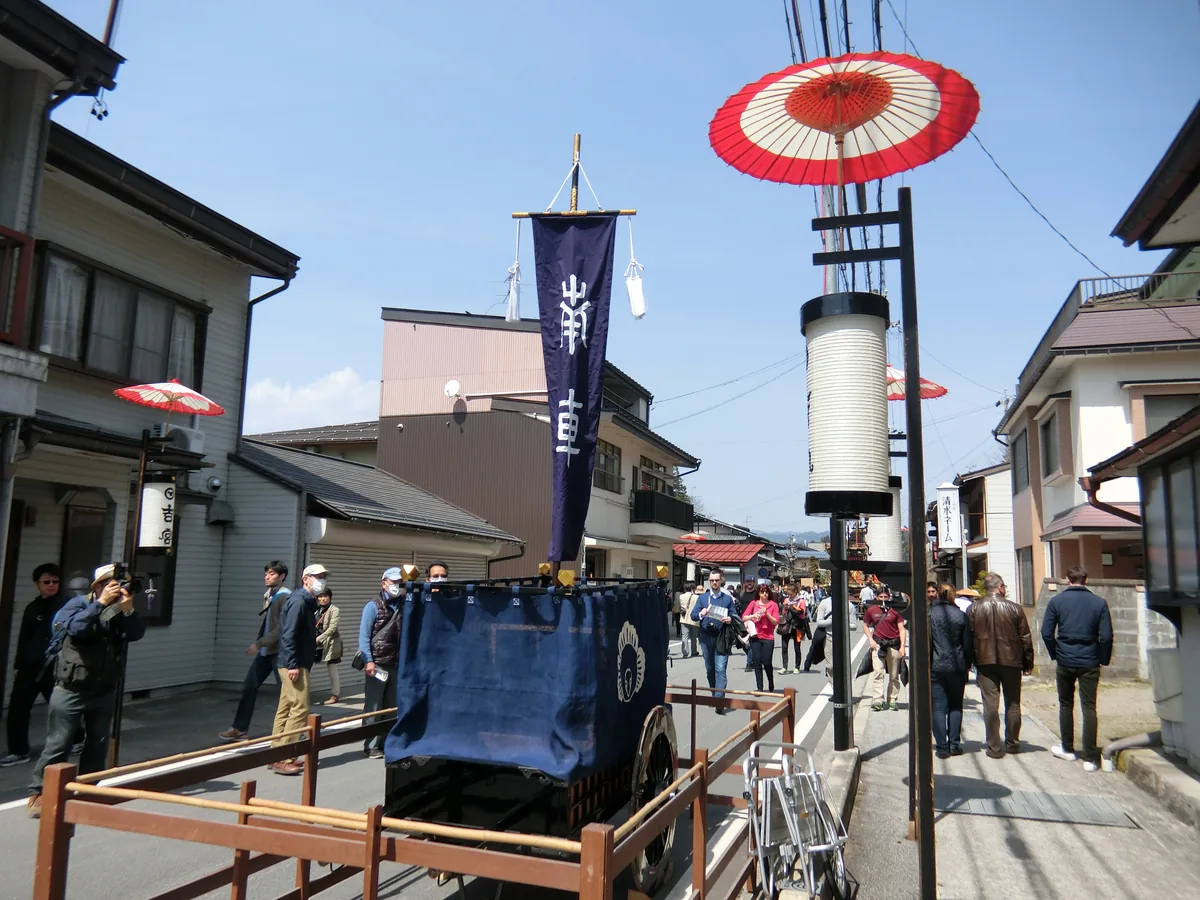

What Is the Takayama Festival, and Why Are There Two of Them?
“Takayama Festival” (高山祭) is an umbrella name for two separate festivals, not one. They are held six months apart, by two different shrines, in two different halves of the same town, using two different sets of floats. Spring belongs to Hie Shrine; autumn belongs to Sakurayama Hachimangu.
Here is the split that most guides gloss over:
- Spring — Sanno Matsuri (山王祭), April 14–15, the annual festival of Hie Shrine (日枝神社), 12 floats, in the southern half of the old castle town.
- Autumn — Hachiman Matsuri (八幡祭), October 9–10, the annual festival of Sakurayama Hachimangu Shrine (櫻山八幡宮), 11 floats, in the northern half.
Sakurayama Hachimangu’s own website spells it out plainly. Yasugawa-dori (安川通り), the street that cuts Takayama in half east to west, is the border between them.
“People tend to think of the Takayama Festival as one festival held twice a year, in spring and autumn — but the shrine, the district and the floats are completely different between the two. Spring is the annual festival of Hie Shrine; autumn is that of Sakurayama Hachimangu.”
— Sakurayama Hachimangu Shrine, official site (translated)
Takayama City describes the pair together as one of Japan’s three most beautiful festivals.
How old is it?
The origins go back to the era of the Kanamori lords who governed Hida, 1585 to 1692, according to Takayama City. The floats start appearing around 1718 — the first documentary mention is a record of the Hachiman festival procession from Kyoho 3 (1718). The karakuri (からくり) marionettes were added in the early Tenmei years, around 1781.
What exactly is the cultural-property status?
Two separate designations apply, and they get mixed up constantly:
- The floats themselves — 11 autumn plus 12 spring — are nationally designated Important Tangible Folk Cultural Properties.
- The festival practices — the hauling, the karakuri offering, the music, the whole organisational tradition — form a nationally designated Important Intangible Folk Cultural Property, designated on February 3, 1979.
Then on December 1, 2016, at the 11th session of the UNESCO Intergovernmental Committee in Addis Ababa, the Takayama Festival float ceremonies were inscribed on the UNESCO Representative List as part of “Yama, Hoko, Yatai, float festivals in Japan” — a single listing made up of 33 designated festivals across the country. Takayama is one of the 33, not a standalone inscription. Source: Takayama City.
The floats have a nickname worth knowing before you see them. The Takayama Yatai Preservation Society calls them “moving Yomeimon gates” — after the famously ornate gate at Nikko. Source: Takayama Yatai Preservation Society.
One vocabulary warning that matters more than it sounds
At Takayama, yatai (屋台) means “festival float.” Everywhere else in Japan the same word usually means a food stall. English pages that describe “yatai lining the streets” at Takayama are almost always mistranslating. There is no official information about street food vendors at this festival, so do not plan your dinner around one.
When Is the 2026 Festival, and What Is Actually Confirmed?
October 9–10, 2026 — a Friday and a Saturday — is confirmed. The detailed timetable is not. The official tourism association states on its own event page that details for autumn 2026 will be announced later, and that the times currently displayed are the 2025 schedule.
The dates are confirmed
October 9–10, 2026. That comes straight from the official event page run by the Hida-Takayama Tourism & Convention Association: Hida Takayama Travel Guide. The dates never move. They were settled in 1968 and are the same two calendar days every year, so the weekday shifts annually — which is exactly why so many travellers assume it is a weekend event and find out otherwise.
The timetable is not confirmed
As of August 15, 2026, the detailed 2026 schedule has not been published. The official page says so directly:
“The following is the schedule of the Autumn Takayama Festival held on October 9–10, 2025. Details of the 2026 Autumn Takayama Festival will be announced at a later date.”
— Hida Takayama Travel Guide (Hida-Takayama Tourism & Convention Association) (translated)
Gifu Prefecture’s tourism site does list times under a 2026 heading — but the day-of-week label on its Yoimatsuri row still reads Thursday, which was the 2025 weekday, so that page has not been fully refreshed. Treat any timetable you find right now as last year’s pattern, not this year’s promise.
The pattern the festival has followed recently
The flip side is that this festival runs to a very stable clock. The 2025 official schedule and the timetable Takayama City published in its 2024 press release are almost identical. So, as a planning guide only:
| Event | Day 1 — October 9 | Day 2 — October 10 |
|---|---|---|
| Float display (hikisoroe) | Around 9:00 to about 17:00, on the shrine approach and in the precinct | Around 9:00 to about 16:00 |
| Karakuri offering | Around 12:00 and again around 14:00, about 20 minutes each | Around 11:00 and around 13:00 |
| Goshinko shrine procession | Around 13:20 to 15:30 | Around 8:30 to 12:00, then 13:30 to 16:00, routing via the otabisho resting shrine |
| Float procession (hikimawashi) | Around 13:30 to 16:00, per Takayama City’s 2024 release | — |
| Yoimatsuri evening festival | Around 18:15 to 20:30. This night only | — |
Even the official sites disagree slightly on when the float display opens — the event page says 9:30, the feature page says 9:00. Turn up early and you have solved it.
Tickets and cost
There are none. Asked directly whether there is spectator seating, the official Q&A answers in four words: there is no seating. No grandstands, no reserved viewing, no ticket booth. You watch from the street and from the shrine precinct like everyone else. No official source states an admission price for the festival either way, so we do not describe it as “free admission” — what we can say is that there is nothing to buy in order to watch.
If it rains
This is the single most important practical fact on this page, so here is the official position verbatim: events are scaled back or cancelled, and when that happens they are not postponed to another day. The call is made on the day itself, and the organisers explicitly say they cannot tell you in advance.
Past wet years have meant the float display being cancelled and the floats viewed inside their storage houses instead, and the procession and Yoimatsuri being shortened or dropped. The karakuri offering moves indoors to the Sakurayama Nikkokan (桜山日光館) hall in the shrine precinct.
Two things soften the blow. The karakuri offering is live-streamed on YouTube by the tourism association. And any same-day change is posted to the official website plus Facebook, Instagram and X as soon as it is decided. Source: official autumn festival page.
How many floats in 2026?
Normally 11. In 2025 the Gyojintai float was under repair, so only 10 came out. The 2026 count has not been announced. Nor have the two rotating floats for the procession — those are drawn by lot, and only two of the four are fixed from year to year.
What Will You Actually See at the Autumn Festival?
Five distinct events, not one continuous parade. The floats lined up on display, the karakuri marionette offering, the autumn-only float procession through the streets, the lantern-lit Yoimatsuri on the evening of the 9th, and the several-hundred-strong goshinko shrine procession across both days.
The float display (yatai hikisoroe)
The Hoteitai float — the one that performs the marionette offering — stands in the shrine precinct; the rest line up along the front approach. It is the only window in the whole festival when you can stand still in front of the carving, the embroidered rear curtains and the figures on top and actually look at them.
Do not touch the floats. The official notice explains why in a line that sticks with you: oil from human hands degrades them.
The karakuri offering
Only one float in the autumn festival performs karakuri: the Hoteitai. Twice a day on both days, in the shrine precinct. Two karako child figures cross over and leap onto the shoulders of Hotei, and a banner unfurls from the fan in his hand.
Sakurayama Hachimangu records that the puppets run on 36 control cords worked by nine operators, and calls it the finest example of detached marionette work in Japan. Nine people, hidden, moving three figures. Source: Sakurayama Hachimangu Shrine.
It is standing-room only and it gets crowded. The official advice for anyone with health concerns, and for visitors with small children, is to watch the YouTube live stream instead — a very Takayama sort of solution.
The float procession — autumn only
This one does not exist in spring. On the afternoon of the 9th, four floats leave the shrine’s front approach and go out into the town. The Kaguratai and Hoootai appear every year; the other two are decided by lot (in 2024 they were Homeitai and Shinmetai). Which two come out in 2026 has not been announced.
What you are really watching is the modoshiguruma (戻し車) — the direction-changing device that lets a large wooden float turn in a narrow Edo-period street. Japan’s Agency for Cultural Affairs singles it out, along with the sideways-operated marionette mechanism, as one of the features that evolved into a form unique to Takayama. Source: Japan Heritage Portal, Agency for Cultural Affairs.
Yoimatsuri — the evening of the 9th
Around 100 paper lanterns are lit on each float, and they move slowly through the dark town led by the Kaguratai. In 2025 the route ran from Daishinmachi through Shimo-ninomachi and Shimo-sannomachi, along Yasugawa-dori, to Shimo-ichinomachi. At the end the crews sing the parting song Takai Yama as each float goes back to its storage house.
Safety notes from the organisers, because they matter in the dark: stay off the roadway — you cannot cross while a float is passing — watch your footing, and be aware that many of Takayama’s roadside gutters have no covers. They are left open for dumping snow in winter. Viewing areas may be closed off if the crowd gets too dense.
The goshinko procession
Sacred sakaki branches, shishimai lion dancers, tokeiraku bell-and-drum performers, dancing maidens, court musicians, guards in kamishimo formal dress, the phoenix palanquin, the head priest — Sakurayama Hachimangu puts the column at 400 people. It leaves the shrine on the afternoon of the 9th, then goes out again on the morning of the 10th and returns in the late afternoon.
Two requests from the organisers: do not cut across the procession, and do not follow along behind it.
The part almost nobody sees
On the evening of October 7, two days before the public festival, the shigakusai and chusensai rites at Sakurayama Hachimangu decide the order the floats will be hauled in, and the sacred gohei wands are handed over to each float. The shrine also notes that everything other than the religious rites is run by the gyoji, an office that rotates each year among the parishioners — this festival has no promoter and no corporate organiser. Source: Sakurayama Hachimangu Shrine, “Reitaisai”. We have not been able to confirm whether the October 7 rites are open to general spectators, so do not build a plan around attending them.
How Do You Get to Takayama from Nagoya?
The Limited Express Hida takes about 2 hours 20 minutes and costs ¥6,140 one way in a regular-season reserved seat. The highway bus is roughly ¥3,600 and 2 hours 40 minutes. From Takayama Station the shrine is 1.3 km, about a 20-minute walk. Driving into the festival area is not possible.
Nagoya to Takayama
| Option | Time | Cost | Notes |
|---|---|---|---|
| JR Limited Express Hida | About 2 hr 20 min, per JR Central | ¥6,140 one way — ¥3,410 base fare plus a ¥2,730 reserved-seat express charge in the regular season | October 9–10 falls outside JR Central’s all-reserved periods, so non-reserved seats do exist (¥2,200 express charge). Book a reserved seat anyway — this is a festival weekend |
| Hida Area Free Kippu | — | ¥12,370 from the Nagoya city zone, valid 3 days | Round trip in a reserved seat on the Hida, plus unlimited non-reserved travel between Hida-Kanayama and Hida-Furukawa. October is not in the blackout windows. No child version. See JR Central |
| Highway bus (Nohi / Meitetsu / JR Tokai) | About 2 hr 40 min | ¥3,600 one way, ¥3,300 with the web discount | Reservation required on every service — all seats are reserved. Verified with Nohi Bus on July 27, 2026 |
Reserved-seat express charges vary by season on JR Central, so the ¥6,140 figure is the regular-season one. Timing and cost from Nagoya, plus whether a rail pass is worth it for this trip, are covered in our JR Pass guide for central Japan.
The Hida Area Free Kippu, in plain arithmetic
Two one-way regular-season reserved seats come to ¥12,280. The pass is ¥12,370 — ninety yen more — and it also gives you three days of unlimited local travel between Hida-Kanayama and Hida-Furukawa. If you are doing anything at all beyond a straight there-and-back, it pays for itself. If you are travelling with a child, note there is no child version of this ticket.
Ready to book a day trip?
Handy if you want to pair this with other sights the same day.
From Takayama Station to the festival
Sakurayama Hachimangu is 1.3 km from Takayama Station, about a 20-minute walk on a normal day, according to the shrine’s own access page. Add time on festival days — the crowds and the road closures both slow you down.
Coming by car
The official line is blunt: the main parts of the city are closed to traffic and you cannot drive in.
In 2025 the setup was a free temporary car park at Takumigaoka with a free shuttle bus to Takayama Civic Culture Hall — a 15 to 20 minute ride, running every 20 to 30 minutes — plus nine paid municipal car parks around the city. Arrangements and prices for 2026 have not been published yet, so check the official page before you set out.
Do not plan on wheels of any kind inside the festival zone either. Asked about rental bicycles and kick scooters, the organisers say flatly that it is too crowded to move on them. Walk.
What Do You Need to Know Before You Go?
Book accommodation first — central Takayama sells out more than six months ahead. Bring a layer for the evening, expect long restaurant waits, and read the rules: no drones, no touching the floats, no street smoking. Free rest areas and wheelchair viewing exist and are worth knowing about.
Accommodation — start here, not last
Straight from the official Q&A: hotels in central Takayama sell out more than six months ahead for the festival, and the recommendation is to look at the outskirts and neighbouring municipalities.
That is the tourism association telling you the truth, not marketing language. If you are reading this in August for an October trip, central Takayama is likely gone. Realistic alternatives, in the order I would try them from the Nagoya side: Gero Onsen, which is on the same Hida line about halfway along; Hida-Furukawa, one stop north; or basing yourself in Nagoya or Gifu and treating it as a long day out. Our where to stay in Nagoya guide covers the last of those.
What to wear
The official guidance is unusually specific, and it is good:
- Clear weather: daytime gets genuinely hot. A T-shirt and a hat, and carry water.
- From about 17:00 the temperature starts dropping. By Yoimatsuri it can feel cold — bring a layer. This catches people out every year.
- Rain: it gets cold. Umbrella or rain poncho, and waterproof shoes.
One thing I would add from the Nagoya side of the mountains, because it is the mistake I see people make with any Hida trip: do not calibrate your packing to the forecast for Nagoya. Takayama sits in the mountains and October evenings there run noticeably colder than the same date on the Nobi plain. If you get on the Hida in a Nagoya-appropriate outfit, you will be cold by the time the lanterns are lit.
Rest, accessibility, food
- Free rest areas: Omasa, where you may bring your own food in, and the Nakabashi Tourist Information Office.
- Baby-changing and kids’ rooms: Nakabashi Tourist Information Office, Omasa, Machihitopuraza Kankakokan, and Takayama City Library Kanshokan.
- Wheelchair users: there is a dedicated viewing area for the karakuri offering near the emaden votive hall in the shrine precinct. Wheelchairs can be borrowed at several places around the city.
- The festival information HQ — in 2025, phone 0577-36-1131, near the car park below Sakurayama Nikkokan — has first-aid staff on site. Year-round, the contact is Takayama City Tourism Division on 0577-32-3333.
- Food: restaurants are open but the official advice is that they are packed with long waits. Eat early or late, consider places outside the centre, and research ahead if you have allergies or small children.
Rules worth not breaking
- Drones are banned. The official wording notes that people have been taken away by police for it.
- Never touch a float.
- No smoking on the street — the old wooden buildings are the reason.
- Bring a rubbish bag and take your rubbish home.
- Follow the marshals inside the traffic-restricted zone.
What If Your Trip Does Not Line Up With the Dates?
Go to the Takayama Festival Floats Exhibition Hall instead. It is, by its own description, the only place with real festival floats on permanent display — four of the eleven autumn floats at a time, rotated three times a year. It sits in the Sakurayama Hachimangu precinct, so you see the festival ground too.
The hall (高山祭屋台会館) also holds a mikoshi portable shrine described as the largest in Japan — two and a half tonnes, needing 80 carriers.
| Detail | Info |
|---|---|
| Opening hours | 9:00–17:00 (March–November); 9:00–16:30 (December–February) |
| Admission | ¥1,000 adults / ¥600 high school / ¥500 elementary and junior high |
| On display | Four of the eleven autumn floats at a time |
| Float changeover | Three times a year — late March, late July and mid-November |
Source: Sakurayama Hachimangu Shrine, Takayama Festival Floats Exhibition Hall. One caveat: official sources do not state whether the hall keeps normal hours on the two festival days themselves, so do not assume it. On wet festival days the floats have been shown here instead of on the street.
If you are building the wider trip, our Takayama and Shirakawa-go day trip guide covers the standard route into Hida and what it costs.
What Happened at the 2025 Festival?
The 2025 festival ran on Thursday October 9 and Friday October 10, and only 10 floats appeared — the Gyojintai was under repair. The timetable below is the official 2025 record. It is the best available guide to the shape of a normal year, and it is not a 2026 schedule.
| Event | Oct 9, 2025 (Thu) | Oct 10, 2025 (Fri) |
|---|---|---|
| Float display | 9:00–17:00 | 9:00–16:00 |
| Karakuri offering | 12:00 / 14:00 | 11:00 / 13:00 |
| Goshinko procession | 13:20–15:30 | 8:30–12:00, 13:30–16:00 |
| Yoimatsuri | 18:15–20:30 | — |
The tourism association’s live page signed off at 16:00 on the 10th: the main events had finished, and thank you for two days. Source: official 2025 autumn festival page, still live as of August 15, 2026.
What Do Visitors Say About the Autumn Festival?
Crowding and the evening festival dominate the feedback. On TripAdvisor the Takayama Festival (Autumn) listing sits at 4.6 out of 5 from 40 reviews as of August 15, 2026, ranked 19th of 188 things to do in Takayama. That is a small sample, so read it as a trend rather than a verdict.
I should be straight with you before the summary that follows: I have not made it to the Hachiman Matsuri myself. It is a two-and-a-bit hour train ride from my side of the mountains and it lands on fixed weekday dates, which is exactly the problem — it is the same reason most people in Nagoya have never been either, despite it being one of the closest world-class festivals to us. So the section below is other people’s experience, summarised in my own words, and the rest of this page is official sources rather than memory.
- Crowding dominates. The most repeated practical tip is to arrive early and to work the side streets rather than fighting for the obvious spots.
- The evening Yoimatsuri is what people remember. It comes up again and again as the highlight, ahead of the daytime display.
- The craftsmanship lands. Reviewers keep returning to the carving and the condition of the floats.
- See both halves. Multiple reviewers recommend doing the daytime display and the night procession rather than picking one.
- It is physically demanding. Heat during the day plus dense crowds is a real issue for anyone with mobility or heat sensitivity — which lines up with the organisers’ own advice about rest areas and the live stream.
For a look at the real thing, the tourism association’s official channels are the best source: their YouTube live stream of the karakuri offering, Instagram and X. The X account is also where same-day cancellations appear first.
Frequently Asked Questions
When is the Takayama Autumn Festival in 2026?
October 9–10, 2026, a Friday and Saturday. The dates never move — it is always October 9 and 10, so the weekday changes each year. The detailed timetable for 2026 had not been published as of August 15, 2026.
Should I go in spring or autumn?
They are different festivals, not two runs of the same one. Spring — Sanno Matsuri, April 14–15, Hie Shrine, 12 floats — coincides with cherry blossom. Autumn — Hachiman Matsuri, October 9–10, Sakurayama Hachimangu, 11 floats — has the float procession through the streets, which spring does not have. Both have a lantern-lit evening event.
Do I need a ticket?
No. There is no paid seating and no ticket — you watch from the street and the shrine precinct.
What happens if it rains?
Events are scaled back or cancelled and there is no rain date. The decision is made on the day and is not announced in advance. The karakuri offering moves indoors to the Sakurayama Nikkokan and is live-streamed on YouTube.
If I can only manage one day, which one?
The organisers do not rank them, so this is a judgement call rather than official advice — but October 9 carries both the Yoimatsuri, which only happens that evening, and the autumn-only float procession. October 10 is the day the goshinko procession runs longest, morning through late afternoon.
Can I do it as a day trip from Nagoya?
Physically yes — about 2 hours 20 minutes each way on the Limited Express Hida — but you will almost certainly give up the Yoimatsuri, which ran until around 20:30 in 2025 and is the event most visitors rate highest. If you want the evening, you need a bed. Check the last Hida departure yourself before committing; we have not verified the 2026 timetable.
When is the spring Takayama Festival?
April 14–15, every year, at Hie Shrine, with 12 floats. The 2026 spring festival has already been held. The detailed 2027 schedule has not been published yet, so the dates are all we can confirm.
Where Should You Check Official Information?
Check the tourism association’s feature page first — that is where the confirmed 2026 schedule will appear. On the days themselves, the association’s X and Instagram accounts carry cancellations before the website does. The list below is every primary source used on this page.
- Hida Takayama Travel Guide — Autumn Takayama Festival event page (Hida-Takayama Tourism & Convention Association): 2026 dates, venue and address, the rules, the drone ban.
- Official autumn festival feature page: the 2025 schedule, the Q&A, parking, rest areas, accessibility. This is where the confirmed 2026 schedule will appear.
- Sakurayama Hachimangu Shrine — Reitaisai: the 400-strong procession, the October 7 rites, the gyoji office.
- Sakurayama Hachimangu Shrine — Takayama Festival Floats Exhibition Hall: the 36 cords and nine operators, hall hours and admission, the mikoshi.
- Takayama City — Takayama Festival float ceremonies: the cultural-property designations and their dates.
- Takayama City — UNESCO inscription: the December 2016 listing and the 33-festival grouping.
- Takayama Yatai Preservation Society: the “moving Yomeimon gates” epithet, the fixed-date rule, the lot-drawn floats.
- Japan Heritage Portal, Agency for Cultural Affairs: the modoshiguruma and the float mechanisms.
- HIDA TAKAYAMA — Takayama City official English site.
- JR Central — Hida Area Free Kippu and JR Central — all-reserved periods.
- Takayama City Tourism Division: 0577-32-3333 (year-round).
About the Author
Yuu was born in Nagoya and has lived there for 35 years. He has travelled the Hida line north out of Gifu many times — Gero, Takayama, Shirakawa-go — and writes the Hida coverage on this site from that side of the mountains. He has not attended the Hachiman Matsuri, and this guide does not pretend otherwise: every objective statement on this page is sourced from the tourism association, the shrine, Takayama City, the preservation society, the Agency for Cultural Affairs or JR Central, with the date each was checked recorded in our fact ledger. Where 2026 information does not exist yet, the page says so instead of filling the gap with last year’s numbers — which is, unfortunately, what a lot of English pages about this festival are currently doing.
Related Guides
- Central Japan Festival Calendar — every major festival in the region, month by month.
- Autumn Festivals in Nagoya & Central Japan — what else is on in the same season, including the October collisions.
- Nagoya to Shirakawa-go & Takayama Day Trip — the standard route into Hida, and what it costs.
- Gero Onsen Guide — the realistic fallback when Takayama is fully booked.
- JR Pass Guide for Central Japan — whether a pass beats point-to-point tickets on this route.
- Where to Stay in Nagoya — if you decide to base yourself in the city instead.
- Getting Around Nagoya — the subway and Meitetsu lines that get you to Nagoya Station.