The Owari Tsushima Tenno Festival (尾張津島天王祭) is a UNESCO-listed river festival in Tsushima, Aichi, held on the fourth Saturday of July and the following Sunday — 25–26 July in 2026. Five lantern boats carry about 500 lanterns each on the Saturday night; six float boats and ten divers follow on Sunday morning. Tsushima is ¥460 from Nagoya.
Most Japanese festivals put their floats on wheels. This one puts them on water. Once a year the pond at Tennogawa Park in Tsushima (津島市), half an hour west of Nagoya, fills with boats carrying roughly five hundred paper lanterns apiece — among them one for every day of the year and one for every month — and the reflections double them. Everything below is verified from the city, the tourist association, the shrine, the park and the railway, on 15 August 2026.
Written by Yuu — a Nagoya native of 35 years. Published August 15, 2026.
This article may contain affiliate links. See our affiliate disclosure for details.
All festival details verified from official sources on August 15, 2026.
On this page
- What do you need to know in one minute?
- What is the Owari Tsushima Tenno Festival?
- What happened in 2026, and when is the next one?
- What happens at the evening festival?
- What happens at the morning festival?
- How do you get to Tsushima from Nagoya?
- What should you know before you go?
- What do visitors actually see?
- Frequently asked questions
- Where can you check official information?
- Related guides
What Do You Need to Know in One Minute?
The festival runs on the fourth Saturday of July and the following Sunday at Tennogawa Park in Tsushima, Aichi — 25–26 July in 2026. Saturday evening is the lantern boats from 18:00; Sunday morning the float boats from 09:10.
| Item | Detail |
|---|---|
| Festival | Owari Tsushima Tenno Festival (尾張津島天王祭 / Owari Tsushima Tennoh Festival) |
| When | Fourth Saturday of July and the following Sunday — 25–26 July in 2026 |
| Evening festival | Yoi Matsuri (宵祭), Saturday from 18:00 — lantern boats |
| Morning festival | Asa Matsuri (朝祭), Sunday from 09:10 — float boats and the divers |
| Where | Tennogawa Park (天王川公園), 1-chome Miyagawa-cho, Tsushima, Aichi 496-0853; the Sunday procession ends at Tsushima Shrine |
| Nearest station | Tsushima Station (津島駅), Meitetsu — about 15 minutes on foot (1 km) |
| From Nagoya | Meitetsu Nagoya → Tsushima: ¥460 adult / ¥230 child, 23–33 minutes |
| Weather policy | Held in light rain; the programme may change or be cancelled depending on weather and boat conditions |
| Status | National Important Intangible Folk Cultural Property (1980); UNESCO Intangible Cultural Heritage (2016) |
| Organiser | Owari Tsushima Tenno Festival Association, inside Tsushima Shrine — 0567-26-3216 |
| Official pages | Tsushima City · Tsushima Tourist Association |

What Is the Owari Tsushima Tenno Festival?
It is the summer festival of Tsushima Shrine, held on the water rather than on the street. Tsushima City calls it one of Japan’s three great river festivals, and in December 2016 UNESCO inscribed it as one of the 33 elements of the Yama, Hoko, Yatai float festivals.
The short version: this is a purification festival that got spectacular. Tsushima Shrine (津島神社) enshrines the deity known historically as Gozu Tenno, and the tourist association explains the logic plainly — epidemics arrived in summer, so shrines dedicated to Gozu Tenno held midsummer rites to get through the heat safely. Kyoto’s Gion Matsuri comes from the same impulse. Where Kyoto pulls floats through streets, Tsushima floats them, because Tsushima was a port town linking Ise and Owari by boat.
The shrine itself is not a minor local site. Its own records date its founding to 540 AD, and it describes itself as the head shrine of roughly 3,000 Tenno shrines nationwide. Its two-storey gate, donated by Toyotomi Hideyoshi in 1591, and its main hall of 1605 are both Important Cultural Properties. It is where the Sunday procession ends, and it is worth pairing with the festival site.
How old is it, exactly?
Officials say “nearly 600 years,” and then, to their credit, admit they do not know. The 2026 leaflet states that the origins are disputed and unclear, but that a record survives from 1459 (Choroku 3), so the festival was already running before then. The tourist association’s history page takes a different line: it names a surviving document recording float-boat figures from 1522 (Daiei 2), and concludes the festival began in the 15th–16th century, giving it “over 500 years.”
Both are official; neither claims a founding year. What they agree on is that this was an established event while Owari was still a battlefield province. The leaflet adds the detail that gives you its scale: Oda Nobunaga watched the festival in 1558, and Hideyoshi and the later lords of Owari watched it repeatedly — Nobunaga, the association adds, from the Tenno Bridge over the river the festival is named after.
Why is a “river festival” held on a pond?
Because the river moved. The tourist association explains that in the Edo period the Tenno River (天王川) was a real waterway: it joined the Miyake and Hagiwara rivers, fed into the Saya River and reached Ise Bay. What survives is Maruike (丸池), the pond at the centre of Tennogawa Park. The boats are not on an ornamental lake by coincidence — they are on what is left of the river the port town was built on.
If you want to know what the festival looked like four centuries ago, there is a surprising place to look: the British Museum. A pair of Edo-period (17th century) eight-panel screens titled River Festival at Tsushima Shrine is in its collection — the right screen showing the evening boats heading for the otabisho, the left showing the morning boats with their Noh dolls. Canon’s Tsuzuri Project, which made the high-resolution facsimile that Tsushima prints on its own festival leaflet, notes that eight screens of this festival are known worldwide and this one is considered the oldest by style. The boats on it are recognisably the boats that went out in July 2026.
What it is officially designated as
Three layers, and it is worth keeping them straight because the names differ:
- National Important Intangible Folk Cultural Property — “The Danjiri-bune Boat Rites of the Owari Tsushima Tenno Festival,” designated 28 January 1980, covering Tsushima City and Aisai City, per the Agency for Cultural Affairs’ heritage database
- Aichi Prefecture Tangible Folk Cultural Property — “The Danjiri of the Owari Tsushima Tenno Festival,” designated in 1984 (the boats and their fittings, as objects)
- UNESCO Intangible Cultural Heritage — inscribed December 2016 as one of the 33 Yama, Hoko, Yatai float festivals
The 1980 designation is the one that shapes what you watch: what it protects is the boat rites themselves — the sequence of the evening and morning processions — rather than the objects. The 1984 prefectural designation covers the hardware.
What Happened in 2026, and When Is the Next One?
The 2026 festival was held on Saturday 25 and Sunday 26 July at Tennogawa Park — the evening festival from 18:00, the morning festival from 09:10, both marked “held in light rain” by the city. The 2027 dates have not been announced as of 15 August 2026.
The 2026 edition
Tsushima City’s dedicated 2026 page, last updated 23 July 2026, set out the plan: lantern-lighting from 18:30 at Kurumakodo, the boats casting off toward the otabisho at 20:15, and the six float boats with their ten cloth-halberd bearers on Sunday morning. The city called the cast-off “the single biggest sight of the evening festival” — rare editorialising from a municipal website.
Both days went ahead and both were broadcast. Clover TV / FM Nanami, the local cable and community-radio operator, streamed the evening festival on 25 July from 18:30 to 22:00 and the morning festival on 26 July from 09:00 to 11:30, with commentary from Yasuhiro Ishida, curator of the Tsushima Shrine treasure museum. Both streams remain up as archives on the operator’s official YouTube channel — three hours 35 minutes for the evening, two hours 34 minutes for the morning.
Alongside the rites, a hospitality event called Ten Age Fes 2026 ran at the Tsushima City Cultural Hall and at Tsushima Cross. Paid seating followed the usual pattern: sajiki boxes and viewing boats went on sale on 18 May 2026, the draw for box positions was held at the shrine office on 2 June, and by August every category had sold out.
2027: what is known and what is not
Tsushima City’s standing page states the rule: the fourth Saturday of July and the following Sunday. It has been on that schedule since 1963, when it moved off the old lunar dates of the 14th and 15th of the sixth month.
Applying that rule, the fourth Saturday of July 2027 falls on 24 July, which would put the festival on 24–25 July 2027. Treat that as arithmetic, not an announcement. As of 15 August 2026 none of the four official channels — the city, the tourist association, Tennogawa Park or the shrine — has published 2027 dates, times or seating. We will update this page when they do. Based on how 2026 was published, here is when to start checking:
| Roughly when | What appeared in 2026 | Where |
|---|---|---|
| Mid-May | Festival event page for the year; paid seating on sale (18 May, 09:30) | Tennogawa Park official site; Tourist Association |
| Early June | Position draw for sajiki boxes (2 June); traffic-control PDF | Tourist Association |
| June | Full leaflet PDF with both programme timetables | Tsushima City |
| Early July | Parking guide; live-broadcast announcement (5 July) | Tsushima City; Clover TV |
You can book flights and hotels off the rule, but not a seat until roughly mid-May. For everything else that month, start with our Central Japan Festival Calendar.
What Happens at the Evening Festival?
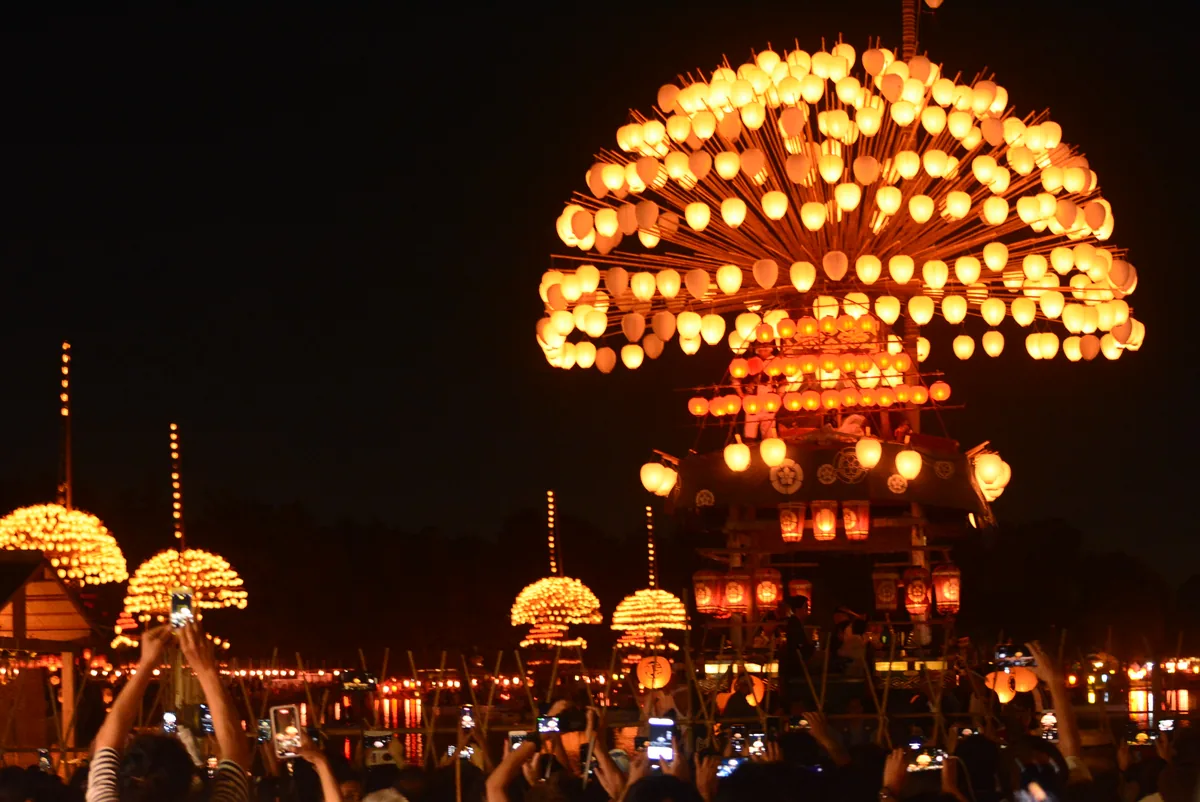
Five makiwara boats (まきわら船), each about 20 metres tall and carrying roughly 500 lanterns, are lit at Kurumakodo from 18:30, cast off at about 20:15, and row across Maruike pond to the otabisho while Tsushima flute music plays.
The lanterns are not decoration in the loose sense; they are a calendar. The official leaflet describes the structure: a central mast (真柱, mabashira) rises above the canopy carrying the number of lanterns in a year’s months, below it the number of days in a year, and on the front face the number of days in a month, plus silk lanterns — about 500 in total. The tourist association spells the numbers out: twelve on the mast, 365 in a semicircle beneath. Tsushima City rounds it to “over 500 lanterns” per boat. With five boats on the water, that is roughly 2,500 flames, doubled by the reflection.
Each boat belongs to one of the five old villages of Tsushima — Imaichiba, Ikadaba, Shimogamae, Doge and Komenoza — which is why the city’s own description calls them the Tsushima gosha (津島五車), “the five carts of Tsushima,” rather than simply the boats.
The 2026 evening timetable
| Time | What happens | Where |
|---|---|---|
| 18:00 | Festival opens | Tennogawa Park |
| 18:30 | Nyoi tenka — the twelve lanterns on the mast are lit first, then the lighting works outward through the rest of the boat | Kurumakodo (車河戸) |
| around 19:30 | The mukae — a messenger from the shrine comes to receive the boats | Kurumakodo |
| around 20:15 | Cast-off — after a greeting from priests aboard a red boat, the boats row out in order, starting with the year’s duty boat | Kurumakodo → Maruike |
| after 21:00 | Boats arrive at the otabisho | North end of Maruike |
| from early evening | Water events and fireworks, “as scheduled” | Floating stage |
Two honest caveats. The official programme is printed as a bar chart, so the arrival at the otabisho — the temporary shrine at the north end of the pond — is not given to the minute. And the leaflet lists fireworks as 随時, “as scheduled,” with no time and no shell count anywhere official. They happen: the site rules warn about falling ash. But nobody publishes a firing time, so do not plan around one.
The lighting sequence is the part worth arriving early for. Watching twelve lanterns go up the mast and the rest of the structure fill in, boat by boat, over nearly two hours, is slower and better theatre than the cast-off itself.
What Happens at the Morning Festival?
Sunday is the same five boats transformed overnight, plus one more. Six float boats (車楽舟, danjiri-bune) about 14 metres tall, topped with life-sized Noh dolls, row out from 09:30 — and ten young men jump off the lead boat carrying cloth halberds.
The transformation is the detail people miss. The lantern frames come down overnight and the same hulls reappear as float boats, so the crews work through the small hours. In the morning the boats carry life-sized dolls dressed as Noh characters. The duty boat at the head of the Tsushima five always carries Takasago; the other four change their Noh programme every year, so no two years look quite the same on the water.
The sixth boat is why this festival spans two cities. The Ichie-guruma (市江車) comes from the Ichie district of the old Saya town — today part of Aisai City, which is why the national cultural-property listing covers both Tsushima and Aisai — and it leads the procession. Aichi Prefecture’s tourism site notes that it is visibly bigger than the others and carries a curved karahafu roof like a shrine building.
The dive
Ten hokomochi (鉾持) ride the Ichie-guruma: unmarried young men in loincloths, each with a nunoboko, a cloth-wrapped halberd roughly three metres long. When the boat reaches the middle of the pond they go into the water one after another, swim to the otabisho, bow to the portable shrine, then run the whole way to Tsushima Shrine — purifying the route ahead of the returning mikoshi before dedicating the halberds.
There is a piece of folk belief attached to it that the official leaflet records without embarrassment: water dripping from the dedicated cloth halberds, applied to the affected part of the body, is said to cure illness and injury.
The 2026 morning timetable
| Time | What happens | Where |
|---|---|---|
| 09:10 | Mukae — the boats are received | Tennogawa Park |
| 09:30 | Cast-off | Maruike pond |
| around 10:00 | The hokomochi dive | Middle of Maruike |
| 10:15 | Ichie-guruma reaches the otabisho; the chigo child attendants come ashore | Otabisho |
| 11:00 | Return of the mikoshi | Tennogawa Park → Tsushima Shrine |
| 11:30 | The chigo perform music before the deity | Tsushima Shrine |
The dive is marked on the official chart just before 10:00 without a printed time, and Aichi Prefecture’s own feature describes it happening “around 9:30, when the boats reach the middle of the pond” — so treat it as a window, not an appointment, and be in position by 09:25. The prefecture also notes that from the east side of the pond you see the dive side-on.
If you can only do one day: the evening is the image, the morning is the ritual — and the morning finishes by lunchtime, which fits a Nagoya-based itinerary far better.
How Do You Get to Tsushima from Nagoya?
Take the Meitetsu Tsushima Line from Meitetsu Nagoya to Tsushima Station: ¥460 for adults, ¥230 for children, 23 to 33 minutes depending on the service, then about 15 minutes on foot — roughly one kilometre.
One quirk worth understanding before you stand on the platform. Meitetsu’s official search returns two patterns for the same fare: a local train that runs through onto the Nagoya main line at Sukaguchi with no transfer, 33 minutes, and a faster combination that changes at Sukaguchi onto an express, 23 minutes. Same price either way — at 22:00 with a tripod, take the through service.
| Route | Fare | Time | Transfers |
|---|---|---|---|
| Meitetsu Nagoya ⇄ Tsushima (through service) | ¥460 adult / ¥230 child | 33 min | None |
| Meitetsu Nagoya ⇄ Tsushima (change at Sukaguchi) | ¥460 adult / ¥230 child | 23 min | 1 |
| From JR / Kintetsu (via Yatomi) | Varies | About 11 min from Yatomi on the Meitetsu Bisai Line | 1 at Yatomi |
| Tsushima Station → Tennogawa Park | — | About 15 min on foot (1 km) | — |
The tourist association quotes “about 24 minutes” and the park’s own site “about 30 minutes” for the same journey — both fair descriptions of different services. The ¥460 and the 23–33 minute range above come from Meitetsu’s own fare and timetable search, run on 15 August 2026.
The last train back
This matters: the evening’s main action starts at 20:15 and crowds do not thin until after 22:00. The official leaflet prints the Saturday and holiday last departures from Tsushima Station:
| Direction | Last departure from Tsushima | Note |
|---|---|---|
| Toward Nagoya | 23:40, for Sukaguchi | Connects at Sukaguchi with an express for Kanayama |
| Toward Ichinomiya / Gifu | 23:30, for Meitetsu Ichinomiya | Connects with a limited express for Meitetsu Gifu |
| Toward Saya / Yatomi | 23:07 for Yatomi; 23:52 for Saya | — |
| Meitetsu bus to Meitetsu Bus Centre | 19:26 and 20:35 | Leaflet notes these were June’s planned times — confirm on the day |
Those are 2026 figures, and the leaflet itself tells you to confirm bus times on the day. Check the current timetable before committing to stay to the end. If Meitetsu is unfamiliar territory, our guide to getting around Nagoya covers the network and IC cards.
By car it is about 15 minutes north from Yatomi IC via Route 155, or about 30 minutes south from Ichinomiya-Inazawa-kita — but read the parking section first.
Ready to book a day trip?
Handy if you want to pair this with other sights the same day.
What Should You Know Before You Go?
Three things: it is genuinely hot, the park’s own car park closes on the Saturday, and the good positions along the pond are sold as paid seating months ahead.
Heat
Late July on the Nobi plain is the hard end of a Japanese summer — flat, humid and slow to cool after dark. Tsushima’s response is official: the venue map designates three cooling shelters, listed as heat-evacuation facilities, at the Cultural Hall, Tennoupia and the Tourism Exchange Centre. Know where they are before you need one.
Crowds and road closures
The official leaflet is unusually direct. Congestion around the venue on Saturday 25 July was expected from about 17:00 until about 22:30, with a request to avoid driving through entirely during that window. From 15:00 to 18:00 the road on the east side of the park becomes one-way northbound; from 18:00 to 22:30 surrounding streets close to vehicles and go pedestrian-only. Regulation times can change with conditions.
Parking
Tennogawa Park normally has 321 spaces, free except during events, plus 48 free bicycle spaces. On the Saturday of the festival, that car park is closed — in 2026, from 08:00 to 23:00. Eight temporary lots open instead, on a staggered schedule, and they close at night:
| Lot | Location | Opens |
|---|---|---|
| P1 | Tsushima Nishi Elementary School | 13:00 |
| P2 | Tsushima Minami Elementary School | 17:00 |
| P3 | Tsushima City Library | 16:00 |
| P4 | JA Aichi Ama Green Centre | 17:00 |
| P5 | Tsushima City Cultural Hall | 17:00 |
| P6 | Aichi Prefecture Ama Government Building | 18:00 |
| P7 | Tsushima City Hall | 18:00 |
| P8 | Tsushima Chamber of Commerce | 18:00 |
The association notes that locations and opening times can change and that some lots may be unusable in bad weather. The official leaflet adds the line that should decide it: parking is limited, the surrounding roads cannot be parked on either, and you are asked to come by train or bus.
Paid seating
There is a formal seating economy here, and it is aimed at groups rather than solo travellers. In 2026 the tourist association sold plots on the north-east bank on which you build your own roofed yakata-sajiki box — each 3.6 m wide by 2.7 m deep, priced by grade at ¥60,000, ¥48,000, ¥40,500 and ¥33,000, plus ¥8,000 per electric light, with the box required to be built in restrained sukiya style. Viewing boats were sold only to sajiki holders: ¥300,000 roofed for 20, ¥180,000 unroofed, ¥120,000 for a large boat seating 10. Permits to bring your own boat cost ¥4,500 or ¥2,200 by size, candles only — no generators.
A separate east-bank viewing seat is sold through the park’s own website; those sale pages came down after the 2026 festival, so we are not quoting a price. No official source states an admission fee for the park, and none says the festival is free — so we will not claim either. What is certain: the paid positions are finite, sold from mid-May, and gone by summer.
On-site rules
The official venue map lists seven requests, and two will catch visitors out. Drones and radio-controlled aircraft are firmly prohibited — carrying them in, operating them, flying them and filming with them, with limited exceptions. And you are asked to watch for falling ash from the fireworks. The rest: no drink-driving, stay out of restricted areas, do not throw anything from the sajiki boxes, take care with cigarettes and sparklers, follow police and stewards, take your rubbish home, use the designated bicycle parking.
Facilities are decent: a festival headquarters with first-aid and security posts, permanent and portable toilets, a tourist information point, vending machines and free bicycle parking — plus a FamilyMart near the otabisho end and a Starbucks south of the central island.
One last thing: the shrine runs a lantern dedication for the festival — the reason it is also called the Lantern Festival (提灯祭) — where individuals and companies have lights lit in their name across the grounds. The 2026 round had closed by August, and the shrine does not publish a price, so ask directly if you want to take part.
What Do Visitors Actually See?
I have not stood on that bank myself, so rather than invent an impression: here is where you can watch the 2026 festival in full, for free, right now.
The most useful source is the complete broadcast. Clover TV / FM Nanami, the West Owari cable operator, streams both days live on its official YouTube channel and leaves the archives up. The 2026 evening broadcast runs three hours 35 minutes and had 582 views when we checked on 15 August 2026; the morning broadcast runs two hours 34 minutes with 269 views. With a shrine treasure-museum curator commentating throughout, it is a better primer than any written guide — you see exactly how long the lighting takes and how the dive unfolds.
- Evening festival 2026, full archive: youtube.com/watch?v=CaHXYX-9n8Q
- Morning festival 2026, full archive: youtube.com/watch?v=VSWBTZmxOZk
- Tsushima Tourist Association, official Instagram: @tsushima_kankou — where the year’s dates, seating and closures are posted first
- Tennogawa Park, official Instagram: @tennogawapark — the venue’s own account
We do not reproduce other people’s posts or reviews here. For atmosphere beyond the official feeds, the archives above are unedited and three hours long — about as unfiltered as it gets.
Frequently Asked Questions
When is the Owari Tsushima Tenno Festival held, and are the 2027 dates confirmed?
It runs on the fourth Saturday of July and the following Sunday, a schedule in place since 1963. In 2026 that was 25–26 July. The 2027 dates were not announced by any official channel as of 15 August 2026; the rule points to 24–25 July 2027, but that is arithmetic, not an announcement.
What time do the lanterns get lit?
In 2026 the lighting, called nyoi tenka, began at 18:30 at Kurumakodo, starting with the twelve lanterns on each boat’s central mast and working outward. The boats cast off toward the otabisho at about 20:15, which Tsushima City itself calls the highlight of the evening.
Do I need a ticket or a paid seat?
No official source lists an admission fee for the park, and none states that the festival is free, so we cannot tell you either way with certainty. What is clear is that paid positions are limited: roofed sajiki plots ran ¥33,000–¥60,000 in 2026 and viewing boats ¥120,000–¥300,000, all sold out by August. Sales open around mid-May.
How do I get there from Nagoya, and what is the last train back?
Meitetsu Nagoya to Tsushima costs ¥460 for adults and ¥230 for children, taking 33 minutes on a through service or 23 minutes with a change at Sukaguchi, followed by a 15-minute walk. The 2026 leaflet listed the last Saturday departure toward Nagoya as 23:40 from Tsushima, connecting at Sukaguchi. Confirm the current timetable before relying on it.
Are there fireworks?
Yes, but no published time. The official programme lists “water events and fireworks” as taking place “as scheduled” during the evening festival, with a floating stage marked on the venue map and a warning about falling ash in the site rules. No official source gives a start time or a shell count, so treat the fireworks as a bonus rather than a fixed item.
What happens if it rains?
Both days are held in light rain. Beyond that, the footnote on both official timetables applies: the programme may be changed or cancelled depending on the weather and the condition of the boats. Some temporary car parks also close in bad weather. Check the city or tourist association page on the day.
What should I know about the heat and the rules on site?
Late July here is hot and humid, and the city designates three cooling shelters — the Cultural Hall, Tennoupia and the Tourism Exchange Centre — as heat-evacuation facilities. Drones and radio-controlled aircraft are firmly prohibited, including carrying them in and filming with them. You are also asked not to throw anything from the sajiki boxes, to watch for falling firework ash, and to take your rubbish home.
Where Can You Check Official Information?
Four official channels cover this festival and publish at different times: the city posts the year’s page and leaflet, the tourist association handles seating and parking, the park handles the venue, the shrine handles the rites. Check from mid-May onward.
- Tsushima City, festival page: city.tsushima.lg.jp — the standing page with the schedule rule and cultural-property status; the year’s dedicated page carries the leaflet, venue map and parking PDFs
- Tsushima Tourist Association: tsushima-kankou.com/tenno — dates, temporary car parks, traffic notices and the paid seating page
- Tennogawa Park official site: tennogawa-park.com — the venue itself, including east-bank viewing seat sales
- Tsushima Shrine: tsushimajinja.or.jp — the shrine’s own history, rites calendar and lantern dedication
- Agency for Cultural Affairs heritage database: the 1980 national designation entry
- Enquiries: festival rites — Owari Tsushima Tenno Festival Association, inside Tsushima Shrine, 0567-26-3216 · events — Tsushima Tourist Association, 0567-28-8051 (weekdays 10:00–17:00) · city — Tourism and Promotion Division, 0567-55-9589 (weekdays 8:30–17:15)
Times, closures and seating change year to year. Everything here was verified on 15 August 2026 and will be rechecked when the 2027 information appears.
Related Guides
- Central Japan Festival Calendar — every major festival in the region, month by month
- Nagoya Summer Festivals — what else runs in the city during the same weeks
- Gujo Odori — the region’s other great summer event, and the opposite experience: you dance rather than watch
- Getting Around Nagoya — the Meitetsu network, subways and IC cards
- Setomono Matsuri — Seto’s pottery festival in September, on the other side of Nagoya
- Best Time to Visit Nagoya — what late July really feels like before you commit to a night outdoors