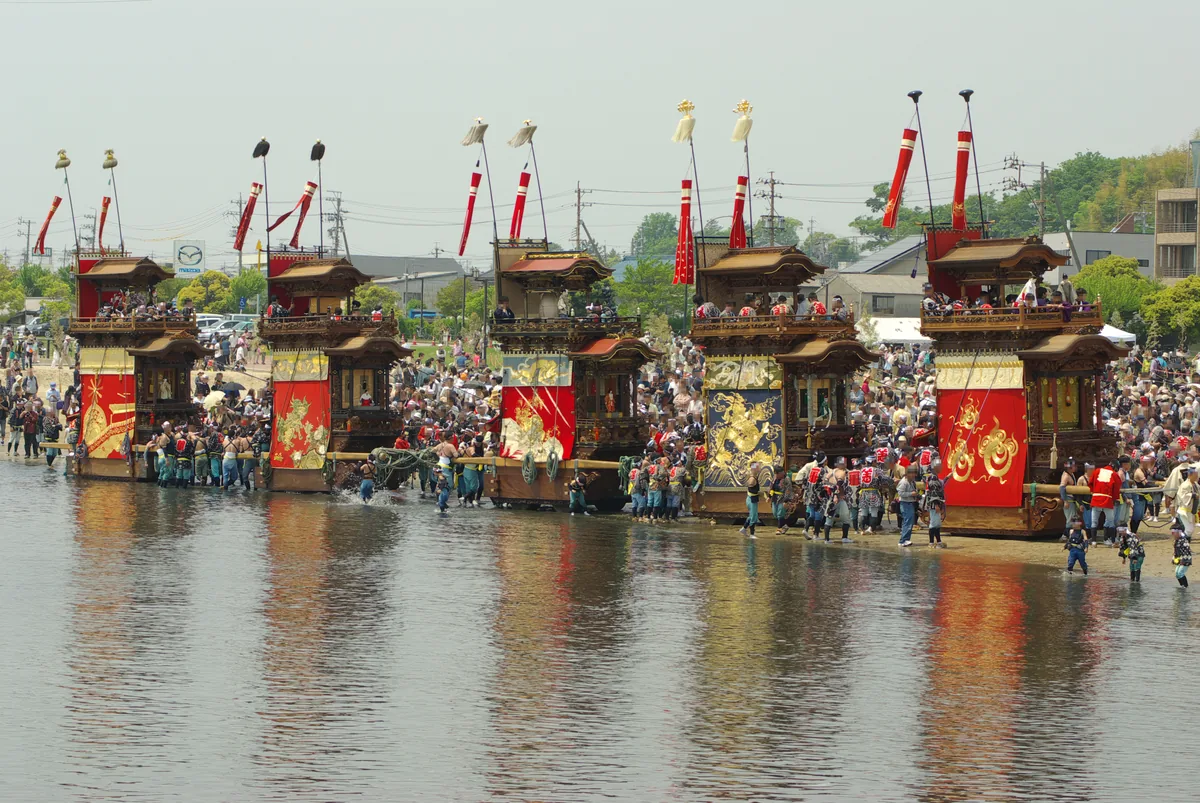
The Kamezaki Shiohi Festival (亀崎潮干祭) is a UNESCO-listed float festival held every 3 and 4 May at Kamezaki in Handa, Aichi. Five two-tiered floats are hauled down a slope onto the beach at low tide and lined up at the water’s edge. Kamezaki is ¥600 and 41 minutes from Nagoya.
Most float festivals are a fight against gravity — teams hauling several tonnes of carved timber along a flat street. This one adds the sea. Once a year, at Kamezaki (亀崎) on the eastern shore of the Chita peninsula, five floats are run down a slope onto a beach that only exists for a few hours, turned at the waterline and lined up nose to tail before the tide takes the ground back. The timetable is not set by a committee. It is set by the moon. Everything below is verified from the preservation society, the shrine, the Agency for Cultural Affairs, Aichi Prefecture and JR Central, on 15 August 2026.
Written by Yuu — a Nagoya native of 35 years. Published August 15, 2026.
This article may contain affiliate links. See our affiliate disclosure for details.
All festival details verified from official sources on August 15, 2026.
On this page
- What do you need to know in one minute?
- What is the Kamezaki Shiohi Festival?
- What happened in 2026, and when is the next one?
- What are the highlights?
- How do you get to Kamezaki from Nagoya?
- What should you know before you go?
- What do visitors actually see?
- Frequently asked questions
- Where can you check official information?
- Related guides
What Do You Need to Know in One Minute?
The festival is held every year on 3 and 4 May at Kamezaki in Handa, Aichi, centred on Kamisaki Shrine. Five floats are pulled onto the beach at low tide on both days. The nearest station is Kamezaki on the JR Taketoyo Line, 15 minutes’ walk away.
| Item | Detail |
|---|---|
| Festival | Kamezaki Shiohi Festival (亀崎潮干祭) — the preservation society’s own English name is the Shiohi-matsuri Festival |
| When | 3 and 4 May, every year — the date is fixed, not calculated |
| Where | Kamezaki, Handa City, Aichi. Three sites: Kamisaki Shrine (神前神社), the seaside park, and Owari Sansha (尾張三社) |
| Shrine address | 2-92 Kamezaki-cho, Handa, Aichi 475-0023 — 0569-28-0019 |
| Nearest station | Kamezaki Station (亀崎駅), JR Taketoyo Line — about 15 minutes on foot |
| From Nagoya | ¥600, 41 minutes, no transfer |
| The main event | The hikioroshi (曳き下ろし) — the floats hauled onto the low-tide beach, on both days |
| Weather policy | Postponed in rain, up to 5 May. This was actually used in 2026 |
| Status | Aichi Prefecture Tangible Folk Cultural Property (1966); National Important Intangible Folk Cultural Property (2006); UNESCO Intangible Cultural Heritage (2016) |
| Organiser | Kamezaki Shiohi Matsuri Preservation Society (亀崎潮干祭保存会) |
| Official pages | shiohi-matsuri.jp · day-of info at shiohi-matsuri.com |

What Is the Kamezaki Shiohi Festival?
It is the annual festival of Kamisaki Shrine in Kamezaki, a former port and sake-brewing town in Handa. Five two-tiered floats of the Chita type (知多型), each carrying karakuri mechanical dolls, are pulled through the streets and then down onto the beach at low water. UNESCO inscribed it in 2016.
The name is the whole idea. Shiohi (潮干) means the drawing-out of the tide — the exposed flats you get at low water. The festival is named for what the floats are pulled down onto, and the preservation society explains why they go there at all: the shrine’s enshrined deity is Emperor Jimmu, and legend has it that during his eastern campaign he came ashore here from the sea. Pulling the floats down to the beach re-enacts a landing.
Note the word “legend.” The society says it plainly, and so should we — this is the story the festival tells about itself, not a documented event.
How old is it?
Officially, nobody knows, and the preservation society is refreshingly direct about it. Its history page states that the origin is not certain. One tradition holds that eighteen samurai households who moved to Kamezaki in the Onin–Bunmei era (the late 15th century) started it, dragging a cart hung with a curtain dyed with the shrine crest, accompanied by festival music.
What can actually be evidenced is narrower and more useful. A specialist survey traced the festival through documentary sources back to the Genroku–Horeki eras — the end of the 17th century to the first half of the 18th — establishing, in the society’s words, that its character and traditions have been passed down firmly for at least 300 years. That is the figure the official site uses everywhere. There is no founding year, and you should be suspicious of any source that gives you one.
The floats themselves are datable, because they are objects. The oldest survivor was built in 1826 and the newest in 1891.
What it is officially designated as
Three separate designations, and they cover three different things. Keeping them straight matters, because they are often blurred together:
- Aichi Prefecture Tangible Folk Cultural Property (1966) — the five floats, as physical objects. The society credits this with kicking off a local re-evaluation: float groups began restoring karakuri dolls lost or broken years before, and today all five dedicate both types again
- National Important Intangible Folk Cultural Property (2006) — “The Float Rites of the Kamezaki Shiohi Festival” (亀崎潮干祭の山車行事), designated 15 March 2006, with the preservation society named as protecting body. This covers the practice, not the hardware
- UNESCO Intangible Cultural Heritage (2016) — inscribed as one of the 33 Yama, Hoko, Yatai float festivals of Japan
Aichi’s other entries on that same UNESCO list are the obvious follow-ons if this one interests you: the Inuyama Festival, whose thirteen floats carry karakuri of their own through a castle town, and the Owari Tsushima Tenno Festival, which puts its lanterns on boats instead of putting its floats on a beach.
The Agency for Cultural Affairs adds one piece of internal machinery that shapes the whole event: each year one of the five groups takes a turn as the daisan (代参), the duty group that oversees the festival. That rotation is why the official day-of website is published jointly by the preservation society and the daisan committee.
Why the beach is artificial — and why that is the interesting part
Here is the detail that changes how you look at the whole thing. The beach procession stopped for decades. After the 1959 Ise Bay Typhoon, the coastline was rebuilt with hard revetments, and there was no beach left to pull a float onto. The central act of a festival named after the tide became impossible.
It came back because the town built the sea back. An artificial beach was completed in front of Kamisaki Shrine in 1993, and the hauling-down was revived. So when you watch floats come off a slope onto wet sand, you are watching a restored ritual on constructed ground — a community that decided the shape of its coastline should follow the shape of its festival, rather than the other way round.
The society adds, in the same passage, that while festivals nationwide struggle for hands, Kamezaki’s kumi (組) group structure has held — and that the tradition of women being excluded from the float crews continues. That applies to who pulls the floats. Nothing in any official source restricts who may watch.
How is this different from the Handa Dashi Matsuri?
Visitors mix these up constantly, so: they are different events. The Kamezaki Shiohi Festival is the annual festival of one district, with five floats, on 3–4 May. The Handa Dashi Matsuri (はんだ山車まつり) is a city-wide gathering held only once every five years, in which 31 floats from 10 districts across Handa — Kamezaki’s five among them — assemble in one place. It began in 1979, and the ninth edition ran on 28–29 October 2023. No official source states the year of the tenth, so we will not guess; check the Handa Float Festival Preservation Society. If you want the floats on the beach, you want Kamezaki in May.
What Happened in 2026, and When Is the Next One?
The 2026 festival was held on Sunday 3 May and — after a weather postponement — Tuesday 5 May, rather than Monday 4 May. The preservation society confirmed afterwards that the festival finished safely. The 2027 dates follow the standing rule of 3 and 4 May, but no 2027 announcement exists yet.
The 2026 edition, including the day that moved
The published plan was the usual one: 3 and 4 May, with the standing note that rain postpones proceedings as far as 5 May. On 2 May 2026, the preservation society posted a notice changing it. Citing the weather and “safe operation,” it moved the second day — Nochi no hi (後の日), “the later day” — from Monday 4 May to Tuesday 5 May. The first day, Hatsu no hi (初の日), went ahead as normal, with a caveat that events might be shortened.
The society was specific about what that meant for anyone already travelling: on 4 May there were no festival rites and no float hauling at all, though some food stalls and kitchen cars traded anyway, and visitors were encouraged to walk the town instead. It is the best argument for checking the official site the morning you go.
Afterwards, the society’s day-of site recorded the outcome in one line: the 2026 festival finished without incident, and please come next year. No attendance figures were published — Handa does not release visitor counts for this festival, so anyone quoting you a crowd number is not quoting an official source.
2027: what is known and what is not
This festival is easier to plan than most, because the date does not move. The official site states it flatly: the festival is held on 3 and 4 May every year. No “fourth Saturday” arithmetic, no lunar calculation. Both dates are national holidays — Constitution Day and Greenery Day — which is why this sits inside Golden Week every year.
So 2027 will be Monday 3 and Tuesday 4 May 2027, on the rule. Treat that as the rule, not an announcement. As of 15 August 2026, no official channel — the preservation society, Handa’s tourist association, or Aichi Prefecture — has published anything naming 2027.
What genuinely changes each year is not the date but the clock, because the tide changes. Here is when to start checking:
| Roughly when | What appeared in 2026 | Where |
|---|---|---|
| Through March | The year’s full preparation calendar — road inspection, float assembly, music rehearsals | Official site, 行事予定表 |
| End of March | The procession timetable with tide heights — posted 31 March 2026. This is the one that matters | Official site, 巡行時刻表 |
| Late April | Food-stall map; car park requests | Official site news |
| Just before | The year’s day-of site goes live with traffic control, parking, karakuri guide | shiohi-matsuri.com |
| The day itself | Changes, delays, postponements | Official site and Instagram |
Book flights and a hotel off the fixed date whenever you like. Do not fix your hour-by-hour plan until the timetable lands at the end of March. For everything else happening that month, start with our Central Japan Festival Calendar.
What Are the Highlights?
One moment above all: the five floats running down the slope onto the beach, turning at the waterline and lining up nose to tail. The preservation society calls this the festival’s single greatest sight. The karakuri doll performances and the float carvings are the slower pleasures around it.
The run down the slope
The official description is better than anything I could write, so here is its substance: the five floats charge down the slope in one go, change direction at the water’s edge, and form up in a line. Decorated with fine carvings and lavish curtains, streamers snapping in the sea wind, they process along the breaking waves — as if flowers had bloomed on the shore.
What that leaves out is the engineering problem. These are tall, top-weighted wooden structures on wheels, taken down a gradient onto soft wet sand and then turned. The timetable allows 45 minutes on day one between the start of the hauling-down and the completed line-up, then starts pulling them back up. It is a tightly rehearsed operation with a hard deadline, and the deadline is the returning tide.
The five floats
Each float belongs to one of the five neighbourhood kumi, and each is a named, dated object with its own carvers and its own puppet routine. The oldest, the Rikijin-guruma, is described by the society as the oldest of the five and the prototype of the Chita-style float.
| Group (組) | Float | Built | Upper-stage karakuri routine |
|---|---|---|---|
| Nakakiri-gumi (中切組) | Rikijin-guruma (力神車) | 1826 | Urashima, a mask-changing routine |
| Tanaka-gumi (田中組) | Kagura-guruma (神楽車) | 1837 | Kugutsushi (Funa-Benkei) — a rare survival of Takeda karakuri |
| Nishi-gumi (西組) | Kao-guruma (花王車) | 1846 | A Chinese child crossing cherry branches |
| Higashi-gumi (東組) | Miyamoto-guruma (宮本車) | 1865 | The yutori hot-water rite |
| Ishibashi-gumi (石橋組) | Seiryu-sha (青龍車) | 1891 | Chinese children playing, including a handstand |
The Higashi-gumi float leads as the “Miyamoto” float, the one with the deep connection to the shrine. The carving credits read like a roll-call of the period’s best workshops — Tatekawa Washiro Tomimasa of Suwa, Segawa Jisuke, Niimi Tsunejiro (known as Horitsune), Takeuchi Kyuichi — with curtains worked from designs by the painters Ganku and Suiko.
The karakuri dolls
Every one of the five floats carries two kinds of mechanical doll: one on the maedana (前棚), the front shelf, and one on the uwayama (上山), the upper stage. That completeness was hard-won — several routines had lapsed entirely through damage or loss and were restored after the 1966 prefectural designation.
The one to seek out is the Kugutsushi on the Kagura-guruma, which the society calls a living fossil of Takeda karakuri — the puppet tradition that shaped much of Japanese mechanical theatre and then largely vanished. If you have any interest in automata, this is a stronger reason to come than the beach is.
Crucially, the doll performances are not on the beach. They happen at set points on land, and on day one the society allots a full 1 hour 45 minutes to the dedication in the festival square. Chase only the hauling-down and you will miss half the festival. If you like the Takayama floats’ automata, you will recognise the family resemblance — see our Takayama Festival guide for the other great karakuri showcase on the UNESCO list.
How Do You Get to Kamezaki from Nagoya?
Take the JR Taketoyo Line to Kamezaki Station: ¥600 and 41 minutes from Nagoya with no transfer, then about 15 minutes on foot to Kamisaki Shrine. Trains for Taketoyo run through from the Tokaido Main Line, so you stay in your seat.
The through service is the thing worth knowing. On JR Central’s own search, the pattern is a Tokaido Main Line kukan-kaisoku (section rapid) bound for Taketoyo: it runs the main line to Obu, pauses two minutes, and continues onto the Taketoyo Line. Nominally you change lines at Obu; in practice you do not move.
| Route | Fare | Time | Transfers |
|---|---|---|---|
| Nagoya → Kamezaki, JR through service | ¥600 | 41 min | None |
| Kamezaki Station → Kamisaki Shrine | — | About 15 min on foot | — |
| By car, from Agui IC (Chita Peninsula Road) | — | About 15 min toward the Kinuura Bridge | — |
That ¥600 is JR Central’s own figure, retrieved from its official access search on 15 August 2026, and it is the paper-ticket price — JR notes the tool rounds to ten yen and does not show the one-yen IC fare, so do not assume your TOICA or Suica will deduct exactly ¥600. Fares and timetables change; check before you travel. If the region’s rail network is new to you, our guide to getting around Nagoya covers the lines and IC cards.
By car, the official routing is the Chita Peninsula Road to Agui IC, then about 15 minutes toward the Kinuura Bridge — from Nagoya via the Nagoya Expressway, or from Centrair airport via the Centrair Line.
Ready to book a day trip?
Handy if you want to pair this with other sights the same day.
Parking
There are five official car parks, all free and all unattended — the society’s phrasing is that it accepts no responsibility for accidents inside them.
| Car park | Walk to shrine / seaside park | Walk to Owari Sansha |
|---|---|---|
| A — Su-no-saki ground, festival-day temporary | 8 min | 20 min |
| B — permanent car park | 8 min | 20 min |
| C — Kamezaki Port yacht harbour | 15 min | 8 min |
| D — Shiokaze-no-oka park (east) | 13 min | 8 min |
| E — Shiokaze-no-oka park (west) | 17 min | 12 min |
Three official warnings come with that. Capacity is limited and public transport is recommended. Parking on the street, on the ground itself, or on the premises of other businesses is firmly refused. And at the yacht harbour, the society asked in 2026 that you keep off the asphalt quay section, because boats need it for loading and rope-hauling. Given a 41-minute train with no transfer, the case for driving is weak.
What Should You Know Before You Go?
Three things: the schedule is dictated by the tide and differs between the two days, times shift on the day, and the whole thing postpones in rain. Everything below is the 2026 timetable — treat it as the shape of the event, not as 2027’s clock.
The tide is the timetable
The official timetable prints tide data next to the events, and reading it tells you exactly why the two days look different.
| 2026 | Tide reference | Hauling-down began | Tide at that moment |
|---|---|---|---|
| Day one (3 May) | High water 06:04, 214 cm | 10:25 | 70 cm, falling |
| Day two (as published) | Low water 13:16, 22 cm | 14:05 | 32 cm, already coming back in |
Day one goes onto the beach on a falling tide at 70 cm, with the ground still emerging — the official timetable prints that day’s high water but not its low, so we will not put a number on the margin. Day two goes on after low water, at 32 cm and rising: the crews take the beach back off the sea while it is being returned to them. Between the 214 cm high water printed for day one and the 22 cm low water printed for day two, the official figures span nearly two metres, and that range is the entire reason the festival can happen at all.
The practical consequence: the beach act is late morning on day one and mid-afternoon on day two, and both times move every year with the tide table. So do not assume last year’s clock — and if you can only come for one day, the two are genuinely different experiences of the same act.
The 2026 shape of each day
Both days are long — the 2026 timetable opens at 06:30 on day one and 06:10 on day two, and closes at 19:00 and 19:30 respectively — and the beach is a fraction of them. The rest is street procession, shrine rites and doll dedications.
| Time | Day one (3 May 2026) |
|---|---|
| 06:30 | Float blessings begin, group by group from Higashi-gumi |
| 08:50 | Floats set off |
| 09:50 | Crossing the national highway, one group at a time |
| 10:00 | Rites at Kamisaki Shrine |
| 10:20 | Floats lined up on the hauling-down slope |
| 10:25 | Hauling-down onto the beach begins |
| 11:10 | Line-up on the beach complete; hauling back up begins |
| 12:10 | Karakuri dedication in the festival square (1 hr 45 min) |
| 14:20 | Front-shelf doll dedication at Akiba-sha |
| 15:45 | Floats drawn in to Owari Sansha |
| 16:25 | Karakuri dedication at Owari Sansha |
| 19:00 | Floats returned to their sheds |
| Time | Day two (as published for 2026; actually held 5 May) |
|---|---|
| 06:10 | Floats dressed at Owari Sansha |
| 10:40 | Front-shelf doll dedication, all five groups |
| 13:00 | Floats set off after lunch |
| 14:00 | Lined up on the slope |
| 14:05 | Hauling-down onto the beach begins |
| 14:40 | Line-up on the beach complete |
| 15:30 | The turning circuit at the shrine begins |
| 16:55 | Karakuri dedication in front of Kamisaki Shrine |
| 19:30 | Floats returned to their sheds — the finale |
The society prints a standing caveat on both timetables: times may run earlier or later depending on weather and other circumstances. Arrive with margin, particularly for the beach.
Rain, and the 5 May reserve
The rule is built into the calendar: in rain, proceedings are postponed as far as 5 May. This is not a formality — it was used in 2026, when the second day moved from 4 to 5 May. If you are travelling any distance, build a floating day into a Golden Week itinerary, or accept that you may see one day rather than two.
One further wrinkle for anyone reading the official calendar directly: 5 May also carries a scheduled item called dashi-oroshi (山車下ろし). That is dismantling the floats for storage, not taking them down to the beach. Same English words, entirely different event.
Tickets, seats and money
There is nothing to buy. No official source lists an admission fee, and none states that the festival is free — so we will not claim either. No paid grandstand system is published for this festival, unlike some larger Aichi events.
Making a day of it
Kamezaki rewards the walk. It was a port on the Mikawa–Ise sea route and then a brewing town: at its 19th-century peak it held 50 sake breweries, of which one survives. The old buildings along the Kurokuwa Kaido are what is left of that money, and the preservation society runs a town-walking guide site covering the shrine, Owari Sansha, the float sheds and the old landing places.
Early May on the Chita coast is about as good as Japanese weather gets — warm, bright, before the humidity arrives. Our guide to the best time to visit Nagoya has the detail.
What Do Visitors Actually See?
I have not stood on that beach myself, so I am not going to invent an impression of it. What I can do is point you at the places where the festival documents itself.
The most useful is the official day-of site, published by the preservation society and the daisan committee as a “web pamphlet.” In 2026 it carried a visitor handbook, parking, a food map, traffic control, both days’ timetables, a karakuri guide and the duty group’s own schedule. It is rebuilt each year, and it is the most practical page for this festival.
- Official day-of information: shiohi-matsuri.com — the year’s web pamphlet, including the karakuri guide
- Official Instagram: @shiohimatsuri — where changes and postponements are announced on the day, alongside the main site
- Official Facebook: facebook.com/shiohimatsuri
- Official PR video: the preservation society’s site hosts a promotional film recording the 2018 festival — the last of the Heisei era — as a record of the town’s history and the festival’s traditions
We do not reproduce other people’s posts, photographs or reviews here. The official feeds above are the primary record, and the PR film is the closest thing to a rehearsal.
Frequently Asked Questions
When is the Kamezaki Shiohi Festival held, and are the 2027 dates confirmed?
It is held on 3 and 4 May every year — a fixed date, not a calculated one, and both days are Japanese national holidays inside Golden Week. That rule puts the 2027 festival on Monday 3 and Tuesday 4 May 2027, but as of 15 August 2026 no official channel has published anything naming 2027. The hourly timetable is a different matter and is not set until late March.
What time do the floats go onto the beach?
It changes every year, because it is set by the tide. In 2026 the hauling-down began at 10:25 on day one, on a falling tide at 70 cm, and was scheduled for 14:05 on day two at 32 cm with the tide already returning. The official timetable with that year’s tide heights is published at the end of March — in 2026, on 31 March.
Did the 2026 festival go ahead?
Yes, but not on the printed dates. On 2 May 2026 the preservation society postponed the second day from Monday 4 May to Tuesday 5 May because of the weather. The first day ran normally on 3 May. On 4 May there were no rites and no float hauling at all, although some food stalls traded. The society later confirmed the 2026 festival had finished safely.
How do I get there from Nagoya?
Take the JR Taketoyo Line to Kamezaki Station — ¥600 and 41 minutes from Nagoya with no transfer, since trains for Taketoyo run through from the Tokaido Main Line via Obu. From the station it is about 15 minutes on foot to Kamisaki Shrine. That fare is JR Central’s paper-ticket price as of 15 August 2026; the IC fare may differ by a few yen.
Is there an admission fee?
No official source lists an admission fee for the festival, and no official source states that it is free either, so we cannot confirm it either way with certainty. There is no published paid-seating or grandstand system for this festival. In practice it takes place on public streets and a public beach, and there is nothing advertised for sale to spectators.
What happens if it rains?
Proceedings are postponed, as far as 5 May. This is printed on both the official annual calendar and the procession timetable, and it was used in 2026. The timetables also carry a standing note that times may run earlier or later depending on the weather and other circumstances, so build margin into your plans and check the official site on the morning.
Can anyone watch, and is it true that women are excluded?
The preservation society states that the tradition of excluding women has been maintained — this concerns the float crews, the people who haul the floats. No official source places any restriction on who may attend and watch. Spectators of any gender are visitors to a public event on public ground.
Where Can You Check Official Information?
Two sites do almost all the work: the preservation society’s main site carries the history, the floats and the year’s timetable, while a separate day-of site carries parking, traffic control and the food map. Check the main site from late March, and both on the morning itself.
- Kamezaki Shiohi Matsuri Preservation Society: shiohi-matsuri.jp — including the procession timetable with tide heights, the five floats, the history, access and parking, and an English page
- Day-of information: shiohi-matsuri.com — the year’s web pamphlet, rebuilt annually
- Kamisaki Shrine: kamisaki-jinja.com — 2-92 Kamezaki-cho, Handa, 0569-28-0019
- Agency for Cultural Affairs: the 2006 national designation entry
- Aichi Now, the prefecture’s official tourism site: the festival listing
- Handa Float Festival Preservation Society: the Kamezaki district page
- Town walking guide: the society’s Kamezaki guide site
Times, tides and traffic control change every year. Everything here was verified on 15 August 2026 and will be rechecked when the 2027 timetable appears at the end of March.
Related Guides
- Central Japan Festival Calendar — every major festival in the region, month by month
- Takayama Festival — the other great karakuri showcase on the UNESCO list, and the region’s most visited float festival
- Inuyama Festival — Aichi’s other UNESCO karakuri festival: thirteen three-tier floats through a castle town, lantern-lit at night
- Owari Tsushima Tenno Festival — the same UNESCO list again, but on water: lantern boats on the Tenno River in July
- Gujo Odori — the region’s other UNESCO-listed tradition, and the opposite experience: you dance rather than watch
- Setomono Matsuri — Seto’s pottery festival in September, on the far side of Nagoya
- Nagoya Matsuri — the city’s own big October parade
- Getting Around Nagoya — the JR, Meitetsu and subway networks, and IC cards
- Best Time to Visit Nagoya — what Golden Week really looks like before you commit