Nagoya Matsuri (名古屋まつり), the city’s biggest autumn festival, runs October 17–18, 2026 at Hisaya Odori Park (久屋大通公園). Entry to that venue is free. The Three Unifiers procession is cancelled for 2026 — the float is on static display instead — and Nagoya Castle is free on both days.
Verified from official sources on August 15, 2026. If you have read anything about the Nagoya Festival before, you have read about the Three Unifiers — Oda Nobunaga, Toyotomi Hideyoshi, and Tokugawa Ieyasu marching through downtown Nagoya with six hundred armoured retainers behind them. It is the image the festival is famous for, and for a lot of overseas visitors it is the reason the trip gets booked for October at all. Know this before you plan your trip: that procession is not happening in 2026. The rest of the festival is, several parts of it are easier to see this year than usual, and the free-admission weekend attached to it is unusually valuable in 2026. Here is what is on, what is off, and how to make the weekend work.
Written by Yuu — a Nagoya native of 35 years — August 15, 2026
This article may contain affiliate links. See our affiliate disclosure for details.
Ready to book a day trip?
Handy if you want to pair this with other sights the same day.
Nagoya Matsuri 2026 at a Glance
| Dates | October 17–18, 2026 (Sat–Sun) — the 72nd Nagoya Festival |
|---|---|
| Hours | Sat 11:00–20:00 / Sun 10:00–20:00 (Hisaya Odori Park venue) |
| Main venue | Hisaya Odori Park — Edion Hisaya Hiroba, Angel Hiroba, Ai no Hiroba, Sakae Hirobas |
| Admission | Free at the Hisaya Odori Park venue (food stalls and some hands-on booths cost extra) |
| Nearest stations | Subway Sakae or Yabacho; Meitetsu Seto Line Sakaemachi |
| Organisers | City of Nagoya, Aichi Prefecture, Nagoya Chamber of Commerce and Industry |
| Not happening in 2026 | The Nagoya Festival procession (including the Three Unifiers), the public casting call for the Three Unifiers roles, the Oasis 21 venue events, and the Osu “Hanamichi” walk |
| Happening instead | Static display of the Three Unifiers float, Flower Car display, dashi-bayashi and karakuri puppet performances, kagura music, a Bon odori night, street performers, a food-truck zone |
| Rain policy | Held in rain, cancelled in severe weather |
| Bonus | Nagoya Castle is free on both days; 11 more city attractions are free on Sunday |

What Is Nagoya Matsuri?
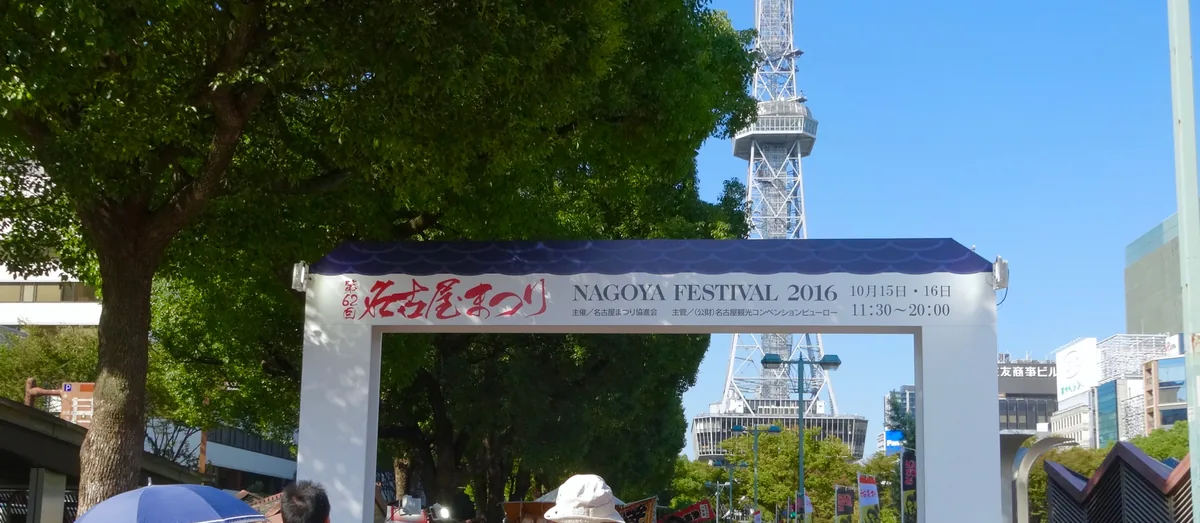
Nagoya Matsuri (名古屋まつり), the Nagoya Festival, is the city’s largest autumn event. It has been held since 1955 and is organised by the City of Nagoya, Aichi Prefecture, and the Nagoya Chamber of Commerce and Industry. 2026 is the 72nd edition, and it takes place on October 17 and 18 at Hisaya Odori Park in Sakae.
That much is constant. What makes the festival famous, in a normal year, is a single enormous procession through the city centre — a moving anthology of the region’s heritage rather than a parade of floats alone. According to the City of Nagoya’s tourism page, when the procession runs it includes:
- Nine dashi (山車, festival floats) designated as City Cultural Properties, lined up in front of City Hall, with their karakuri (からくり, mechanical puppets) performing
- Eight kagura yakata (神楽屋形) — portable shrines housing lion-head masks, a form of cultural property particular to this area, with musicians playing on board
- Handmade mikoshi built by children’s associations from all 16 city wards
- The Flower Car parade — three floats covered in fresh flowers, with more than 300 people marching alongside them: baton teams, brass bands, dance troupes
- Sister-city representatives from Los Angeles, Mexico City, Nanjing, Sydney, Turin, and Reims riding in open cars
- The Kyodo Eiketsu Gyoretsu (郷土英傑行列) as the finale — Nobunaga, Hideyoshi, and Ieyasu with over 600 retainers in armour
That last one is the reason people fly in. All three unifiers of Japan have roots in this region, and seeing them together in the city that produced them is the whole point. It is also the one part that is not running this year.
A note on that City of Nagoya tourism page, because it matters if you are researching this yourself: it still carries an update date of October 16, 2025, and it describes the procession as a current feature. It is an accurate description of a normal year and a misleading one for 2026. The same is true of several English-language listings. For 2026 the only reliable sources are the official festival site and the City of Nagoya’s own press releases.
What Changed for 2026?
The short version: the procession is cancelled because the festival dates collide with the Asian Para Games, and the city has replaced it with a set of one-year-only programmes at Hisaya Odori Park. Nothing else about the festival’s scale or admission has changed, and the free-admission weekend runs as usual.
Why the procession was cancelled
On February 16, 2026, the City of Nagoya announced that the 72nd Nagoya Festival would not run its procession. The official reason, quoted directly from the city’s press release:
“Because the dates overlap with the torch relay and opening ceremony of the Aichi-Nagoya 2026 Asian Para Games, it is with great regret that, from a safety standpoint, we have decided to forgo holding the Nagoya Festival procession.”
The 5th Asian Para Games (2026 / Aichi-Nagoya) run from October 18 to 24, 2026 — the opening ceremony falls on the festival’s second day. Closing kilometres of downtown road for a procession while a torch relay and an opening ceremony are moving through the same city was judged unworkable.
Two events with similar names are easy to confuse here, so to be precise: the 20th Asian Games ran September 19 to October 4, 2026, and the 5th Asian Para Games run October 18 to 24, 2026. It is the second one that overlaps the festival.
Three things are officially cancelled for 2026, per the City of Nagoya’s June 10, 2026 press release and the official site:
- The Nagoya Festival procession, including the Kyodo Eiketsu Gyoretsu
- The public casting call for the Three Unifiers roles, normally open to Nagoya residents and workers
- The Oasis 21 venue events
The “Sanneiketsu Osu no Hanamichi” — the walk where the three unifiers, having finished the procession, stroll roughly 600 metres through the Osu (大須) shopping arcade to Osu Kannon temple — is also not running in 2026. The official page for it now carries the heading “not held for the 72nd (2026)”. If you have seen that listed on another site as a 2026 event, it is out of date.
What is happening instead
Here is the part most English-language write-ups are missing. Following the Nagoya Festival general meeting on June 10, 2026, the city built a set of one-year-only special programmes around “elements of the procession,” all concentrated in Hisaya Odori Park.
Angel Hiroba (エンゼル広場) is where the procession content lands:
- Static display of the Kyodo Eiketsu Gyoretsu float — the float itself, parked, at eye level
- Dashi-bayashi (festival float music) with karakuri puppet performances
- Kagura sacred-music performance
- Traditional-culture hands-on booths
- A Bon odori dance night — a first for this festival, and a one-year-only addition
- Festival-style game stalls
Edion Hisaya Hiroba (エディオン久屋広場) carries the main stage and the food:
- Flower Car display — the flower-covered floats, stationary
- Stage programmes with the festival ambassador
- Sword-fighting performances by a local samurai warlord troupe
- “Nagoya Youth Power Stage” run by students
- Exhibitor promo stage
- Food-truck stadium and a Nagoya-meshi gourmet zone
Ai no Hiroba (愛の広場) has street performers. Sakae Hirobas (サカエヒロバス) has stage programmes, booths, and another food-truck cluster.
There is also a roaming programme designed to be walked from Nagoya Station through to Yabacho. The city has announced the concept but not the format, route detail, or timings.
One caveat, and it is an important one: as of August 15, 2026, every one of these is listed by the organisers as “planned,” with details “to be posted as they are confirmed.” The stage timetable and the official 2026 leaflet are due in early October — the leaflet currently on the official site is still the 2025 one, so do not read timings off it. Do not build your day around a specific act until the 2026 version drops.
Other official venue events
The festival is not confined to Hisaya Odori Park. These run under the same banner at their own venues:
| Event | When | Where |
|---|---|---|
| Nagoya Castle Autumn Festival | September 19 – November 23, 2026 | Nagoya Castle |
| Japanese Classical Martial Arts Tournament | Sun Oct 18, 10:40–12:00 (Kagura-den plaza) / 10:30–16:00 (Bunkaden hall) | Atsuta Jingu |
| Elementary & Junior High Kendo Tournament | Sat Oct 17, 10:00–16:30 | Tempaku Sports Center |
| Free Admission Day Concert | Sun Oct 18, 11:00 (doors 10:30) | Tokugawaen Garden Hall |
| Environment Day Nagoya 2026 central event (co-sponsored) | Sat Nov 21, 10:00–15:00 | Hisaya Odori Park (Edion Hisaya Hiroba / Angel Hiroba) |
The martial arts tournament at Atsuta Jingu is worth flagging: schools from across Japan demonstrate koryu bujutsu on the grounds of the region’s most important shrine. The concert at Tokugawaen lands on the same day the garden is free to enter, which makes it an easy pairing. Admission charges for these events are not stated on the official pages, so check with each venue rather than assuming they are free.
What Should You Actually See This Year?
If you only have a couple of hours, prioritise Angel Hiroba for the parked Three Unifiers float and the karakuri performances, Edion Hisaya Hiroba for the Flower Cars and the food, and then use the free-admission weekend at Nagoya Castle. That combination is the strongest version of 2026.
The float you can actually look at
In a procession year, the floats pass you. You get thirty seconds, a wall of people in front of you, and a photo of the back of someone’s head. In 2026 the Three Unifiers float is parked at Angel Hiroba, with the dashi-bayashi and karakuri performances in the same space. If you have ever wanted to study one of these things rather than glimpse it — the carving, the lacquer, the mechanism that drives the puppets — this is the year for it. The same goes for the Flower Cars at Edion Hisaya Hiroba, which normally roll past inside the parade and are, up close, far more elaborate than they look in motion.
I will be honest about the trade-off, because it is a real one. The procession is the better spectacle; a static display is the better look. If your trip is fixed to this weekend, 2026 is a good year to see the objects. If you are choosing a year specifically to see the Three Unifiers march, this is not it — and nothing about 2027 has been announced yet.
Bon odori in October
Bon odori is a summer thing. Getting one at a mid-October festival is odd in the best way, and the organisers have explicitly labelled it a one-year-only special programme. It is at Angel Hiroba, alongside the game stalls. Bon odori is also one of the few Japanese festival formats that actively wants outsiders to join in rather than watch, so it is a low-barrier entry point if you have never danced one.
Nagoya-meshi in one place
The gourmet zone is built around Nagoya-meshi (名古屋めし), the city’s own school of cooking, with food trucks at two of the four plazas. If you are working through the local specialities without hunting down individual restaurants across the city, a festival food zone is the efficient version — and Sakae is where the density is highest anyway. Bring cash; festival stalls in Japan are still not reliably cashless.
Kagura, karakuri, and why they matter here
The kagura yakata and the karakuri puppets are not generic festival decoration. The karakuri tradition of the Owari region — mechanical puppets driven by whalebone springs and cords, mounted on the upper deck of a float — is one of the things this part of Japan is genuinely distinctive for, and the dashi that carry them are designated City Cultural Properties. Seeing a demonstration at ground level, with the music that goes with it, is a better introduction to that tradition than watching one roll past in a crowd.
Which Attractions Are Free During Nagoya Matsuri?
Nagoya Castle and the Toyotomi Museum are free on both festival days. Eleven more city attractions — museums, gardens, the zoo, the sky tower — are free on Sunday, October 18 only. Three further sites give a discount if you show the festival guidebook. This is the part I would plan around.
Free both days (Oct 17 & 18):
- Nagoya Castle (名古屋城) — 9:00–16:30; last entry to Honmaru Palace and the Nishinomaru Okura Joho-kan at 16:00. Subway Meijo Line Nagoyajo Station, exit 7, 5 minutes on foot.
- Toyotomi Museum in Nakamura Park, including the NHK taiga drama exhibition for Toyotomi Kyodai! — 9:00–17:00, last entry 16:30. Subway Higashiyama Line Nakamura Koen Station, exit 3, about 10 minutes north on foot.
Free on Sunday, October 18 only — eleven sites: Shumokukan and Futabakan in the Cultural Path district, Nagoya City Science Museum (officially FUJI Nagoya Kagakukan), Nagoya City Art Museum, Tokugawaen, Yokiso, Shirotori Garden, Higashiyama Sky Tower, Higashiyama Zoo and Botanical Gardens, Higashiyama Fruit Park, and the Shidami Ancient Tombs Museum.
Two official caveats on that list: closing days and other details should be confirmed with each facility directly, and parking at these facilities is not free even when admission is.
Guidebook discounts: show the festival guidebook — or, per the official FAQ, just the PDF of it on the official site, on your phone — for 10% off Noritake Garden (both days), 20% off the Toyota Commemorative Museum of Industry and Technology (Sunday), and ¥200 off the Furukawa Art Museum’s Tamesaburo Memorial Hall annex (both days). One guidebook covers up to five people, and the discounts cannot be combined with other offers.
Why this matters more than usual in 2026: Nagoya Castle’s regular adult admission goes from ¥500 to ¥1,000 on October 1, 2026, under a revision to the city’s park ordinance. The festival weekend lands just over two weeks after that increase, and it is free. For two adults visiting the castle, that is ¥2,000 saved on the castle alone, before you add anything from the Sunday list.
Nagoya Castle: what you can and cannot enter
The castle’s main keep (tenshukaku) is closed and you cannot go inside it. The official site states plainly that visitors cannot enter the main keep, which is tied up in a timber-reconstruction project, and the festival’s own free-admission page repeats the warning. What you can see is Honmaru Palace — the fully reconstructed and genuinely spectacular interior — plus the Ninomaru Garden, the Nishinomaru Okura Joho-kan, the surviving Edo-period corner turrets, and the stone walls. That is still a strong half-day. Just do not arrive expecting to climb the tower.
How Do You Get to the Nagoya Matsuri Venues?
All four plazas sit along Hisaya Odori Park, a strip of green running north–south through the middle of Sakae, and each is within two minutes of a subway exit. Take the Meijo Line to Yabacho for the float display and the main stage, or Sakae for the northern plazas.
| Plaza | Station and exit | Walk |
|---|---|---|
| Sakae Hirobas | Subway Higashiyama/Meijo Line Sakae, or Meitetsu Seto Line Sakaemachi — exits 14 or 15 | Right there |
| Ai no Hiroba | Same exits | 2 min |
| Angel Hiroba | Subway Meijo Line Yabacho — exit 6 | 2 min |
| Edion Hisaya Hiroba | Subway Meijo Line Yabacho — exits 5 or 6 | 2 min |
For the Nagoya Castle venue: Subway Meijo Line Nagoyajo, exit 7, then 5 minutes on foot.
The practical consequence of that table is that you do not need to pick one plaza and commit. Walking the length of the venue from Sakae to Yabacho is a stroll through a park, not a trek, and the Meijo Line runs directly under it if you would rather hop.
The ticket to buy
The festival falls on a Saturday and Sunday, which means the Donichi Eco Kippu (ドニチエコきっぷ) applies — ¥620 for adults, ¥310 for children, unlimited city subway and city bus for the day. It is only sold for weekends, public holidays, and the 8th of each month, so this is exactly its use case, and it is the cheapest of the city’s day passes by a clear margin.
Alternatives from the Nagoya City Transportation Bureau: the all-day bus-and-subway pass (¥870 adult, ¥430 child) or the subway-only 24-hour ticket (¥760 adult, ¥380 child). The 24-hour ticket runs from first use rather than to midnight, which occasionally makes it the better buy if you arrive in the afternoon.
The pass trap to avoid
None of these passes work on Meitetsu, the Aonami Line, or other private railways — the transport bureau says so explicitly. If you are coming in on the Meitetsu Seto Line to Sakaemachi, you pay Meitetsu separately, even though Sakaemachi is one of the listed access stations for the venue. Holders of a Japan Rail Pass get nothing here either; the city subway is not a JR line.
No procession-related road closures this year
Because there is no procession, there is no procession-related traffic control. The official FAQ states it directly. In a normal year, large stretches of the downtown avenues shut down for hours across both days and getting across town by taxi or bus becomes an exercise in patience. That particular headache is gone in 2026. Note the precise wording, though: what the organisers have ruled out is traffic control tied to the procession. They have not published anything about local restrictions immediately around the plazas, so do not plan on driving to the door — which brings us to the next point.
What Should You Know Before You Go?
Four things decide whether the day is smooth: there is no parking, there are only three toilets across the whole venue, the event runs in rain but not in severe weather, and the printed materials — including the English pamphlet — do not appear until October.
No parking, and no bicycle parking
The organisers provide neither, and ask visitors to come by public transport to ease congestion around the venue. They also ask that you do not ride a bicycle through the venue itself. Given that every plaza is two minutes from a subway exit, this is not a hardship.
Toilets — read this bit
There are three toilet locations across the entire Hisaya Odori Park venue:
- Sakae Hirobas: 1 (includes an accessible/multipurpose toilet)
- Edion Hisaya Hiroba: 2
- Ai no Hiroba: none
- Angel Hiroba: none
Angel Hiroba hosts the float display, the karakuri performances, and the Bon odori — the three things most people are coming for — and has no toilet. Use the ones at Edion Hisaya Hiroba two minutes away, or the station concourses at Sakae and Yabacho, before you settle in. With a small child, plan this in advance rather than discovering it at 19:00 during the Bon odori.
Rain
Both the Hisaya Odori Park venue and the Nagoya Castle venue run in rain, and cancel in severe weather. Individual events can still be cancelled or altered on the day because of rain, so a wet forecast does not cancel your plans but may thin the programme. Cancellations are announced on the official website and the official X account. There is also a phone line — the Nagoya Oshiete Dial, 052-953-7584, open 8:00 to 9:00 the following morning, every day.
Accessibility and pets
Wheelchair space is set up in the stage viewing area at Edion Hisaya Hiroba, first-come first-served and limited in size. Pets are allowed, with a request from the organisers to be considerate of other visitors. The one accessible toilet at the venue is at Sakae Hirobas, at the opposite end from the main stage, which is worth knowing when you choose where to base yourself.
Viewing etiquette
The organisers’ etiquette guidance — no spreading picnic sheets, no folding chairs, no reserving space with luggage, no tripods, monopods or selfie sticks, and no drones — is published in the procession section of the official FAQ, which now carries the note that there is no procession in 2026. Read it as the spirit of how these venues are run rather than as a 2026-specific rule: at a packed plaza event, a tripod is going to be a problem whether or not a rule names it.
Printed guides, and when they appear
The Japanese guidebook is scheduled for September — the city’s press release says early September and the official FAQ says distribution starts in mid-September — handed out at ward offices, libraries, tourist information centres, and subway stations. The English pamphlet is distributed from early October at ward offices, the International Center, the Civic Information Center, and the tourist information centres at Nagoya Station, Kanayama Station, and the Oasis 21 i-Center. Both are posted page-by-page on the official site from around mid-September, and that PDF is what you show for the museum discounts. Print runs are limited and distribution ends when they run out. Publicity posters go up in major subway stations from early September, which is the point at which the festival becomes visible around town.
A local’s read on timing
Thirty-five years here and the pattern does not change: Sakae is busiest on the Saturday evening and the Sunday afternoon. The festival opens an hour later on Saturday (11:00) than on Sunday (10:00), so Sunday morning is the quietest window with the full programme running — and it is also the day the eleven extra attractions are free. If you can only do one day, make it Sunday and start early. The trade-off is that Sunday is also the Asian Para Games opening day, so expect the city generally to be busy.
What Does a Procession Year Look Like?
For context on what you are missing — and on what may return in 2027, though nothing about 2027 has been announced — here is the 71st festival from the organisers’ own records, still published on the official FAQ as a reference.
- Dates: October 18–19, 2025 (Sat–Sun)
- Procession start: Saturday from in front of Nagoya Station at 13:40; Sunday from City Hall at 10:50
- Routes: Saturday, Nagoya → Fushimi → Sakae → Yabacho. Sunday, City Hall → Hisaya Odori → Sakae → Yabacho
- Performance stops (where units stopped and performed rather than walking through): Saturday at the Sasashima and Sakae crossings; Sunday in front of City Hall and at the Sakae crossing
- Units that performed: the dashi lineup (karakuri demonstrations) and the Kyodo Eiketsu Gyoretsu (battle re-enactments)
- Osu no Hanamichi: Sunday 15:50–16:20, about 600 metres from Shintenchi-dori south through Higashi Nioumon-dori and Nioumon-dori to Osu Kannon
Two things are worth drawing out of that. First, the procession ran on both days with different start points, which is why “which day should I go” is a live question in a normal year and largely irrelevant in 2026. Second, the performance stops are where the procession stopped and performed — that is where people who knew what they were doing stood. If the procession returns, that is the planning detail to look for.
If you are reading this in a later year, check the current dates and the current programme before relying on any of the above.
Where Can You Follow Official Updates?
The two official accounts below are the fastest sources for weather calls and for the October release of the timetable. Both are linked from the festival’s own site, and the X account is the channel the organisers name for cancellation announcements.
- Official X — @nagoya_matsuri: the primary channel for day-of updates, and the account that posts weather cancellations. Worth following the week of the festival.
- Official Instagram — @nagoyamatsuri: the visual record, including the float and stage setups.
Rather than paraphrase visitor reviews I have not verified, here is one observation drawn from the layout itself: this is an unusually low-effort festival to attend. The four plazas are strung along a single park, each of them two minutes from a subway exit, in the middle of the city’s main entertainment district with everything else Sakae has around them. Compared with a festival that needs a two-hour train ride and a hotel booked months out, this is a weekend you can decide on the day before — which, for a first-time visitor juggling a fixed itinerary, is the single most useful thing about it.
FAQ
Can I see the Three Unifiers procession at Nagoya Matsuri in 2026?
No. The 72nd Nagoya Festival is not holding the Nagoya Festival procession, including the Kyodo Eiketsu Gyoretsu with Nobunaga, Hideyoshi, and Ieyasu. The organisers cancelled it because the dates clash with the Asian Para Games torch relay and opening ceremony and roadside safety could not be assured. The procession float is on static display at Angel Hiroba instead, and dashi-bayashi and karakuri performances take place there.
Is Nagoya Matsuri free?
Entry to the Hisaya Odori Park venue is free. Food stalls and some hands-on booths charge separately. Nagoya Castle is also free on both festival days, and 11 more city attractions are free on Sunday, October 18. Admission for the events at other venues is not stated on the official pages, so check with those venues directly.
What happens if it rains?
Both the Hisaya Odori Park venue and the Nagoya Castle venue go ahead in rain and are cancelled only in severe weather. Individual events may still be cancelled or changed because of rain. Check the official website or the official X account, or call the Nagoya Oshiete Dial on 052-953-7584.
Are there road closures during Nagoya Matsuri 2026?
There is no procession-related traffic control this year, because there is no procession. The organisers have stated that specifically. In procession years, major downtown streets close for several hours across both days.
Can I go inside Nagoya Castle’s main keep on the free days?
No. The main keep is closed for a timber-reconstruction project and cannot be entered. Free admission on October 17 and 18 covers the castle grounds, Honmaru Palace, the Ninomaru Garden, and the Nishinomaru Okura Joho-kan. Note that regular adult admission rises from ¥500 to ¥1,000 on October 1, 2026, which makes the two free days worth planning around.
Which day of Nagoya Matsuri 2026 is better?
Sunday, October 18 has the wider offer: the venue opens at 10:00 rather than 11:00, and eleven extra city attractions are free that day alongside Nagoya Castle. Sunday is also the Asian Para Games opening day, so the city as a whole will be busier. Saturday is the quieter option if you only want the festival venue itself.
How do I get to Hisaya Odori Park for the festival?
Take the subway to Sakae (Higashiyama or Meijo Line) for Sakae Hirobas and Ai no Hiroba, or to Yabacho (Meijo Line) for Angel Hiroba and Edion Hisaya Hiroba. Every plaza is within two minutes of an exit. Since the festival falls on a weekend, the Donichi Eco Kippu day pass at ¥620 for adults is the cheapest way to move around; it does not cover Meitetsu or the Aonami Line.
Official Information
- Nagoya Matsuri official site: nagoya-festival.jp (language switcher available)
- Official X: @nagoya_matsuri — weather and cancellation announcements
- Official Instagram: @nagoyamatsuri
- City of Nagoya press release, programme details (June 10, 2026): city.nagoya.jp
- City of Nagoya press release, cancellation of the procession (February 16, 2026): city.nagoya.jp
- Free and discounted admission list: nagoya-festival.jp/openplace
- Nagoya Castle official site: nagoyajo.city.nagoya.jp
- Nagoya City Transportation Bureau, day passes: kotsu.city.nagoya.jp
- Enquiries: Nagoya City Tourism Promotion Division 052-972-2226 / Nagoya Oshiete Dial 052-953-7584
Related Festivals and Guides
- Central Japan Festival Calendar — every major festival in Aichi, Gifu, Mie, Nagano, and Shizuoka, month by month
- Autumn Festivals in Nagoya & Central Japan — what else is on in the same season, including the Takayama Autumn Festival and the Seto pottery festivals
- Osu Shopping Street Guide — a short subway ride from the festival venue, and the arcade the Three Unifiers walk through in procession years
- Nagoya Castle Complete Guide — what to see now that the main keep is closed
- Asian Games 2026 Nagoya Guide — the event that reshaped this year’s festival calendar
Ready to book a day trip?
Handy if you want to pair this with other sights the same day.