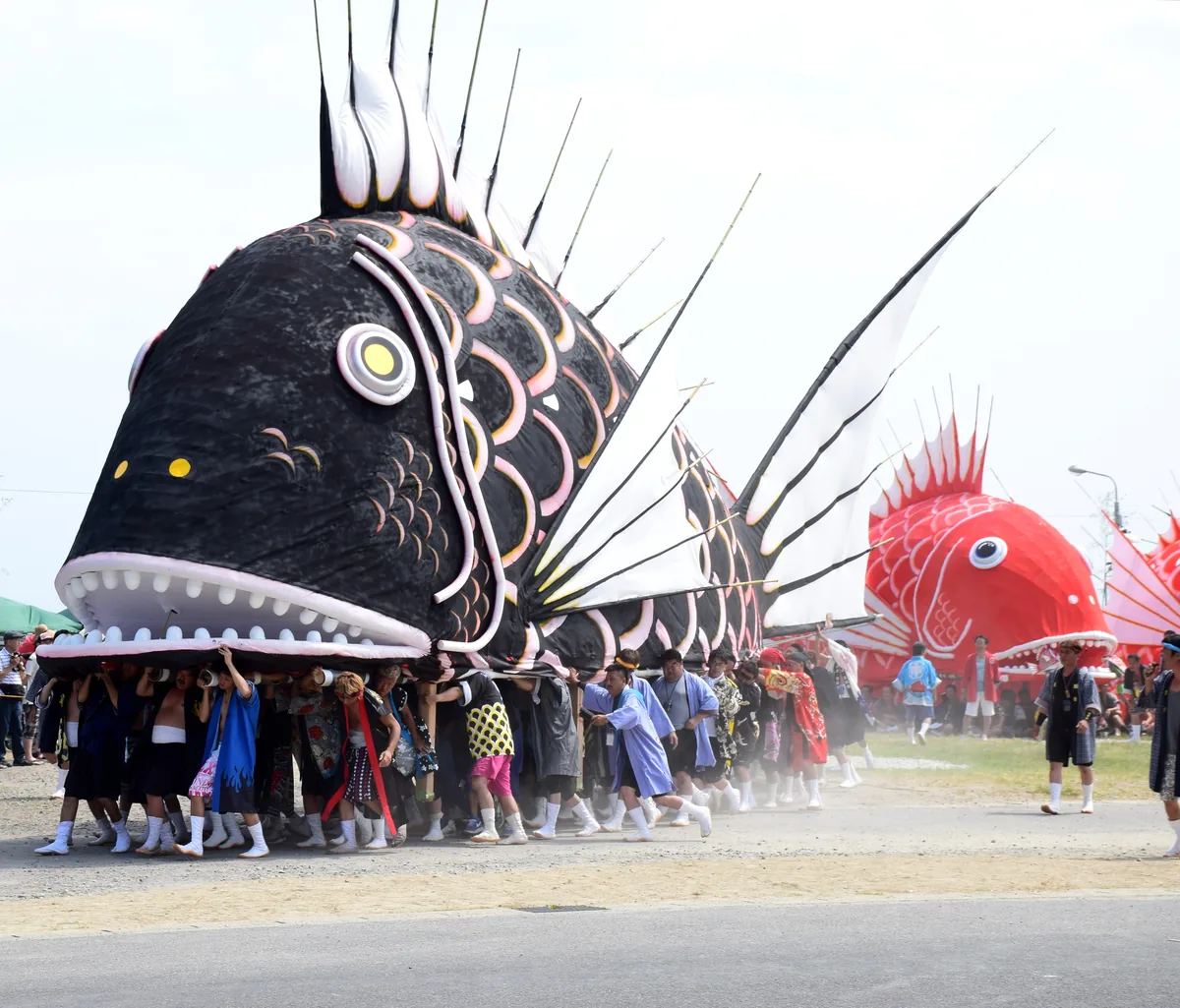
Toyohama Tai Matsuri (豊浜鯛まつり) is a fishing-town festival in Minamichita, Aichi, where sea bream up to 18 metres long and around a tonne in weight are carried through the streets. In 2026 it ran on 18 and 19 July across two districts. The 2027 dates have not been announced.
Two hours south of Nagoya, at the tip of the Chita Peninsula, a fishing town builds enormous fish out of bamboo, timber and white cotton and carries them through its own streets. The sea bream are 10 to 18 metres long. The heaviest weigh more than a tonne. About sixty people get underneath one. Everything below is confirmed from the tourism association, the town, the prefecture, the Cabinet Office and the railway themselves – including the part that most English-language pages get wrong.
Written by Yuu – a Nagoya native of 35 years. Published August 15, 2026.
This article may contain affiliate links. See our affiliate disclosure for details.
All festival details verified from official sources on August 15, 2026.
On this page
- What is Toyohama Tai Matsuri?
- When is Toyohama Tai Matsuri, and what happened in 2026?
- What are the highlights of Toyohama Tai Matsuri?
- How do you get to Toyohama from Nagoya?
- What do visitors say about the Tai Matsuri?
- Frequently asked questions
- Where can you check official information?
- Related festivals

What Is Toyohama Tai Matsuri?
Toyohama Tai Matsuri is a July festival in the Toyohama area of Minamichita, at the southern tip of Aichi’s Chita Peninsula. Districts build giant papier-mache sea bream 10 to 18 metres long, weighing about a tonne, and carry them through town to pray for a big catch and safety at sea.
| Item | Detail |
|---|---|
| Festival | Toyohama Tai Matsuri (豊浜鯛まつり / Toyohama Sea Bream Festival) |
| Where | Toyohama, Minamichita, Aichi (南知多町大字豊浜) – the Nakasu and Susa districts |
| Most recent edition | 18 July 2026 (Sat), Nakasu district / 19 July 2026 (Sun), Susa district |
| 2026 hours | Nakasu 10:00-approx. 15:00 / Susa 8:00-approx. 15:00 |
| 2027 dates | Not announced as of 15 August 2026 |
| The fish | 10-18 m long, bamboo and timber frame wrapped in white cotton, around 1 tonne |
| Carriers | About 60 young people per fish |
| Nearest stations | Meitetsu Utsumi (内海) or Kowa (河和), then the Umikko community bus |
| From Nagoya | Meitetsu Nagoya to Utsumi: ¥1,260, about 1 hr 12 min, one change at Fuki |
| Admission | No fee is published by the organisers |
| Enquiries | Minamichita Town Tourism Association, 0569-62-3100 |
| Official page | minamichita-kk.com |
A mouse that turned into a sea bream
The festival did not start with fish at all. According to Aichi Prefecture’s own tourism leaflet, the origin is 1885, when a local shipwright made a papier-mache hatsuka-nezumi – a house mouse – to liven up the festival at Nakasu-jinja shrine. Bonito, whales and prawns followed. It was only in the early Taisho era, in the 1910s, that the big sea bream took over.
A teaching page published by the Aichi Prefectural Board of Education tells the same story but dates it slightly later, to around 1887, and names the shipwright as Mori Sahei. Two official sources, two years apart – so treat the 1880s as the honest answer rather than a single date.
Why a sea bream? The Cabinet Office’s own magazine, Highlighting Japan, offers one explanation and is careful to call it a theory: this is a prayer for a big catch, and Ebisu, the god of fishermen, is always shown holding a sea bream. In the Showa era the fish grew a second function – musicians started riding inside the body, playing while the fish moved.
Locals do not usually call it a float. They call it a tai mikoshi (鯛みこし), a sea-bream palanquin, or by the older nickname omoitsuki (おもいつき).
Two festivals wearing one name
This is the detail that trips up almost every English write-up. “Toyohama Tai Matsuri” is not one event in one place. The Cabinet Office article spells it out: the festival is held in two locations – the Susa side (須佐), which is a collective name for four districts (Nakamura, Torii, Hangetsu and Tobu), and the Nakasu side (中洲), which runs its own.
On the Susa side the festival belongs to the local Tsushima-jinja shrine. Its opening day centres on welcoming the deity into an okariya (御仮屋) – a temporary hall built near the water to receive a god – with the district’s own portable shrine going to fetch it and the sea bream escorting it through the streets. The Nakasu side historically ran a single day, with a 14-metre fish paraded late into the night and floodlit after dark.
Counting all five districts together – Nakasu, Hangetsu, Nakamura, Torii and Tobu – a full-scale year produces five fish. The prefectural education board records the largest ever built at 19 metres long and 6 metres high.
Not a designated cultural property – and that matters
You will find English pages calling this an Important Intangible Folk Cultural Property. It is not. I checked Minamichita’s national, prefectural and town cultural-property lists individually: 4, 4 and 32 items respectively, and the Tai Matsuri is in none of them. The town’s own Regional Plan for the Preservation and Utilisation of Cultural Properties lists “Susa no Tai Matsuri” explicitly as an undesignated intangible folk cultural property. It is not a UNESCO listing either.
What the town does track is the costume. The plan notes that a large number of kimono worn by the taiko-uchi (太鼓打ち) – the child drummers who walk with the fish – survive from the Meiji era onwards, and values them for the dyeing techniques and the period designs on them. The Cabinet Office adds that the drummer’s role once went to children of prominent local families and is now decided by lottery, and that a single costume was once said to cost about as much as a house.
When Is Toyohama Tai Matsuri, and What Happened in 2026?
The most recent edition ran on Saturday 18 July 2026 in the Nakasu district, 10:00 to about 15:00, and Sunday 19 July 2026 in the Susa district, 8:00 to about 15:00. The 2027 dates had not been announced as of 15 August 2026.
The 2026 edition, day by day
| Date | District | Hours | Also on |
|---|---|---|---|
| Sat 18 July 2026 | Nakasu (中洲地区) | 10:00 – approx. 15:00 | 36th Toyohama Fireworks, from 19:40, Toyohama fishing port |
| Sun 19 July 2026 | Susa (須佐地区) | 8:00 – approx. 15:00 | – |
Both dates come from the Minamichita Town Tourism Association and from the official 2026 poster, and are matched by Aichi Prefecture’s tourism site, which now marks both as finished. No cancellation or postponement notice was issued for 2026.
The 2026 change you need to know about
The tourism association’s page for 2026 carries one line that changes the whole reason most travellers come:
“Owing to a shortage of hands and other reasons, there will be no uchikomi and no sea swimming.” (人手不足などにより「打ち込み」や「海中遊泳」はございません)
Kaichu yuei (海中遊泳) is the sea swimming – the sequence where the fish goes into the water, either towed behind a boat or hauled in by hand. Uchikomi (打ち込み) is the climax where the fish are driven at each other. Those two scenes are the images used on practically every poster, blog and travel page about this festival, and in 2026 the organisers stated in advance that neither would take place.
That is not a cancellation. The festival ran. But if you plan a 2027 trip around footage of a giant sea bream wading into the Pacific, check the current year’s official page before you book anything – because the last confirmed year did not include it.
How the festival has shrunk, and partly come back
| Year | What officially happened |
|---|---|
| 2020-2022 | Cancelled outright for three years because of COVID-19 (Cabinet Office) |
| 2023 | Scheduled for 23 July, but the government magazine reported the sea-bream parade would not be performed |
| 2024 | Sun 21 July. “Scaled down, one day only” (tourism association) |
| 2025 | Sun 27 July, 8:00-approx. 16:00. Scaled down, one day only. Three fish: Hangetsu, Nakamura, Tobu |
| 2026 | Two days across two districts – Nakasu on the Saturday, Susa on the Sunday. No uchikomi, no sea swimming |
Read that table as a recovery in progress rather than a full restoration. Two districts on two days in 2026 is more festival than 2025’s single day, but the organisers have not published how many fish took part in 2026, and their page still says “details will be added once confirmed”.
For scale: the association’s own visitor figure, published for years alongside this festival, is about 5,000 people in 2019 – the last full-size edition. No attendance figures have been published for the years since. By Japanese festival standards 5,000 is small, and that is exactly why this one is worth the trip: it is a working fishing town doing something enormous for itself, not a spectacle built for coaches.
What we can and cannot say about 2027
Nothing official exists yet. Aichi Prefecture’s leaflet describes the timing as “the Saturday and Sunday around 20 July”, and the prefectural education board describes it as “the late-July weekend with the lowest tide” – a rule that made sense when the fish went into the water. Neither is a schedule.
Recent years have not followed a clean pattern either: Sunday 21 July in 2024, Sunday 27 July in 2025, Saturday and Sunday 18-19 July in 2026. Districts, days and content have all moved. So I am not going to print a 2027 date here.
What I can tell you is when to look. The association’s page is the single slot where the year’s dates appear, and the archived copy of it from 22 July 2025 already carried the 2025 date and the “scaled down, one day only” note – so by the back half of July the information is certainly up. The fireworks poster, which is where the hour-by-hour detail actually lives, goes out around the same time. If you want this festival, book flexible accommodation and start watching the official page from mid-June rather than assuming a date.
What Are the Highlights of Toyohama Tai Matsuri?
The sea bream themselves are the event: one-tonne papier-mache fish shouldered by about 60 people at a time. Around them come the child drummers in heirloom costume, the dedication at the okariya on the Susa side, and, on the Saturday, a 3,500-shell fireworks display over the fishing port.
1. The fish, up close
A photograph does not prepare you for the scale. The frame is bamboo and timber, wrapped in white cotton and painted. At 10 to 18 metres, the biggest ones are longer than an articulated bus, and the weight – about a tonne, more for the heaviest – is carried on human shoulders. New fish are built for the festival, which is why the faces change from year to year; regulars come partly to see what each district has made.
They also do something no float on wheels can: they move like a fish. The line usually quoted for this comes from the tourism association, and it is worth knowing exactly what it describes. Until the 2026 rewrite the association’s page called the highlight of the festival a giant tai on the shoulders of about sixty young men, moving through the sea “waving its tail and stiffening its fins as though it were alive” (海中をさながら生きているかのように、尾をふり、ひれをピンと張って練り歩きます). That sentence is about the sea swimming, not the street parade – so read it as a description of the festival at full strength, and check the year’s programme before you expect to see it.
2. The taiko-uchi, the small people in the expensive clothes
Walking with each fish is a taiko-uchi (太鼓打ち), a child drummer in a full formal costume. The costumes are the closest thing this festival has to a museum: Minamichita’s cultural-property plan records that many survive from the Meiji era onwards and reads the era’s fashions off the patterns painted on them. Selection used to be a matter of family standing; it is now a lottery.
3. The okariya dedication on the Susa side
On the Susa side, where the festival belongs to Tsushima-jinja, the emotional peak is not on the water. It is the moment the fish are driven up to the okariya (御仮屋), the temporary hall built to receive the deity, with the district’s portable shrine at the centre and the tai forming an escort around it. If you only have a couple of hours, this is the part with the ritual weight.
4. The sea swimming – when it happens
In a normal year this is the headline. The Cabinet Office’s account describes the Susa side’s four floats being towed by boat around Toyohama fishing port from 7:00 on the second day, and the Nakasu fish going into the water under human power for about an hour, floodlit into the night.
Say it once more, clearly: the sea swimming did not take place in 2026, and the organisers said so in advance. Everything above describes how the festival works when there are enough hands to do it. Whether it returns in 2027 is not something anyone can promise you today.
5. The fireworks over the fishing port
The 36th Toyohama Fireworks ran on Saturday 18 July 2026 from 19:40 at Toyohama fishing port, sponsored under the names of the YouTubers Kimagure Cook and Mushimegane of Tokai OnAir together with the seafood brand Uo Ichiban, and organised by the Toyohama tourism association. Aichi Prefecture’s listing gives 3,500 shells including ten-inch shells and calls the roughly 300-metre spread among the largest on the Chita Peninsula; the finale is a music-synchronised starmine. Light rain goes ahead, heavy rain postpones – 25 July was set as the 2026 rain date.
The 2026 poster mentions something worth remembering: there are spots where you can get a sea bream and the fireworks in the same frame.
6. The fish market next door
Toyohama Sakana Hiroba (豊浜魚ひろば) sits at the port a few minutes from the fireworks site: a covered market of fishmongers, dried-fish stalls, prawn-cracker shops and two canteens. It is open 8:30-17:00 at weekends and public holidays, 9:00-16:00 on weekdays, and closed on Tuesdays unless the Tuesday is a public holiday. In 2025 the three sea bream converged on the market itself at about 11:30 for an iwaikomi (祝い込み) celebration – not an announced fixture every year, but a sign of how tightly this festival is stitched into the working port.
How Do You Get to Toyohama from Nagoya?
Take a Meitetsu train down the Chita Peninsula to Utsumi or Kowa, then change to the Umikko community bus. Meitetsu Nagoya to Utsumi is ¥1,260 and about 1 hour 12 minutes with one change at Fuki. The bus is a flat ¥400 per ride.
The rail leg
| Route | Adult / child | Time | Changes |
|---|---|---|---|
| Meitetsu Nagoya → Utsumi (内海) | ¥1,260 / ¥630 | approx. 1 hr 12 min | 1, at Fuki (富貴) |
| Meitetsu Nagoya → Kowa (河和) | ¥1,050 / ¥530 | 51-55 min | 0 (direct) |
Both figures come from Meitetsu’s own fare and route search, run on 15 August 2026. The Utsumi route uses a limited express down the Nagoya Main Line, Tokoname Line and Kowa Line to Fuki, then a local on the Chita New Line. Those limited expresses are “partly reserved” trains: the total quoted equals the ordinary fare, so if you sit in an unreserved car you do not need a Mu-ticket.
The bus leg
Toyohama has no station. The last few kilometres are on the Umikko Bus (海っ子バス), Minamichita’s community service. Since October 2023 it charges a flat ¥400 per ride – primary-school children half, preschoolers free – with a ¥600 one-day pass. The town publishes the drill: board through the rear door, press the stop button, put the fare in the box beside the driver, and get off at the front. Carry coins for that box; day passes and multi-ride tickets can also be bought in advance as smartphone e-tickets.
Which stop you want depends on which district is running that day:
| For | Bus stop | From Utsumi Station (anticlockwise loop) |
|---|---|---|
| Nakasu district festival | Nakasu (中須) | approx. 14 min |
| Susa district festival | Toyohama (豊浜) | approx. 25 min |
| Fireworks / fish market | Toyohama-ko – Sakana Hiroba (豊浜港・魚ひろば) | 3 min walk from the stop |
Two practical warnings. First, the loop runs in both directions and they are not interchangeable: from Utsumi Station you want the anticlockwise (左回り) service, which runs Morozaki – Oi – Kowa – Utsumi – Toyohama – Morozaki. Get on the clockwise one and you will tour the whole peninsula the wrong way round.
Second, and this one matters for a 2027 trip: Minamichita is rebuilding the bus network from 1 October 2026, altering the loop route and adding a new Toyohama Line between Morozaki port and Kowa Station. The times above are taken from that new timetable, which is already published and is the one that will apply in 2027 – but check the town’s timetable page before you travel rather than trusting a cached PDF.
A ticket that may or may not come back
For 2026 Meitetsu is selling a Minami-Chita Kaisen DON ticket – ¥4,800 adult, ¥3,800 child, on sale 11 April to 31 October 2026 – bundling a seafood-bowl voucher for nine restaurants, a one-day Umikko bus pass and a ¥500 coupon usable at 27 shops. Note what it does not include: the train fare. Whether a 2027 version appears is not yet published, and the current one stops selling well before next July.
Driving, and why the organisers would rather you didn’t
By car it is about five minutes from the Toyooka interchange (豊丘IC) on the Minami-Chita Road. But the organisers’ line on the 2026 fireworks poster was blunt: parking exists, congestion is expected, please use public transport. No capacity figures or locations were published for the 2026 festival at all. In 2025 the association opened part of the reclaimed land at Toyohama fishing port, near the public toilets, as free parking – that was a 2025 arrangement, and I would not assume it repeats.
One genuinely useful 2026 measure, in case it returns: a free bus left the Eiwado confectionery car park at 20:45 on the fireworks night for Meitetsu Kowa Station.
What to bring
This is a summer festival on a fishing port with almost no shade and a long bus ride at either end. Bring water, a hat and sunscreen; carry cash, because the bus fare box does not take cards and small coastal shops often don’t either; and give yourself far more buffer than the timetable suggests, since the community bus is not frequent and road closures move it around. If you are building a wider Chita Peninsula day out, our day trips from Nagoya guide covers the alternatives, and getting around Nagoya explains the Meitetsu network in general.
Ready to book a day trip?
Handy if you want to pair this with other sights the same day.
What Do Visitors Say About the Tai Matsuri?
The consistent theme in what people post is scale and noise – the shock of how big the fish are in person, and how physical the carrying is. The other recurring note in recent years is disappointment when the sea-swimming sequence is not on the programme.
I want to be straight with you about two things here. First, I have not carried a sea bream through Toyohama, and I am not going to write as though I have. Second, I am not going to reprint other people’s posts as if they were mine. What follows is where to look for the genuine article.
The organisers’ own channels. The Toyohama tourism association runs an Instagram account, @toyohama.kk, listed on the official 2026 poster alongside their LINE page. This is the account that carries festival-day updates and photographs from the people running it. If you embed or follow one thing, make it this.
The town’s own film. Minamichita Town’s website hosts a documentary video titled “Minamichita Toyohama: the Strange Festival, Tai Matsuri”, introduced as a record following the festival from preparation through to the day itself. It sits ninth in a series of fourteen town films on the history and culture video page. Because the filming year is not stated, treat what you see in it as how the festival can look rather than how it will look on your visit.
The Cabinet Office feature. Highlighting Japan’s May 2023 piece, written by Morohashi Kumiko with photographs supplied by the Minamichita Town Tourism Association, is the single best written account in either language, and the only one I found that explains the two-district structure properly.
Frequently Asked Questions
When is Toyohama Tai Matsuri 2027?
Not announced as of 15 August 2026. Aichi Prefecture describes the usual timing as the weekend around 20 July, but recent editions have fallen on 21 July 2024, 27 July 2025 and 18-19 July 2026. Watch the tourism association’s page from mid-June.
Do the sea bream really go into the sea?
In a full year, yes – towed by boat on the Susa side and hauled in by hand at Nakasu. But for 2026 the organisers announced in advance that there would be no sea swimming and no uchikomi clash, citing a shortage of hands. Confirm for the year you are visiting.
Is there an admission charge?
The organisers publish no fee, and neither the tourism association nor Aichi Prefecture lists one. The festival takes place on public roads and around the fishing port. I would not describe it as officially free, only as having no published charge.
How big are the sea bream, and how many are there?
Ten to eighteen metres long and about a tonne, on a bamboo and timber frame wrapped in white cotton. Five districts build one each in a full year; the prefectural education board records a maximum of 19 metres long and 6 metres high. In 2025 only three took part.
Can I get there and back from Nagoya in a day?
Yes. Meitetsu Nagoya to Utsumi is about 1 hour 12 minutes for ¥1,260, plus roughly 14 to 25 minutes on the Umikko bus. Allow generous buffers: the community bus is infrequent and festival road closures alter its route and stops.
What happens if it rains?
The fireworks have a published policy – light rain goes ahead, heavy rain postpones, with a set rain date. For the festival itself no wet-weather policy is published anywhere official, so ring the Minamichita Town Tourism Association on 0569-62-3100 rather than assuming.
Is Toyohama Tai Matsuri a designated cultural property?
No. It is not a national, prefectural or town-designated cultural property, and it is not a UNESCO listing. Minamichita’s own cultural-property plan records “Susa no Tai Matsuri” as an undesignated intangible folk cultural property, alongside the drummers’ kimono as undesignated tangible items.
Where Can You Check Official Information?
This festival changes shape from year to year more than almost any other in Aichi, so check before you commit. In priority order:
- Minamichita Town Tourism Association – Toyohama Tai Matsuri (Japanese). The primary source for dates, districts and any change to the programme. Enquiries 0569-62-3100, office open 9:00-17:00, closed Mondays.
- Toyohama Tourism Association on Instagram (@toyohama.kk). Day-of updates from the people running the fireworks and the Toyohama-side events; their LINE page handles enquiries and a car-parking FAQ.
- Aichi Now – Toyohama Tai Matsuri (Japanese). The prefecture’s listing, with the basic access summary.
- Minamichita Town – Umikko Bus fares and the timetable revised 1 October 2026. The only reliable source for the last leg of the journey.
- Cabinet Office, Highlighting Japan (May 2023). Background on the two-district structure, the okariya rite and the drummers.
Related Festivals
If you are building a summer around Aichi’s water festivals, these pair naturally with Toyohama:
- Owari Tsushima Tenno Festival – the other great July water festival in Aichi, with lantern boats on the river rather than sea bream in the surf.
- Kamezaki Shiohi Festival – the Chita Peninsula’s other festival that depends on the sea, with five UNESCO-listed floats hauled onto the low-tide beach at Handa every 3 and 4 May. Note the contrast: Kamezaki is a designated and UNESCO-inscribed festival, Toyohama is not.
- Kariya Mando Festival – the other Aichi July festival built on giant painted paper on a bamboo frame, except each five-metre warrior is lit from inside and carried by one man on his own. It is a prefecture-designated intangible folk cultural property, which is exactly the status Toyohama does not hold.
- Nagoya Minato Festival and fireworks – the city’s own port festival in the same month, and a much easier trip if you are short on time.
- Nagoya summer festivals – the full season, laid out month by month.
- Atsuta Festival – June, inside the city, and the most accessible major shrine festival in Nagoya.
- Central Japan festival calendar – the hub page for every festival we cover across Aichi, Gifu and Mie.