The fireworks at Umi no Hi Nagoya Minato Matsuri (海の日名古屋みなと祭) were cancelled in 2026. The organisers scrapped every event that uses Nagoya Port Garden Pier because the Asian Games took the site. The festival still ran on July 20 as floats and dancing on a closed road. The organisers have not yet said whether the fireworks return in 2027.
If you found this page because an English travel listing promised you fireworks over Nagoya Port on Marine Day, stop planning around it. The 80th festival went ahead on July 20, 2026, but the organisers had announced back in May that the fireworks, the parades and everything else staged on Garden Pier were off. Below: what was decided, what was left, what the night looks like in a normal year, and when to check for the next one.
Written by Yuu — a Nagoya native of 35 years. Published August 15, 2026.
This article may contain affiliate links. See our affiliate disclosure for details.
All festival details verified from official sources on August 15, 2026.
On this page
What Do You Need to Know in One Minute?
The 80th Umi no Hi Nagoya Minato Matsuri ran on Monday, July 20, 2026, but with no fireworks and no parade. Only the neighbourhood float procession and the mass dance took place, moved onto a closed section of Egawa-sen avenue beside Nagoya Port Station.
| Item | Detail |
|---|---|
| Festival | Umi no Hi Nagoya Minato Matsuri (海の日名古屋みなと祭 / Marine Day Nagoya Port Festival), 80th edition |
| 2026 date | Monday, July 20, 2026 (Marine Day, a national holiday) |
| Fireworks in 2026 | Cancelled. So were the parades and every event using Garden Pier |
| What did run | Floats 16:50–21:30 (Tsukiji Shrine → Garden Pier crossing); mass dance 18:20–20:00 |
| Reason | The 20th Asian Games and 5th Asian Para Games — viewing space and event space could not be secured |
| Normal venue | Nagoya Port Garden Pier (名古屋港ガーデンふ頭), Minato-ku, Nagoya |
| Nearest station | Nagoya Port Station (名古屋港駅), Subway Meiko Line — terminus |
| Next edition | 81st, 2027. Not announced as of August 15, 2026. Marine Day 2027 falls on July 19 |
| Paid seating | None advertised by the organisers in any year |
| Organiser | Umi no Hi Nagoya Minato Matsuri Kyosankai (海の日名古屋みなと祭協賛会), 052-654-7894 |
| Official site | nagoya-port-festival.com |
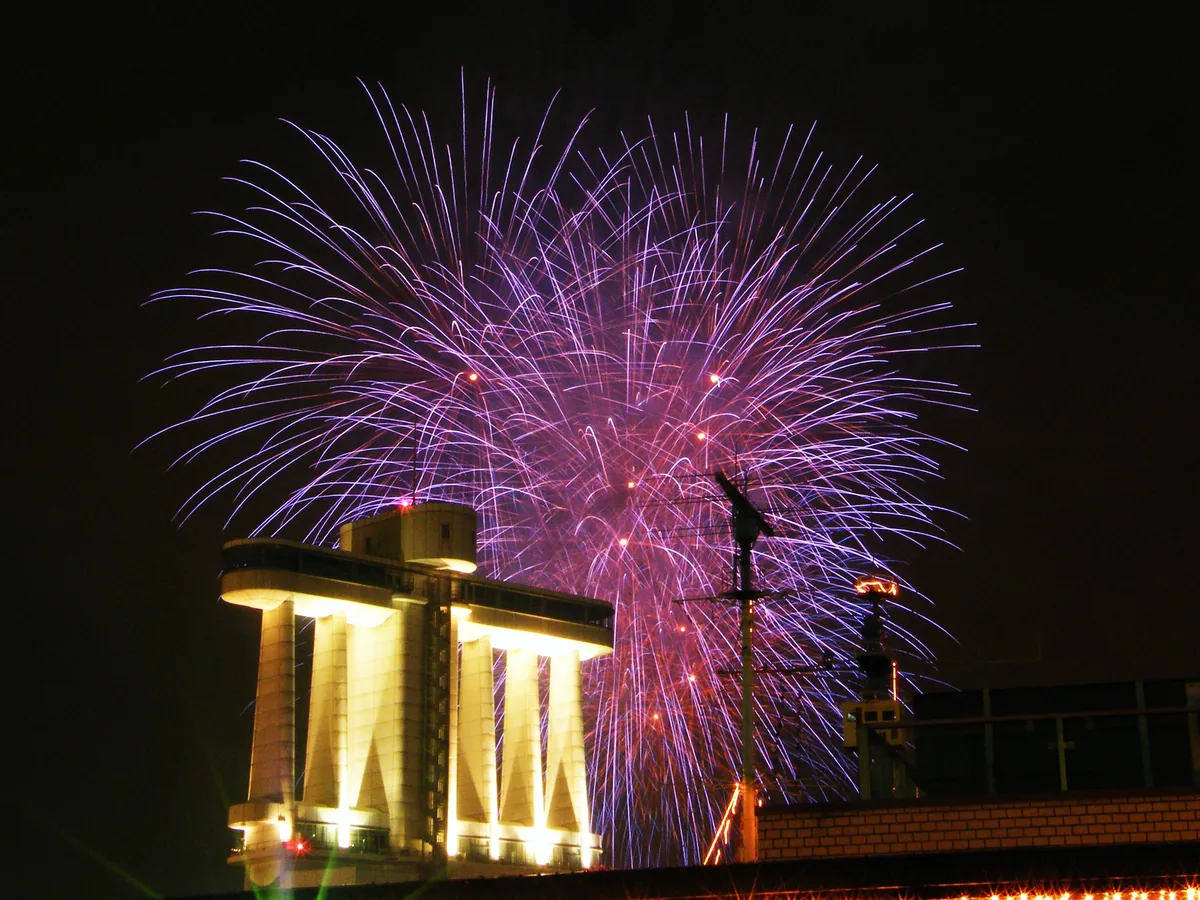
.jpg)
What Is Nagoya Minato Matsuri?
Nagoya Minato Matsuri is the city’s port festival, started in 1946 as a wish for the recovery of a Nagoya that the war had burned flat. It is held every July on Marine Day, and in a full year it ends with fireworks over the water at Garden Pier.
The City of Nagoya’s own page on the festival puts the founding plainly: it began in Showa 21 — 1946 — “wishing for the recovery of Nagoya, which had become a burnt plain” after the war. That timing explains the character of it. This is not a shrine rite carried down from the Edo period like the pottery festival up in Seto; it is a civic celebration built by a bombed-out port city to prove to itself that it was still standing.
The city describes the classic form of it as a grand parade “up to two kilometres long,” with children’s portable shrines, children’s lion dancers, kagura troupes and marching bands, “numbering as many as 1,600 people.” In the evening, it says, eight floats come out from around Minato Ward onto Garden Pier and the whole town turns out for a folk-dance contest.
One honest caveat about that description, and it is the sort of thing that trips up English guides: the city’s page was last updated on October 16, 2025. It still lists the ikada no ippon-nori (筏の一本乗り), the raftsmen’s single-log riding contest that the city has designated an intangible folk cultural property. That event does not appear in the organisers’ official programme for the 79th festival in 2025, and it does not appear for 2026 either. It shows up in the official photo gallery from the 77th edition. So treat it as part of the festival’s heritage, not as something you can turn up and watch this year.
The parts that have been on the official programme in recent years are more modest and more local: a marching band, a massed kagura (神楽) sacred-music performance, taiko drumming, a jazz concert at the Port House, uniformed parades by sea-scout and unicycle groups, the neighbourhood dashi (山車) floats coming down from Tsukiji Shrine, the so-odori (総おどり) mass dance — and then, as the closing act, the fireworks.
The festival counts editions rather than years, and the count does not line up with the calendar: 2024 was the 78th, 2025 the 79th, and 2026 the 80th — eighty editions counted from a first festival in 1946. So read “80th” as an edition number, not as eighty unbroken summers.
Were There Fireworks in 2026?
No. On May 18, 2026, the organising association met and decided to cancel the fireworks display, the parades, and every event that uses Garden Pier. The festival still ran on July 20 in reduced form, and the official site now simply reports that the 80th edition “finished without incident.”
The decision is on the record in the association’s own press release, headed “On holding the 80th Umi no Hi Nagoya Minato Matsuri (to be held 7/20) — this year’s fireworks display is cancelled.” The operative sentence, in the organisers’ words:
本年は、第20回アジア競技大会及び第5回アジアパラ競技大会開催のため、観覧場所及び実施場所の確保が困難であることから、安全を第一に考え「花火大会・パレード等、ガーデンふ頭を使用する行事」を中止といたします。
(“This year, because of the 20th Asian Games and the 5th Asian Para Games, it is difficult to secure viewing space and event space. Putting safety first, we are cancelling the fireworks display, the parades and other events that use Garden Pier.”)
The same release confirms what replaced it: the floats and the mass dance, “which have traditionally been held,” were moved off the pier and onto the Egawa-sen avenue between the Minatobashi crossing and the Garden Pier crossing — a strip of ordinary city road just east of Nagoya Port Station.
The full 2026 programme
| Event | Date and time | Place |
|---|---|---|
| Minato Ward women’s performing arts show | Thu July 16, 13:00–15:00 | Minato Bunka Shogekijo theatre |
| Dashi floats | Mon July 20, 16:50–21:30 | Tsukiji Shrine → Garden Pier crossing |
| So-odori mass dance | Mon July 20, 18:20–20:00 | Special area north of the Garden Pier crossing |
That is the entire official listing — three items. The organisers describe the floats as “a parade of floats belonging to the local neighbourhood associations” and the dance as “a mass dance by local residents.” Road closures ran from 17:00 to 21:30, four and a half hours rather than the seven and a half hours of closures a fireworks year requires.
Two details from the 2026 traffic notice hold true whatever the programme: there is no car park anywhere near the site and parking is prohibited across the whole surrounding area. In 2026 the organisers also stated that no road-access permits (通行証) would be issued — the passes that in other years let a limited number of vehicles through the closure. Nothing about them affects visitors arriving by train.
As of August 15, 2026, no attendance figure and no other result has been published for the 80th edition. If you see a visitor number for 2026 quoted anywhere, it is not coming from the organisers.
Why Were the Fireworks Cancelled?
Because the launch site and the viewing ground sit inside the footprint of the Games. Nagoya Port is being used by the Aichi-Nagoya 2026 Asian Games and Asian Para Games for accommodation and competition, and part of Garden Pier has been closed to the public since January.
The Nagoya Port Authority states it directly: for the Aichi-Nagoya 2026 Games in September and October 2026, facilities inside Nagoya Port “will be used as accommodation bases and competition venues.” Since January 13, 2026, part of the Garden Pier waterfront park has been closed to the public — a restriction the Garden Pier operators say is scheduled to run until January 1, 2027, with the restricted area subject to change along the way.
Put those two facts together and the cancellation stops looking like a decision and starts looking like arithmetic. The fireworks go up over the water at Garden Pier; the crowd stands on the pier’s plazas and quaysides, and the 2025 official site map marked fireworks viewing areas right across it. In 2026 that same ground was committed to the Games.
If the Games themselves are what brought you to central Japan, we have a separate guide to the 2026 Asian Games in Nagoya covering dates, venues and how the city is likely to behave around them.
When Are the Next Nagoya Port Fireworks?
The 81st festival has not been announced. As of August 15, 2026 the organisers have published nothing about 2027 — no date, and no statement on whether the fireworks return. Marine Day 2027 falls on Monday, July 19, and the programme is normally settled at a general meeting in the second half of May.
Here is what can be said without guessing.
The date it would fall on. Marine Day is fixed by law as the third Monday of July, and the Cabinet Office’s official holiday list gives 2027/7/19 for 海の日. So if the 81st edition follows the 78th, 79th and 80th, July 19, 2027 is the day to hold. That is a statement about the holiday calendar, not about the festival.
When you will actually know. The organisers run to a fairly consistent annual rhythm, visible in their own site update log:
| Roughly when | What appears |
|---|---|
| April 1 | Memorial fireworks sponsorship opens to the public |
| Mid-May | Sponsorship applications close |
| Mid-to-late May | General meeting decides the programme; the event listing goes up |
| Late June | Fireworks programme, site map, access page and traffic-control map are published |
In 2025 those steps landed on April 1, May 16, May 23 and June 24. In 2026 the meeting was May 18 and the maps went up June 22. So the honest answer to “will there be fireworks in 2027?” is: check the official site in the last week of May 2027. That is when the question gets answered, every year.
One piece of context that is suggestive but not a promise: the Garden Pier park restriction is currently scheduled to end on January 1, 2027, which would clear the site well before a July festival. The organisers have not linked the two, and neither will I.
What Is the Fireworks Night Like in a Normal Year?
In a full year the fireworks close the evening. In 2025 they ran forty minutes from 19:30, launched over the water at Garden Pier, at the end of an afternoon of stage events, parades and floats. The organisers have never advertised ticketed or reserved seating — the whole waterfront is the viewing gallery, and it fills up.
The best single record of the normal shape of this festival is the official programme for the 79th edition, held on Monday, July 21, 2025.
| Time | Event (2025, 79th edition) | Place |
|---|---|---|
| 14:30–15:00 | Marching band | Garden Pier Tsudoi-no-Hiroba plaza |
| 15:30–16:00 | Kagura-zoroe — massed sacred music | Same plaza |
| 15:30–16:30 | Parades: sea scouts, unicyclists, marching bands | Nishi-Tsukiji Elementary → Garden Pier |
| 16:00–16:40 | Taiko drumming and performing arts | Garden Pier plaza |
| 16:30–20:00 | Dashi floats | Tsukiji Shrine → Garden Pier |
| 16:45–17:30 | Jazz concert | Garden Pier Port House |
| 17:45–19:00 | So-odori mass dance | Garden Pier plaza |
| 19:30–20:10 | Fireworks | Across Garden Pier |
What actually goes up
The organisers describe the display as “memorial fireworks, star-mines and so on.” The published 2025 running order gives a clearer picture than any adjective: it opened at 19:30 with a star-mine and a five-go memorial shell, worked through eight numbered star-mines and repeated rounds of rapid-fire shells, made room for an “Illust HANABI” segment at 19:44 and an “Art of Hanabi” segment at 19:57, ran a burst of large 6-, 8- and 10-go shells at 20:04, and closed at 20:07 with the Minato Matsuri Finale Dai Star-mine.
No shell count and no attendance figure has ever been published by the organisers. English and Japanese listing sites quote round numbers for both. Those numbers are not sourced to the organisers, the port authority or the city, so you will not find them here.
Memorial fireworks — the part that is genuinely unusual
Part of this display is bought shell by shell, by companies and by ordinary people. The memorial hanabi (メモリアル花火) scheme lets anyone pay for a specific shell and attach a message of up to twenty characters, which is printed in the programme and, for the larger sizes, read aloud over the site as the shell goes up.
| Shell | Price per shell | What you get |
|---|---|---|
| Finale grand star-mine | ¥5,000 | Message printed in the programme and on site boards (not announced aloud) |
| Memorial shell, 5-go | ¥10,000 | Above, plus announced during the launch |
| Memorial shell, 8-go | ¥30,000 | Above, plus announced before the launch |
| Memorial shell, 10-go (one-shaku) | ¥50,000 | Above, the largest shell available to the public |
Read the 2025 programme and you can see exactly what was bought. A couple marking twenty years of marriage — “twenty years married! Thanks to the fireworks, a toast to the fireworks.” Someone at seventeen years, thanking their partner for standing beside them. Parents telling a boy now in his third school year to keep at his studies and his sport. A shell sent up to “an angel in the sky.” And, near the end, three shells signed the same way — “a man who loved this port” — thanking the port’s people, wishing them well, and saying simply: “67 years, thank you.”
Between those messages sit the corporate slots: Toyota bought star-mine number two, Toho Gas number six, and the local television stations took others. That mixture is the display. It is not only a show staged at an audience — it is a page of messages, private and commercial side by side, fired one at a time in front of the whole city.
The scheme’s own terms also contain the only official statement I could find about bad weather: sponsorship money is not refunded even if the fireworks are cancelled due to severe weather. Note the wording — cancelled, not postponed. The organisers do not publish a rain date.
How Do You Get to Nagoya Port, and How Do You Get Home?
Take the subway Meiko Line to Nagoya Port Station, the last stop. From Nagoya Station change at Sakae; from a JR or Meitetsu train change at Kanayama. There is no parking at the site in any year, and on festival night the station exits themselves are put under one-way control.
The route, in the organisers’ own words
The official access page lists exactly three ways in:
- By subway from Nagoya Station: Higashiyama Line to Sakae, change to a Meijo Line / Meiko Line train bound for Nagoya-ko (名古屋港), ride to the end.
- From a JR or Meitetsu train: get off at Kanayama, change to the Meiko Line bound for Nagoya-ko.
- By Aonami Line: get off at Inaei, walk about 20 minutes east, then about 10 minutes south.
The Meiko Line is short and a dead end, so it is hard to get wrong once you are on it. The Nagoya Port Public Aquarium on the same pier puts the last leg at “five minutes on foot from Exit 3” — that is how close the festival ground is to the ticket gates, and why the crowd and the station become the same problem after dark.
A note from a Nagoya local: the Meiko Line is the branch that peels off the Meijo Line loop at Kanayama and runs south to the water. Trains on the platform are signed for both, so the thing to look for is the destination 名古屋港 (Nagoya-ko), not the line name. Get on a Meijo Line loop train by mistake and you will do a slow circuit of the city centre and end up back where you started.
Tickets and passes
Nagoya’s subway fares are distance-based, and the Transportation Bureau does not publish a static station-to-station fare table — its fare page is a search form only. So rather than quote a number I cannot source, here are the day passes, which it does publish and which are the better buy on a festival day anyway:
| Pass | Adult | Child | Notes |
|---|---|---|---|
| Donichi Eco Kippu (ドニチエコきっぷ) | ¥620 | ¥310 | Weekends, public holidays and the 8th of each month only |
| Bus & subway one-day ticket | ¥870 | ¥430 | Any day |
| Subway 24-hour ticket | ¥760 | ¥380 | 24 hours from first use, subway only |
Marine Day is a national holiday, so the ¥620 Donichi Eco Kippu is valid — the Transportation Bureau’s own English guide calls it the “Weekend Eco Ticket.” One catch to remember: these passes cover city buses and the subway only. They are not valid on the Aonami Line or on Meitetsu, so if you take the Aonami Line option you are paying separately for it.
If Nagoya’s transport network is new to you, our guide to getting around Nagoya covers IC cards, ticket machines and which line does what.
Ready to book a day trip?
Handy if you want to pair this with other sights the same day.
Claiming a spot, and the rule most guides do not mention
On a fireworks year the organisers publish a list of requests, and one of them is unusually specific: unattended place-holding on the roads or inside the site — leaving a mat down, taping off ground — is refused. That is a direct instruction, not a suggestion. Plan on turning up and standing where you can, rather than the Japanese festival ritual of laying a sheet out at noon.
The rest of the official request list is worth reading in full before a fireworks year, because it is unusually candid about what the crowd is like:
- The site gets extremely crowded — if you have small children, do not let go of their hand.
- There is no public-address paging on site. Agree a meeting point before you separate.
- Drones are firmly refused anywhere in or around the festival site.
- Restricted zones are set up on the roads to keep the float procession safe.
- Depending on the wind, burnt fireworks debris can fall on the crowd. The organisers suggest a hat and eye protection, and direct anyone injured or burned to the wharf clinic on site.
- Drink water constantly — heatstroke is the stated risk.
The organisers also warn on their site that they may restrict entry onto Garden Pier itself if safety requires it, and ask people to allow extra time.
Getting home — read this part twice
The single most useful thing on the 2025 official leaflet is the station exit plan, because it tells you that the crowd is big enough to need one-way traffic at the gates. In 2025 the arrangement was:
- Nagoya Port Station: Exits 1 and 2 became entry-only from 19:45; Exit 3 became exit-only from 18:00.
- Tsukijiguchi Station: Exits 1 and 4 were sealed from 19:45; Exit 2 became entry-only and Exit 3 exit-only from the same time.
Two readings of that. First, Tsukijiguchi is the pressure valve — the next station up the same line, a walk back from the pier, and heading there instead of queuing at the terminus is the standard local move at any dead-end-station event. Second, the 2025 road closure ran until 22:00, an hour and fifty minutes after the last shell, which tells you how long the area was expected to take to empty.
A note from a Nagoya local on July weather: Marine Day here is not the gentle start of summer. Mid-July afternoons in Nagoya sit in the thirties Celsius with humidity to match, and the port has no shade at all — it is concrete, water and open sky. If you are building a plan around a 19:30 start, do not spend the whole afternoon on the pier waiting for it. Our guide to when to visit Nagoya goes into what each month actually feels like.
Exit arrangements and closure times are re-announced every year on the official leaflet. Do not carry the 2025 numbers into a future festival — check the current year’s map, which goes up in late June.
What Is Open at Garden Pier Right Now?
Less than usual. Because of Games preparations, the Nagoya Port Building — including the Maritime Museum and the observation deck — plus the Antarctic research vessel Fuji and the Port House are all closed from August 1 to November 30, 2026. The aquarium and the waterfront itself remain the reason to come.
If you are visiting the port in the second half of 2026, this is the part to plan around. The Garden Pier operators have confirmed the closure of “Nagoya Port Building (the whole building, including the Nagoya Maritime Museum and observation deck), the Antarctic research vessel Fuji, and the Port House” for that four-month window, citing preparation for the Aichi-Nagoya 2026 Games. Part of the waterfront park has been off limits since January 13, 2026 and is scheduled to stay that way until January 1, 2027. Car parking around the pier has also been rearranged from April 1 to December 31, 2026, with an equivalent number of replacement spaces secured.
What that leaves is still a good half-day: the Nagoya Port Public Aquarium, which is the biggest draw on the pier by a distance and which we cover in our Port of Nagoya Public Aquarium guide, plus the Sea Train Land amusement park with its Ferris wheel, and the JETTY shopping and dining complex. LEGOLAND Japan is further out along the same waterfront on Kinjo Pier — a separate trip rather than a walk, reached on the Aonami Line from Nagoya Station, if you are assembling a full day out of the port.
What Do Visitors Say About This Festival?
I have not been to this one, so rather than invent an evening, here is what the organisers say about the crowd — more revealing than a review — and where to see the port for yourself.
The clearest signal is in the official language, not in visitor reviews. On a fireworks year the organisers open their own homepage with a warning that “considerable crowding is expected on the day” and ask people to allow extra time; they add that they “may restrict entry into Garden Pier to ensure safety.” They print a rule forbidding unattended place-holding. They state that there is no paging system. Events do not publish those three things together unless the site is genuinely, uncomfortably full.
For the port between festivals, these are the official channels worth following:
- Nagoya Port Building official Instagram — @nagoyaportbuilding, run by the Nagoya Port Promotion Foundation, posting events and views of Garden Pier
- Garden Pier official site — nagoyaaqua.jp/garden-pier, where the closure notices above are posted first
- The festival’s own photo gallery — the organisers keep an archive of past editions covering the raft-riding contest, the marching bands, the kagura, the floats, the mass dance and the fireworks
One caution about researching this festival in English: the cancellation was announced in Japanese in mid-May 2026, and many aggregator listings still describe the 2026 fireworks as going ahead. They are describing 2025.
Frequently Asked Questions
Were there fireworks at Nagoya Minato Matsuri in 2026?
No. On May 18, 2026 the organising association cancelled the fireworks display, the parades and every event using Garden Pier, because the Asian Games and Asian Para Games made it impossible to secure viewing and event space. The festival itself still ran on July 20 with floats and a mass dance.
What did actually happen on July 20, 2026?
Two things. Neighbourhood floats processed from Tsukiji Shrine to the Garden Pier crossing between 16:50 and 21:30, and local residents performed the so-odori mass dance from 18:20 to 20:00 in a special area north of that crossing. Both were moved onto Egawa-sen avenue instead of the pier. A ward performing-arts show was also held on July 16.
Will the fireworks come back in 2027?
Unknown as of August 15, 2026. The organisers have published nothing about the 81st edition. They normally decide the programme at a general meeting in the second half of May and post it immediately afterwards, so late May 2027 is when to check. Marine Day 2027 falls on Monday, July 19.
Where are the fireworks launched, and where do you watch from?
In a normal year they are fired over the water at Nagoya Port Garden Pier, and the viewing areas are the pier’s plazas and quaysides. The organisers have never advertised ticketed, reserved or paid viewing in any year, and their site map marks free viewing areas only. They do say they may restrict entry onto the pier if safety requires it.
How do I get to Nagoya Port from Nagoya Station?
Take the Higashiyama subway line to Sakae, change to a Meijo Line or Meiko Line train bound for Nagoya-ko, and ride to Nagoya Port Station, the terminus. From a JR or Meitetsu train, change at Kanayama instead. On a holiday the ¥620 Donichi Eco Kippu day pass covers the whole trip on city subways and buses.
Is there parking at the festival?
No. The organisers state that there is no car park or bicycle park anywhere near the site, that parking is prohibited across the whole surrounding area, and that street parking must never be attempted because it obstructs residents and emergency vehicles. Roads around the site are closed for several hours on the day.
What if it rains on the fireworks?
The organisers publish no rain date. The only official statement on weather is in the terms of the memorial fireworks sponsorship scheme, which say that sponsorship money is not refunded even if the display is cancelled due to severe weather. Read that as cancellation rather than postponement, and check the official site on the day.
Where Can You Check Official Information?
These are the channels carrying this festival; only the first two are authoritative on the programme. Everything above comes from them, checked on August 15, 2026.
- Umi no Hi Nagoya Minato Matsuri official site: nagoya-port-festival.com — programme, site map, access and traffic-control map, published fresh each year from late May
- Umi no Hi Nagoya Minato Matsuri Kyosankai (organising association, inside the Nagoya Port Authority): 052-654-7894,
info@nagoya-port-festival.com - Nagoya Port Authority: port-of-nagoya.jp — the standing page on Games-related restrictions inside the port
- City of Nagoya: the city’s festival overview — good on history, but note it was last updated in October 2025 and does not reflect the 2026 cancellation
- Garden Pier: nagoyaaqua.jp/garden-pier — current closures and opening hours for the pier’s attractions
In a fireworks year the organisers also run an information line active only on the day itself.
Related Festivals and Guides
- Central Japan Festival Calendar — every major festival in the region month by month, and the right place to start if you are building a trip around one
- Nagoya Summer Festivals — what else fills the city’s July and August, which matters more than usual in a year when the port night is off
- Asian Games 2026 in Nagoya — the event that took Garden Pier, and what it means for visiting the city in September and October
- Port of Nagoya Public Aquarium — the reason most people come to this pier the other 364 days of the year
- LEGOLAND Japan Guide — the other waterfront day out, along the Aonami Line at Kinjo Pier
- Setomono Matsuri — September’s pottery festival in Seto, which still ends with fireworks