The Ueno Tenjin Festival (上野天神祭) fills the old castle town of Iga, Mie Prefecture, on October 23-25, 2026. More than a hundred masked demons walk one set of streets while nine towering danjiri floats work another. It is UNESCO-listed, free to watch, and about two hours from Nagoya by direct bus.
Most of Japan’s UNESCO float festivals ask you to look up. This one asks you to look sideways, at eye level, into a lacquered demon mask that is three hundred years old and coming straight at you. The Ueno Tenjin Festival is the autumn festival of Ueno Tenjingu in Iga, and it is two festivals braided together: a procession of demons, and a procession of floats. Everything below comes from the organisers’ own documents, the prefecture’s tourism body, the Agency for Cultural Affairs and the transport operators themselves.
Written by Yuu – a Nagoya native of 35 years. Published August 15, 2026.
This article may contain affiliate links. See our affiliate disclosure for details.
All festival details verified from official sources on August 15, 2026. I have not walked this one myself, so nothing here is written from memory – every date, time and fare below is traced to an official page, and I have flagged the places where the officials themselves disagree.
On this page
- What do you need to know in one minute?
- What is the Ueno Tenjin Festival?
- When is the Ueno Tenjin Festival 2026, and what is confirmed?
- What are the highlights of the Ueno Tenjin Festival?
- How do you get to Iga Ueno from Nagoya?
- What should you know before you go?
- What do the organisers and locals say about it?
- Frequently asked questions
- Where can you check official information?
- Related guides
What Do You Need to Know in One Minute?
The Ueno Tenjin Festival runs Friday 23 to Sunday 25 October 2026 in Iga City, Mie Prefecture. Sunday is the main day. Watching costs nothing, the streets are the venue, and the nearest station is Uenoshi on the Iga Railway.
| Item | Detail |
|---|---|
| Festival | Ueno Tenjin Festival (上野天神祭 / Ueno Tenjin Matsuri) |
| 2026 dates | October 23-25, 2026 (Fri-Sun), with the main procession on Sunday the 25th |
| Shrine | Ueno Tenjingu, properly called Sugawara Shrine (菅原神社), Ueno Higashimachi, Iga City |
| Where it happens | The Misuji-machi streets of the Iga Ueno castle town – Honmachi-dori, Ninomachi-dori and Sannomachi-dori – plus Ginza-dori |
| Nearest station | Uenoshi Station (上野市駅), Iga Railway |
| Admission | Free |
| From Nagoya | Mie Kotsu highway bus, Meitetsu Bus Center to Uenoshi Station: 2,300 yen, 103-106 minutes, no transfer |
| Status | National Important Intangible Folk Cultural Property (2002); UNESCO Representative List (2016) |
| Organiser | Ueno Bunka Bijutsu Hozonkai (上野文化美術保存会), the Ueno Culture and Art Preservation Society |
| If it rains | The official notices say rain cancels – not postpones. See the FAQ below. |
| Official site | ueno-tenjin-matsuri.jp |
One warning before you search for anything else. The address ueno-tenjin-matsuri.com still ranks in search results, but as of August 2026 it is a parked domain offering itself for sale. It is not the organisers’ site. The live official site is the .jp address above.

What Is the Ueno Tenjin Festival?
It is the autumn festival of Ueno Tenjingu, the shrine in Iga City more properly known as Sugawara Shrine, which enshrines Sugawara no Michizane. On the main day, two portable shrines process through the castle town, and two very different escorts follow them: a parade of demons and a parade of nine wooden floats.
The shrine sits in Ueno Higashimachi, in the middle of Iga Ueno – a castle town whose Edo-period street grid is still legible, which is why the festival looks the way it does. The floats are not moving through a modern city centre that happens to have old buildings. They are moving through the same three parallel streets they were built for.
Two processions, one festival
The order on the main day, as the organisers set it out, is: the mikoshi first, then the demons, then the floats. The two portable shrines are the Tenmangu mikoshi and the Kusha-no-miya mikoshi, and they are joined by a young men’s association mikoshi, a children’s mikoshi and a women’s mikoshi.
Behind them comes the oni gyoretsu (鬼行列), the demon parade. The Iga Ueno Tourist Association describes it as running to well over a hundred figures. It is not one column but two, put on by four “demon towns” on Sannomachi-dori:
- The En-no-Gyoja column (役行者列), staged by the Sanki-kai – the towns of Aioi-cho, Konya-cho and Sannonishi-cho. It re-enacts the mountain ascetic En-no-Gyoja’s ascent of Mt Omine. A record from 1690 already mentions one of its figures, so it was probably in place during the Genroku era (1688-1704).
- The Chinzei Hachiro Tametomo column (鎮西八郎為朝列), staged by Tokui-cho. It arrived roughly a century later, around 1798.
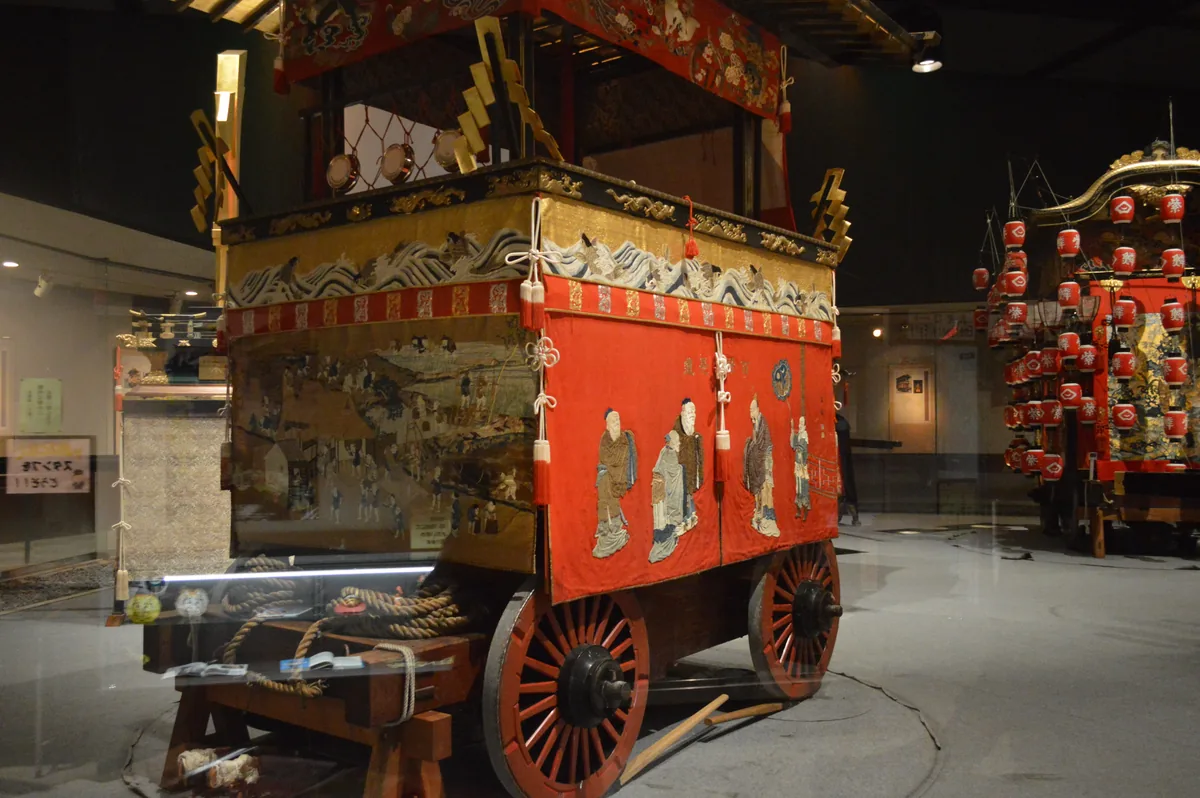
Then come the danjiri (だんじり), also written 楼車 and read danjiri here – nine floats from nine towns on Honmachi-dori and Ninomachi-dori. Each is led by its town’s shirushi (印), a tall standard that announces whose float is coming.
What UNESCO actually listed
This is worth getting right, because most English write-ups get it slightly wrong. The property registered by Japan and inscribed by UNESCO is not “the Ueno Tenjin Festival.” According to the Agency for Cultural Affairs’ Cultural Heritage Online database, it is the Danjiri Events of the Ueno Tenjin Festival (上野天神祭のダンジリ行事) – the float and demon events within the festival, not the shrine rites as a whole.
That property was designated a National Important Intangible Folk Cultural Property on 12 February 2002, and on 1 December 2016 (Japan time) it entered UNESCO’s Representative List of the Intangible Cultural Heritage of Humanity as one of the 33 Yama, Hoko, Yatai float festivals inscribed together.
What the inscription singled out, in the organisers’ own words, is the pairing: the shirushi standard with the demon parade, and the shirushi with the float – “the thing being accompanied and the thing accompanying it” forming matched sets. That structural pairing is what makes this festival distinct from the other 32.
How old is it?
The festival was revived in the ninth lunar month of 1660, and in 1662 the mikoshi paraded inside the castle grounds for the first time. The floats came later: the Mukaijima-cho hanaboko of 1756 and the Nakamachi Kishinzan of 1759 are treated as the prototypes, and the word “danjiri” first appears in a Nishimachi festival ledger of 1797. The line-up settled into roughly today’s form in the early 19th century, recorded in detail by an 1840 woodblock print whose printing block is now a city-designated cultural property.
The organisers describe the festival as having “over 400 years of history” and count it “among the three great festivals of Kansai.” Treat that second phrase as the organisers’ own description rather than an official ranking – I could not find a third-party public body that assigns it.
When Is the Ueno Tenjin Festival 2026, and What Is Confirmed?
October 23, 24 and 25, 2026 – Friday, Saturday and Sunday, with the main procession on the Sunday. The dates follow a fixed rule, and Mie Prefecture’s tourism federation lists them, but the organisers had not yet posted their own 2026 announcement when this article was verified.
Why the dates are reliable even before the organisers post them
The organisers publish the rule rather than the date. In their words, the festival falls on “the Sunday closest before 25 October, on which the main event, the Shinkosai, is held, plus the two days before it” – a three-day festival, Friday to Sunday. That rule has applied since 2017, adopted in the wake of the UNESCO inscription.
Before that, the main day was fixed to 25 October, and before the solar calendar it was the 25th day of the ninth lunar month. So the modern rule is a compromise: keep the date’s meaning, move it to a weekend people can actually attend.
In 2026, 25 October falls on a Sunday. The rule therefore gives Friday 23, Saturday 24, Sunday 25. The Mie Prefecture Tourism Federation – the prefecture’s official tourism body – lists exactly that, marked as information current as of June 2026.
What is not out yet. As of 15 August 2026, the leaflet on the organisers’ site is still the 2025 edition, and there is no page giving 2026 times. Based on last year’s pattern, expect the 2026 leaflet PDF around mid-to-late September and the road-closure map in early October – the 2025 leaflet carries an editorial date of 20 September 2025, and the traffic-map PDF a 2 October 2025 file date. Check the official site in the week before you travel.
What happens on each of the three days
The times below are from the organisers’ standing programme. They shift year to year – the 2025 road-closure map, for example, gave a Sunday departure of 8:50 rather than the 8:30 in the standing programme, and put the Saturday evening float run at 18:30-21:00. Use these as shape, not schedule.
| Day | Name | What happens |
|---|---|---|
| Friday Oct 23 |
Yoiyoiyama (宵々山) | At 10:30 the three floats kept in the Danjiri Kaikan museum are pulled back to their home towns; the rest come out of their storehouses in the early afternoon, until all nine stand on street corners along Honmachi and Ninomachi. Towns open their meeting halls to show festival gear. At dusk the paper lanterns are lit and the musicians start. Everything is put away around 21:00. The demon towns begin preparing at 10:00, and set out prefecturally designated masks in display cases. |
| Saturday Oct 24 |
Ashizoroe-no-gi (足揃えの儀) and Yoiyama (宵山) | Floats come out at 10:00 and parade 13:00-16:00. The demons assemble in Aioi-cho around 13:00 and walk Sannomachi-dori from 14:00 to 16:00, to conch shells and drums. At 18:00 the lanterns are lit together; at 18:30 four floats gather at the west end of Honmachi-dori and move east toward the shrine, while another five work Ginza-dori. Back in the storehouses by 21:00. |
| Sunday Oct 25 |
Shinkosai (神幸祭), the main day | The full procession. Everything assembles in Kurumazaka-cho from 7:30; the mikoshi leave the eastern otabisho around 8:30; demons and floats follow from about 9:10, heading west along Honmachi-dori. A full day of parading, with a break from about 11:40 to 13:30. |
The Sunday running order
The organisers publish this sequence for the main day:
| Time | Event |
|---|---|
| 7:30 | Nine floats and the demon columns assemble in Kurumazaka-cho |
| 8:30 | Mikoshi procession departs the eastern otabisho |
| 9:10 | Demon parade, then the floats, depart westward along Honmachi-dori |
| 10:45 | Kuji-aratame (籤改め) – the lot order is checked in front of the festival headquarters |
| 11:40 | Morning session ends; break |
| 13:30 | Afternoon session departs |
| 16:00 | At Tokui-cho, the demon columns and floats 4 to 9 disband and return home |
| 16:30 | Floats 1-3 wait by Hi-Topia, then cross the Uenoshi Station level crossing |
| 17:30 | Floats delivered into the Danjiri Kaikan |
Two things about that table are worth knowing. The kuji-aratame is not decoration – it is the public verification of an order drawn by lot weeks earlier. And the 17:30 delivery is why the museum keeps three floats: they go straight from the parade into the display hall.
The shrine also holds its own rites, and they are on different days from the parades. In 2025 the yoimiya-sai fell on 24 October and the grand rite reitaisai on the 25th – the week after the parade weekend. The 2026 shrine dates had not been published at the time of writing.
What Are the Highlights of the Ueno Tenjin Festival?
Six things carry this festival: the demon column’s structure, the enormous gohei standard at its head, the lurching hyorotsuki demons at its tail, the Tametomo column that closes it, the nine floats and the way they turn corners, and the mask exhibitions the demon towns open on the Sunday.
1. The demon column, and what the masks actually are
The En-no-Gyoja column processes in a set order: the great gohei leads, then the akki, the hatten, the shiten, En-no-Gyoja himself, the sendatsu, and finally the hyorotsuki-oni.
The masks were made between the Momoyama period and the late Edo period, and several are Noh masks pressed into festival service. The akki wears a shinja mask, a mid-Edo Noh piece; En-no-Gyoja wears an akobujo, an early-Edo one.
One point of translation that changes how you read the whole parade: the aku in akki (悪鬼) does not mean “evil” here. As Professor Emeritus Shudo Yoshiki of Takada Junior College explains in an essay the organisers host on their own site, it means physically powerful. The akki is the demons’ captain, clearing the way ahead of En-no-Gyoja. It is a bodyguard, not a villain.
2. The great gohei – and an honest note about its size
The ogohei (大御幣) that leads the column is a genuine spectacle: a pillared standard carried by five men, with white on the central pillar and blue, red, yellow and black on the eastern, southern, western and northern ones, following the five-phase cosmology, with one of the Five Wisdom Kings invoked in each.
Its size is where the official sources disagree, so here are both. The organisers’ printed leaflet says 21 shaku tall and 30 kan in weight – roughly 6.4 metres and 113 kilograms – and calls it one of the largest in Japan. The organisers’ own website, on its programme page, says the crews assemble a five-metre gohei on the Saturday morning. I have not found a source that reconciles the two, so I am not going to pick one for you. Either way: it is very large, very heavy, and it goes first.
3. Hyorotsuki-oni, the ones children remember
At the tail of the column come the hyorotsuki-oni (ひょろつき鬼), staggering along under a temple bell, two great axes and a mountain ascetic’s pack box – implements from En-no-Gyoja’s mountain practice. The organisers’ leaflet describes the effect precisely: their movements are “frightening and comic at once – adults laugh, and children cry.”
Making small children cry is not an accident here. The organisers note on their programme page that hyorotsuki-oni reducing children to tears is a long-standing custom. If you are travelling with a nervous three-year-old, watch from a doorway.
4. Tametomo, and the town that holds a war council
The second column belongs to Tokui-cho and is led by Minamoto no Tametomo – Chinzei Hachiro – described in the leaflet as a giant of seven shaku and an archer whose bow took five men to string. He closes the demon parade. Before setting out on the Saturday, Tokui-cho performs a departure rite it revived in the 1970s after a long lapse: the three-cup sake ceremony, the three auspicious foods – dried abalone, victory chestnuts and kelp – and a shouted “Ei, ei, oh.”
5. Nine floats, and the order nobody knows until September
Nine towns own one float each:
| Town | Float | Romanised |
|---|---|---|
| Higashimachi (東町) | 桐本 | Kirimoto |
| Uomachi (魚町) | 紫鱗 | Shirin |
| Mukaijima-cho (向島町) | 鉄英剣鉾 | Tetsuei-kenboko |
| Kajimachi (鍛冶町) | 二東・月鉾 | Nito / Tsukihoko |
| Nakamachi (中町) | 其神山・葵鉾 | Kishinzan / Aoiboko |
| Kodamacho (小玉町) | 小簑山 | Kominoyama |
| Shinmachi (新町) | 薙刀鉾 | Naginataboko |
| Fukuicho (福居町) | 三明 | Sanmei |
| Nishimachi (西町) | 花冠 | Kakan |
The order they parade in is drawn by lot on 9 September each year, at a ceremony called the kuji-tori-shiki (くじ取式) held at the shrine. So if you see a “float order” list on a travel site, check what year it belongs to – last year’s order tells you nothing about this year’s. The music is mostly Gion-bayashi, though each town keeps tunes of its own.
The mechanical highlight is the corner. Small course corrections are made with levers, but at a crossroads the crew uses the hokomanriki (方向万力), a turntable jack under the float body, and spins the whole thing around. The organisers flag this as the moment to watch for.
6. The mask exhibitions on the Sunday
This is the part visitors most often miss. On the main day, all four demon towns open their masks to the public – three of them showing prefecturally designated pieces:
- Ueno Aioi-cho – Demon Mask Gallery Exhibition, 8:00-16:00
- Ueno Konya-cho – Demon Mask Exhibition, 9:00-17:00
- Ueno Sannonishi-cho – Demon Mask Exhibition, 10:00-16:00
- Ueno Tokui-cho – Storehouse Opening, 9:00-16:00
If the procession is stalled or you want an hour out of the crowd, these are the answer. You get to look at a 17th-century Noh mask from thirty centimetres away instead of watching it go past at walking pace.
How Do You Get to Iga Ueno from Nagoya?
The simplest route from Nagoya is the direct Mie Kotsu highway bus from the Meitetsu Bus Center to Uenoshi Station: 2,300 yen for an adult, 103 to 106 minutes, no transfer. By rail you change onto the Iga Railway either at Iga-Ueno or at Iga-Kambe.
By highway bus (the direct option)
Mie Kotsu runs the Nagoya-Ueno highway line from the Meitetsu Bus Center. Querying Mie Kotsu’s own timetable and fare system for Sunday 25 October 2026 returns five departures from the Meitetsu Bus Center – 8:55, 10:15, 14:25, 16:25 and 18:10 – arriving at Uenoshi Station at 10:41, 12:01, 16:08, 18:08 and 19:53 respectively. Adult fare 2,300 yen, child 1,150 yen. The bus continues to the Sanko Ueno depot after Uenoshi.
Set those times against the festival timetable and the trade-off is obvious. The 8:55 bus lands you in Iga Ueno at 10:41 – too late for the Sunday morning departure, but in the middle of the morning procession. To catch the 9:10 start you are staying the night before, or driving. Note also that the organisers’ site quotes “about 90 minutes” for this bus while the operator’s own search gives 103-106 minutes; plan on the longer figure.
By rail
The organisers give two rail routes, both ending on the Iga Railway (伊賀鉄道) at Uenoshi Station:
- JR Kansai Line to Iga-Ueno, then transfer to the Iga Railway. That last leg is 260 yen for an adult, 130 yen for a child.
- Kintetsu Osaka Line to Iga-Kambe, then transfer to the Iga Railway. That leg is 370 yen adult, 190 yen child.
Both figures come from the Iga Railway’s official fare table (revised 1 October 2019, still posted at the time of writing). I could not retrieve the Nagoya-side JR or Kintetsu fares from those operators’ own systems, so I am not going to quote a total – check the operator directly for that leg rather than trusting a third-party aggregator.
Note the station name confusion, which trips people up: Iga-Ueno (JR) and Uenoshi (Iga Railway) are different stations. The festival is at Uenoshi. Mie Prefecture’s tourism federation describes the festival as being right at the Uenoshi exit; the tourist association says about five minutes’ walk. Both are true, because the venue is a whole district rather than a point.
Building a wider trip around it?
Iga is a long day from Nagoya – useful if you are pairing it with other stops.
By car
From the Meihan Expressway, it is about 5 to 10 minutes from the Nakase or Ueno-Higashi interchange to the centre of town – the tourist association says five, the organisers say about ten to reach the festival area, and the prefecture says five. Take the range.
But read the organisers’ own line first: “Parking is limited. Please come by public transport where possible.”
What Should You Know Before You Go?
Four things matter practically. Parking is limited and the 2026 map is not out yet. Streets close to traffic from early morning on the Sunday. Drones are banned outright. And the Danjiri Kaikan museum shuts for the festival days, because its floats are on the street.
Parking, if you must drive
The 2025 official road-closure map listed nine car parks, three of them free. These are 2025 figures – the 2026 map had not been published when this was written, so treat the list as an indication of scale rather than a plan.
| Car park | Capacity | Charge (2025) |
|---|---|---|
| Municipal Johoku (buses too) | 275 | Paid 8:00-17:00 on festival days; free on weekdays |
| Municipal Danjiri Kaikan (buses too) | 35 | Paid 8:00-17:00 |
| Municipal Ueno Park | 47 | Paid 8:00-17:00 |
| Municipal Hakuho-mon | 25 | Paid 8:00-17:00 |
| Former city hall, SAKAKURA BASE | 150 | Paid |
| Ueno Nishi Elementary School (temporary) | 200 | Paid |
| Ueno Gas | 30 | Free |
| Iga City Hall (temporary) | 262 | Free |
| JA Iga Furusato head office | 250 | Free |
Road closures
In 2025, sections closed to traffic from 6:00 to 11:00 on the Sunday, with shorter closures around the Danjiri Kaikan, Honmachi-dori and Ninomachi-dori on the Friday morning and again late Sunday afternoon. The prefecture’s tourism page notes that Ginza-dori and Honmachi-dori are subject to restrictions and asks drivers to take the diversions. The 2026 map, again, comes out in early October.
Drones
Do not. The organisers carry a standing request in the footer of every page of their site: “For safety reasons, please refrain from using drones.”
Crowds, food stalls and seating – what nobody will tell you
I want to be straight about the limits of what is documented here, because a lot of English pages fill these gaps with invention.
- Attendance figures do not exist publicly. Mie Prefecture’s official tourism-volume estimates do not itemise this festival, and neither the organisers, the city nor the tourist association publish a number. Any visitor count you see elsewhere is not from an official source.
- Food stalls are not documented. No official page states where the stalls are, how many there are, or when they open. There will almost certainly be food; I just cannot tell you what or where from a source I trust.
- There is no paid seating – or more precisely, no official source mentions any, and the prefecture lists the festival as free. Assume you are standing.
The one piece of crowd advice that is official is genuinely useful, and it comes from the organisers themselves: on the Saturday, they write, the afternoon stretch of Sannomachi-dori “can be watched at a relatively relaxed pace, and is an ideal hidden spot for visitors.” That is the organisers telling you where to stand. Saturday, 14:00 to 16:00, Sannomachi-dori.
The Danjiri Kaikan closes during the festival
Worth planning around. The Danjiri Kaikan museum in Ueno Marunouchi keeps three of the nine floats and a demon-parade display on show all year, 9:00-17:00, 600 yen for adults and 400 for children. But its listed closing days include “the days of the Ueno Tenjin Festival (October)” – because its floats are out on the street. You cannot do the festival and the museum on the same day.
What Do the Organisers and Locals Say About It?
Rather than paraphrase other people’s travel posts, here are the festival’s own channels – all run by the Ueno Bunka Bijutsu Hozonkai itself, all live as of August 2026. These are the best current-year source for what the streets actually look like:
- Official Instagram: @ueno_bunka_bijutsu_hozonkai
- Official YouTube: the preservation society’s channel, which includes its own recording of the festival appearing in a Mie festivals showcase at Expo 2025 Osaka, Kansai on 22 September 2025
- Official Facebook: the society’s page, which the organisers embed on their own homepage
2026 is also an anniversary year. According to the local newspaper Iga Town Joho YOU, on 19 April 2026 the preservation society held a ceremony in the multipurpose square in front of Uenoshi Station marking ten years since the UNESCO inscription, bringing six floats together with a demon parade and returning Kodamacho’s Shichifukujin figures to public view for the first time since 2017. The society’s chairman, Nakamura Akinobu, framed it to the paper as a starting point for thinking about the next decade. I have not found the society’s own announcement of that event, so treat the detail as newspaper reporting rather than an official record.
What that tells a visitor: the people running this festival are actively thinking about its next ten years, not just its last four hundred.
Frequently Asked Questions
When is the Ueno Tenjin Festival 2026?
October 23-25, 2026 (Friday to Sunday), with the main Shinkosai procession on Sunday the 25th. The dates follow the organisers’ rule: the Sunday closest before 25 October, plus the two days before it. Mie Prefecture’s tourism federation lists the same dates.
What is the difference between the three days?
Friday is Yoiyoiyama, when the nine floats come out and stand on street corners under lanterns. Saturday is Ashizoroe-no-gi and Yoiyama: a daytime float parade, the demon parade along Sannomachi-dori from 14:00 to 16:00, and lantern-lit floats in the evening. Sunday is the full procession.
How much does it cost to attend?
Nothing. Mie Prefecture’s tourism federation lists the festival as free, and it takes place on public streets and shrine grounds. No official source mentions paid viewing seats, so plan on standing. The Danjiri Kaikan museum charges separately, but it closes during the festival.
How do I get to the Ueno Tenjin Festival from Nagoya?
The simplest way is Mie Kotsu’s direct highway bus from the Meitetsu Bus Center to Uenoshi Station: 2,300 yen for an adult, 103 to 106 minutes, no transfer. By rail, take the JR Kansai Line to Iga-Ueno or the Kintetsu Osaka Line to Iga-Kambe, then the Iga Railway to Uenoshi.
What happens if it rains?
The official notices mark rain as cancelling, not postponing – that wording appears against the demon parade, the float runs, Yoiyama and the Shinkosai alike. No official source explains how or when the call is made, or whether light rain counts. On the day, check the organisers’ site and social accounts.
What exactly is UNESCO-listed here?
Not the festival as a whole. The inscribed property is the Danjiri Events of the Ueno Tenjin Festival, added to UNESCO’s Representative List on 1 December 2016 as one of 33 Yama, Hoko, Yatai float festivals. Japan had already designated it an Important Intangible Folk Cultural Property in February 2002.
Can I see the floats and demon masks outside the festival?
Yes. The Danjiri Kaikan in Ueno Marunouchi displays three of the nine floats plus a demon-parade exhibit, open 9:00 to 17:00, 600 yen for adults and 400 yen for children. It closes on the festival days themselves, during the April float changeover, and from 29 December to 1 January.
Where Can You Check Official Information?
Four sources cover this festival properly. Because the 2026 timetable and road-closure map are not out until September and October, the organisers’ own site is the one to check in the week before you travel.
- Ueno Tenjin Festival official site (Ueno Bunka Bijutsu Hozonkai): https://ueno-tenjin-matsuri.jp/ – programme, history, the annual leaflet PDF and the road-closure map. Again: the .com address is not theirs.
- Mie Prefecture Tourism Federation (Kanko Mie), the prefecture’s official tourism body: https://www.kankomie.or.jp/event/5285 – the most reliable source for the current year’s dates before the organisers post theirs.
- Cultural Heritage Online, Agency for Cultural Affairs: https://bunka.nii.ac.jp/heritages/detail/300029 – the designation record for the Danjiri Events.
- Iga Railway fare table: official PDF. Mie Kotsu highway bus: Iga-Nagoya line.
- Enquiries: Ueno Tenjin Festival Regional Promotion Committee, inside the Ueno Chamber of Commerce, 0595-21-0527 (weekdays) – Iga Ueno Tourist Association 0595-26-7788 – Iga City Tourism Strategy Division 0595-22-9670 (weekdays).
Related Guides
- Inuyama Festival – another of the 33 UNESCO-inscribed float festivals, and the closest one to Nagoya. If Iga is too far for a day trip, start here.
- Owari Tsushima Tenno Festival – also UNESCO-inscribed, and the summer counterpart: lantern-lit boats instead of street floats.
- Kamezaki Shiohi Festival – the UNESCO festival where the floats are dragged across a tidal flat, on the Chita Peninsula.
- Takayama Festival – the best-known float festival in central Japan, with an autumn edition in October.
- Koromo Matsuri – eight floats hauled through Toyota under a blizzard of confetti on 17-18 October 2026, the weekend before this one. The obvious pairing if you want two float festivals in one trip.
- Ise Grand Shrine Day Trip from Nagoya – the other reason people cross into Mie, and a natural pairing if you are already heading that way.
- Autumn Festivals in Nagoya and Central Japan – what else is on in October, if you are choosing between weekends.
- Central Japan Festival Calendar – every major festival in the region, month by month.