Konomiya Hadaka Matsuri (国府宮はだか祭) is a purification rite at Owari Okunitama Shrine in Inazawa, Aichi, said to date back about 1,250 years. Thousands of men in loincloths mob a single chosen man, the shin-otoko, to shed a year of misfortune. The next edition is February 19, 2027, three minutes from Konomiya Station.
Most Japanese festivals ask you to watch. This one is a scrum. Several thousand men in nothing but a cotton loincloth and white split-toe socks pack a shrine approach in February, wait for one naked man to be pushed into the middle of them, and then try to touch him — because touching him is how you hand him your bad luck for the year. It is forty minutes from Nagoya, and everything below is confirmed from the shrine, the city, the prefecture and the railway themselves.
Written by Yuu — a Nagoya native of 35 years. Published August 15, 2026.
This article may contain affiliate links. See our affiliate disclosure for details.
All festival details verified from official sources on August 15, 2026.

What Is Konomiya Hadaka Matsuri?
Konomiya Hadaka Matsuri is the popular name for Naoi Shinji (儺追神事), an exorcism rite held every year at Owari Okunitama Shrine in Inazawa, Aichi. Thousands of men in loincloths converge on one chosen man — the shin-otoko — because touching him is believed to transfer your misfortune away.
| Item | Detail |
|---|---|
| Festival | Konomiya Hadaka Matsuri (国府宮はだか祭), formally Naoi Shinji (儺追神事) |
| Next edition | February 19, 2027 (Friday), from 15:00 |
| Most recent edition | March 1, 2026 (Sunday) — the date moves every year |
| Why the date moves | It is fixed to the 13th day of the first lunar month |
| Where | Owari Okunitama Shrine (尾張大國霊神社), 1-1-1 Konomiya, Inazawa, Aichi 492-8137 |
| Nearest station | Konomiya Station (国府宮), Meitetsu Nagoya Main Line — 3 minutes on foot from the north exit |
| Also reachable from | Inazawa Station (稲沢), JR Tokaido Main Line — 15 minutes on foot |
| From Nagoya | Meitetsu Nagoya → Konomiya: ¥400 adult / ¥200 child, 11–15 min, no transfer |
| From Centrair airport | ¥1,200 adult / ¥600 child, 49 min, no transfer |
| Parking | None. The shrine car park is completely unusable for three days around the rite |
| Cultural status | Designated an Intangible Folk Cultural Property by Aichi Prefecture, November 28, 1984 |
| Official site | konomiya.or.jp/hadakamatsuri |
A rite that started with a plague
The shrine’s own account puts the origin in the year 767. In Jingo-keiun 1, it says, Empress Shotoku ordered prayers against epidemic disease at every provincial temple in the country, and the governor of Owari Province also had prayers performed at this shrine, the province’s sosha or head shrine. Inazawa City and Aichi Prefecture both repeat the same account, which is where the widely quoted figure of “about 1,250 years” comes from.
That makes the rite old. It does not make the scrum old — the commonest mistake in English write-ups. According to Inazawa City, the naked mobbing only fused onto the rite at the very end of the Edo period, when the local custom of midwinter cold-water pilgrimage in minimal clothing merged with the older exorcism. The shrine says the same thing in a single blunt line on its festival page: the men’s scrum began around the late Edo period.
What is actually being driven out
The Japanese name is the giveaway. Naoi (儺追) means “chasing out the na” — the demon of pestilence. Everything in the festival is a delivery system for moving misfortune off a community and into the ground.
Inazawa City explains that in earlier times a man was found in that year’s auspicious direction and seized to serve as the naoinin, the shin-otoko. That practice was called naoi-tori, “catching the burden-bearer,” and the city states that the modern scrum is the descendant of it. Nobody is caught against their will now — the shrine takes volunteers, holds a rite in the Naoiden hall and draws the shin-otoko by sacred lot, then hands him a written token of appointment.
He is not simply a mascot. Three days before the main rite he enters the Naoiden and stays for three days and three nights. On the festival afternoon he is pushed naked into the crowd. Then, at three the following morning, the part almost no visitor ever sees: in the Choya hall in the southeast corner of the grounds, priests call in the gods of the province’s first, second and third shrines along with this one, load the shin-otoko with a black rice cake said to have every impurity pounded into it, and drive him out of the grounds with a great iron bell and pellets of peach and willow twig. He drops the cake on the way home without looking back, and a priest buries it where it fell. The shrine calls this — not the scrum — the true meaning of the festival.
The rice cake with last year’s ashes in it
The detail I find hardest to forget is what that black cake is made of. The shrine’s description of the tsuchimochi rite says it is pounded from rice wrapped around the ash of the pellets burned at last year’s night rite, then blackened with ash on the outside. Every year’s impurity is packed into the residue of the year before it and put back into the earth. The whole thing loops.
When Is Konomiya Hadaka Matsuri, and What Happened in 2026?
The next edition is Friday, February 19, 2027, with the main rite from 15:00 and the night rite at 03:00 on February 20. The 2026 edition was held on March 1 — the date moves annually because it is tied to the 13th day of the first lunar month.
Why nobody can tell you “it’s always the third weekend of February”
The shrine answers this itself in its own FAQ: the date changes every year because the rite falls on the 13th day of the first lunar month. That is a real trap for trip planning. In 2026 it landed on March 1. In 2027 it lands on February 19. Ten days of drift between those two editions, and a March date is rare enough to be news in itself: the Chunichi Shimbun noted that 2026 was the first March edition in eleven years.
It does not respect your weekend either: 2026 fell on a Sunday, 2027 falls on a Friday.
The 2027 schedule, as published by the shrine
Unusually for a Japanese festival, the full following-year schedule is already online. As of August 15, 2026, the shrine’s festival page carries the complete Reiwa 9 (2027) Naoi Shinji related events schedule:
| Date (2027) | Time | Lunar date | Rite |
|---|---|---|---|
| Mon, Feb 8 | 09:00 | 1st month, day 2 | Raising of the marker post (shimebashira-tateshiki) |
| Mon, Feb 8 | 10:00 | 1st month, day 2 | Selection of the shin-otoko by sacred lot |
| Fri, Feb 12 | 09:00 | day 6 | Washing the rice for the giant rice cake |
| Sat, Feb 13 | 06:00 | day 7 | Pounding the giant rice cake |
| Tue, Feb 16 | 17:00 | day 10 | Shin-otoko enters seclusion in the Naoiden |
| Wed, Feb 17 | 09:00 | day 11 | Pounding the tsuchimochi; writing of the secret talismans |
| Wed, Feb 17 | 09:00 | day 11 | Decorating the giant rice cake |
| Thu, Feb 18 | 13:00 | day 12 | Offering of the giant rice cake (parade to the shrine) |
| Thu, Feb 18 | 19:00 | day 12 | Choya rite (eve of the festival) |
| Fri, Feb 19 | 15:00 | day 13 | Naoi Shinji — the Hadaka Matsuri |
| Sat, Feb 20 | 03:00 | day 14 | Night Naoi rite (yo-naoi shinji) |
| Sat, Feb 20 | 08:00 | day 14 | First cutting of the giant rice cake |
| Tue, Feb 23 | 19:00 | day 17 | Target-shooting rite (matoi shinji) |
| Sun, Feb 28 | 09:30 | day 22 | Naoi tea ceremony |
One of those deserves attention even if you only care about the main afternoon: February 18 at 13:00, when the four-tonne rice cake reaches the second torii after a parade led by priests purifying the road, and is hauled up the approach by hand before being craned into place — a spectacle in its own right, and a separate event from the afternoon scrum.
What has not been published for 2027 yet
As of August 15, 2026, the following are still unannounced, and I will not guess at them:
- The 2027 shin-otoko. He is drawn by lot on February 8, 2027, and the shrine posts the name the same day. For 2026 the announcement went up on February 18 and named Kimura Yuki of Yamato-cho, Ichinomiya, aged 28 by the traditional count.
- Traffic restriction hours. The shrine publishes a road-closure map roughly one to two weeks out.
- Hall-entry visits to the shin-otoko, and the price of the cut rice cake. Both are announced annually, usually in early February.
The 2026 edition, briefly
The 2026 rite ran on Sunday, March 1 from 15:00, with the night rite at 03:00 on March 2. Traffic around the shrine was closed to vehicles from 09:00 to 18:00. The shrine’s official announcements confirm the shin-otoko was decided on February 18, that hall-entry visits ran on three evenings and the festival morning, and that cut pieces of the giant rice cake were distributed from March 2 at ¥200 each.
For the day itself the fullest account is journalistic rather than official. The Chunichi Shimbun reported that a record 14 groups totalling roughly 620 people took part in the bamboo offering, that the women’s groups began theirs around 09:00, that the shin-otoko appeared after 17:00, and that he was pulled into the Naoiden at 18:10 after sunset, in a mild 18°C. I flag the source because none of those numbers appear on an official page. No official or press source publishes a total spectator figure, so I am not going to invent one.
What Are the Highlights of Konomiya Hadaka Matsuri?
The scrum around the shin-otoko is the reason people come, and the shrine says it lasts about an hour. Around it: bamboo offerings carried in by district, a bucket team throwing water over steaming bodies, a four-tonne rice cake, and a paid chance to touch the shin-otoko without joining the crowd at all.
1. The bamboo offerings, from around midday
Long before anything else happens, groups of men come up the approach carrying naoi-zasa — tall bamboo hung with cloth strips. Each strip carries somebody’s name, age and wish. They are the prayers of everyone who cannot or will not strip: children, the elderly, women, anyone at all.
The shrine’s FAQ is specific about timing, and this is the single most useful line on the whole official site: groups from the earlier districts start arriving around noon, so if you want a good spot near the approach, come at lunchtime. Not at three. At noon.
Anyone can put a wish into the festival this way. The shrine sells the cloth (sasa-yo-nuno) for ¥500 a sheet, in a roughly one-month window that closes two days before the festival.
2. The bucket team, and then the shin-otoko
The offerings end with a set piece. Inazawa City describes it: the tebuke-tai, the bucket team from the Koike Shomyoji district, comes out last and starts throwing water over the packed men. The city’s description notes that the water turns to steam almost immediately off the heat of bodies rubbing together in a February crowd — which tells you more about the density of that crowd than any attendance figure would.
Then, quietly, guarded, the shin-otoko is let out into the approach. Everyone converges. He works his way from the approach through the romon gate — an Important Cultural Property dating in its lower structure to the early Ashikaga period — and into the Naoiden.
The shrine says the scrum begins around 16:00, and immediately adds “it varies from year to year.” Take that seriously: in 2026 it ran an hour later than the usual guidance. The shrine describes the stretch from the start of the scrum until the shin-otoko is safely inside as the roughly one-hour highlight of the whole thing.
3. The four-tonne rice cake
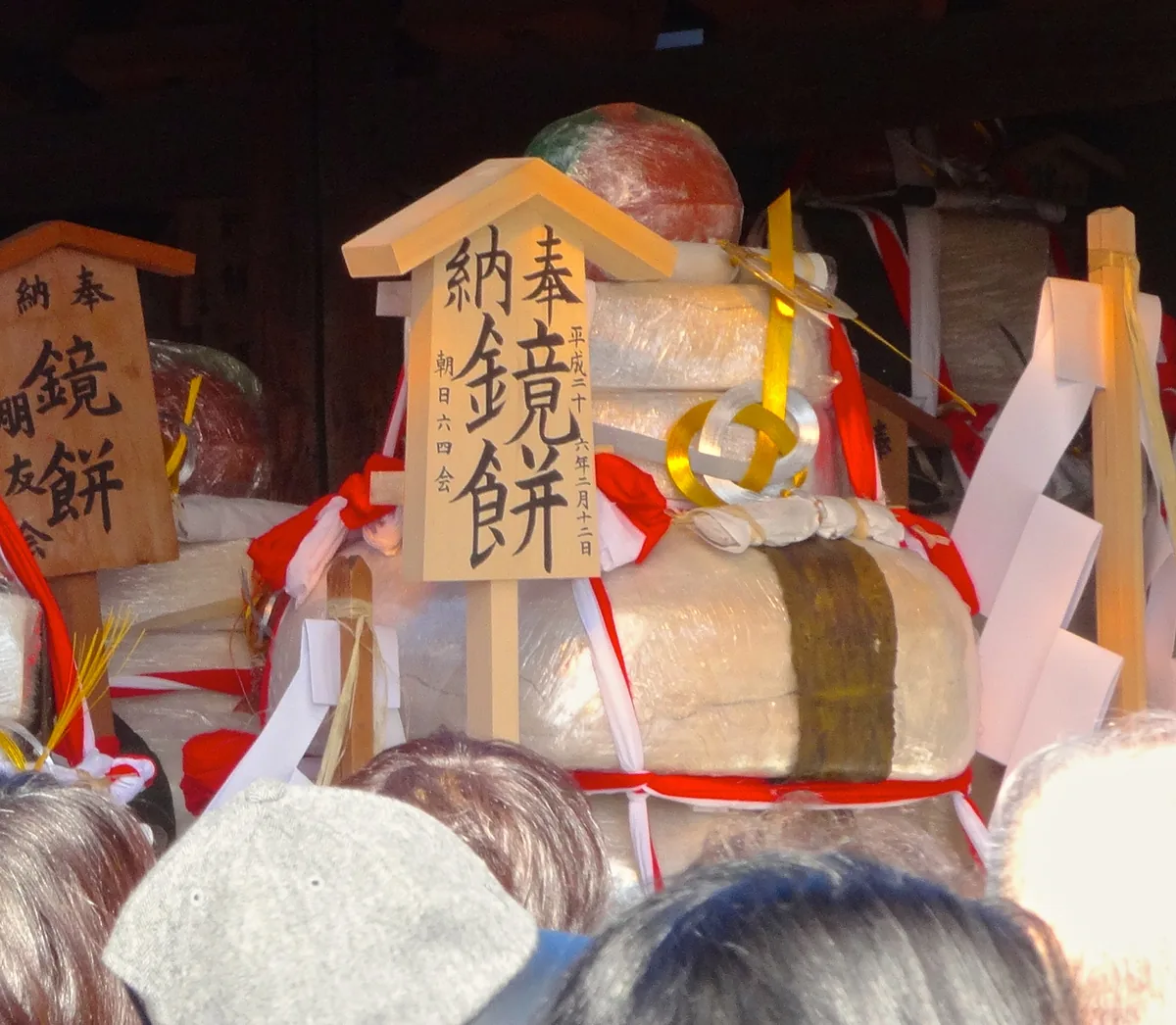
Every year districts around the old Owari region offer an o-kagami-mochi, a stacked ceremonial rice cake, to the main hall. The shrine’s own figures: 2.35 m tall, 2.40 m across, about 4 tonnes — described as the largest that will physically fit through the romon gate and onto the worship hall. Fifty hyo of rice go into it.
It has not always been that big. The shrine’s history says the offering started in the early Meiji period at around five or six hyo, grew after the shrine was elevated in rank in 1940, then ballooned from the 1950s as offering districts competed on prestige. It is loaded onto a large truck the day before, paraded to the shrine, and craned into place.
The morning after the festival, it is cut up and distributed. Eating it is said to keep you healthy — the shrine says the belief is specifically that it stops you falling ill in summer, while Inazawa City phrases it as general freedom from sickness. In 2026 pieces were ¥200 each, distribution began the day after the rite, and the shrine’s FAQ sets the practical window at roughly 10:00 to 15:00 at the Naoiden, capped at ten bags per person, usually continuing about three days. Note the gap: the 08:00 entry on the schedule is the ritual first cut, not the moment you can buy any.
4. Touching the shin-otoko without joining the scrum
This is the part almost nothing in English mentions, and it is the best option for most travellers, women included.
While the shin-otoko is in seclusion, the shrine opens hall-entry worship (儺追殿昇殿参拝), described on its own notice as a chance to touch the shin-otoko and have your misfortune cleansed. In 2026 it ran on the evenings of February 26 and 27 (19:00–20:30), February 28 (20:30–21:30) and on the festival morning itself, March 1, from 08:00 to 10:30, at the west entrance of the Naoiden, for an offering of ¥1,000 per person.
The 2027 dates and price had not been published as of August 15, 2026, but the pattern is stable: the shrine posts them in early February. Separately, the FAQ says you can usually meet the shin-otoko the day after the festival, roughly 09:00 to noon, at a temporary counter on the south side of the grounds — with the honest caveat that it depends on how he is feeling, which, given what he has just been through, is fair.
5. Where women fit — and where they do not
English coverage has garbled this badly, so here is what the shrine actually wrote down.
Aichi Prefecture states that in 2024 women took part in the bamboo offering for the first time, in a separate time slot from the men’s scrum, wearing happi coats. In November 2025 the shrine published a formal one-page set of rules, Guidance on women’s group participation (bamboo offering). Its six points, paraphrased:
- Women’s groups offer bamboo between 09:00 and 11:00 — that is the window for offering at the worship hall.
- Participants must be clothed, wearing a coat marked with the group’s name.
- Women may not take part in the afternoon men’s bamboo offering or in the scrum around the shin-otoko.
- The offering route is, in principle, only from the second torii to the worship hall; processing along public roads from home districts is not encouraged, and groups arrange their own transport to the second torii.
- Participating groups must file a road-use permit with the police, and the group’s representative must attend the permit briefing.
- The prayer cloth should be obtained from the shrine’s own counter (¥500 per sheet).
So: yes, women take part, and by 2026 the Chunichi Shimbun counted a record turnout across all bamboo-offering groups. But it is a clothed, morning, group-based offering with a police permit behind it — not an open sign-up, and explicitly not the scrum. If you are hoping to join, that is the shape of the thing.
How Do You Get to Konomiya Hadaka Matsuri, and What Should You Plan For?
Take the Meitetsu Nagoya Main Line from Meitetsu Nagoya to Konomiya: ¥400, 11–15 minutes, no transfer, and the shrine is three minutes from the north exit. Do not drive. The shrine car park is unusable for three days around the rite and there is no parking nearby.
By train, which is the only sensible option
| Route | Adult / Child | Time | Transfers |
|---|---|---|---|
| Meitetsu Nagoya → Konomiya (limited express, part reserved) | ¥400 / ¥200 | 11–12 min | 0 |
| Meitetsu Nagoya → Konomiya (express) | ¥400 / ¥200 | 15 min | 0 |
| Chubu Centrair Airport → Konomiya (limited express, direct) | ¥1,200 / ¥600 | 49 min | 0 |
| Chubu Centrair Airport → Konomiya (μSKY, change at Kanayama) | ¥1,650 / — | 44 min | 1 |
Those figures come from Meitetsu’s own fare and timetable search, run on August 15, 2026. Two things follow from them.
First, every train type stops at Konomiya. I checked the raw page source on Meitetsu’s station listing rather than trusting a summary, and μSKY, rapid limited express, limited express, rapid express, express, semi-express and local are all marked as stopping. That is unusual for a station this far out and it means you can just get on whatever is at the platform.
Second, if you are coming straight from the airport, the direct limited express is both cheaper and only five minutes slower than the μSKY route with a change at Kanayama. On a festival day, with luggage, take the direct one.
JR also works: Inazawa Station on the JR Tokaido Main Line is a 15-minute walk to the shrine, per the shrine’s own access page. I have not verified the JR fare against a JR Central official source, so I am not quoting one.
For a wider explanation of Meitetsu, IC cards and how the Nagoya rail network fits together, see our guide to getting around Nagoya.
Do not drive. This is not a soft suggestion
The shrine’s access page states that during the three days around the rite the shrine car park cannot be used at all. The official traffic-restriction map for 2026 closed the streets around the shrine to vehicles from 09:00 to 18:00 on March 1, and carries two lines in plain language: the area around the shrine is a no-parking zone, so do not park on the street; and there is no parking in the vicinity, so please use public transport. Aichi Prefecture repeats it in its own press release.
You will find a listing on Aichi Now, the prefecture’s tourism portal, saying the shrine has 150 free car spaces. That is true on an ordinary day and false on this one. Do not plan around it.
Timing your day
- Around noon — arrive if you want a position near the approach. This is the shrine’s own advice, not mine.
- 15:00 — the Naoi Shinji ceremony itself begins.
- Roughly 16:00, but genuinely variable — the shin-otoko enters the crowd. In 2026 it was after 17:00. Budget for waiting.
- About an hour later — he reaches the Naoiden and it is over.
- 05:00 on the day — if you want a personal purification prayer, the shrine opens the reception at five in the morning on festival day. On ordinary days it is 09:00 to 16:00, no booking needed.
Rules the shrine actually publishes
- No drones. No stepladders or step stools. The shrine bans both for spectators anywhere on the grounds, the approach or the surrounding roads, as a safety matter. Tripods are not mentioned either way, so treat the crowd, not the rulebook, as your constraint.
- In rain or snow, dangerous sections of the approach — the arched drum bridge among them — are closed off. There is no published “rain or shine” or “cancelled in severe weather” policy at all; the rite is fixed to a lunar date. Check the official site on the day rather than assuming either way.
- Participants must write their name and phone number somewhere visible on their loincloth, and the shrine explicitly tells group leaders not to let anyone visibly drunk take part.
- You cannot board a train in a loincloth. The shrine spells this out: anyone using Meitetsu or other public transport afterwards needs a coat reaching to about knee length, and yes, you still have to pay the fare.
Practical notes for foreign visitors
This is a working shrine rite in a suburban city, not a tourism product. There is no English-language ticketing, no reserved viewing area, and no official English page. February in Aichi is cold — nearby Nagoya averages a daytime high of about 10.5°C (51°F) in February on the Japan Meteorological Agency’s 1991–2020 normals, and it drops sharply once the sun goes down — and you may be standing outside for four hours. The 2026 edition fell in March and was unusually mild, at a reported high of 18°C, which is not what February will give you. Our guide to the best time to visit Nagoya covers what the season actually feels like.
And joining as a hadaka otoko is not something you sign up for on the day — see the FAQ below. Watching, by contrast, needs no arrangement at all.
Ready to book a day trip?
Handy if you want to pair this with other sights the same day.
What Do Visitors Actually Say About Konomiya Hadaka Matsuri?
Reviewers consistently praise how close the shrine is to the station and rate the Important Cultural Property gate and worship hall highly. The recurring warnings are about crowding on festival days and about the gravel grounds being difficult for wheelchairs.
Review trends
On the Japanese travel-review site 4travel, the shrine scored 3.34 out of 5 across 22 reviews when I checked on August 15, 2026. The sub-scores tell a clearer story than the average: access 4.29, sights 4.23, low-crowding 3.62, barrier-free 3.07. The points reviewers return to are that Konomiya Station is genuinely walkable, that the romon gate and worship hall are the architectural draw, that ordinary weekdays are quiet while Hadaka Matsuri and the Shichi-Go-San season are not, and that the gravel across the grounds is hard going in a wheelchair.
That is a summary of the pattern, not a quotation of anyone’s words, and scores move — treat it as an August 2026 snapshot.
Where to see the festival before you go
Rather than second-hand descriptions, three sources worth looking at directly:
- The video on the shrine’s own festival page. The shrine embeds a short film of the rite directly on konomiya.or.jp/hadakamatsuri, immediately above the schedule table. It is the closest thing to an officially endorsed look at the scrum.
- Inazawa Tourism Association on Instagram — @inakankou1730, the official account of one of the bodies that formally backs the festival’s photo contest.
- Inazawa City on Instagram — @inazawa_pr, the city’s own public-relations account.
One indirect measure of how photogenic this is: the shrine’s own photo contest reached its 70th edition in 2026, backed by Nagoya Railroad, the Aichi Prefecture Tourism Association and the Inazawa City Tourism Association, with a ¥50,000 top prize and winning shots exhibited on the shrine grounds in early May. Seventy years of people turning up with cameras is its own kind of review.
Frequently Asked Questions
When is Konomiya Hadaka Matsuri 2027?
Friday, February 19, 2027. The main rite starts at 15:00 and the night rite follows at 03:00 on Saturday, February 20. The shrine has already published the full 2027 schedule on its official festival page.
Why does the date change every year?
The rite is fixed to the 13th day of the first lunar month, not to a calendar date or a weekend. The shrine states this directly in its FAQ. In 2026 that fell on March 1; in 2027 it falls on February 19.
Are the men completely naked?
No. Participants wear a bleached cotton fundoshi loincloth and white tabi socks. Inazawa City and Aichi Prefecture both describe the dress the same way. The shin-otoko himself is the exception — the shrine describes him entering the crowd with nothing on.
Can women take part in Konomiya Hadaka Matsuri?
Women’s groups have offered naoi-zasa bamboo since 2024, but under written rules: fully clothed in coats marked with the group’s name, in a 09:00–11:00 slot, offering only between the second torii and the worship hall, with a police road-use permit. The shrine’s guidance states women may not join the afternoon scrum around the shin-otoko.
Can a foreign visitor join as one of the naked men?
Not easily, and not on the day. The shrine explains that participants prepare at a yado, a house or community hall, and arrive as district groups, and its own advice is to go through someone you know in the Inazawa area. Anyone with no local contact is pointed to a single referral address. Watching, by contrast, needs no arrangement at all.
Is there a way to touch the shin-otoko without joining the scrum?
Yes. During the shin-otoko’s three-night seclusion the shrine runs hall-entry worship at the Naoiden, described as a chance to touch him and be cleansed. In 2026 it ran on three evenings plus the festival morning, for a ¥1,000 offering. The 2027 dates were not published as of August 15, 2026; they are usually posted in early February.
Can I drive and park near the shrine?
No. The shrine states its car park cannot be used at all for the three days around the rite, and the official traffic-restriction map says there is no parking in the vicinity and that street parking is prohibited. In 2026 the surrounding streets were closed to vehicles from 09:00 to 18:00. Take the Meitetsu Nagoya Main Line to Konomiya Station instead.
Where Can You Check Official Information?
Four official sources cover this festival, and they update at different times. If you are checking a date, a fare or a closure, go to the source rather than to an aggregator — several tourism listings still carry the previous year’s date.
- Owari Okunitama Shrine — Hadaka Matsuri page (Japanese). The primary source. Carries the following year’s full rite schedule, the origin account, the FAQ, participant rules and the women’s-participation guidance. This is where the 2027 dates come from.
- Owari Okunitama Shrine — announcements (Japanese). Where the shin-otoko’s name, the traffic-restriction map, the hall-entry worship dates and the rice-cake price are posted each year. Shrine office: 0587-23-2121.
- Inazawa City — festival information (Japanese). Publishes the annual schedule PDF and the traffic-restriction map PDF, typically updated in December. Its background page is the clearest official explanation of the rite’s structure.
- Aichi Now — event listing (Japanese/English). Aichi Prefecture’s official tourism portal. Useful for address and access, but check the year on the page before trusting a date.
The rite itself is listed as an Intangible Folk Cultural Property designated by Aichi Prefecture on November 28, 1984, under the name Konomiya no Naoi Matsuri, with the Konomiya Tesshokai as its custodian. It is a prefectural designation — not a national one, and not UNESCO.
Related Festivals
- Central Japan Festival Calendar — every major festival in the region, month by month, and the right place to start if you are building a trip around one. Note that Hadaka Matsuri is the awkward entry in any calendar, because its date moves with the moon.
- Atsuta Jingu Guide — the third shrine of old Owari Province, and its deity is one of the four called into the Choya hall on the eve of the rite and again at three in the morning — alongside the first shrine (Masumida), the second (Ogata) and Konomiya itself as the province’s sosha. Worth understanding the network this rite draws on.
- Nagoya Matsuri — the city’s own big autumn festival, and the seasonal opposite of this one: parades and stages rather than a crowd crush.
- Setomono Matsuri — the September pottery market in Seto, another Aichi festival reachable on a single Meitetsu ride from central Nagoya.
- Best Day Trips from Nagoya — the other half-day and full-day trips worth building around this one, for the rest of your visit.