The Hamamatsu Festival (浜松まつり) is a three-day city festival in Shizuoka held every year on 3, 4 and 5 May. Over 170 neighbourhoods fight giant kite battles beside the Nakatajima dunes by day, then pull more than 80 carved palace floats through central Hamamatsu after dark. In 2026 it ran 3-5 May.
Most Japanese festivals belong to a shrine. This one belongs to a city. Its organisers say so plainly: unlike Kyoto’s Gion Matsuri, the Hamamatsu Festival has no connection to a shrine or temple — it is a citizens’ festival, held for the children born into it. What it has instead is a hundred and seventy-odd neighbourhoods, five-millimetre hemp lines, and a stretch of coast where the wind does the rest. The 2026 edition ran on 3, 4 and 5 May, and everything below is verified from the organising committee, Hamamatsu City, the Festival Pavilion, the Tourism Bureau, JR Central and the Cabinet Office on 15 August 2026, with what actually happened in 2026 taken from the Shizuoka and Chunichi newspapers.
Written by Yuu — a Nagoya native of 35 years. Published August 15, 2026.
This article may contain affiliate links. See our affiliate disclosure for details.
All festival details verified from official sources — and, for the 2026 edition itself, from contemporary newspaper reports — on August 15, 2026.
What Do You Need to Know in One Minute?
The Hamamatsu Festival runs on 3, 4 and 5 May every year, whatever days of the week those fall on. Daytime is the kite battle on the coast; evening is the float parade in the city centre. Hamamatsu is thirty minutes from Nagoya by Shinkansen.
| Festival | Hamamatsu Matsuri (浜松まつり), Hamamatsu City, Shizuoka Prefecture |
|---|---|
| Annual rule | 3, 4 and 5 May every year — fixed calendar dates, not weekdays |
| 2026 dates | Sunday 3 – Tuesday 5 May 2026 (all three are national holidays) |
| 2027 dates | 3–5 May 2027 under the fixed rule — Monday to Wednesday, all three national holidays. Not yet announced by the organisers |
| Daytime | Kite battle (凧揚げ合戦) at the Nakatajima Kite Venue — Enshunada Seaside Park ball ground, 2834-1 Shirowa-cho, Chuo-ku |
| Evening | Gosaten yatai parade (御殿屋台引き回し) in central Hamamatsu, centred on Kajimachi-dori |
| Scale | Over 170 neighbourhoods; more than 80 palace floats. 173 towns took part in 2026; the record is 174, in 2009 |
| Purpose | Celebrating the birth of a family’s firstborn (初子, hatsugo) and wishing children healthy growth |
| Character | A city festival (都市まつり) — explicitly not a shrine or temple rite |
| From Nagoya | Tokaido Shinkansen Hikari, non-reserved: ¥4,510, 30 min, no transfer. Local line: ¥1,980, 1 h 39 min, one change |
| Parking at the kite venue | None. The organisers state there is no visitor car park — shuttle bus or taxi only |
| Admission | No official source publishes an admission policy (see the FAQ) |
| Organisers | Hamamatsu Matsuri Organising Committee; secretariat is the Hamamatsu and Lake Hamana Tourism Bureau |
| Official site | hamamatsu-daisuki.net/matsuri |
Local tip: from Nagoya this is not really a trip — Hamamatsu is the near edge of Shizuoka, half an hour on the Shinkansen, closer in time than plenty of places inside Aichi. The catch nobody mentions until you are on the platform: Nozomi does not stop at Hamamatsu. You want Hikari or Kodama, and the festival falls squarely inside Golden Week.

What Is the Hamamatsu Festival, and Why Isn’t It a Shrine Festival?
It is Hamamatsu’s annual city festival, held 3-5 May, in which more than 170 neighbourhood associations fly enormous kites against each other on the coast by day and pull carved wooden floats through the city centre at night. It exists to celebrate babies, not a deity.
That is not a footnote — it is the whole organising principle. The organisers state the purpose on their introduction page: the festival celebrates the birth of a hatsugo (初子), a family’s firstborn, and wishes children healthy growth, with the whole district joining in. The great kites going up on the opening day are flown for particular babies in particular neighbourhoods — the newspaper covering the 2026 opening described exactly that, kites raised in hope of a child’s growth. They also class it a toshi matsuri (都市まつり), a city festival, stating that unlike Edo’s grand festivals or Kyoto’s Gion Matsuri it has no connection to a shrine or temple.
The same page gives the scale: over 170 towns in the kite battle, more than 80 floats at night. A separate official PDF, the register of all 174 participating towns, lists each neighbourhood’s kite crest, float and happi coat — the fastest way to grasp that this is not one festival with 170 spectators but 170 simultaneous neighbourhood festivals sharing a beach and a street. Daytime belongs to the tako-age gassen (凧揚げ合戦), the kite battle at the Nakatajima Kite Venue on the coast; evening to the gosaten yatai hikimawashi (御殿屋台引き回し), the palace-float parade in the city centre kilometres away.
Who runs it
The organiser is the Hamamatsu Matsuri Organising Committee (浜松まつり組織委員会), with the public-interest Hamamatsu and Lake Hamana Tourism Bureau as secretariat. Underneath sits a body with no real equivalent elsewhere: the Tokanbu (統監部), a planning and control division of 55 volunteers, all former neighbourhood group leaders nominated by their residents’ associations. Per the committee’s page, they lay out the encampments, build the float-parade running order and instruct the towns, in grey uniforms with a left-arm armband.
Where it came from
The origin story is where I want to be careful, because the official history is careful. It records the legend — around 450 years ago, in the Eiroku era (1558-1569), the lord of Hikuma Castle flew a kite high above the castle to celebrate the birth of his eldest son — then adds, in the same sentence, the thing most tourist copy leaves out: as a record, it is not certain. What the official history does document runs like this:
- Kansei era (1789-1800) — the earliest written references to kites in the area
- Around 1887 — the hatsudako and kite contests take hold as the custom of flying a kite for a newborn son spreads across Enshu
- 26 April 1919 — the Tokanbu wins permission from the 67th Infantry Regiment to use the Wachiyama parade ground, today’s Wachiyama Park
- 1948 — the festival revives three years after the war, the venue moving temporarily to Nakatajima, with the Hamamatsu Municipal Kite-Flying Federation running the first postwar battle for just over 50 towns
- 1950 — the event is renamed Hamamatsu Matsuri
- 1993 — high-school students return after a long break
- December 2011 — the four-body “Hamamatsu Matsuri Headquarters” hands over to the present committee
That “temporary” 1948 move has now lasted seventy-eight years, and the growth since is unusual: pre-war participation was 40 to 50 towns, against over 170 today and a record 174 in 2009 per the Hamamatsu Festival Pavilion. Few Japanese festivals have quadrupled inside living memory rather than shrunk. It took root here for a reason the history names: the Enshu no karakkaze (遠州のからっ風), the strong dry wind across the region, makes the climate unusually favourable for kite flying — and our guide to when to visit this region covers the same weather from its windy southern edge.
When Was the Hamamatsu Festival 2026, and When Is the Next One?
The 2026 edition ran Sunday 3 to Tuesday 5 May. Rain cancelled the first evening’s parades, and the float parade returned from the second day. The dates are fixed to 3-5 May every year, so 2027 falls on a Monday to Wednesday — though the organisers have announced nothing yet.
Start with the rule, because it removes most of the planning uncertainty other festivals create. Hamamatsu Matsuri is held on 3, 4 and 5 May, by calendar date, regardless of weekday. The Festival Pavilion states it plainly, the official masthead carries the same three dates on every page, and the Tourism Bureau’s English listing gives the period as “May 3 – May 5” with no year attached. The timing is no accident: all three are national holidays under Japan’s Cabinet Office holiday register — Constitution Memorial Day, Greenery Day and Children’s Day. A festival about children occupying Children’s Day is doing exactly what it looks like.
The 2026 timetable, as the organisers published it
| What | Sun 3 May | Mon 4 May | Tue 5 May |
|---|---|---|---|
| Kite venue traffic restriction | 09:00–16:00 on all three days (official traffic PDF) | ||
| Kite battle | Opens 10:00 with fireworks; 10:00–15:00 | 10:00–15:00 | 12:00–15:00 |
| Children’s kite flying | — | — | 10:00–12:00 (cancelled if wet) |
| Brass band parade | 17:15–19:00 | — | — |
| Gosaten yatai parade | 19:00–21:00 | 18:00–21:00 | 18:00–21:00 |
| City centre traffic restriction | 17:00–21:00 on all three days; buses diverted 16:40–21:00 | ||
One sourcing note. The traffic windows, float-parade times and band parade come from the official 2026 traffic notice, issued by the committee with the Hamamatsu Chuo and Higashi police stations on 8 April 2026 — which also stated that for 2026 only the band parade’s timing and route changed. The kite-battle and children’s-kite hours come from the Hamamatsu Machinaka Nigiwai Council’s 2026 page, which cites the official site, states its own contents are current as of 25 April, and which I could not confirm on a live committee page — treat those two lines as a published plan, one step removed. The 10:00 opening, signalled by a firework with roughly 170 towns’ kites going up at once, comes from the Festival Pavilion.
What actually happened in 2026
It was a mixed year. The festival opened on time: Shizuoka Shimbun reported the kites of 173 participating towns going up at the 10:00 signal on 3 May. That evening, however, the committee cancelled the band parade and the float parade due to rain, per the same paper — and since the band parade was a 3 May fixture only, it was the one item the weather took outright. On 4 May, Chunichi Shimbun reported the rain lifting by early morning, the float parade running from 18:00 in the city centre north of JR Hamamatsu Station, and strong wind at the venue — good kite weather. The same report put attendance at the venue and related events at 936,000 people that day, a single-day figure counted across the venue plus related events. On 5 May the children’s kite flying went ahead, children hauling the lines alongside the adults, and Chunichi’s closing report gave the three-day turnout as 2,413,000 people. That three-day total is the newspaper’s; neither the committee nor the city published one.
2027, and how far ahead you can plan
Under the fixed rule, 2027 falls on Monday 3 to Wednesday 5 May, all three national holidays again per the Cabinet Office register. What does not exist yet is any announcement: as of 15 August 2026 the official news feed ends at 1 May 2026, with nothing referring to 2027 or Reiwa 9 — no programme, no times, no shuttle arrangements. The 2026 cycle is a rough guide to when things surface: stall applications on 22 December 2025, the traffic notice on 8 April, the hotline notice on 1 May, and the committee’s venue booking from 4 April in city park records. That is one observed year, not a published schedule — treat it as “check from March” rather than a promise.
Local tip: the official site is emptied out of season — five of its detail pages carry no live body text between festivals. If you are planning from a distance, do your reading in April and May, and treat anything you find out of season as possibly years old.
What Actually Happens at the Kite Battle?
Each town flies a giant kite on a five-millimetre hemp line. Crews deliberately tangle their lines with rivals’ and then run, using friction to burn through the opponent’s line. The winner is whoever is still flying. It is loud, physical and genuinely competitive.
The mechanics, from the Festival Pavilion’s description, are almost crude in their simplicity: crews entangle 5 mm hemp lines and cut the opponent’s by friction, which is why the local name is kenka-dako (ケンカ凧), “fighting kites.” The Pavilion adds the details that tell you this is no gentle pastime — the scorched smell of line grinding on line, and the sand dust rising as crews haul.
The kites themselves
Kite size is measured in jō (帖), a unit of twelve sheets of Mino paper, and festival kites run from 2 to 10 jō. The mainstream size for a hatsudako, a firstborn’s kite, is 4 jō, about 2.4 metres per side; the Pavilion notes that 4 jō and 6 jō (about 2.9 metres per side) suit combat best. Those are edge lengths, not areas — the official English pamphlet renders them as square metres, apparently a translation slip.
The hatsudako is the emotional centre of the day: flown jointly by the town’s young men and the child’s parents, inscribed with the family crest and the baby’s name, and carrying a lovely piece of sympathetic magic — the higher it flies, the more healthily the child will grow. Every kite also bears a takojirushi (凧印), the town’s crest, usually derived from its name, and the happi coats repeat it. Once you know that, the crowd becomes a readable map of which street each person comes from.
The tools, and the noise
The Tourism Bureau’s official English pamphlet catalogues the kit, and it explains the sound: bugles (ラッパ) signal the flyers to change rhythm and rally them; taiko drums carry each town’s own signals and set the hauling rhythm; the itowaku (糸枠) is a large reel for the heavy line; and the tegi (手木) is a pulley-like device for taking the main line in, needed because friction makes the rope hot during combat.
Bear that heat in mind when deciding how close to stand — along with the one safety line the organisers actually print, in the official register of towns: kites may fall at the venue, so watch the sky above you. Objects several metres across, held up by strong coastal wind, sometimes come down. That is the whole of the official guidance, and it is worth taking literally.
What Happens After Dark With the Palace Floats?
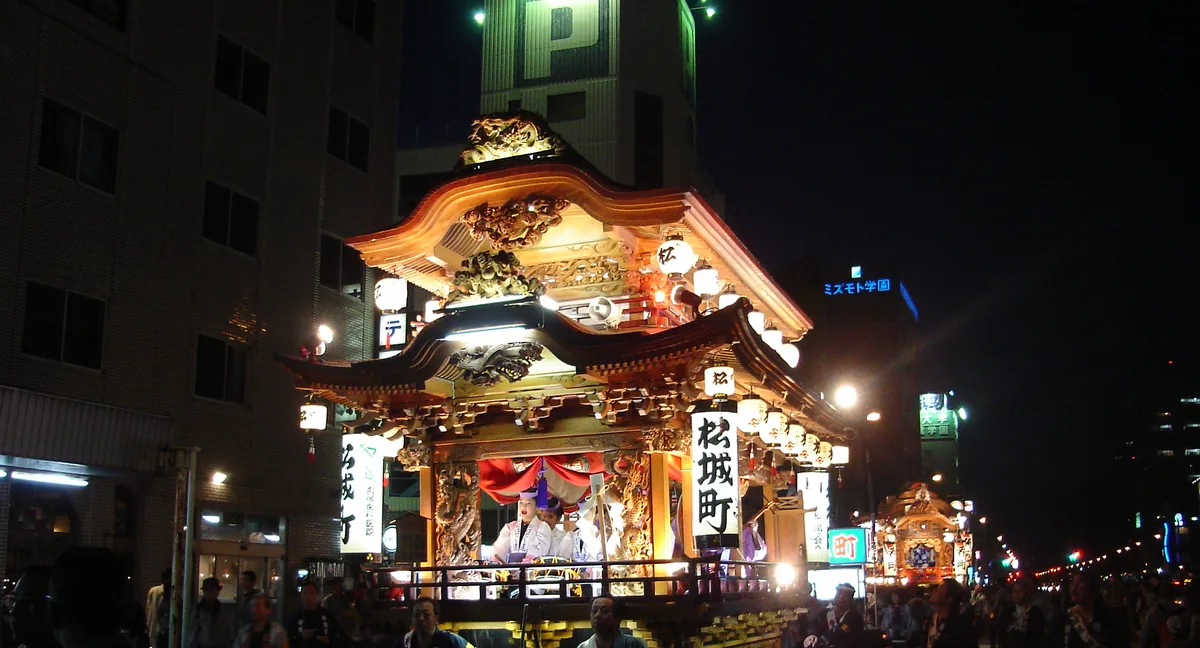
From around 18:00 or 19:00, each town pulls its gosaten yatai — an elaborately carved, illuminated wooden float — through central Hamamatsu, with children playing festival music on board and crews performing a surging, shouting procession called neri around it.
The organisers describe carved palace floats competing in gorgeous display, centred on Kajimachi-dori; the Tourism Bureau’s English listing gives the location as Kajimachi in Chuo Ward and describes the lit floats emerging in the dusk like bands of light. More than 80 take part.
Where the floats came from
The origin, per the Festival Pavilion, is one of my favourite pieces of festival history precisely because it is so undignified. In the late Meiji period, people heading home from the kite battle would stand posts at the corners of a daihachi handcart and use a kite as a roof; one evening, actors from the Wakamatsu-za theatre in Tenma-cho and geisha began banging bells and drums to accompany them. It escalated fast: the “bottomless” sokonuke yatai, hung with artificial flowers and lanterns, appear by 1915; from around 1928 the towns competed to build refined ones; and in 1931 the carving-studded, double-roofed gosaten yatai proper arrived.
The music, the neri, and the part you will not see
On board, children play flute, taiko, hand drum and gong. The detail worth knowing, from the official English pamphlet, is that Hamamatsu’s ohayashi is not generic festival music: it is the same music played in kabuki, each town’s repertoire drawn from the traditional accompaniment of classical dance and kabuki theatre.
Around the float comes the neri (練り): a town flag at the front, dozens of lantern bearers behind, bugles at full blast, drums, and a ceaseless call of “oicho, oicho” as the group jostles forward in a swirling mass. The Pavilion describes the intense version, gekineri (激練り), as happi-clad participants advancing in a sliding step to shouts of “oisho, yaisho”, swelling to a peak during the night parade — one of the festival’s three faces, alongside the great kites and the floats.
Then, when the parade ends, the young men of each town go to the hatsuke, the home of the firstborn child, and perform the hatsuneri for that specific baby. After three cheers of banzai, the family serves food and sake to the crew in thanks. This happens indoors, by neighbourhood, and it is where the festival’s stated purpose finally lands.
How Do You Get to the Hamamatsu Festival From Nagoya?
The Tokaido Shinkansen takes 30 minutes and costs ¥4,510 non-reserved on a Hikari; the local Tokaido Line costs ¥1,980 and takes 1 hour 39 minutes with one change. Nozomi does not stop at Hamamatsu. From the city, the kite venue is shuttle bus or taxi only.
| Route | Fare | Time | Transfers |
|---|---|---|---|
| Shinkansen Hikari, non-reserved | ¥4,510 (¥1,980 ticket + ¥2,530 limited express) | 30 min | None |
| Shinkansen Hikari, reserved | ¥4,840 (¥1,980 + ¥2,860) | 30 min | None |
| Shinkansen Kodama, non-reserved | ¥4,510 | 45 min | None |
| Tokaido Line (local/rapid) | ¥1,980 | 1 h 39 min | One, at Toyohashi |
All four figures come from JR Central’s official access search, run on 15 August 2026; the operating distance is 108.9 km. JR Central’s own caveat, which I pass on: actual fares, times and rolling stock may differ. The choice is unusually clean — the Shinkansen saves 69 minutes for ¥2,530, which matters twice on a day running 10:00 to 21:00, but the local line is a genuine option for one half of it.
The Nozomi point strands people every year. Hamamatsu is served by Hikari and Kodama only; run JR Central’s search restricted to Nozomi and it returns no Shinkansen route at all. If you are working from a rail-pass explainer written around Nozomi, recheck before you book. Our guide to getting around Nagoya covers the station layout and IC cards at the Nagoya end.
Building more into the trip?
Handy if you want tours or day trips booked around the wider Tokaido route.
Getting from the city to the kite venue
First, fix the location, because the name misleads. The venue is the ball ground of Enshunada Seaside Park, and Hamamatsu City gives its address as 2834-1 Shirowa-cho, Chuo-ku — not Nakatajima-cho, despite everyone calling it the Nakatajima venue. The park covers 43.29 hectares next to the Nakatajima Sand Dunes.
The official traffic materials are unusually blunt about cars: there is no visitor car park at the kite venue, the map tells you to use the shuttle bus or a taxi, parking on nearby streets or vacant land is subject to enforcement, and everything south of Route 1 is a traffic-restricted or voluntary-restraint zone.
The shuttle runs from JR Hamamatsu Station and Iida Park, 09:00 to 14:00, as demand requires. The official 2026 map labels it a paid shuttle but publishes no fare anywhere I could find — so budget for one without me guessing at the amount. From the shuttle drop-off it is a 15-minute walk to the venue; from the taxi drop-off, 1 minute. That gap is the most useful number here. If you drive as far as the edge, the Iida Park temporary car park held about 1,000 vehicles free in 2026, with a vehicle restriction (buses excepted) 08:00-17:00.
Accessibility
The committee publishes a dedicated wheelchair access guide, more specific than most festivals manage:
- The shuttle drop-off, on the north side of the Hamamatsu Festival Pavilion, is about 1.3 km from the spectator seating, via Sazanka-dori or the side path by the dunes. Parts are unpaved
- Staff at all three drop-offs assist wheelchair users onto omnibus low-floor vehicles; there may be a wait
- The accessible taxi drop-off is only 0.4 km from the seating, but requires a disability certificate — shown at the venue entrance, or copied to the taxi operator when booking
- Wheelchair-accessible taxis are prioritised but limited; if none is free a standard vehicle is sent and the driver assists
That guide confirms spectator seating exists. What it does not say — and I could not confirm on any live official page — is who may use it, when, or whether it costs anything, so I will not guess.
What Should You Know Before You Go?
Three things: there is an official phone line that tells you whether the festival is running that day, the city-centre closures are long and start at 17:00, and drones are explicitly banned. None of these is optional reading.
Checking whether it is happening
This is the most useful single fact in the article. The organisers run the Hamamatsu Matsuri Navi Dial: 0570-064-736, and publish their decision timings: the kite battle is decided around 07:30 on the day, the float parade around 15:00. Both are same-day calls, and 2026 proved the point. The traffic notice adds the corollary: if the festival is cancelled for rain, the traffic restrictions do not come into force, so an empty, open city centre on 3 May is itself a signal.
The road closures
From the official 2026 notice:
- Kite venue: restricted 09:00-16:00 on all three days, everything south of Route 1 inside the zone
- City centre: restricted 17:00-21:00 on all three days
- Hamamatsu Station south exit: no vehicle entry 17:00-21:00, with an approach road for station drop-offs only
- Route buses: diverted 16:40-21:00
- Car parks inside the zone: vehicles cannot be moved during the restricted hours
That last bullet ruins evenings: park in central Hamamatsu before 17:00 and you are not retrieving that car until 21:00. The notice also warns that times may shift with traffic conditions.
Rules, and what I will not tell you
Two prohibitions appear on the official venue map page: radio-controlled aircraft and drones are banned, and smoking while walking and littering are prohibited under the city’s civic manners ordinance. The drone ban is not a formality — the airspace above the venue is full of large objects on long lines.
Food stalls do operate, but no official source gives their number, locations or hours, and there is no official “best viewing spot” list for either half. Where the organisers have not published something, I would rather leave a gap than fill it.
Can You See the Kites and Floats Outside May?
Yes. The Hamamatsu Festival Pavilion sits inside the same seaside park as the kite venue and displays giant kites and a full-size palace float year-round, for ¥400. It also hosts real kite events in autumn and late winter.
The Hamamatsu Festival Pavilion (浜松まつり会館), the city-run festival museum, is at 1313 Nakatajima-cho, Chuo-ku, phone 053-441-6211, inside Enshunada Seaside Park next to the dunes. It opens 09:00-16:30 and closes only over new year, 29 December to 3 January. Admission is ¥400 for adults, and free for junior-high age and under, visitors aged 70 and over, and holders of a disability or rehabilitation certificate plus one carer; groups of 30 or more get 10% off, 100 or more 20%.
Inside are a large-kite exhibition room, where the bugles and the shouts of the gekineri reconstruct the battle through sound and video; a float room displaying a full-size gosaten yatai, carved for the city’s 80th anniversary; a room holding the machinery that once made the kite line; and a hi-vision room whose eight-minute film carries English subtitles, with English pamphlets at the desk. Parking for 14 coaches and 191 cars exists but is unavailable during the festival itself, 3-5 May, which follows given the shuttle drop-off sits on the Pavilion’s north side. From JR Hamamatsu Station, take bus terminal stand 6, the Nakatajima line, to Nakatajima Sakyu: about 15 minutes.
Kites in the air outside May
The same ground hosts real kite events through the year, per Hamamatsu City’s park schedule. The All-Japan Kite Flying Hamamatsu Tournament, run by the Hamamatsu Kite Association, takes the ball ground on 14 and 15 November 2026, 09:00-15:00, and the Tokanbu runs kite-technique transmission sessions — training days for the towns — on 1 November 2026 and 7 and 28 February and 7 and 14 March 2027. None is the festival, but all put large kites over the same sand with far fewer people watching.
How Big and How Crowded Does It Actually Get?
Very big, and the official numbers do not agree with each other. The Tourism Bureau’s English pamphlet says about two million people a year; the Festival Pavilion says over one million. Chunichi Shimbun counted 2,413,000 across the three days of 2026.
I have not been to this one, so instead of inventing an afternoon on the sand, here is what the record shows and where to watch it through other people’s eyes.
On scale, the discrepancy is worth seeing rather than smoothing over. The Tourism Bureau’s official English pamphlet says the festival draws approximately 2 million people each year; the Hamamatsu Festival Pavilion, a city facility, says over one million tourists visit. That is a factor-of-two gap between two official-side sources, neither publishing its counting method. Chunichi Shimbun’s own counts for 2026 — 936,000 on 4 May and 2,413,000 across the three days — land above the pamphlet’s two million, so the higher of the two official figures looks like the closer one.
On the crowd, the tell is what the organisers spend their year on: first-aid doctors and police briefings from February, then the guidebook, traffic maps, shuttle coordination and installing the spectator seating in April, then running the event in May while standing by for falling kites. The participating towns are split into 15 blocks just to hold coordination meetings. A festival needing a standing kite-fall response team is not a small gathering.
For current images, the secretariat — the Hamamatsu and Lake Hamana Tourism Bureau — runs the region’s official accounts: @visit_hamanako on Instagram, @hamanako_kanko on X, and visithamanako on Facebook. The committee’s own festival site carries no social links.
Frequently Asked Questions
When is the Hamamatsu Festival held?
It is held every year on 3, 4 and 5 May, by calendar date rather than weekday. In 2026 that was Sunday 3 to Tuesday 5 May, and under the same rule 2027 falls on Monday 3 to Wednesday 5 May — though the organisers had announced nothing for 2027 as of 15 August 2026.
Where is the Hamamatsu kite battle held, and can I drive there?
The kite battle is at the ball ground of Enshunada Seaside Park, 2834-1 Shirowa-cho, Chuo-ku, next to the Nakatajima Sand Dunes. You cannot drive there: the organisers state there is no visitor car park at the venue and direct people to the paid shuttle bus or a taxi instead.
What happened at the Hamamatsu Festival 2026?
The festival opened on 3 May with 173 towns flying their kites, but rain cancelled that evening’s band parade and float parade. The float parade returned on 4 May from 18:00, and the children’s kite flying went ahead on 5 May. Chunichi Shimbun reported 936,000 people at the venue and related events on 4 May, and 2,413,000 across the three days.
How do I get to the Hamamatsu Festival from Nagoya?
JR Central’s official search gives 4,510 yen and 30 minutes on a non-reserved Hikari Shinkansen, with no transfer, or 1,980 yen and 1 hour 39 minutes on the Tokaido Line with one change at Toyohashi. Note that Nozomi trains do not stop at Hamamatsu, so only Hikari and Kodama are usable.
Is there an admission fee for the Hamamatsu Festival?
No official source publishes an admission policy. Both halves are street and open-ground events, and while the organisers do install spectator seating at the kite venue, the terms for using it are not stated on any live official page. Check the organisers’ site in April or May.
What happens if it rains at the Hamamatsu Festival?
The festival can be cancelled, and in 2026 the evening programme on 3 May was. The organisers decide on the kite battle around 07:30 on the day and the float parade around 15:00, publishing the result on the Hamamatsu Matsuri Navi Dial, 0570-064-736. If it is cancelled, the traffic restrictions do not come into force.
Can I see the kites and floats outside May?
Yes. The Hamamatsu Festival Pavilion in Enshunada Seaside Park displays giant kites and a full-size palace float year-round, opening 09:00 to 16:30 and closing only from 29 December to 3 January. Admission is 400 yen for adults, free for junior-high age and under and for visitors aged 70 and over.
Where Can You Check Official Information?
Four official channels cover this festival: the Organising Committee, Hamamatsu City, the Hamamatsu Festival Pavilion and the Tourism Bureau’s English site. The programme and traffic details appear in early April, so check from March onward.
- Hamamatsu Matsuri Organising Committee: hamamatsu-daisuki.net/matsuri — notices land on the news feed, and the committee page explains the Tokanbu and the annual cycle
- Official English page: hamamatsu-japan.com — run by the Tourism Bureau, the festival’s own secretariat, and not to be confused with the privately run Hamamatsu tourism sites
- Hamamatsu Festival Pavilion: matsuri.entetsuassist-dms.com — the fullest explanation of the kites, lines, floats and gekineri
- Hamamatsu City: Enshunada Seaside Park for the venue’s real address and the year’s other kite events
- Enquiries: committee secretariat, 053-458-0011 (09:00-18:00, closed weekends and holidays); during the festival, 053-454-0516; traffic restrictions, 053-452-1600; Entetsu Bus call centre, 053-455-2255
- Is it running today? Hamamatsu Matsuri Navi Dial, 0570-064-736
Details change year to year — the band parade route was altered for 2026 only, shuttle arrangements are re-announced annually, and nothing about 2027 exists yet. Check the news feed from March.
Related Guides
- Central Japan Festival Calendar — every major festival in the region, month by month
- Takayama Festival — the region’s other great float festival, in Gifu, with mechanical puppets
- Inuyama Festival — UNESCO-listed tiered floats in Aichi in April, lantern-lit after dark
- Atsuta Festival — the shrine festival Hamamatsu Matsuri explicitly is not, at Nagoya’s oldest shrine
- Konomiya Hadaka Matsuri — Aichi’s naked festival in February
- Setomono Matsuri — September pottery in Aichi, a gentler daytime alternative
- Getting Around Nagoya — IC cards, the subway and the Shinkansen platforms
- Best Time to Visit Nagoya — what Golden Week does to this region