Nagara River Cormorant Fishing 2026: Times, Boats & Tips
ゆうBy Yuu — 35 years in Nagoya·Updated August 16, 2026·20 min read
Gifu’s Nagara River cormorant fishing runs every night from 11 May to 15 October 2026, with one scheduled closure on 24 September. Shared viewing boats leave at 18:15, 18:45 and 19:15, cost 4,200 yen for an adult on a normal night, and must be booked online or at the counter.
Written by Yuu — a Nagoya native of 35 years. Published August 15, 2026, with every objective fact on this page checked against an official source that day.
This article may contain affiliate links. See our affiliate disclosure for details.
What Do You Need to Know in One Minute?
Cormorant fishing (鵜飼 / ukai) runs on the Nagara River in Gifu City every night from 11 May to 15 October. In 2026 the single scheduled night off is 24 September. A shared viewing boat is 4,200 yen for an adult on a normal night, and the fishing itself begins around 19:45.
Gifu Nagara River cormorant fishing 2026 at a glance
Official name
ぎふ長良川の鵜飼 (Gifu Nagaragawa no Ukai), run by Gifu City
2026 season
11 May – 15 October 2026, every night
Scheduled closure
Thursday 24 September 2026 (one night only)
Shared boat departures
18:15 / 18:45 / 19:15
Fishing begins
About 19:45; you land about 20:30
Shared boat fare
Adult 4,200 yen / child 2,100 yen (normal night) Adult 5,100 yen / child 2,600 yen (peak night)
One thing to absorb before anything else: this is not a festival with a date to circle. It is a working fishery running nightly for five months, so the only real question is which night you pick.
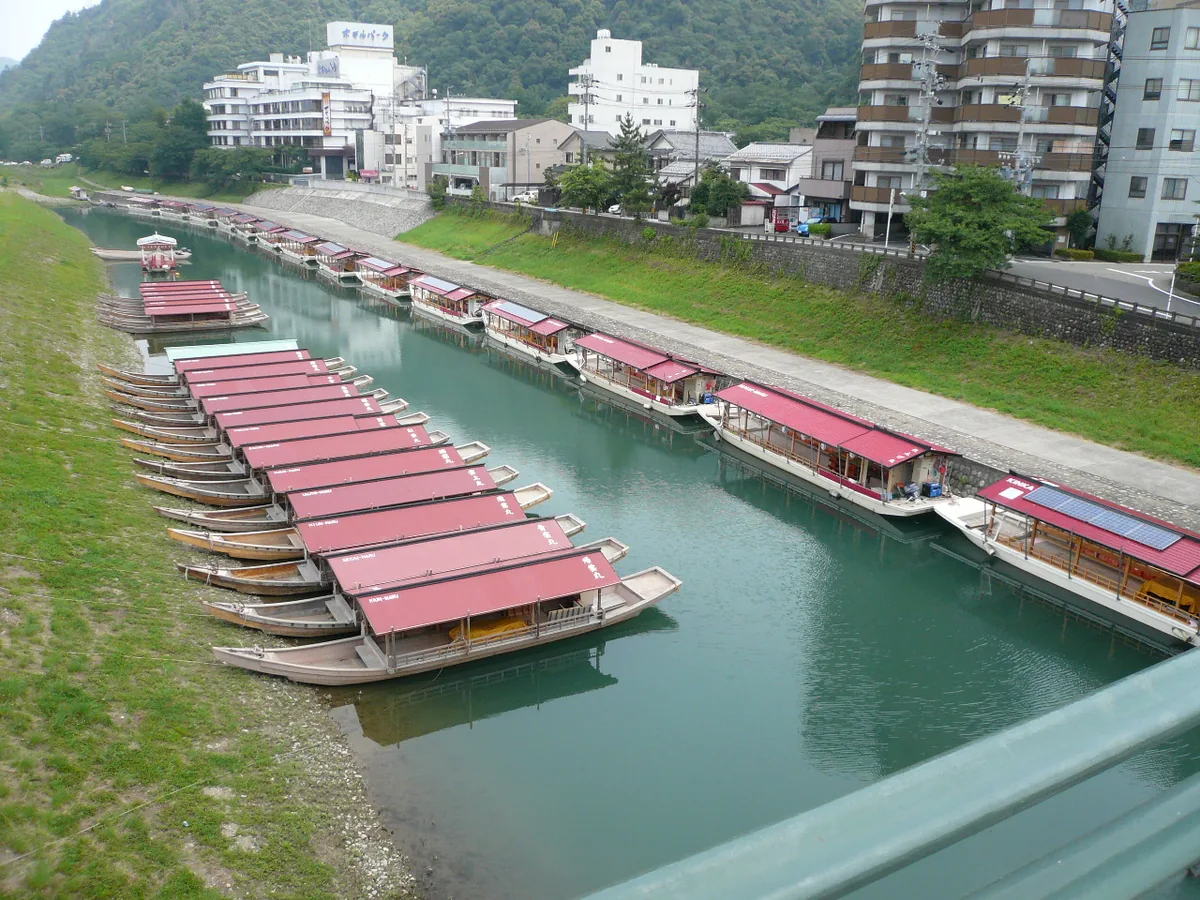
Wooden boats with red awnings lie moored side by side on the Nagara River, below riverside inns and hills. Photo: Douggers at English Wikipedia / CC BY 2.5
What Is Nagara River Cormorant Fishing?
It is a method of night fishing in which a master called an usho handles up to twelve tethered cormorants from a wooden boat, working by the light of a burning basket of pine. On the Nagara it is a designated national cultural property, not a show, and it has been recorded here for well over a thousand years.
The word ukai (鵜飼) simply means using cormorants to catch river fish. What makes the Gifu version particular is who does it, how many birds one person handles, and how old the paper trail is.
Start with the paper trail, because the number you will see everywhere — 1,300 years — deserves an explanation rather than a headline. Gifu City traces it to a household register of 702, held among the Shosoin documents and attributed to Mino Province, naming a person called Ukaibe-no-Mezurame — a surname understood to mark someone from a group whose livelihood was cormorant fishing. The city is careful to call that an inference, and so am I. The register is real; the reading of it is a reasonable deduction; the headline number rests on the deduction.
From there the history is firmer. In 1568 Oda Nobunaga, ruling Gifu from the castle above the river, invited an envoy of Takeda Shingen to watch the fishing — the moment the official history credits with turning ukai from a fishery into hospitality. Tokugawa Ieyasu and his son Hidetada are said to have watched in 1615, after which fermented sweetfish sushi went to the shogun’s household every year. Basho came in 1688 and left the haiku Gifu has quoted ever since: omoshirote / yagate kanashiki / ubune kana — delightful, and then, before long, sad.
Then in 1890 the Imperial Household Ministry designated three stretches of the Nagara as imperial fishing grounds, closed to all other fishing year-round, and attached the masters to its own bureau. That decision is why the job still exists in the form it does. Edward, Prince of Wales, watched in 1922; Charlie Chaplin came twice, in 1936 and 1961.
What it is officially recognised as
This matters more than it sounds, because English-language write-ups get it wrong in a specific and consistent way.
Official designations connected to Nagara River cormorant fishing
Designation
What it covers
Date
Important Intangible Folk Cultural Property (national)
The fishing technique itself (長良川の鵜飼漁の技術)
2 March 2015
Important Tangible Folk Cultural Property (national)
The 122-piece set of fishing equipment
22 April 1955
Important Cultural Landscape (national)
The middle Nagara River landscape at Gifu
18 March 2014
Japan Heritage (Agency for Cultural Affairs)
The “Nobunaga’s hospitality” castle-town story
24 April 2015
Globally Important Agricultural Heritage System
The ayu sweetfish of the clear Nagara
15 December 2015
None of those is UNESCO. Gifu City says on its own front page that it is aiming for UNESCO Intangible Cultural Heritage status — which is exactly the opposite of already having it. If you read that this fishing is UNESCO-listed, that is not coming from Gifu. The 2015 designation was itself a first: the Agency for Cultural Affairs had never before designated a skill tied to farming, forestry or fishing. The equipment listing is no token handful either — 122 items, held at the Gifu City Museum of History, sorted into six categories that the official description gives as the gear used during the fishing season, the gear for feeding the birds, and the tools for making the hand-lines and the straw skirts, among others. Many of the pieces are no longer in use.
When Is the 2026 Season, and What Is Left of It?
The season runs 11 May to 15 October 2026 — the same fixed pair of dates every year. From mid-August onward the whole back half of the season is still to come, with one scheduled closure on 24 September and the last two imperial fishing nights on 20 and 25 August.
Those two dates are not “usually” or “roughly”. They are the dates, every year, and the fishing happens every night in between except when the river is too high. That makes this one of the easiest things in central Japan to build a trip around — and one of the easiest to be caught out by, because it ends abruptly on 15 October with nothing until the following May.
There is exactly one planned closure in a season. The office ties it to the harvest moon, though the pairing is loose rather than exact — Gifu’s tourism association writes it as the one night around the harvest moon — and in 2026 it falls on Thursday 24 September, marked as closed on Gifu City’s own booking calendar. Everything else is a fishing night unless the water says otherwise.
Departure times and what happens when
A normal fishing night, hour by hour
From 15:00
Check-in opens at the Ukai Viewing Boat Office. You must check in at least 15 minutes before your departure time
17:45
A fishing master gives a talk at the pier. Free, drop-in, and not held on imperial fishing nights
18:15 / 18:45 / 19:15
Shared boats depart. Charter boats leave at any time the group picks between 17:30 and 19:15
After departure
The boat moves upstream, then moors to wait. You can step off again until the fishing starts
About 19:45
A firework announces the start. The fishing runs roughly 45–60 minutes
About 20:30
Landing. In practice it can run to about 21:00 in peak season, because boats come back in turn
Here is the single most useful thing on this page: all three shared departures watch the same 19:45 fishing, for the same fare. The only difference is how long you sit on a moored boat beforehand. The office’s own advice: the 18:15 and 18:45 boats give you over an hour to eat on board; on the 19:15 boat, eat first.
Fares
From 2026 the fare splits between normal nights and peak nights.
Shared boat fares, 2026 season (tax included)
Night type
Adult
Child
Normal night
4,200 yen
2,100 yen
Peak night
5,100 yen
2,600 yen
Second run on a noryo night
4,200 yen
2,100 yen
Adult means junior-high age and up; child means three years old to the end of primary school. Under-threes ride free but still count towards the boat’s headcount, so declare them when you book.
The rule for peak nights is 11 May, every Saturday from 13 July to 30 September, plus Obon and Silver Week. The published 2026 list is: 11 May; 18 and 25 July; 1, 13, 14, 15, 22 and 29 August; and 5, 12, 19, 20, 21, 22 and 26 September. June and October have no peak nights at all — which, with the office’s own comment that mid-July to mid-September is the crowded stretch, makes early October the quiet, cheap end of the season.
Charter boats are priced per boat, from 53,600 yen for a 15-seater on a normal night to 216,800 yen for a 50-seater on a peak night. Three premium ones — Shiratsuki, Aiyama and Hanakagari — have bench seating and let you keep your shoes on.
Two kinds of special night
Imperial fishing nights (御料鵜飼 / goryo ukai). Eight times a season the masters work first as Imperial Household Agency officers, catching sweetfish for the imperial table in a normally closed reach of the river. Public viewing only begins afterwards, so the fishing starts about 20:30 and ends about 21:30, the 18:15 boat does not run, and there is no pier talk. Gifu City’s booking calendar marks 20 and 25 August 2026, with none in September or October. Note that the office’s FAQ does not publish these dates and tells you to ring and ask — the calendar is the only place they appear.
Two-run summer nights (納涼鵜飼 / noryo ukai). On selected peak Saturdays the fishing runs twice: first from 19:30 to about 20:20, then a second sailing around 20:40 with fishing from 21:10 to about 22:00. The calendar marks 1, 15 and 29 August and 5, 12 and 19 September, none in October. Be careful — a peak night is not automatically a two-run night. 22 August and 26 September are peak-priced but carry no two-run label.
One date is missing from the peak-night list for a reason: 8 August 2026 was the fireworks night, when only charter boats ran, seats went by ballot and the fare rose by 50 per cent.
Rain, high water and cancellations
The boats are roofed and the fishing runs in the rain. What stops it is the river: heavy rain that raises the water level cancels the sailing. Not theoretical — the operator’s own news feed records cancellations on 26 and 27 June 2026, both for high water.
Cancel on your own account and you pay. For a shared boat: 20 per cent from three days out, 30 per cent the day before, 50 per cent on the day up to departure, and the full fare once the boat has sailed or if you do not turn up. Reducing your party size or changing your date counts as a cancellation too.
What Do You Actually See on the Water?
You see six wooden boats working by firelight, each with a master handling up to twelve birds on hand-lines while a fire basket burns off the bow. The set piece is the finale, sogarami, when the boats line abreast across the full width of the river and drive the fish into the shallows together.
The three formations, and why you cannot choose
The evening is built from named movements, and which ones you get depends on the river and on how many viewing boats are out. The office is explicit that it decides on the night, for safety and sightlines.
狩り下り (karikudari) — the viewing boats run downstream alongside a single fishing boat: fire, birds and master a few metres away and moving with you.
付け見せ (tsukemise) — your boat stays moored and the fishing boats pass in turn. Less kinetic, but you compare all six masters one after another.
総がらみ (sogarami) — the finale, and it always happens. The boats spread across the full width of the river and sweep the fish into the shallows together.
So: either karikudari or tsukemise, then sogarami. Anyone promising the close-run version on a given night is guessing.
The nine people allowed to do this
Six masters work at Gifu; three more work the smaller Oze fishery upstream at Seki. Those nine are the only people in Japan appointed as Kunaicho Shikibushoku Usho — cormorant fishing masters of the Imperial Household Agency’s Board of Ceremonies. The post is hereditary, one man per household, son succeeding father, and cannot be entered from outside.
What the role involves, in the officials’ description, is a set of skills braided together rather than a single trick. A Nagara master handles up to twelve birds at once — the largest number used in any Japanese cormorant fishing. The lines, tanawa, are held in the left hand loosely enough to read each bird through the fingers, and pinned with the thumb when one moves. They tangle constantly, so the master pulls the snarl free with the right hand and returns it to the left, over and over, all night. That repeated action, tanawa-sabaki, is what the designation singles out.
The other detail worth knowing is the neck tie, kubiyui: hemp cord set so a large fish stops at the throat while a small one passes through and is swallowed. The master judges that tension by hand, per bird, before every outing.
The birds, the boats and the fire
The birds are Japanese cormorants — larger and hardier than the great cormorant — caught wild at Ishihama beach in Hitachi, Ibaraki Prefecture. A newly arrived bird is a shintori. Each master keeps more than twenty behind the house, knows them individually, checks throats and bellies every morning, and picks that night’s team daily by condition, temperament, season and the state of the river. They are kept in pairs — katarai — because paired birds stop fighting, and retired birds stay on at the house.
The fire basket off the bow lights the whole scene, and the boat is built around it: about 12 metres long, roughly 90 centimetres across at the middle, in maki timber for lightness and flex. The master’s outfit is protective equipment rather than costume — the kazaori-eboshi headcloth guards against sparks, the black cotton coat keeps the birds from being startled, the straw skirt keeps out the chill.
And the sound: Gifu’s tourism association notes that the masters’ calls of ho, ho and the drumming on the gunwale were chosen for Japan’s list of one hundred soundscapes worth preserving. On a moored boat in the dark, that is what reaches you before the fire does.
How Do You Book, and How Do You Get There from Nagoya?
Book online at the operator’s own site or in person at the office — never by phone. From Nagoya, take JR to Gifu (480 yen, about 20 minutes), then a Gifu Bus service via Nagara Bridge for 250 yen to the Nagarabashi-minami / Kawaramachi stop, one minute from the pier.
Booking, step by step
Both boat types are bookable through the official reservation site, open 24 hours, paid by card in a single payment (Visa, Mastercard, Amex, JCB, Diners). The alternative is the office counter, open for bookings 15:00 to 19:30 in season and taking cash or card. For 2026, online booking opened on 24 February and counter booking in mid-April.
Two warnings for visitors from abroad. The reservation site is in Japanese and requires an account before you can complete a booking — do that on a laptop with a translation tool, not on a phone at Gifu Station. And the discount scheme (700 yen off the adult fare on a normal night, 900 on a peak night) is keyed to Japanese disability certificates, so it will not help most overseas travellers. For the wider itinerary, see our best day trips from Nagoya.
Combining this with more of the city?
Handy if you want to pair the boat ride with other Nagoya-area sights on the same trip.
Gifu is close. JR’s Special Rapid covers Nagoya to Gifu in about 20 minutes for 480 yen (a 470-yen fare plus the 10-yen barrier-free charge). Meitetsu runs Meitetsu Nagoya to Meitetsu Gifu in 29 to 30 minutes for 630 yen with no change, and no reserved-seat ticket is needed in a general car. The two Gifu stations are five minutes apart on foot; if Nagoya’s network is new to you, start with our guide to getting around Nagoya.
From either station, take a Gifu Bus service via Nagara Bridge — the Takatomi-bound services and the anticlockwise city loop, destination numbers N32 to N86 — and get off at 長良橋南・川原町 (Nagarabashi-minami / Kawaramachi), a minute from the pier. The boat office puts the ride at about 20 minutes, the city’s tourism association at 16.
A note from a Nagoya local on the fare, because the official pages disagree. The boat office and Gifu’s tourism association both say 250 yen; one Gifu City page still says 230. The tiebreaker is the bus company: Gifu Bus’s own flat-fare zone map, dated 1 April 2026, puts both “JR Gifu” and “Nagarabashi-minami / Kawaramachi” inside the 250-yen zone. Budget 250 yen each way. The same operator sells a 700-yen day pass for that zone — worth it only if you are also seeing Gifu Park in daylight, since the boat trip alone is 500 yen return.
Driving is discouraged — the office asks visitors to use public transport because the car parks fill. If you must, it is the Gifu Park riverside car park at 310 yen, or the free Kagamiiwa Ryokuchi car park.
Getting back, and getting fed
You land around 20:30, nearer 21:00 in peak season. Buses run to both Gifu stations until just after 22:00, so a same-night return to Nagoya is comfortable — but confirm the last departure with Gifu Bus, and check the last train yourself. The exception is a two-run night: the second run ends about 22:00, the same hour the buses stop. Plan on a taxi, or plan on staying — our guide to hot springs near Nagoya covers the Nagaragawa Onsen district directly above the fishing grounds.
On food: nothing is included and nothing is sold, on the boat or at the pier. You may bring anything aboard, and the office notes that almost no shops near the boarding area sell bento — so buy at Gifu Station, or order delivery. It keeps an English page naming the four caterers that deliver to the pier and take orders in English: Cappou Kishino, Eau et sel (also French), The Nomad Life (also Chinese) and Hiyashitanuki-tengoku Kawaramachi. All require advance reservation.
Or skip the organising: the Omakase Pack bundles a shared-boat seat with a bento and a drink for 7,200 yen (4,700 for children) — Tuesday to Friday only, 18:45 departure only, booked 11 days ahead through the Gifu Convention & Visitors Bureau.
What to bring, and what to know before you sit down
A layer. The office recommends a jacket in May and from September through October — you sit still on water after dark.
Use the toilet before the fishing starts. Some boats have one, and a dedicated toilet boat is moored alongside while you wait, but once the fishing begins there is no access for roughly 45 to 60 minutes.
Expect the floor. Most boats are tatami-style seating; only some have sunken tables or chairs, and only some take a wheelchair — ask the office if either matters.
Leave the cool box. Anything over 30 centimetres a side or 5 kilograms counts as one passenger under small-craft safety rules. No pets, and no smoking on any boat.
Ask for the leaflet. English, Chinese (both scripts) and Korean leaflets are handed out at check-in or on boarding.
Two things about the daytime that will save you a wasted afternoon
A note from a Nagoya local about the view. The classic image of this fishing has Gifu Castle lit on the mountain above the boats. That is not what the 2026 season looks like. The keep and its museum closed for renovation on 19 May 2026 and stay closed until about the end of October 2027. The scaffolding has been going up since late July, and the photograph Gifu City posted on its own castle page on 7 August 2026 already shows the keep hidden behind it; from late August the tower is wrapped in protective sheeting, and the city’s published schedule says it will not be visible at all until about mid-April 2027. The castle’s evening opening this year finished on 6 May. Come for the river, not the skyline; our Gifu City day trip guide covers what is open in the meantime.
The other: the Nagara River sightseeing boat, which several English pages offer as a daytime alternative, ran in 2026 only during the cherry-blossom season and Golden Week — seven days each. It does not operate during the fishing season at all.
What does work is the Nagaragawa Ukai Museum, open in step with the fishing: 1 May to 15 October, daily, 9:00 to 19:00, last entry 18:30, 600 yen for adults and 300 for children aged four to fourteen. Going before your 18:15 boat is the best preparation there is — it explains the neck ties and hand-lines while it is still light.
What Do Visitors and the Officials Say?
No official body publishes a recent attendance figure, so there is no crowd number here. What the officials do say is that mid-July to mid-September is the busy stretch, that May and June are the most comfortable months, and that the fishing has in the past drawn more than 300,000 spectators in a year, in the decade from 1965 to 1974.
I have not been out on a viewing boat myself, so rather than invent an evening, here is where to see the fishing through other people’s eyes first. Gifu City’s own YouTube channel carries several films, embedded on the boat office’s video page — including one on the boatmen’s and boat-builders’ craft, and one following a master through a season’s opening. City footage rather than a tourist’s phone, and the quickest honest look at a night on the water.
The most telling official line is not in the tourism copy but in the practical pages. The office recommends May and June specifically because fewer boats sail and the weather is easier — a rare case of an operator steering you away from its own peak. Read alongside its note that mid-July to mid-September is heavily booked, the signal is clear: if your dates are flexible, the shoulders of the season are the answer, and early October carries no peak-night surcharge at all.
One detail says a lot about how this works: the office states that the sweetfish the birds catch is a luxury product, almost none of which reaches the market, so you cannot eat that night’s catch on the spot.
Frequently Asked Questions
When does Nagara River cormorant fishing run in 2026?
The season runs from 11 May to 15 October 2026, every night. The one scheduled closure is Thursday 24 September. The fishing is also cancelled whenever heavy rain raises the river — it happened on 26 and 27 June 2026.
How much does a viewing boat cost?
A shared boat costs 4,200 yen for an adult and 2,100 yen for a child on a normal night, and 5,100 yen and 2,600 yen on a peak night. Adult means junior-high age and up; child means three to the end of primary school. Under-threes ride free but must be declared. Charter boats run from 53,600 yen per boat.
Do I need to book, and can I book by phone?
You should book, and you cannot book by phone — the office does not accept telephone reservations. Book online at booking.ukai-gifucity.jp, paying by credit card, or in person at the Ukai Viewing Boat Office counter, which takes bookings from 15:00 to 19:30 during the season.
Which departure time should I choose?
All three shared departures — 18:15, 18:45 and 19:15 — watch the same fishing, which starts about 19:45, and all three cost the same. Choose 18:15 or 18:45 if you want an hour or more to eat on board, and 19:15 if you would rather eat before boarding.
Is the fishing cancelled if it rains?
No. The viewing boats have roofs and the fishing runs in the rain. What cancels it is high water: heavy rain that raises the river level stops the boats sailing, and the operator posts the cancellation on its booking site.
Can I watch for free from the riverbank?
Yes. The boats can be seen from the bridge and from the bank, and the office recommends the Nagaragawa Promenade on the north bank upstream of Nagara Bridge. It also says plainly that you will not be anywhere near as close as you are from a viewing boat.
Is Nagara River cormorant fishing a UNESCO World Heritage or Intangible Cultural Heritage?
No. Gifu City states on its official site that it is aiming for UNESCO Intangible Cultural Heritage status, which it does not yet hold. The fishing technique was designated a national Important Intangible Folk Cultural Property on 2 March 2015, and the 122-piece equipment set an Important Tangible Folk Cultural Property in 1955.
Where Can You Check Official Information?
Four organisations publish official information on this, one of them the operator itself. Because sailings are cancelled at short notice for high water, check the booking site on the day you travel rather than relying on anything written in advance, this page included.
The official booking site — reservations, high-water cancellation notices, and the calendar marking each night G (imperial), N (two-run), H (seasonal closure) or X (cancelled).
Gifu City — booking guidance including the full charter-boat price table.
Enquiries: Gifu City Ukai Viewing Boat Office, 1-2 Minato-cho, Gifu 500-8009 · 058-262-0104 · 8:45–17:30, extended to 19:30 in season.
Related Festivals and Guides
Gifu is unusually rich between May and October, and the fishing pairs naturally with the daytime side of the same city.
Gifu City Day Trip from Nagoya — the afternoon before an 18:15 boat, and the state of the castle and Mt Kinka during the renovation
Gifu Nobunaga Festival — the same city in November, honouring the lord who turned this fishing into hospitality in 1568
Gujo Odori — Gifu’s great summer dance, upriver in the same valley; the obvious July or August pairing
Gifu Nagaragawa Fireworks — the same river, 8 August 2026; on that one night the viewing boats run as private charters only, allocated by lottery, at a raised fare
Mino Washi Akari Art Exhibition — washi paper light sculptures at Mino, upriver on the Nagara, from 11 October; the natural next stop once the fishing season closes
Takayama Festival — the prefecture’s headline float festival, with an autumn edition in October