Nabana no Sato (なばなの里) in Kuwana, Mie, lights its winter illumination from October 17, 2026 to May 31, 2027, including what the park calls the largest illumination on water in Japan. This guide covers confirmed dates, the five-tier admission price, verified fares from Nagoya, and the December 23-25 trap.
Every winter the same thing happens in Nagoya. Somebody asks where to see the big illumination, gets pointed at Nabana no Sato, books nothing, turns up on Christmas Eve with an ordinary ticket, and finds the gates shut. This guide is built to stop that. Every date, price and fare below was verified against the operator’s own pages and the bus and rail companies’ fare systems on August 16, 2026 — and where the record is still blank, it says so rather than filling the gap with last year’s answer.
Written by Yuu — a Nagoya native of 35 years. Published August 16, 2026.
This article may contain affiliate links. See our affiliate disclosure for details.
All festival details verified from official sources on August 16, 2026.
What Do You Need to Know in One Minute?
Nabana no Sato is a flower park in Kuwana, Mie, about 35 minutes by direct bus from central Nagoya. Its winter illumination runs October 17, 2026 to May 31, 2027. Admission is 2,500 to 3,200 yen on most dates and includes a spending voucher.
| What | Winter illumination at Nabana no Sato (なばなの里), a flower park inside the Nagashima Resort complex |
|---|---|
| Season | October 17, 2026 – May 31, 2027 |
| Closed | January 6 and 7, 2027 for maintenance. No regular closing days otherwise |
| Hours | Basic listing 10:00–21:00, varying by date and day of week. Last entry 30 minutes before closing. The day-by-day calendar for the season was not yet published on August 16, 2026 |
| Admission | 2,500–3,200 yen depending on date, including a 1,000 yen park voucher and Begonia Garden entry. December 23–25 is a separate 5,000 yen ticketed event |
| Children | Free below elementary-school age. From elementary school upwards, everyone pays the adult price — there is no child rate |
| Theme | Not yet announced for 2026-2027 as of August 16, 2026. The 2025-2026 theme was ZIPANGU |
| Address | 270 Komae, Nagashima-cho, Kuwana City, Mie Prefecture 511-1144. Tel 0594-41-0787, 9:00–21:00, Japanese only |
| By bus from Nagoya | Meitetsu Bus Center platform 22, direct, 1,200 yen, about 35 minutes |
| By train | Kintetsu Nagoya to Kintetsu-Nagashima, 490 yen, then a 250 yen shuttle bus. Only Local and Semi-express trains stop |
| Parking | Free, 5,700 spaces. Coaches and large vehicles pay 2,000 yen during the illumination |
| Rain | Open, and the lights go on as normal |
The one thing to get right: December 23, 24 and 25 are not normal opening days. The park is closed until 15:00, needs a date-specified advance ticket, and will not accept an ordinary advance ticket, a group tour ticket, a membership benefit or the disability discount. If Christmas is the point of your trip, read the Christmas section first.

What Is Nabana no Sato?
Nabana no Sato is a flower park on the Nagashima delta in Kuwana, Mie Prefecture, part of the Nagashima Resort. From mid-October to the end of May it turns its grounds over to an illumination that has run every winter since 2004, counted by the operator as its 22nd edition in 2025.
The setting matters more than the brochures let on. Nagashima sits between the mouths of the Kiso Three Rivers, on flat reclaimed land where the wind comes straight off Ise Bay. To a Nagoya resident this is not a mountain destination or a hot-spring town — it is the open, slightly bleak stretch you cross on the expressway towards Mie, and that flatness is what makes an illumination on this scale possible. The main theme area alone covers 8,000 tsubo, or 26,400 square metres.
The park sits inside a larger complex: Nagashima Spa Land, the Mitsui Outlet Park Jazz Dream Nagashima and the Yuami no Shima bathhouse are all a short bus ride away, which is why many people build a whole day around the area and arrive here only for the evening.
One point of genuine difference explains why the place photographs the way it does. The operator states outright that no projection mapping is used anywhere: everything you see is physical bulbs and LEDs. In a country where most winter light events are now projected video on a building facade, that is why the display reads as depth rather than as a screen.
What Is Confirmed for the 2026-2027 Season?
The dates and the admission prices are confirmed and published. The theme, the day-by-day opening hours, the exact switch-on times and the 2026-2027 shuttle bus timetable are not. That split is unusual for a Japanese attraction and worth understanding before you plan.
The season runs from Saturday, October 17, 2026 to Monday, May 31, 2027. Within that stretch the park closes on Wednesday January 6 and Thursday January 7, 2027 for maintenance. There are no other closing days: the operator keeps no weekly rest day, and there are only two shutdowns all year, the January one and a longer one in July. On those two January dates the local buses to the park do not run either.
Rain is not a reason to cancel. The park’s English guidance says the illuminations look better on wet days because the lights reflect off the ground, and both opening and lighting go ahead as normal. Severe weather is handled separately through the operator’s notice pages.
The theme is genuinely not announced yet. As of August 16, 2026 the operator has published nothing about the 2026-2027 main theme area or the annual theme of the 100-metre tunnel. The theme pages still on the official site describe ZIPANGU, the 2025-2026 main theme — a 35-metre-tall, 155-metre-wide Mount Fuji staged in three acts — and the press page is a season older still. Third-party sellers are worse: one international ticket site was still describing a Mount Fuji theme in August 2026, two seasons out of date. On past timing, expect the announcement from early September 2026.
Opening hours are the other soft spot. The standing description is 10:00 to 21:00, varying by period and day of the week, with entry closing 30 minutes before the park does. But the official calendar had times filled in only up to September 30, 2026; from October 1 onwards the dates are listed with the time fields blank. Check your own date rather than assuming 21:00.
The same applies to the switch-on: there is no fixed lighting time. The park adjusts it to sunset, and publishes the schedule as an image map that had not been updated for the new season. The one figure it does give is for the nightly Twin Trees ceremony, cued by the chapel bell, which its guidance puts at around 17:00 while warning that this shifts without notice.
Why Do December 23 to 25 Need a Different Plan?
Because on those three dates Nabana no Sato is not open in the daytime at all, and your ordinary ticket does not work. It runs as a separate, capped, date-specified event, and every one of the usual discounts and passes is excluded. This catches out more overseas visitors than any other detail here.
The mechanics are simple once written down. On December 23 the park opens 15:00 to 22:00; on December 24 and 25, 15:00 to 23:00. Before 15:00 it is closed. You cannot arrive in the early afternoon, wander the flower gardens, eat, and then stay on for the lights, which is how most people spend a normal illumination evening here.
Entry requires a date-specified advance ticket, sold at FamilyMart and Seven-Eleven and through the Asoview electronic ticket service. It costs 5,000 yen and includes a 2,000 yen park voucher and Begonia Garden entry. A same-day ticket at 5,500 yen exists but is sold at the gate only if any of the capped allocation remains — a fallback, not a plan. Sales open on a designated day in November that the operator had not yet specified in August.
Two exclusions bite hardest. Ordinary advance tickets bought for another date are not valid, and neither are membership benefits or group tour tickets. And the disability discount, which applies for the rest of the season, does not apply on December 23 to 25 — worth knowing before you commit to Christmas rather than, say, the 26th.
What Are the Highlights Inside the Park?
Four things carry the illumination: the main theme area, the water illumination in the central pond, two light tunnels of 200 and 100 metres, and the Begonia Garden. A fifth, the Island Fuji ride, is the only way to see it all from above.
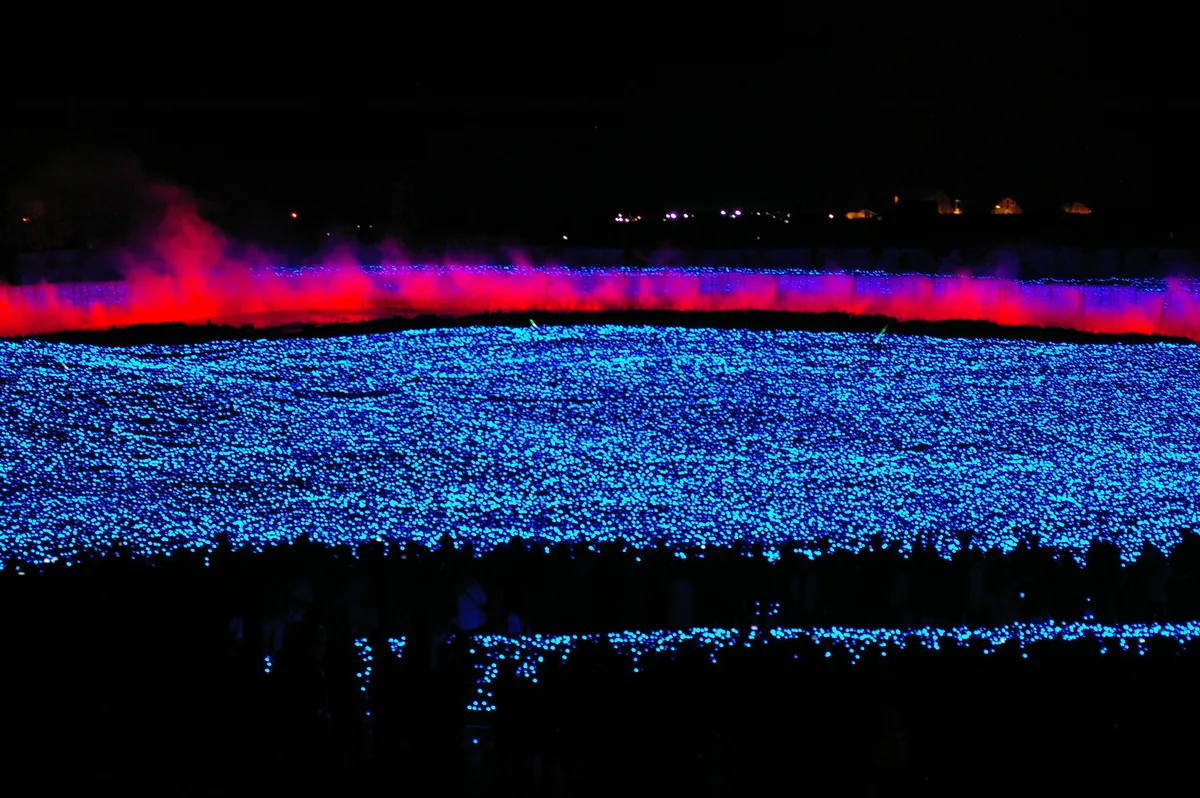
The water illumination, called 光の大河 and rendered by the park itself as “Hikari-no-taiga” (great river of light), is the piece most people remember. It is roughly 8 metres wide and 130 metres long, runs a programme of about 10 minutes, and uses LEDs the operator describes as capable of around 64 billion colours. The imagery draws on the Kiso Three Rivers that surround Nagashima. The park names one viewing spot specifically: the bridge on the far side of the pond from the chapel. It runs from switch-on until closing, so there is no need to rush it.
The 200-metre light tunnel (華回廊) is the signature photograph. Its bulbs sit in petal-shaped sockets that throw a warm, soft light rather than a white one; it first appeared in 2006, was converted to LED in 2017, and stands near the Hanahiroba (花ひろば) flower field. A separate 100-metre tunnel carries a theme that changes every season — “Nami”, waves of light, in 2025-2026. Its 2026-2027 theme is part of the announcement still to come.
The Twin Trees are two natural Himalayan cedars in front of the chapel, each over 20 metres tall, one dressed in crystal white and the other in pastel blue. They were ranked first in western Japan in a Christmas-tree ranking published by NIKKEI Plus 1 on November 21, 2015. An old accolade, but the trees are still where the crowd gathers for the nightly lighting ceremony.
The Begonia Garden (ベゴニアガーデン) is the one visitors underestimate, and the one that solves the biggest practical problem of a winter evening on the delta. It is four linked greenhouses covering about 9,000 square metres, holding some 5,000 pots of tuberous begonias and a standing display of around 600 varieties and 12,000 plants, kept at roughly 26 degrees all year. Entry is included in your admission ticket — worth repeating, because much English-language writing calls it a paid extra. From November 21 to December 22 and from December 26 to February 28, a sound-and-light show runs in the greenhouses after the main switch-on.
Island Fuji is a 45-metre observation ride lasting about seven minutes, running from switch-on until 30 minutes before closing. It costs extra, and the ticket machine takes cash only. It does not run in bad weather.
What Does Admission Cost and How Do You Buy It?
Admission is priced in five bands across the season, from 2,500 to 5,500 yen, and every ticket bundles in a spending voucher and Begonia Garden entry. Buying at a convenience store before you travel is 200 yen cheaper on most dates and saves a queue that the park itself warns can exceed 30 minutes.
| Dates | Convenience store | At the gate | Voucher included |
|---|---|---|---|
| Oct 17 – Nov 20, 2026 | 2,500 yen | 2,700 yen | 1,000 yen |
| Nov 21 – Dec 22, 2026 | 3,000 yen | 3,200 yen | 1,000 yen |
| Dec 23 – 25, 2026 | 5,000 yen, date-specified, compulsory | 5,500 yen, only if stock remains | 2,000 yen |
| Dec 26, 2026 – Feb 28, 2027 | 3,000 yen | 3,200 yen | 1,000 yen |
| Mar 1 – May 31, 2027 | 2,500 yen | 2,500 yen | 1,000 yen |
Two things in that table repay attention. First, the spring band is the only one where the gate price matches the convenience-store price. Second, there is no child rate at all during the illumination: children below elementary-school age enter free, and from elementary school upwards they pay exactly what an adult pays. For a family of four with two school-age children in December, that is 12,800 yen at the gate — not what most European or North American families are braced for.
The voucher, called 金券 in Japanese, is not a discount and is not the admission fee under another name, a confusion that turns up regularly in English write-ups. It is a 1,000 yen credit you receive with your ticket and spend inside the park. Some vending machines will not take it, it carries an expiry date, and it is not refundable.
The park’s buying advice is emphatic: issue your ticket at a FamilyMart or Seven-Eleven before you arrive, because gate issuance can take more than 30 minutes on a busy night. A ticket bought on the day is fine — the point is where you buy it, not when. Whether those terminals can be driven in English is not published, so allow translation-app time.
One route skips the ticket entirely. Reserve a set course in advance at one of four restaurants inside the park — Italian Mugi (イタリアン麦), Yoshoku Marseille (洋食マルセイユ), Nihon Ryori Hisui (日本料理翡翠) or Chugoku Ryori Tosen (中国料理桃仙) — and admission is waived; you give the restaurant and booking name at the gate information desk. Same-day reservations do not qualify, no voucher comes with it, and the park warns you not to buy an advance ticket as well, because it cannot be refunded. Course prices during the illumination are not published, so investigate this one by phone. A similar warning applies at the Nagashima Resort official hotels: the operator tells those guests not to buy advance tickets, so check with your hotel first.
How Do You Get to Nabana no Sato from Nagoya?
Two realistic options without a car. The direct highway bus from Meitetsu Bus Center takes about 35 minutes for 1,200 yen and needs no reservation. Or take a Kintetsu train to Kintetsu-Nagashima for 490 yen and a 250 yen shuttle bus from outside the station.
| Route | Adult | Child | Time |
|---|---|---|---|
| Meitetsu Bus Center → Nabana no Sato, direct highway bus, route 661 | 1,200 yen | 600 yen | 35 min out, 40 min back |
| Kintetsu Nagoya → Kintetsu-Nagashima, Kintetsu Nagoya Line | 490 yen | 250 yen | about 25 min on a Semi-express, per the park |
| Kintetsu-Nagashima Station → Nabana no Sato, shuttle bus | 250 yen | 130 yen | about 10 min, per the park |
| Nagashima Onsen → Nabana no Sato, local bus | 550 yen | 280 yen | 15 min |
| Nagoya by car, expressway | Parking free | about 30 min | |
Those fares come from the operators themselves — Mie Kotsu, trading in English as Sanco, for the buses and Kintetsu for the train — not from the park’s access page, which prints two different figures for the Meitetsu bus and an out-of-date one in its English text. One condition on that bus is worth knowing before you rely on it: no reservation is taken, but because it runs on the expressway there is no standing room, so a full departure means waiting for the next one.
The single most important rail detail: Kintetsu-Nagashima Station (近鉄長島駅, station number E12) is served only by Local and Semi-express trains. Express and Limited Express services run straight through. A weekend timetable check on Kintetsu’s English station page returns 41 Local and 27 Semi-express departures and zero Express. If you board a Limited Express at Kintetsu Nagoya expecting to get off at Nagashima, you will not be able to. In past seasons the park advertised a handful of Express trains making a special weekend stop during the illumination, but nothing has been announced for 2026-2027, so plan on a Semi-express.
Three access myths are worth killing off. There is no bus from Kuwana Station during the illumination season, in either direction — for Kuwana, take the shuttle to Kintetsu-Nagashima and ride one stop. JR Nagashima Station is not Kintetsu-Nagashima Station; they are separate, and arriving on the JR Kansai Line means walking between them, which matters on a rail pass. And the direct bus from Chubu Centrair International Airport is suspended for the time being.
The 2026-2027 shuttle timetable had not been published as of August 16, 2026; the operator’s page still carried the previous season’s schedule, marked current to September 2025. Its English guidance says the shuttle runs every 20 to 60 minutes or so, with the last departure tied to closing time. Check it before committing to a late train connection.
By car it is about 30 minutes from Nagoya via Wangan-Nagashima IC on the Isewan-wangan Expressway; the park recommends approaching by Route 23 and that expressway, and warns that Route 1 and the Higashi-Meihan Expressway get congested. Parking is free, with 5,700 spaces, while coaches and large vehicles pay 2,000 yen during the illumination. The operator advises arriving by 16:00 on weekdays or 15:00 at weekends, and leaving after 19:00 on weekdays or 20:00 at weekends, though it says itself that this does not hold on the busiest dates.
Building the trip around this?
Handy if you want tours or day trips booked around the wider Central Japan route.
What Should You Know Before You Go?
Dress for a river delta rather than for a city, use the Begonia Garden to sit out the crush around switch-on, and carry some cash. The park’s own crowd advice is better than most visitors realise and costs nothing to follow.
On the cold: anyone who has driven the Isewan-wangan Expressway in January knows how exposed this delta is, with nothing between you and the wind off Ise Bay. It is reliably harder going than an evening in central Nagoya, and the walking distances inside the park are real — 200 metres of tunnel is 200 metres. Gloves, a hat and something windproof, not just warm.
On the crowds: the operator advises staying inside the heated Begonia Garden from before the switch-on until roughly 30 minutes after, then coming out once the paths have thinned. It publishes this as advice for visitors with pushchairs and wheelchairs, but it works for everybody, and it turns the worst 45 minutes of the evening into the most comfortable. There is also a day-by-day congestion forecast page.
On accessibility, money and language: wheelchairs are lent free at the gate, around 20 of them, first come and not reservable. The operator publishes downloadable guide maps in English, Korean, simplified and traditional Chinese and Portuguese, plus a separate night-time map — worth downloading before you lose signal in a crowd. Island Fuji’s ticket machine takes cash only, and the telephone line, 0594-41-0787, is answered 9:00 to 21:00 in Japanese only, so a same-day question is better sent through the website if you have no Japanese.
One last piece of sequencing. If you are combining this with the Mitsui Outlet Park Jazz Dream Nagashima, shop first and see the lights second: the local bus between Nagashima Onsen and Nabana no Sato takes 15 minutes and costs 550 yen, but some extra-service buses skip the Nabana no Sato stop, so read the destination board.
What Do Visitors Say, and Has the Author Been?
Honest answer first: this guide is desk-verified, not a visit report. I have not walked the illumination at Nabana no Sato myself, and the 2026-2027 season has not started, so I will not dress up second-hand impressions as my own evening out.
What I can tell you is what the operator chooses to emphasise, which is revealing. It leads with the absence of projection mapping, the scale of the water display, and the fact that the Begonia Garden is warm — the arguments of a business that knows its audience arrives cold, in a queue, in the dark, and that the gap between a good evening here and a bad one is logistical rather than aesthetic.
Rather than paraphrase strangers’ reviews, watch the operator’s own channels before you travel: that is where the theme announcement, the daily hours and the shuttle timetable appear first. Nagashima Resort posts to Instagram, X, Facebook and YouTube under one resort-wide account, and its press releases go out through Kyodo News PR Wire.
Frequently Asked Questions
When is the Nabana no Sato illumination held in 2026-2027?
The 2026-2027 season runs from October 17, 2026 to May 31, 2027, and the park closes for maintenance on January 6 and 7, 2027. There are no regular closing days, and the illumination is switched on in the rain as well. Daily opening hours for the season had not been published as of August 16, 2026.
How much does it cost to get into Nabana no Sato?
Admission runs from 2,500 yen to 3,200 yen depending on the date, rising to 5,000 or 5,500 yen for the Christmas special opening on December 23 to 25. Every ticket includes a 1,000 yen voucher to spend inside the park, 2,000 yen at Christmas, plus entry to the Begonia Garden.
Do I need to buy a ticket before I arrive?
The park asks you to buy and print your ticket at a FamilyMart or Seven-Eleven before you come, and warns that issuing a ticket at the gate can take more than 30 minutes. For December 23 to 25 a date-specified advance ticket is not merely recommended but compulsory, and same-day tickets are sold only if any remain.
Why can I not visit Nabana no Sato in the daytime on December 23 to 25?
The park closes until 15:00 on those three dates and reopens as a separate ticketed event: 15:00 to 22:00 on December 23, and 15:00 to 23:00 on December 24 and 25. Ordinary advance tickets, member benefits, group tour tickets and the disability discount are all invalid on those dates.
How do I get to Nabana no Sato from Nagoya without a car?
Two ways. Take the direct highway bus from Meitetsu Bus Center, platform 22, for 1,200 yen and about 35 minutes. Or ride the Kintetsu Nagoya Line to Kintetsu-Nagashima for 490 yen and change to the 250 yen shuttle bus. Only Local and Semi-express trains stop at Kintetsu-Nagashima.
Is the Begonia Garden included in the admission price?
Yes. Entry to the Begonia Garden is included in the Nabana no Sato admission ticket, whether you bought it at a convenience store or at the gate. The 1,000 yen adult charge you may see quoted is the standalone rate for people arriving without an admission ticket. The greenhouses are kept at around 26 degrees all year.
What is the theme of the 2026-2027 illumination?
It had not been announced as of August 16, 2026. The park publishes a new main theme area each season, and the theme for 2025-2026 was ZIPANGU, staged around a 35 metre Mount Fuji. Announcements have tended to appear from early September, so check the official site before you build a trip around a particular theme.
Where Can You Check Official Information?
Three organisations hold everything in this guide: the park operator, the bus company and the railway. Nothing here comes from a listing site, and for the items still unannounced these are the pages that will change first.
- Illumination portal, first to change when the theme is announced: https://www.nagashima-onsen.co.jp/nabana/illumination/index.html
- Hours and admission, the source of every price here: https://www.nagashima-onsen.co.jp/nabana/illumination/fee/index.html
- Opening calendar, where day-by-day hours from October 2026 will appear: https://www.nagashima-onsen.co.jp/nabana/fee/calendar/index.html. Closure dates sit on the parent page, https://www.nagashima-onsen.co.jp/nabana/fee/index.html
- Access, good for route shapes but check fares against the operators below: https://www.nagashima-onsen.co.jp/nabana/illumination/access/index.html
- Switch-on times: https://www.nagashima-onsen.co.jp/nabana/illumination/info/illumi_tentou_time.html, plus notices and congestion forecasts at https://www.nagashima-onsen.co.jp/nabana/illumination/info/index.html
- Begonia Garden: https://www.nagashima-onsen.co.jp/nabana/flower/garden/index.html, and guide maps at https://www.nagashima-onsen.co.jp/nabana/guide/index.html
- Mie Kotsu (Sanco), for every bus fare quoted here: https://www.sanco.co.jp/
- Kintetsu Railway, English site: https://www.kintetsu.co.jp/foreign/english/
- Enquiries: 0594-41-0787, 9:00 to 21:00, Japanese only
A warning about the official site itself. Several pages still carry the previous season’s content — the theme pages, the switch-on times, the shuttle timetable and the access page all describe 2025-2026 — and the January closure dates appear in three different forms across the site, two of them with the wrong year. Check the season label at the top of any page before relying on it. The dates in this guide were reconciled against the maintenance-closure listing, the only page giving the year and the day of the week together.
Related Guides
- Nagoya in Winter — what else the region offers between December and February
- Nagoya Christmas Markets and Winter Illuminations — the city-centre alternatives, none of which shut at 15:00 on Christmas Eve
- Best Day Trips from Nagoya — where Nagashima sits among the other one-day options
- Ise Grand Shrine Day Trip from Nagoya — further down the same Kintetsu line, if Mie gets two days
- Central Japan Festival Calendar — every major regional event, month by month
- Best Time to Visit Nagoya — seasonal trade-offs, including why mid-October now catches opening night
- Getting Around Nagoya — IC cards, the Kintetsu and Meitetsu networks, and the bus centre this trip starts from