Magome and Tsumago are two preserved post towns on the old Nakasendo highway, linked by a 9 km mountain trail over the 790-metre Magome Pass. Magome is in Gifu, Tsumago in Nagano. This guide covers the walk, the bus times that constrain it, and how to do it from Nagoya in a day.
Written by Yuu — a Nagoya native of 35 years. Published August 16, 2026.
This article may contain affiliate links. See our affiliate disclosure for details.
All details verified from official sources on August 16, 2026.

What are Magome and Tsumago?
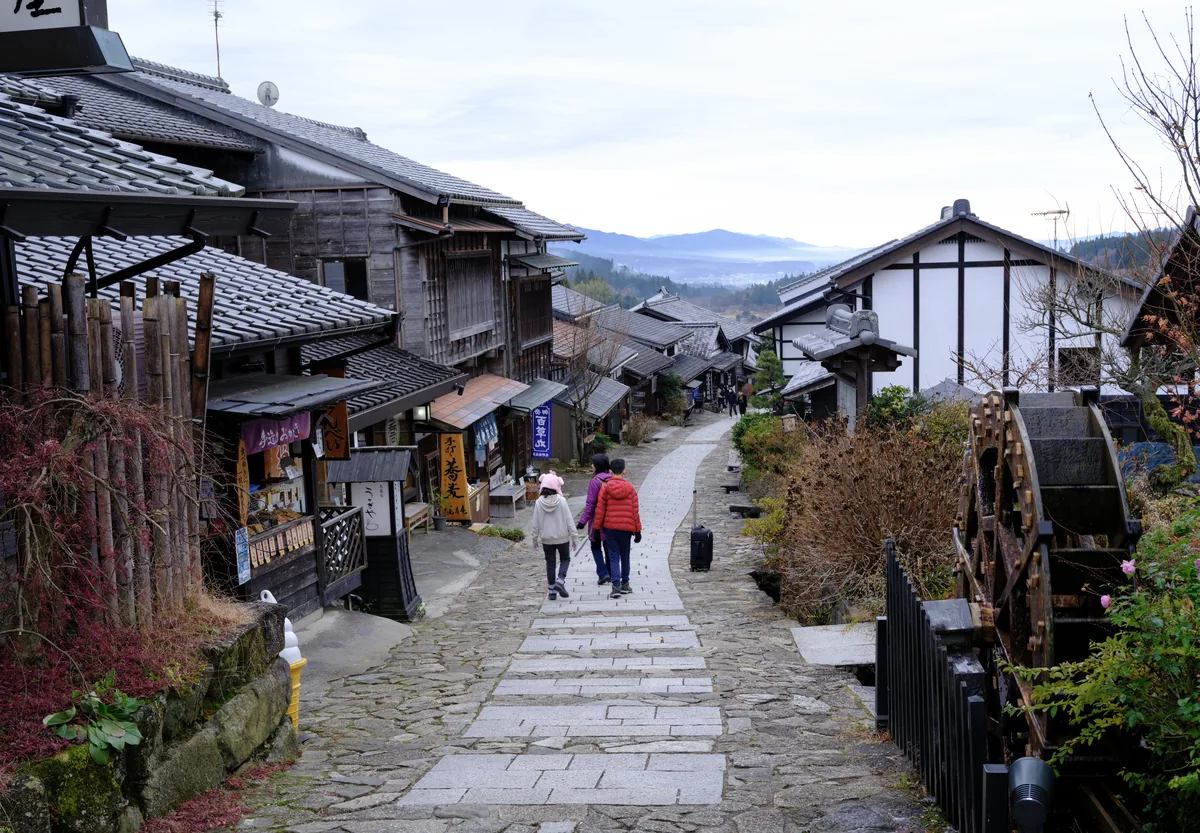
They are two adjacent post towns on the Nakasendo, the Edo-period highway between Edo and Kyoto. Tsumago was the 42nd of the road’s 69 stations counted from Edo and has been a national preservation district since 1976. Magome is its neighbour over the pass.
Start with the geography, because English-language pages often blur it. Magome-juku (馬籠宿) is in Gifu Prefecture, in the city of Nakatsugawa; Tsumago-juku (妻籠宿) is in Nagano Prefecture, in the town of Nagiso, and the trail crosses the border at the top of Magome Pass. Magome was Nagano territory until 2005, when the former village of Yamaguchi was transferred into Nakatsugawa, which is why guides still file the pair under “southern Nagano”.
The word juku (宿) means post station: a licensed stopping place with designated lodgings, stables and porters. The Nakasendo had 69, linking Edo, now Tokyo, with Kyoto by an inland route, and because it threaded the deep mountains of the Kiso district it was also called the Kiso Kaido — Nakasendo, Kisoji and Kiso Road are one road and its nicknames.
Why Tsumago looks the way it does
Tsumago is not a film set. In the late 1960s, while the rest of Japan was demolishing anything old, the residents went the other way. The Association to Love Tsumago was founded in 1968, and in July 1971 the residents declared a charter covering the buildings, plots, farmland and forest along the old highway: 売らない, 貸さない, こわさない — not to sell, not to rent out, not to destroy. Those rules still hold, and people live in these houses.
National recognition followed. On September 4, 1976 Tsumago-juku was selected as an Important Preservation District for Groups of Traditional Buildings in the post town category, covering 1,245.4 hectares — a figure taking in the surrounding natural setting, not that much old housing. You will read that it was Japan’s first such district; it was one of the first four, sharing that date with Kakunodate, the Sanmachi district of Takayama and Horiuchi in Hagi. The system was a year old, created by the 1975 revision of the cultural properties law, and by August 2024 covered 129 districts.
Magome, by contrast, is a slope: Nakatsugawa City calls it a nationally rare post town on a hill, a stone-paved incline lined with restaurants and shops. Tsumago is walked on the flat; Magome uphill, and it is the livelier of the two.
How do I hike the Magome to Tsumago trail?
The trail is about 9 km (5.6 miles) and takes 2.5 to 3 hours over Magome Pass, at 790 metres (2,592 feet). Both tourist associations agree on the distance. Start by 3pm in summer or 2pm in winter, because there is no lighting on the route.
You will see 8 km quoted on English travel sites and 7.8 km in tour operators’ copy, neither figure from the people who maintain the path.
Which direction to walk
Most people walk Magome to Tsumago and justify it by saying it is downhill. Officially it is not: Magome-juku to the pass is a short steep climb, while Tsumago-juku to the pass is a long gentle one, so from Magome you get a sharp ascent then a long descent. The better reason to go this way is timing — you reach Tsumago once the coach parties have thinned. There is also an official short version, the energy-saving course: bus up to the pass and walk down only, a gentle 1.5 hours into Tsumago.
Send your bag ahead for 1,000 yen
This is the most useful thing to know before you come. The forwarding service runs a scheduled daily van, the teikibin, which for 2026 operates March 20 to November 30 at 1,000 yen per item. Hand the bag over between 8:30 and 11:30 and collect it between 13:00 and 17:00 the same day, at either tourist information office, Magome-juku BASE or the inns of Otsumago, in either direction.
Do not confuse it with the rinjibin, the on-demand run: 4,500 yen per trip for up to three bags, plus 1,000 yen per extra bag, covering the hours after the 11:30 cut-off and the closed season from December 1 to March 19. Several English guides quote 4,500 yen as the normal price; three independent official sources publish 1,000 yen per bag for the scheduled van.
| Service | Price | Times |
|---|---|---|
| Magome to Tsumago forwarding, scheduled van | 1,000 yen per bag | Drop 8:30 to 11:30, collect 13:00 to 17:00 same day, March 20 to November 30 |
| Magome to Tsumago forwarding, on-demand run | 4,500 yen per trip for up to 3 bags, plus 1,000 yen per extra bag | 8:30 to 17:00, covering 11:30 to 17:00 and December 1 to March 19 |
| Day storage, Nakatsugawa City tourist office beside JR Nakatsugawa Station | 700 yen per bag, or 500 yen for up to 2 hours | 9:00 to 17:00 |
| Day storage, Magome tourist office and Magome-juku BASE | 500 yen | Accepted 8:30 to 16:30 |
| Inn-to-inn transfer along the Kisoji, Walk Lite Nakasendo | From 2,750 yen per item | Nakatsugawa Station area to Matsumoto, by arrangement |
Walking the trail you want forwarding; riding back, storage. Our guide to luggage forwarding in Japan covers the nationwide system.
What is on the route
Roughly halfway, at Ichikokutochi (一石栃立場茶屋), a mid-Edo building stands on the site of a former checkpoint. The Magome association describes going inside for a cup of tea; the Tsumago association calls it a free rest house. Neither publishes hours or a price, so treat it as a roof and a bench rather than a guaranteed stop. Below the pass are Odaki and Medaki (男滝・女滝), the male and female waterfalls, where Medaki is the taller at 12 metres and Odaki drops 10. At the pass, on the prefectural border, stands a haiku stone by Masaoka Shiki.
Bears, wet stone and what actually goes wrong
The Nagiso town tourism association states that black bears are sighted within the town every year and recommends carrying something that makes noise, and the associations run a bear bell rental for that purpose. You pay 2,100 yen and get 2,000 yen back on return, so it costs 100 yen; pick up and drop off in either direction at the Tsumago tourist information office on 0264-57-3123, the Magome office on 0573-69-2336, or Magome-juku BASE on 0573-64-2750. No sighting statistics are published, so I will not quote odds — only note that the people who maintain the path built a rental scheme around it.
In a notice dated May 18, 2026 the association reported walkers hurting their feet on the stone paving from Koshinzuka (庚申塚) at Otsumago towards Magome, where the footing is poor and turns slippery after rain, and asked people to use the handrails. June and July are the wettest months here.
The official kit list is short: water, bear bell, a bag for your rubbish, rain gear, sunscreen, towel and insect repellent, plus shoes or boots — not sandals or heels. There is nowhere to shelter from rain. On accessibility the official position is unambiguous: the Magome association asks that wheelchairs and pushchairs not be brought onto the trail, advises that children of three and under be carried, and tells walkers to use the buses rather than push on when struggling.
One reward at the end: a hinoki cypress completion certificate, sold at either tourist office for 300 yen, or 150 yen with a hiking voucher from a local inn.
What should I see in Magome?
The Toson Memorial Museum, on the site of the Shimazaki family home and Magome’s former honjin, at 500 yen for adults. Beyond it, the stone-paved slope itself, two small private collections, and the lookout above the village facing Mt Ena.
Magome’s asset is a writer. Shimazaki Toson was born here, and the Toson Memorial Museum (藤村記念館) stands on the Shimazaki family plot, which was also the site of the Magome-juku honjin (本陣) — the inn officially designated for daimyo and government officials. It displays manuscripts including Before the Dawn and The Eastern Gate, and has reconstructed the study at Oiso where he died.
Admission is 500 yen for adults, 400 yen for high school and university students, and 100 yen for elementary and junior high pupils whatever the group size; adult groups of 20 to 29 pay 450 yen and adult parties of 30 or more 400 yen. Both the museum and Nakatsugawa City publish 500 yen; a well-known booking portal still lists 550. Hours change with the season: April to November 9:00 to 17:00, last admission 16:45; December to March 9:00 to 16:00, last admission 15:45. It closes on Wednesdays, but only from December to February.
Two smaller collections sit on the same slope: the Magome Wakihonjin Shiryokan (馬籠脇本陣史料館), open 9:00 to 17:00, and the Shimizuya Shiryokan (清水屋資料館), open 8:00 to 17:00, or 8:30 to 16:30 from December to March, and showing letters in Toson’s hand. Both list irregular closing days and neither publishes a price.
Neither official site lists an observation deck in Magome, whatever some listings say. What exists is a lookout on the high ground above the village at Magome Kamijinba (馬籠上陣場), looking out to Mt Ena (恵那山).
The Magome tourist association also takes bookings for a guide at 2,000 yen per guide per hour, on 0573-69-2336. No English-language service is advertised.
Vehicles are banned from the streets of both towns between 10:00 and 16:00, in Tsumago under a public safety commission order and in Magome from the upper to the lower entrance.
Building more into the trip?
Handy if you want tours or day trips booked around the wider Central Japan route.
What should I see in Tsumago?
The Wakihonjin Okuya, a national Important Cultural Property built of solid cypress in 1877, together with the history museum, on a single 800 yen ticket. The reconstructed honjin next door has been free since April 2026. Allow an hour and a half.
Those three buildings are run together as the Nagiso Town Museum (南木曽町博物館), established on April 1, 1995.
The wakihonjin (脇本陣) was a post station’s second official inn. Tsumago’s was held by generations of the Hayashi family, who brewed sake and traded under the shop name Okuya (奥谷). The building dates from 1877, put up in solid hinoki cypress once the ban on felling the protected Kiso trees was lifted — which is why a modest merchant’s house is built of a timber that had until recently been effectively illegal to cut. It opened to the public in 1967 and was designated a national Important Cultural Property in 2001, a lower grade than National Treasure.
The honjin next door connects the two towns. It was held by the Shimazaki family — a different branch of Magome’s. Its last head, Hirosuke, was Shimazaki Toson’s elder brother, adopted from the Magome Shimazakis by his mother’s brother. In the Meiji 20s, the decade from 1887, he left for Tokyo and the building was pulled down; in 1995 it was reconstructed from late-Edo floor plans, so it is a reconstruction rather than a surviving Edo structure.
Prices changed on April 1, 2026, and most third-party listings still show the old numbers.
| Ticket | Adult | Child, elementary and junior high |
|---|---|---|
| Wakihonjin Okuya and history museum | 800 yen | 400 yen |
| Same, groups of 20 or more | 700 yen | 350 yen |
| Same, visitors with a disability | 400 yen | 200 yen |
| Tsumago-juku honjin | Open free of charge | Open free of charge |
The combined three-building ticket older guides mention at 700 yen no longer exists; the honjin was made free instead. Anyone quoting 600 yen for the Okuya or a 700 yen combined ticket is working from pre-April 2026 information.
Opening hours are 9:00 to 17:00, with the desk closing at 16:45. The museum shuts on the second and fourth Thursday of each month, opening as normal if that Thursday is a public holiday, and from December 29 to January 3. A second-Thursday arrival with no plan B is the easiest way to waste this trip.
If you drive, Tsumago’s car parks cost 500 yen a day, with no time limit and no reservations; the central lot, which holds 75, is signposted for wheelchair users. Drive here and walk one-way to Magome, though, and you have to come back for the car on a bus that runs four times a day.
How do I get there from Nagoya?
Take a JR Chuo Line rapid from Nagoya to Nakatsugawa, 1,340 yen and about 1 hour 15 minutes with no change, then a Kitaena Kotsu bus from stop 3 to Magome, 800 yen and about 25 minutes. Return from Nagiso Station.
Nagoya to Magome
A Chuo Line rapid for Nakatsugawa runs direct from Nagoya with no transfer for 1,340 yen, and JR Central’s own journey search returns 1 hour 13 minutes for a mid-morning departure, 09:23 arriving 10:36. To start at the Tsumago end instead, the through fare from Nagoya to Nagiso is 1,690 yen, about two hours by rapid and local with a change at Nakatsugawa; a Shinano limited express as far as Nakatsugawa cuts that to 1 hour 18 minutes but adds a 1,930 yen express charge, making 3,620 yen. Our JR pass guide for central Japan is where to work out what a pass covers.
At Nakatsugawa the buses leave from stop 3 in front of the JR station, by the Nigiwai Plaza building. Take the Kitaena Kotsu Magome Line, route letter M, signed for Ochiai and Magome, and ride to the terminus: 800 yen, about 25 minutes. On the weekday timetable in force since October 1, 2025 there are twelve departures from Nakatsugawa, first at 07:42 and last at 18:30, and fourteen back, from 07:00 to 18:15. Weekends and holidays differ and the schedule is usually revised each October 1, so check the operator’s page for your date rather than trusting any printed time, including mine.
Kitaena Kotsu also runs a Sakashita Line that skips Magome entirely, from Nakatsugawa to Tsumago for 1,400 yen and on to Nagiso Station for the same fare.
Getting back, and the four buses that govern everything
From Tsumago, Nagiso Station is 300 yen and seven to nine minutes on the community bus, about 10 minutes by taxi with Nagiso Kanko Taxi on 0264-57-3133 between 7:00 and 19:00, or about 40 minutes on foot. From Nagiso the through fare back to Nagoya is 1,690 yen.
Now the part most guides leave out. The bus connecting Nagiso Station, Tsumago, the pass and Magome is the Nagiso town community bus, run by Ontake Kotsu, and it goes four times a day in each direction. A fifth service runs only from April 25 to May 6 and from July 25 to August 23.
| Stop | Run 1* | Run 2 | Run 3 | Run 4 | Run 5 |
|---|---|---|---|---|---|
| Nagiso Station, departs | 8:40 | 10:10 | 12:40 | 14:15 | 16:35 |
| Tsumago | 8:47 | 10:17 | 12:47 | 14:22 | 16:42 |
| Magome Pass | 9:03 | 10:33 | 13:03 | 14:38 | 16:58 |
| Magome, arrives | 9:15 | 10:45 | 13:15 | 14:50 | 17:10 |
| Magome, departs | 9:25 | 10:55 | 13:25 | 15:00 | 17:15 |
| Magome Pass | 9:36 | 11:06 | 13:36 | 15:11 | 17:26 |
| Tsumago | 9:51 | 11:21 | 13:51 | 15:26 | 17:41 |
| Nagiso Station, arrives | 10:00 | 11:30 | 14:00 | 15:35 | 17:50 |
Read that table as a set of deadlines: it is the bus to the pass for the downhill-only course, the bus if the weather turns, and the bus out of Tsumago at the end. Miss the 15:26 and the next is 17:41.
Fares changed on April 1, 2026 and are zonal: 300 yen for adults within the town, between Nagiso Station and Ichikoku, 300 yen for the out-of-town section between Magome Pass and Magome, and 1,000 yen from Nagiso Station across into the out-of-town section. Children pay 100 yen within a zone and 500 yen across. The published table does not spell out the fare from Tsumago to Magome, so ask at the tourist office instead of guessing. Figures of 800 yen from Nagiso to Magome, or 600 yen from Tsumago to Magome, are pre-April 2026 and still circulating in journey-planner apps.
If that is a lot of moving parts, a guided tour is a legitimate alternative: our rundown of bookable day trips from Nagoya covers what the marketplaces sell on this route.
When should I go?
Late spring and autumn. The Japan Meteorological Agency’s normals for Nagiso give April a mean of 10.2C and October 13.7C, both comfortable for a 9 km walk, while July brings 365.8 mm of rain and January averages below freezing at minus 0.6C.
The weather station is at Nagiso, on the Tsumago side, at around 420 metres. The pass is 370 metres higher and colder, but there is no observation point up there, so I will not invent a figure for it.
| Month | Mean | Daily maximum | Daily minimum | Rainfall |
|---|---|---|---|---|
| January | minus 0.6C (31F) | 4.6C (40F) | minus 4.5C (24F) | 107.5 mm |
| April | 10.2C (50F) | 17.3C (63F) | 4.2C (40F) | 181.0 mm |
| July | 22.6C (73F) | 28.3C (83F) | 18.7C (66F) | 365.8 mm |
| August | 23.5C (74F) | 30.0C (86F) | 19.5C (67F) | 245.9 mm |
| October | 13.7C (57F) | 20.0C (68F) | 9.5C (49F) | 186.2 mm |
| December | 1.9C (35F) | 7.2C (45F) | minus 1.8C (29F) | 111.6 mm |
| Year | 11.5C (53F) | 17.7C (64F) | 7.0C (45F) | 2,381.2 mm |
Summer is walkable but wet. July is the wettest month at 365.8 mm, in a valley taking 2,381.2 mm a year, and that rain lands on the hazard flagged in May 2026: stone paving that turns slippery. August is the hottest, averaging a daily maximum of 30.0C, and it is when the fifth bus stops running, on August 23.
Winter needs planning rather than avoiding. January averages minus 0.6C with a daily minimum of minus 4.5C, which is why the last permitted start moves back to 2pm. Three other things change: the luggage van stops on November 30 and only the pricier on-demand run operates until March 19; the Toson Memorial Museum closes an hour earlier and shuts on Wednesdays; and the Nagiso Town Museum closes from December 29 to January 3. For the region in the cold season, Nagoya in winter and the Gero Onsen guide are gentler propositions. For autumn colour the valley peaks later than the city, and if your dates are fixed you may do better at Korankei.
What should I check before I go?
Three things, in this order: the Nagiso town tourism association’s hiking notices for trail warnings, the Nagiso Town Museum calendar for second and fourth Thursdays, and the current bus timetables, which are revised each October and each April.
I have not walked this trail. Everything here comes from the two tourist associations, the Nagiso town office, Nakatsugawa City, the bus operators, the Agency for Cultural Affairs and the Japan Meteorological Agency, checked on August 16, 2026. Where those sources are silent — the fare from Tsumago to Magome, the price of the tea at Ichikokutochi, whether the Magome guides speak English — I have said so instead of guessing.
One warning concerns a link rather than a place. Reach the Tsumago tourist association through the addresses in the table below, tsumago.jp and nagiso.jp, rather than through a link copied from an older English guide or forum post. A lapsed address that circulated for years as the association’s own has been taken over and now serves adult content, and because it still returns a normal response, automated link checkers do not flag it.
Both associations run Instagram feeds reachable from their own home pages, and the Nagiso site carries a live feed beside its walking notices — the fastest way to see current trail conditions and bear warnings. I am not printing handles, because I could not confirm the account names from an official page. Check anything you read in traveller posts against the sources below.
What else do visitors ask about Magome and Tsumago?
How long does the Magome to Tsumago hike take?
Between 2.5 and 3 hours for the full 9 km over Magome Pass: the Magome tourist association publishes about three hours, the Tsumago association two and a half to three. A shorter option is to bus up to the pass and walk down only, a gentle 1.5 hours. There is no lighting, so the last permitted start is 3pm in summer and 2pm in winter.
Which direction should I walk, Magome to Tsumago or the other way?
Magome to Tsumago is the usual choice, but not because it is downhill. Officially, Magome-juku to the pass is a short steep climb while Tsumago-juku to the pass is a long gentle one, so starting at Magome means a sharp ascent then a long descent. The better reason is reaching Tsumago in the quieter afternoon.
Can I send my luggage between Magome and Tsumago?
Yes. The scheduled daily van costs 1,000 yen per item, runs from March 20 to November 30, 2026, and takes bags between 8:30 and 11:30 for collection between 13:00 and 17:00 the same day at either tourist information office, Magome-juku BASE or the inns of Otsumago. The 4,500 yen figure quoted elsewhere is the separate on-demand run.
How do I get from Nagoya to Magome?
Take a JR Chuo Line rapid from Nagoya to Nakatsugawa, 1,340 yen with no change and about 1 hour 13 minutes, then the Kitaena Kotsu Magome Line bus from stop 3 to the Magome terminus, 800 yen and about 25 minutes. On the weekday timetable buses leave Nakatsugawa from 07:42 to 18:30.
How often do buses run between Tsumago and Magome?
Four times a day in each direction on the Nagiso town community bus, with a fifth only from April 25 to May 6 and July 25 to August 23. Departures from Nagiso Station are 10:10, 12:40, 14:15 and 16:35; returns from Magome are 10:55, 13:25, 15:00 and 17:15.
How much does it cost to go inside the buildings in Tsumago and Magome?
In Tsumago, 800 yen for adults and 400 yen for children covers the Wakihonjin Okuya and the history museum, and the reconstructed honjin has been free since April 1, 2026. In Magome, the Toson Memorial Museum is 500 yen for adults. Listings quoting 600 yen or a 700 yen combined ticket are out of date.
Do I need a bear bell for the trail?
The Nagiso town tourism association reports black bear sightings within the town every year and recommends carrying something that makes noise. You can rent a bell for an effective 100 yen: you pay 2,100 yen and receive 2,000 yen back on return, at either tourist information office or at Magome-juku BASE.
Where is the official information?
Prices and timetables move on annual cycles — community bus fares each April, Kitaena timetables each October — so these are the pages to open before you travel.
| What you need | Official source |
|---|---|
| Trail distance, timing, kit list, accessibility and last start times | Magome Tourist Association, Nakasendo hiking |
| Walking routes, bear bell rental, completion certificates | Tsumago-juku official site, walking |
| Current trail warnings and bear notices | Nagiso Town Tourism Association, notes for hikers |
| Luggage forwarding dates, times and prices | Tsumago-juku official site, 2026 luggage service |
| Luggage storage and inn-to-inn transfer | Nakatsugawa City, luggage services |
| Nagiso Town Museum admission, hours and closing days | Nagiso Town Museum |
| Community bus timetable and zonal fares | Nagiso town office, community transport |
| Kitaena Kotsu timetables and fare tables | Kitaena Kotsu, timetables and fares |
| Magome-juku access, guides and traffic restrictions | Nakatsugawa City, Magome-juku |
| Toson Memorial Museum admission and hours | Toson Memorial Museum |
| Parking, taxi and wider access to Tsumago | Tsumago-juku official site, access |
| Preservation district selection date, category and area | Agency for Cultural Affairs, preservation districts |
| Rail fares and journey times from Nagoya | JR Central journey search |
| Climate normals for Nagiso | Japan Meteorological Agency, Nagiso normals |
The Toson Memorial Museum’s site responds over plain http only, which is why that link is written without the s.
Which related guides should I read next?
This is a full day rather than a half day, so the useful next reads help you decide whether to spend it here.
- The best day trips from Nagoya sets Magome and Tsumago against the other full-day options.
- Luggage forwarding in Japan explains the nationwide system the 1,000 yen Magome to Tsumago van is a local version of.
- Takayama and Shirakawa-go covers Sanmachi, selected as a preservation district on the same day as Tsumago in 1976.
- Inuyama Castle and Meiji Mura is the shorter, flatter answer if a mountain trail is more than you want.
- Getting around Nagoya untangles the station layout at Nagoya, where this trip starts.
This guide will be revised when the Kitaena Kotsu timetables are reissued in October 2026 and when the luggage van switches to its winter arrangement.