Update: the Asian Games have ended
The 20th Asian Games Aichi-Nagoya 2026 ran from September 19 to October 4, 2026, and closed with the closing ceremony on October 4 [Source]. This page is now a record of how the Games worked for visitors; ticket sales, schedules and event-day arrangements described below are no longer current. The day plans for Atsuta Jingu, Nagoya Castle, Osu, Kinjo-futo and Tokoname still work as ordinary Nagoya days out, but the Games-period hours, closures and prices below were written for September and October 2026, so confirm current details with each facility. The Asian Para Games are still to come, from October 18 to 24, 2026 — see our Asian Para Games 2026 guide [Source].
The 20th Asian Games ran in Aichi and Nagoya from 19 September to 4 October 2026, and most sessions took only part of a day. This guide was written to turn that leftover time into four venue-by-venue day plans — Mizuho, Meijo Park, Kinjo-futo and Aichi Sky Expo — plus an evening-session plan and a rain plan, using verified hours, fares and walking times.
Quick Answer: During the Games, the advice was to build the day around your venue, not around the city centre. A session at Nagoya City Mizuho Park Athletic Stadium pairs with Atsuta Jingu and hitsumabushi; Aichi International Arena pairs with Nagoya Castle (both stations are on the Meijo subway line); the Kinjo-futo venues pair with the SCMaglev and Railway Park, LEGOLAND Japan and Maker’s Pier; Aichi Sky Expo pairs with Tokoname’s Pottery Footpath. As a rule there was no spectator parking — only a few venues had free car parks, mostly reservation-only — so the plan was a Bus & Subway One-Day Ticket (870 yen) and the train.
Last updated: August 2026 | Written by Yuu, a Nagoya native of 35 years
This article may contain affiliate links. See our affiliate disclosure for details.
Table of Contents
- How Does a Spectator Day in Nagoya Actually Work?
- What Should You Settle Before You Plan Any Day?
- Plan A: Mizuho — Athletics or the Ceremonies, Plus Atsuta Jingu
- Plan B: Meijo Park — Basketball or Judo, Plus Nagoya Castle
- Plan C: Kinjo-futo — 3×3, Climbing or Squash, Plus Trains and LEGO
- Plan D: Aichi Sky Expo — Breaking and Skateboarding, Plus Tokoname
- What If Your Ticket Is for Toyota Stadium?
- What Should You Do Before an Evening Session?
- What Is the Rain Plan?
- Which Venue Pairs With Which Sights?
- Frequently Asked Questions
- Related Guides
How Does a Spectator Day in Nagoya Actually Work?
A session is not a whole day. That is the single most useful thing to understand before you book anything.
The 20th Asian Games (2026/Aichi-Nagoya) ran from Saturday 19 September to Sunday 4 October 2026. Paid competition sessions, however, start earlier than the ceremonies: the earliest paid session listed in the official ticketing guide was a men’s basketball preliminary block at 10:00 on 10 September. Within Nagoya city alone, 16 sports were scheduled at 17 venues, so a visitor based in the city could realistically watch on several days without ever leaving the subway network.
The organising side has been blunt about how you get there: public transport is the basic assumption. As a rule there is no spectator parking, and only a limited number of competition venues have free car parks at all (mostly reservation-only). Venue pages state plainly that there are no spectator car or bicycle parks on site [Source]. Plan trains, not cars.
The one official note about crowding is that stations nearest the venues and shuttle bus stops can get congested before the start and after the end of a session, and spectators are asked to allow extra time. That is exactly why a sightseeing block before a session works better than one squeezed in after it.
Four mornings also had road closures scheduled. The marathon was scheduled for Saturday 26 September and the race walks for 23 and 27 September; the published notices listed early-morning closures on parts of the roads on the Nagoya Castle side and around Mizuho, and short rolling restrictions were announced for the opening ceremony and its related events on 19 and 20 September. None of the published notices mentioned train services; what they restricted was roads.
Schedules moved before the Games. The competition programme, daily schedule and session schedule were all revised on 19 August 2026, and eight sessions were cancelled outright and became refundable — five handball sessions, two weightlifting sessions and one water polo session. As of 20 August 2026 the dates were published only in the organising committee’s PDFs, so every time in this guide was meant as a shape, not a timetable.
What Should You Settle Before You Plan Any Day?
1. Buy the right day pass
Nagoya city passes (adult / child)
- Bus & Subway All-Line One-Day Ticket: 870 yen / 430 yen — every city bus and subway line, first to last train, any day
- Subway All-Line 24-Hour Ticket: 760 yen / 380 yen — 24 hours from the moment you first pass a gate
- Donichi Eco Kippu: 620 yen / 310 yen — buses and subway, but only on Saturdays, Sundays, public holidays and the 8th of each month
- Single subway fare: 210 yen (up to 3 km) rising in steps to 340 yen (over 15 km)
Prices and conditions from the Nagoya City Transportation Bureau’s own pages: day passes and subway fares.
The maths is simple: at 210 yen a ride the 870-yen pass pays for itself past four rides, and after three rides if you are crossing the city on 340-yen hops. A spectator day is almost always four or more rides. The 24-hour subway ticket is the sharper buy if your session is in the evening — start it that afternoon and it is still alive for the next morning’s sightseeing. During the Games period several days fall on a weekend, and on those days the Donichi Eco Kippu does the same job as the 870-yen pass for 250 yen less.
Your Suica, PASMO or ICOCA works on the subway and city buses. What it will not do is earn manaca mileage points or trigger the bus-to-subway transfer discount — those are manaca-only.
2. How tickets were sold during the Games
- General sales ran from 30 June 2026 and continued up to the day of each session, first-come, no lottery, with no restriction on buyers abroad.
- “Asian Q” tickets, launched 19 August 2026, could be bought without Supporter ID registration — first-come, unreserved seating only, sold until 90 minutes before a session’s scheduled finish, paid by Apple Pay or Google Pay, delivered as e-tickets.
- “After 4” tickets allowed entry from 4 PM, cost 1,500–6,500 yen, covered 11 sports, and were sold until 90 minutes before the finish — but they required Supporter ID registration.
- The Aichi-Nagoya 2026 Ticket Center was the walk-in counter during the Games: 3-5-10 Sakae, right by Exit 15 of Sakae Station and next to Sakae Mitsukoshi, open 10:00–17:00 daily from 9 September to 4 October 2026 (with a second period listed from 15 to 24 October), selling tickets for every sport over the counter while stocks lasted. An earlier counter inside the Oasis 21 i-Center ran only 20 August to 6 September 2026.
During the Games you could also buy in person after landing — just not at Oasis 21, which closed on 6 September. The organising committee opened the Aichi-Nagoya 2026 Ticket Center at Sakae in its place, and eight competition venues sold same-day tickets from 90 minutes before a session started until 90 minutes before it was due to finish. Every venue also had a ticket box where staff helped visitors buy on their phones. Our Asian Games 2026 ticket guide records how the purchase flow worked from overseas.
3. Ceremony tickets required advance registration
The opening ceremony was scheduled for 18:00 on Saturday 19 September and the closing ceremony for 18:00 on Sunday 4 October. Both required visitor information to be registered in advance and checked at entry, and the official access guidance for the ceremonies was published separately from the competition-day guidance because the routes were not the same.
4. Check what is open on the day you go
Closing days and one October price change were what caught visitors out during the Games:
- The Toyota Commemorative Museum of Industry and Technology closes on Mondays, and on the following weekday when Monday is a public holiday. Because 21, 22 and 23 September are all holidays, that pushes its closing day to Thursday 24 September, and it also closes on Monday 28 September.
- The Port of Nagoya Public Aquarium normally closes on Mondays, but it has no closed day at all between 19 September and 4 October 2026, and it stays open until 20:00 from 19 to 23 September instead of the usual 17:30. Its next closures are 5, 13, 19 and 26 October.
- Nagoya Castle admission is 500 yen up to 30 September 2026 and 1,000 yen from 1 October 2026 — the increase lands inside the Games period. The combination ticket with Tokugawa Garden moves from 640 yen to 1,040 yen on the same date [Source].
- From 1 August to 30 November 2026, the Nagoya Port Building (including the observation deck and the Nagoya Maritime Museum), the Antarctic research vessel Fuji and the Port House are all closed for Games preparations. The aquarium itself stays open as normal [Source].
5. Use the official route search
“my route” runs a dedicated site for the Games venues with public-transport route and connection search, linked from the English top page of the official site. It is operated by Toyota Financial Services rather than the organising committee, so treat it as a tool rather than as the official app.
Plan A: Mizuho — Athletics or the Ceremonies, Plus Atsuta Jingu
Nagoya City Mizuho Park Athletic Stadium
- Sports: opening and closing ceremonies; athletics (track and field)
- Address: 5-1 Yamashita-dori, Mizuho-ku, Nagoya 467-0062
- Walk: about 10–15 min from Mizuho-undojo-nishi (瑞穂運動場西, Sakura-dori Line); about 5–10 min from Mizuho-undojo-higashi (瑞穂運動場東, Meijo Line); about 10–15 min from Aratamabashi (新瑞橋, Sakura-dori and Meijo Lines)
- Parking: none for spectators, and no bicycle parking either
The neighbouring Nagoya City Mizuho Park Rugby Field hosts football and rugby sevens, roughly 10–15 minutes on foot from the same three stations, so this plan works for either ticket.
Morning: the shrine before the stadium
Mizuho-undojo-higashi and Atsuta-Jingu-Nishi are both on the Meijo Line, which means no transfer between your sightseeing and your seat. Atsuta Jingu is the obvious pairing and, honestly, the better half of the day for most visitors.
The shrine enshrines the Kusanagi-no-Mitsurugi, one of the Three Sacred Treasures of the imperial family — housed in the inner sanctuary and not viewable. Founded roughly 1,900 years ago, it has long been regarded as second in standing only to Ise Jingu, and its grounds cover about 190,000 square metres of dense old forest in the middle of the city. Admission to the grounds is free and they are open 24 hours; the reception desk for amulets and goshuin opens at 7:00 and closes at sunset. Two things worth finding: the great camphor tree, roughly a thousand years old with a trunk over seven metres around, said to have been planted by Kukai; and the Nobunaga-bei, the tile-and-clay wall Oda Nobunaga donated after praying here before the Battle of Okehazama in 1560.
If you have an extra 40 minutes, the Treasure Museum holds about 6,000 objects including National Treasures. It opens 9:00–16:30 with last entry at 16:00, costs 500 yen for adults and 200 yen for elementary and junior-high students, and closes on the last Thursday of each month together with the day before it, plus 25–31 December. The museum does not publish a day-by-day calendar, so read that rule against your own dates: in September 2026 it falls on Wednesday 23 and Thursday 24 — right in the middle of the Games — and an autumn special exhibition runs from 18 September, so ring 052-671-4151 on the day if the treasure hall is the reason you are going.
Lunch: hitsumabushi where it was invented
Atsuta Horai-ken Honten
- Address: 503 Godo-cho, Atsuta-ku, Nagoya
- Access: about 7 min on foot from Atsuta-Jingu-Tenmacho (Meijo Line); about 10 min from Meitetsu Jingu-mae
- Hours: 11:30–14:00 (L.O.) and 16:30–20:30 (L.O.); closed Wednesdays and the 2nd and 4th Thursdays
- Hitsumabushi: 4,950 yen
- Queueing: no numbered tickets and no online booking — you give your name and party size at the door
Hitsumabushi was created here: the restaurant was founded in 1873, and the story is a practical one. Delivery orders kept breaking ceramic bowls, so the shop switched to a sturdy wooden ohitsu and chopped the eel so it could be portioned easily. The eel is grilled Kansai-style, directly over charcoal without pre-steaming. It is now a registered regional dish of Aichi Prefecture.
Because there is no reservation system, this is a lunch you eat before an afternoon or evening session, never one you gamble on after it. If the wait looks impossible, the kishimen stand inside the shrine grounds itself opens 9:00–16:30, with the signature Miya kishimen from 850 yen — a fifteen-minute, 850-yen lunch instead of a two-hour, 5,000-yen one. Our hitsumabushi guide compares sixteen eel restaurants if you want a shorter queue elsewhere in the city.
Full background on the shrine is in our Atsuta Jingu guide.
Plan B: Meijo Park — Basketball or Judo, Plus Nagoya Castle
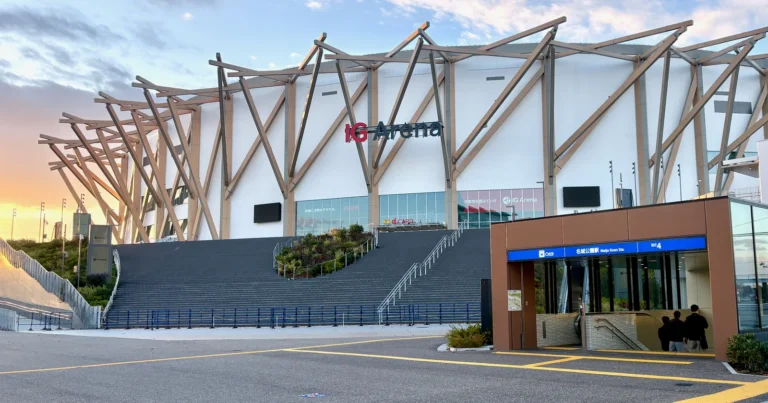
Aichi International Arena (愛知国際アリーナ)
- Sports: basketball; judo
- Address: 1-2-22 Meijo, Kita-ku, Nagoya 462-0846
- Walk: about 0 minutes from Exit 4 of Meijo-koen Station (名城公園, Meijo Line); about 18 minutes from Joshin Station (浄心, Tsurumai Line)
- Parking: none for spectators
This is the easiest venue in the Games to combine with sightseeing, for one reason: Meijo-koen and Nagoyajo — the castle station — are both on the Meijo Line, so you go from a subway exit to an arena door with no transfer and effectively no walk.
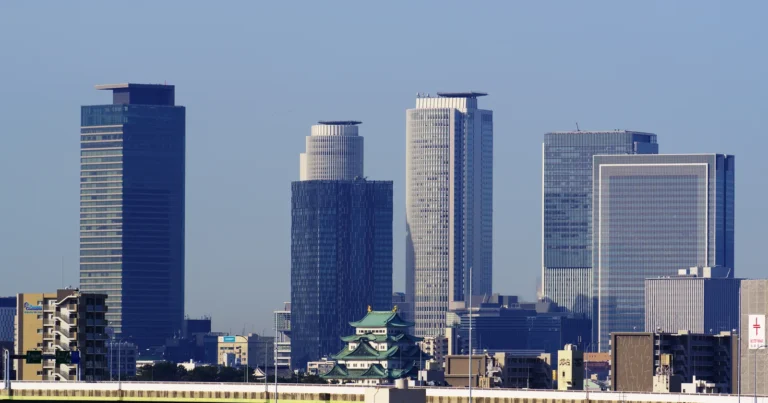
Morning: Nagoya Castle, and the Hommaru Palace
Nagoya Castle visitor information (2026)
- Hours: 9:00–16:30 daily, last entry 16:00 (Hommaru Palace last entry also 16:00)
- Admission: 500 yen for adults up to 30 September 2026; 1,000 yen from 1 October 2026
- Access: Meijo Line to Nagoyajo Station, Exit 7, about a 5-minute walk
- Free English guiding: the NPO Aichi Goodwill Guide Network runs a scheduled daily tour at 12:30 from the East Gate / Main Gate, no reservation needed — but it is suspended for the summer heat from 22 June to 23 September 2026, and the castle warns the suspension may be extended if the weather stays hot, so check before counting on a tour even after 24 September
Set expectations first: the main tower is closed. The 1959 concrete reconstruction has been shut since 2018 over earthquake safety, a wooden reconstruction is planned, and no completion year has been announced. What you actually come for is the Hommaru Palace, which is fully open — rebuilt in stages between 2009 and 2018 at a cost of roughly 15 billion yen, using traditional carpentry to reproduce the 1615 original that burned in the air raids of 14 May 1945. Shoes come off at the entrance; photography is allowed without flash. There is no heating or cooling anywhere inside, because the interior was rebuilt to Edo-period specification — worth knowing on a warm late-September morning.
For food between the castle and your session, Kinshachi Yokocho has two separate zones and they are not next to each other: the Yoshinao Zone sits at the Main Gate on the west side (3-1-2 Sannomaru), the Muneharu Zone at the East Gate on the east side (right by Exit 7 of Nagoyajo Station). Pick the one on the side you are actually entering or leaving from. Inside the paid grounds, Ninomaru Chatei serves matcha with a Japanese sweet as a regular daily item for around 600 yen.
Our complete Nagoya Castle guide covers the palace room by room.
Afternoon variant: Osu instead of the castle
If your session is in the morning, flip the day and spend the afternoon in Osu. The district holds about 1,200 shops and facilities along five main covered corridors — Banshoji-dori, Niomon-dori, Akamon-dori, Shin-Tenchi-dori and Higashi-Niomon-dori — and you can walk it end to end from Osu Kannon Station in the west to Kamimaezu Station in the east. Osu Kannon Temple (formally Kitanosan Shinpuku-ji Hoshoin, founded 1333 and moved here by Tokugawa Ieyasu in 1612) is free, with grounds open 6:00–19:00, three minutes from Exit 2 of Osu Kannon Station on the Tsurumai Line. If your date happens to be the 18th or the 28th, the temple grounds hold an antique and flea market.
For miso katsu, Yabaton’s main branch at 3-6-18 Osu has been operating since 1947 and is open 11:00–21:00 daily, a five-minute walk from Yaba-cho Station on the Meijo Line. See our Osu shopping street guide and Nagoya food guide.
Plan C: Kinjo-futo — 3×3, Climbing or Squash, Plus Trains and LEGO
Three venues sit within a few minutes of one station, which makes this the densest spectator day on the map.
The Kinjo-futo cluster (all from Kinjo-futo Station, Aonami Line)
- Kinjo Futo Station Square Venue — 3×3 basketball; about 1 min on foot
- Nagoya International Exhibition Hall [Portmesse Nagoya] Exhibition Hall 1 — sport climbing; about 3 min on foot
- Nagoya Kinjo-Futo Arena — squash; about 3 min on foot
- Parking: none for spectators, and the official guidance warns that surrounding car parks will be heavily congested and strongly recommends public transport
Getting there: the Aonami Line runs from Nagoya Station to Kinjo-futo in 24 minutes for 360 yen one way [Source]. Note that the Aonami Line is a separate line from the city bus and subway network that the one-day tickets cover, so budget 360 yen each way on top of your pass.
What is within walking distance
- SCMaglev and Railway Park — about 2 minutes from the station, and closed on Tuesdays (the following weekday when Tuesday is a public holiday). In the Games window that means it is shut on Tuesday 29 September 2026; it is open on the 22nd and 23rd. Open 10:00–17:30, last admission 30 minutes before closing. The 0-series, Japan’s original 1964 bullet train, is on display alongside the Series 955 (300X) experimental car that set a 443 km/h record in 1996, and one of the largest model railway dioramas in Japan. The N700 Shinkansen driving simulator and the conventional-line conductor simulator cost 500 yen each (about 15 minutes per session), and the conventional-line driving simulators 100 yen (about 10 minutes), all sold first-come rather than by lottery.
- LEGOLAND Japan — about a 10-minute walk from the station. Eight themed zones and more than 40 attractions. Operating hours are 10:00–17:00 or 18:00 depending on the season, and 1-Day Passports run 4,900–7,800 yen for adults and 3,700–5,200 yen for children aged 3–18 under calendar-based dynamic pricing. Outside food is refused at the bag check, so eat before or inside.
- Maker’s Pier — about 4 minutes from the station, with around 16 restaurants among roughly 40 tenants. This is the practical answer to “where do we eat between sessions?”
- SEA LIFE Nagoya — inside the LEGOLAND Japan Hotel building on floors 1 and 2, fully indoor, with around 150 species across 11 themed zones.
A realistic shape: morning 3×3 session at the station square, lunch at Maker’s Pier, then two hours in the railway park before heading back. Do not try to add LEGOLAND to a session day unless the session is short — a full-price park ticket deserves a full day. Our LEGOLAND Japan guide has the ticket-tier detail.
Two nearby venues that are not at Kinjo-futo. Wrestling and mixed martial arts are at Nagoya City Inae Sports Center, which is about 15 minutes on foot from Noseki (野跡) Station — not Kinjo-futo — and where surrounding car parks are reserved for Games operations and closed to spectators entirely. Jujitsu, kurash and wushu are at the Aichi Prefectural Martial Arts Hall at 1-1-4 Maruike-cho, Minato-ku, about 15 minutes from Kohoku (港北) Station. Both are on the Aonami Line, but they are different stops.
Plan D: Aichi Sky Expo — Breaking and Skateboarding, Plus Tokoname
Aichi Sky Expo (Aichi International Exhibition Center)
- Sports: breaking; BMX freestyle; esports; fencing; skateboarding
- Address: 5-10-1 Centrair, Tokoname City, Aichi 479-0881
- Walk: about 10 minutes from the Access Plaza Terminal 2 exit of Chubu Centrair International Airport Station (Meitetsu Airport Line)
- Fare from Meitetsu Nagoya: 980 yen; 1,430 yen if you take the mu-SKY, which adds a 450-yen limited-express seat charge
This venue is not in Nagoya. It is on the airport island in Tokoname City — which sounds like a problem but is one of the easiest sightseeing pairings of the Games, because two stops back up the line is Tokoname, said to be the oldest and largest of Japan’s Six Ancient Kilns and still a working pottery town.
The Pottery Footpath, two stops before the airport
Tokoname Pottery Footpath (やきもの散歩道)
- From Tokoname Station to Chubu Centrair: 330 yen for adults, 3 minutes by limited express or 5 by semi-express, no transfer
- From Meitetsu Nagoya to Tokoname: 750 yen for adults, about 33 minutes by limited express, no transfer
- Footpath entrance: about 5 minutes on foot from Tokoname Station; free to walk
- Course A: 1.6 km, about 60 minutes. Course B: 4 km, about 2 hours 30 minutes
Important: the mu-SKY and the Rapid Limited Express do not stop at Tokoname. Only the Limited Express, Rapid Express, Express, Semi-Express and Local services do. If you buy a mu-ticket out of Nagoya expecting to hop off at Tokoname, you will end up at the airport.
Course A — 1.6 km, about 60 minutes — is the right size for a session day. Separately, the tourist association publishes a model course, and that is the route to follow if you want the highlights in order: Tokoname Station → Tokoname Maneki-neko Street → the tourist information office at the Ceramic Hall → the chimney landscape → Tokonyan → the Takita Family House → Dokan-zaka → the Noborigama Plaza Exhibition Workshop Hall → the climbing kiln (Tōeigama) → Kurofuto-ya-dori → back to the tourist information office [Source]. The walk runs past brick chimneys, black-boarded workshops and slopes paved with kiln waste. Two set pieces stand out. Dokan-zaka, ten metres or so south of the Takita Family House, has walls covered in Meiji-era clay pipes and early-Showa shochu bottles, with the sloping path itself laid with kesawa — discarded firing rings — to stop people slipping. And the Tōeigama climbing kiln, built around 1887 and fired until 1974, is among the largest surviving noborigama in Japan: a 17-degree slope, eight firing chambers and ten chimneys of differing heights, designated an Important Tangible Folk Cultural Property in 1982.
The one paid stop is the Takita Family House, the former shipping agent’s residence: 300 yen for adults, free for junior-high age and under, open 9:30–16:30 and closed every Wednesday (open when Wednesday is a public holiday) [Source]. Start at the Tokoname Ceramic Hall at 3-8 Sakaemachi, which is free, open 9:00–16:30 and open year-round apart from the New Year period — it is both the tourist information point and the place to buy a teapot.
Tokoname’s signature is the shudei red clay, whose iron content fires to a deep red, and the teapot production that began in the Edo period. It is said that the iron oxide in a Tokoname teapot reacts with the tannins in tea and rounds off the bitterness — and Tokoname is said to be the oldest and largest of Japan’s Six Ancient Kilns (Seto, Echizen, Tokoname, Shigaraki, Tamba and Bizen).
A collision worth knowing about. The 60th Tokoname Pottery Festival was scheduled for Saturday 3 and Sunday 4 October 2026 — the final weekend of the Games. It was planned across three sites, one of which was the Pottery Footpath itself (the others were the Tokoname boat race venue and Ceramall), with listed hours of 9:00–20:00 on the Saturday, including a city fireworks display from 18:00 to 18:45, and 9:00–16:00 on the Sunday. For anyone holding a Sky Expo ticket for that weekend, it made a two-for-one day.
Coming or going by air, our Centrair airport to city guide covers the same line in the other direction.
What If Your Ticket Is for Toyota Stadium?
Football is also played at TOYOTA STADIUM, at 7-2 Sengoku-cho, Toyota City. From Meitetsu Nagoya to Toyotashi Station the fare is 900 yen and the journey takes about 57 minutes with one change; from the east exit of Toyotashi the stadium is about a 20-minute walk, or about 25 minutes from the east exit of Shin-Toyota Station on the Aichi Loop Line. There is no spectator parking here either.
Treat this as a full day out rather than a session you slot into a Nagoya itinerary — roughly two hours of travel round trip plus 40 minutes of walking is most of an afternoon on its own.
What Should You Do Before an Evening Session?
An evening session is the most forgiving ticket you can hold, because the whole day in front of it is yours. Three shapes work well.
The museum afternoon (Nagoya Station side)
The Toyota Commemorative Museum of Industry and Technology is about ten minutes door to door from Nagoya Station — one stop on the Meitetsu line to Sako, then a three-minute walk — or a 25-minute walk past Noritake Garden. It opens 9:30–17:00 with last admission at 16:30, closes on Mondays, and costs 1,000 yen for adults, 500 yen for junior and senior high school students and 300 yen for elementary students. Real industrial machinery runs in front of you: a forging press cycles every ten minutes from 9:40 to 16:30, the steam engine runs at 11:00, 14:30 and 15:30, and the circular loom at 9:55, 11:25, 13:25 and 14:55. Free English guided tours run at 14:00 (Textile Machinery Pavilion) and 15:15 (Automobile Pavilion), about 45 minutes each. Finish the 15:15 tour and you are still comfortably ahead of an 18:00 start. See our Toyota Commemorative Museum guide.
The Osu afternoon
Covered arcades, about 1,200 shops, street food, and a subway station at each end. It is the lowest-commitment afternoon in the city: you can leave at any moment without feeling you cut something short, which is exactly what you want when a gate opens at a fixed time.
The After-4 shape
For visitors without a ticket and with only a spare evening, the After 4 ticket was designed for precisely this: entry from 4 PM at 1,500–6,500 yen across 11 sports, sold up to 90 minutes before the session’s scheduled finish. It needed a Supporter ID, registered before the day rather than at the gate.
Getting home afterwards
Late-night margins in Nagoya are tighter than in Tokyo. The transport bureau’s official last-train pages give 23:52 from Nagoya towards Tokushige on the Sakura-dori Line and, on the Meijo Line, 00:10 at Sakae and 00:18 at Kanayama for the last counter-clockwise train, which terminates at Aratamabashi (if you are going further round the loop, the last train through leaves Sakae at 23:42 and Kanayama at 23:50). Those pages do not separate weekday and weekend timetables, so check your own last train on the bureau’s timetable search for your date [Source]. And do not count on a Friday reprieve: as of 20 August 2026 the bureau’s page for the Higashiyama Line’s Friday last-train extension states that it is suspended until further notice, from 7 August [Source]. If your session runs long, know your last train before you sit down.
What Is the Rain Plan?
You should have one. September is Nagoya’s wettest month on average — 231.6 mm, ahead of July at 211.4 mm and June at 186.5 mm. A Games trip in late September is a trip in the wettest part of the year.
The good news for the sport itself: where shuttle buses operate, they run in ordinary rain, though services can change with weather and traffic conditions.
For the sightseeing half, swap to something indoors:
- Port of Nagoya Public Aquarium — five minutes from Nagoyako Station, fully indoor, 9:30–17:30 normally and 9:30–17:00 from December to March, last entry one hour before closing. It usually closes on Mondays, but there is no closed day between 19 September and 4 October 2026, and it runs until 20:00 from 19 to 23 September. Adults and high-school students 2,030 yen, elementary and junior-high 1,010 yen, ages 4 and up 500 yen [Source]. Allow about three hours for the full route plus one dolphin performance. Remember that the Port Building, the Maritime Museum and the vessel Fuji are all closed until 30 November 2026.
- Osu’s covered arcades — the one outdoor district that works in rain, with Osu Kannon at the western end.
- The underground malls — Unimall runs north from Nagoya Station towards Kokusai Center, ESCA is on the Shinkansen side, Gate Walk is under the plaza on the Sakura-dori (east) side, and Sun Road, Japan’s first full-scale underground mall, opened in 1957 on the east side. In Sakae, the network runs from Sakae Station through to Hisaya-odori, with Mori no Chikagai the oldest, also opened in November 1957.
- The science museum — one stop on the Higashiyama Line to Fushimi, then about five minutes on foot, for one of the world’s largest planetarium domes at 35 metres inner diameter, a minus-30℃ Gokkan Lab with an all-sky aurora film, and a nine-metre artificial tornado. The last stretch crosses open parkland, so keep the umbrella handy.
Our full Nagoya in the rain guide lists twelve indoor options.
Which Venue Pairs With Which Sights?
| Venue (official name) | Sport | Nearest station and walk | Pair it with |
|---|---|---|---|
| Nagoya City Mizuho Park Athletic Stadium | Ceremonies, athletics | Mizuho-undojo-higashi (Meijo), 5–10 min | Atsuta Jingu, hitsumabushi |
| Nagoya City Mizuho Park Rugby Field | Football, rugby sevens | Mizuho-undojo-nishi (Sakura-dori), 10–15 min | Atsuta Jingu, hitsumabushi |
| Aichi International Arena | Basketball, judo | Meijo-koen (Meijo) Exit 4, about 0 min | Nagoya Castle, Kinshachi Yokocho |
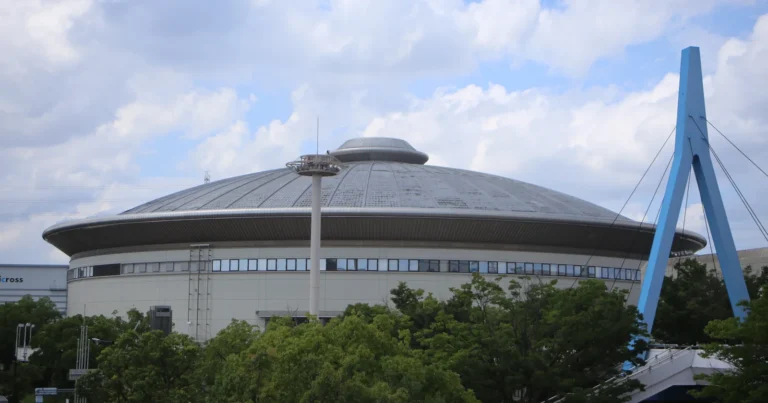
| Nagoya City General Gymnasium [Rainbow Hall] | Gymnastics, rhythmic, trampoline | Kasadera (笠寺, JR Tokaido), about 5 min | Atsuta Jingu — Atsuta Station is on the same JR Tokaido Line |
| Nagoya City General Gymnasium [Rainbow Pool] | Water polo | Kasadera (笠寺, JR Tokaido), about 7 min | Atsuta Jingu |
| Kinjo Futo Station Square Venue | 3×3 basketball | Kinjo-futo (Aonami), about 1 min | SCMaglev and Railway Park, Maker’s Pier |
| Nagoya International Exhibition Hall [Portmesse Nagoya] Hall 1 | Sport climbing | Kinjo-futo (Aonami), about 3 min | LEGOLAND Japan, SEA LIFE Nagoya |
| Nagoya Kinjo-Futo Arena | Squash | Kinjo-futo (Aonami), about 3 min | SCMaglev and Railway Park |
| Nagoya City Higashiyama Park Tennis Center | Tennis, soft tennis | Yagoto-nisseki (八事日赤, Meijo) Exit 2, about 15 min | Osu via Kamimaezu |
| Nagoya City Trade and Industry Center | Weightlifting | Fukiage (吹上, Sakura-dori) Exit 5, about 10 min | Osu, Sakae |
| Aichi Prefectural Government and Nagoya City Halls Loop Course | Race walking | Nagoyajo (Meijo) Exit 6, about 5 min | Nagoya Castle (same block) |
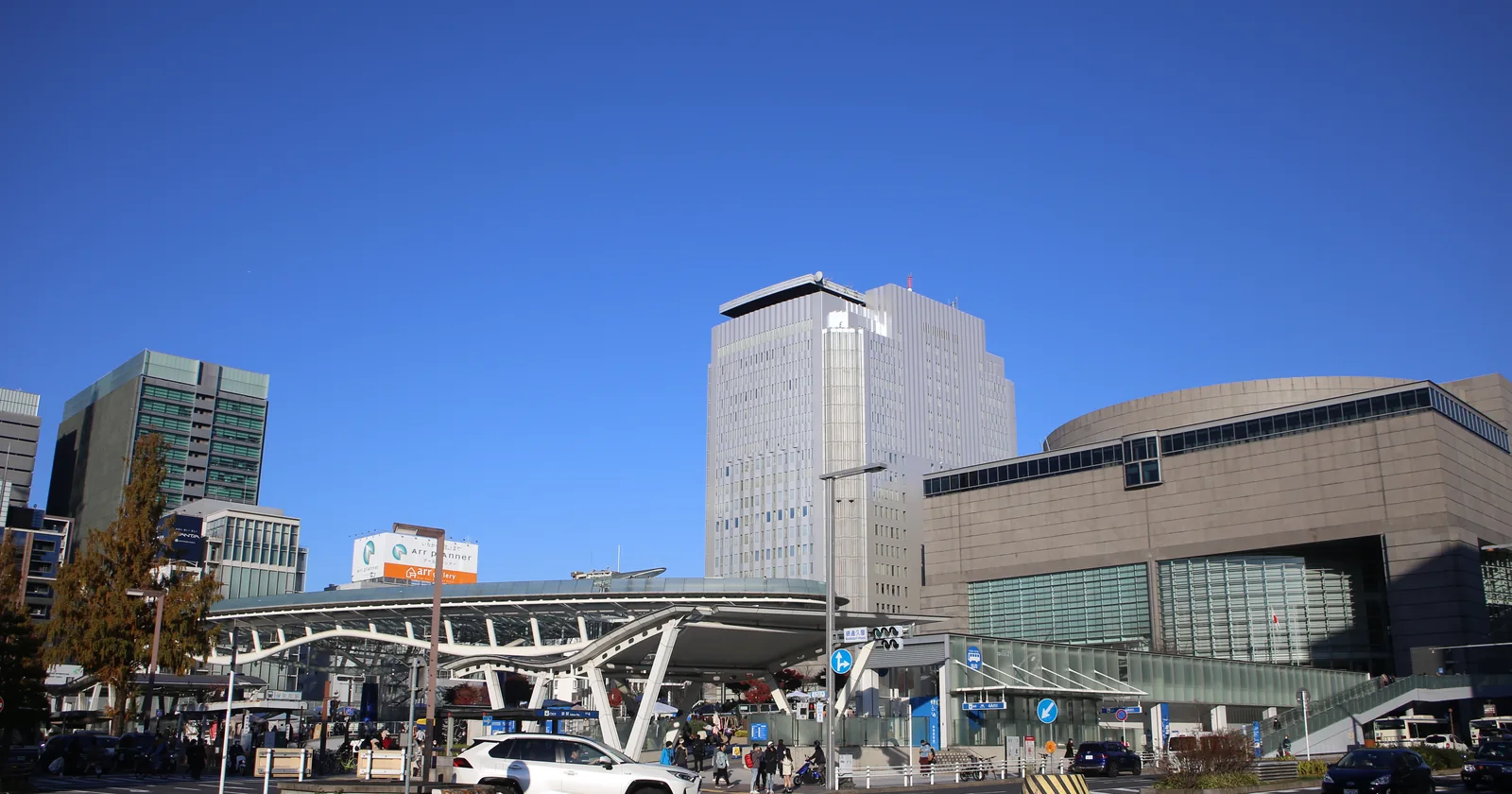
| Aichi Sky Expo | Breaking, BMX freestyle, esports, fencing, skateboarding | Chubu Centrair International Airport (Meitetsu), about 10 min | Tokoname Pottery Footpath |
| TOYOTA STADIUM | Football | Toyotashi (Meitetsu) east exit, about 20 min | Nothing — treat as a full day |
Venue-by-venue access detail, including bus routes and accessibility, is in our Asian Games 2026 venues and access guide.
Frequently Asked Questions
Can I really watch a session and still see something of Nagoya in the same day?
Yes, if you put the sightseeing first. Official guidance is that the stations nearest the venues and the shuttle stops get congested both before and after sessions, so the hour after a session ends is the worst possible time to start a museum visit. Sightsee in the morning, eat early, then go to the venue with time in hand. The exception is Aichi Sky Expo and TOYOTA STADIUM, where the travel time alone eats most of the spare day.
Which day pass should I buy?
The Bus & Subway All-Line One-Day Ticket at 870 yen for adults is the default, since a spectator day is usually four or more rides and single fares run 210–340 yen. On a Saturday, Sunday or public holiday, the Donichi Eco Kippu does the same job for 620 yen. If your session is in the evening, the Subway All-Line 24-Hour Ticket at 760 yen is better value, because it stays valid into the next morning. The one-day tickets cover the city bus and subway network; the Aonami Line to Kinjo-futo is a separate line with its own fare of 360 yen each way from Nagoya Station.
Is Nagoya Castle worth visiting during the Games, and why does the price change?
The main tower is closed and has been since 2018, so go for the Hommaru Palace, which is fully open and is the genuinely remarkable part. On price: admission is 500 yen for adults up to 30 September 2026 and 1,000 yen from 1 October 2026, which means the increase falls inside the Games period. If your ticket is for the first half of the Games, the castle is half price; if it is for the last week, it is not.
Could visitors buy a ticket after arriving, without registering an ID?
Yes, during the Games — the “Asian Q” service launched on 19 August 2026 sold tickets without Supporter ID registration, first-come, unreserved seating only, up to 90 minutes before a session’s scheduled finish, paid with Apple Pay or Google Pay and delivered as e-tickets. In-person sales were also possible: the Oasis 21 counter closed on 6 September, but the Aichi-Nagoya 2026 Ticket Center at 3-5-10 Sakae (Exit 15, Sakae Station) sold tickets for every sport 10:00–17:00 from 9 September to 4 October 2026, and eight venues sold same-day tickets on the day itself.
Can I drive to a venue and park there?
No. As a rule there is no spectator parking; only a limited number of venues have free car parks, mostly on a reservation basis, and the venue pages ask spectators not to come by car or bicycle at all. At Nagoya City Inae Sports Center, even the surrounding car parks are reserved for Games operations and cannot be used by spectators. Park-and-bus-ride exists as a separate scheme with its own reservations. Plan on trains.
Related Guides
The Asian Games 2026 cluster
- Asian Games 2026 Nagoya: Tickets, Dates, Venues — the overview guide to the whole event
- Asian Games 2026 Tickets: How to Buy From Abroad — Supporter ID, payment methods and the purchase flow
- Asian Games 2026 Venues: Which Sport Is Where, and by Train — every venue, station and walking time
- Asian Games 2026 Nagoya Hotels: Where to Stay, and From When — which district to book, and how early
- After the Asian Games: Takayama Autumn Festival Trip — what to do after the Games finished on 4 October
Planning the sightseeing half
- 3-Day Nagoya Itinerary — the non-Games version of the same city
- Nagoya Castle Complete Guide — Hommaru Palace, the golden shachihoko and Kinshachi Yokocho
- Atsuta Jingu Guide — the Kusanagi sword, the great camphor and the festival calendar
- Osu Shopping Street Guide — 1,200 shops, street food and the monthly flea market
- Nagoya Food Guide: 18 Must-Try Nagoya Meshi Dishes — what to eat between sessions
- Hitsumabushi Guide — sixteen eel restaurants compared
- LEGOLAND Japan Guide — for the Kinjo-futo day
- Toyota Commemorative Museum Guide — for an evening-session afternoon
- Nagoya in the Rain — twelve indoor options
- Getting Around Nagoya — the subway, buses and passes in full
- Where to Stay in Nagoya — districts and hotels beyond the Games window
- Centrair Airport to City Guide — the line that also serves Aichi Sky Expo
Dates, sessions and prices in this guide reflect official information as of 20 August 2026 — the competition schedule was last revised on 19 August 2026 and eight sessions were cancelled in that revision. Confirm opening hours and admission with each facility before you travel.