The short version.
- The Games run October 18–24, 2026 — seven days, in Aichi and Nagoya. This is the first time Japan has hosted the Asian Para Games.
- Competition starts on October 16, two days before the Opening Ceremony. Four sports are already running on the 16th and six on the 17th.
- October 18 has no competition at all. The Opening Ceremony is the only thing on the schedule that day.
- 18 sports at 19 venues, which the organizers describe as “provisionally selected”. Seventeen venues are in Aichi; two are in Shizuoka Prefecture, and need a separate trip.
- Adult tickets start at ¥1,000 and children’s tickets at ¥500 (under 15 on the day). The cheapest adult seat of all is an After 4 ticket for boccia at ¥800.
- You can buy from outside Japan, with no restriction on international buyers, and since August 18 there is a route that needs no account registration at all.
- Ceremony tickets have their own deadlines. Advance spectator registration is compulsory, sales close five days early, and the organizers ask ceremony spectators to be inside the stadium by 4:00 p.m.
Last updated: October 2026 | Written by Yuu, a Nagoya native of 35 years
The Asian Para Games have never been held in Japan before. In October 2026 they come to the city I live in, and the practical information an English-speaking spectator needs is scattered across an official PDF, a ticketing site, a set of news posts, and — for anything to do with actually reaching a venue — a set of Japanese-only prefectural web pages with no English original behind them.
This guide pulls that together. Every figure about the Games themselves — dates, sports, venues, prices, deadlines — was read off the organizers’ own pages and the Aichi Prefectural Government’s own pages on August 30, 2026; the ceremony arrival times, venue rules, venue opening times and the commemorative transit pass were added from official pages checked on October 17, 2026. The festival section draws on the Koromo Festival’s own published timetable, checked separately. Where the official sources have not published something yet, this page says so instead of guessing: there is a whole section of unanswered questions near the end, and it is there on purpose.
If you are planning around the Asian Games rather than the Para Games, start with our Asian Games 2026 Nagoya guide instead — the Asian Games finish on October 4 and the Para Games open on October 18, and the two run on separate rules.
The Games at a glance
| Item | Detail |
|---|---|
| Official name | The 5th Asian Para Games Aichi-Nagoya 2026 |
| Games period | Sunday October 18 – Saturday October 24, 2026 (7 days) |
| Competition days | Friday October 16 – Saturday October 24, 2026 |
| Sports | 18 |
| Venues | 19 (officially described as “provisionally selected”) |
| Main venue | Nagoya City Mizuho Park Athletic Stadium |
| Participating countries and regions | 45 across Asia (planning figure) |
| Athletes and team officials | Up to 4,000 |
| Organizer | Asian Paralympic Committee (APC), held every four years in principle |
| Games slogan | IMAGINE ONE HEART |
| Cheapest adult ticket | ¥1,000 (¥800 for an After 4 boccia session) |
| Cheapest child ticket | ¥500 (under 15 on the day of the session) |
| Most expensive sports ticket | ¥3,500 (A seat, wheelchair basketball and wheelchair tennis medal sessions) |
| Ticket sales | Open since 5:00 p.m. on June 30, 2026, international sales included, first come first served |
What the Asian Para Games are
The Asian Para Games are organized by the Asian Paralympic Committee, the regional committee of the International Paralympic Committee, and are held every four years in principle. Aichi-Nagoya 2026 is the fifth edition, and the first to be held in Japan.
The official planning figures are 45 countries and regions and up to 4,000 athletes and team officials. Both numbers come from the organizers’ ticketing guide and describe the scale they are planning for. Since the organizing committee relaunched its website on September 1, 2026 it has published a named list of all 45 participating countries and region; entry numbers and confirmed team sizes have not followed.
The Games slogan is IMAGINE ONE HEART.
Competition starts two days before the Opening Ceremony
This is the single most useful thing on this page. The official ticketing guide gives the Games period as October 18–24, and most coverage repeats those dates. But the competition schedule in the same document runs across nine columns, from Friday October 16 to Saturday October 24.
In other words, matches are being played two days before the Opening Ceremony.
| Date | What is on |
|---|---|
| Fri Oct 16 | Para badminton, blind football, Para table tennis, wheelchair basketball |
| Sat Oct 17 | Those four sports, plus boccia and goalball |
| Sun Oct 18 | Opening Ceremony only — no competition sessions at all |
| Mon Oct 19 – Sat Oct 24 | All 18 sports run somewhere in this window, phasing in and out |
Two things follow from that, and both change how you build an itinerary.
If you are in Aichi on the weekend of October 16–17, you can watch six sports without holding a ceremony ticket at all — three of them inside Nagoya city, at Aichi International Arena, Terraspo Tsuruma and Rainbow Hall. Those are also preliminary days, which means ordinary-day prices rather than medal-session prices.
And you cannot pair the Opening Ceremony with a day of sport. October 18 has nothing else on it. The ceremony starts at 6:00 p.m., so the daytime is free — which is why the festival section further down this page matters more than it might look.
Remember this “Games period” and “competition days” are two different things at these Games. Book flights against October 16–24, not October 18–24.
The schedule has already changed once
Here is the honest caveat. The competition schedule printed in the English ticketing guide (version 3.02) is stated as being correct as of June 1, 2026, with a note that it is subject to change without prior notice.
It has already changed. On July 29, 2026 the organizers announced a reorganization of the Para athletics program and adjustments to its schedule, and one session — PAT10, Para athletics, October 24 at 9:00 a.m. at Nagoya City Mizuho Park Athletic Stadium — was cancelled. Tickets for it are refunded in full, processed after the Games, and cannot be exchanged for another date or another sport.
The dates on this page reflect that July 29 change. Para athletics therefore runs October 19–23, five days, not through to the 24th. Any page still saying Para athletics runs to October 24 is quoting the PDF and has not caught the correction.
For the same reason this guide gives dates by sport and not by individual event. The reorganization means the per-event timings printed in the June 1 guide may no longer hold, and there is no point publishing a start time for a specific final that has since moved. Check the official ticket information site before you fix a date.
All 18 sports: where they are and what they cost
Seventeen of the nineteen venues are in Aichi Prefecture. Two are not — the Para cycling venues are in Izu, Shizuoka Prefecture, and that is covered separately below.
Prices in this table are the cheapest adult seat and the child price for each sport. Most sports also sell higher categories, and medal sessions cost more than preliminaries.
| Sport | Venue | Dates (October) | Adult from | Child |
|---|---|---|---|---|
| Para archery | Okazaki Chuo Sogo Park Multipurpose Square | 19, 20, 21, 22, 23, 24 | A ¥1,500 | ¥800 |
| Para athletics | Nagoya City Mizuho Park Athletic Stadium | 19–23 (all medal days) | C ¥1,000 | ¥500 |
| Para badminton | Ichinomiya City Municipal Gymnasium | 16, 17, 19–23 | B ¥1,000 | ¥500 |
| Boccia | Nagoya City General Gymnasium [Rainbow Hall] | 17, 19–24 | B ¥1,000 | ¥500 |
| Para cycling (track) | Izu Velodrome (Shizuoka) | 19, 20 | A ¥1,000 | ¥500 |
| Para cycling (road) | Cycle Sports Center 5km Circuit (Shizuoka) | 21, 22, 23 | No ticket sales | — |
| Blind football | Terraspo Tsuruma | 16, 17, 19, 20, 21, 23 | A ¥1,500 | ¥500 |
| Goalball | Toyohashi Gymnasium | 17, 19–23 | B ¥1,000 | ¥500 |
| Para judo | Aichi Prefectural Martial Arts Hall | 19, 20, 21 (all medal days) | A ¥1,500 | ¥800 |
| Para powerlifting | Nagoya City Trade and Industry Center | 19–24 (all medal days) | A ¥2,000 | ¥1,000 |
| Shooting Para sport | Aichi Prefectural General Shooting Gallery, Toyota | 19, 20, 22, 23 (all medal days) | A ¥1,000 | ¥500 |
| Sitting volleyball | Okazaki Chuo Sogo Park Gymnasium | 19–23 | B ¥1,000 | ¥500 |
| Para swimming | Nagoya City General Gymnasium [Rainbow Pool] | 19–23 (all medal days) | A ¥1,500 | ¥800 |
| Para table tennis | SKY HALL TOYOTA | 16, 17, 19–23 | B ¥1,000 | ¥500 |
| Para taekwondo | Nagoya City Mizuho Park Gymnasium | 19, 20, 21 (all medal days) | A ¥1,000 | ¥500 |
| Wheelchair basketball | Aichi International Arena | 16, 17, 19–23 | B ¥1,500 | ¥800 |
| Para fencing | Nagoya City Inae Sports Center | 19–24 (all medal days) | B ¥1,000 | ¥500 |
| Wheelchair rugby | WING ARENA KARIYA | 19–23 | B ¥1,500 | ¥800 |
| Wheelchair tennis | Nagoya City Higashiyama Park Tennis Center | 19–23 | Ground ¥1,000 | ¥800 |
Boccia is a one-day pass
The boccia ticket is explicitly described in the guide as requiring a one-day pass. Sessions start at 9:30 a.m., and a single boccia ticket covers the whole day, morning and afternoon blocks alike.
No tickets are sold for the road race
The three Para cycling road sessions at the Cycle Sports Center circuit have an empty price column in the official guide, marked “no ticket sales”.
Be careful how you read that. No tickets are being sold for the road race; the organizers have not published whether roadside viewing is possible. Those are two different statements, and only the first one is official. If you are planning around the road race, wait for the organizers to say something about spectators.
Wheelchair tennis has a ground ticket
Wheelchair tennis sells a Ground Ticket at ¥1,000, rising to ¥1,500 on medal days, and the guide states plainly that seating is not guaranteed with it. It is not sold for the October 23 session (WTO05) at all. A and B seat holders can watch matches on the Show Court as well as every other court.
The courts are outdoors. The official guide notes that weather or other unavoidable circumstances may mean a session is held without spectators, or moved to an indoor venue, either from the start of a session or partway through it.
What tickets actually cost
The cheapest adult seat is ¥1,000, and it turns up in eleven places: shooting Para sport and Para cycling track (A seat), the first Para taekwondo session (A seat), Para athletics (C seat), Para badminton, boccia on ordinary days, goalball on ordinary days, sitting volleyball on ordinary days, Para table tennis and Para fencing (B seat), and the wheelchair tennis ground ticket.
Watch the seat letters there. The cheapest category is A in some sports, B in others and C in others, because each sport sells a different set. Shooting and track cycling only sell an A seat; Para athletics goes down to C. “Get a B seat, it is always the cheapest” is simply wrong at these Games.
Children’s tickets start at ¥500, for anyone under 15 on the day of the session, and they exist only in the lowest seat category of each sport. Preschool children under three go free if they sit on an adult’s lap; if they need their own seat, they need their own ticket.
The most expensive sports ticket is ¥3,500, an A seat for a wheelchair basketball or wheelchair tennis medal session. The ceremonies are priced separately and run far higher — see below.
Four discount tickets, and who they are for
| Ticket | Who it is for, and the conditions |
|---|---|
| Child ticket | Under 15 on the day of the session. Lowest seat category only. Under-threes free on a lap. |
| Ticket for Persons with Disabilities | For holders of a valid disability certificate and their companion. The certificate is checked on entry. Lowest seat category only. The companion must enter and leave with the holder. A wheelchair cannot be used in these seats. |
| Wheelchair ticket | For a wheelchair user plus one companion. Wheelchair spaces are available at every session. The price covers the companion’s admission, and the companion sits next to the wheelchair space. Both must enter and leave together. |
| Heartful ticket | For groups of 2–4 that include at least one person aged 65 or over on the day, or one holder of a valid disability certificate. Everyone in the group pays the child price. Lowest seat category only. A wheelchair cannot be used in these seats either. |
The Heartful ticket is the one worth knowing about. If your group qualifies, all four of you pay the child price, which starts at ¥500. On the numbers alone it is the largest discount at these Games.
If you use a wheelchair Buy the wheelchair ticket, not the disability ticket. Wheelchairs cannot be used in the disability-price seats or the Heartful seats — only the wheelchair ticket comes with an actual wheelchair space.
One caveat for visitors from abroad. The official wording throughout is “a valid disability certificate”, and the scheme is written around the certificate issued in Japan. Nothing official says whether a certificate issued in another country is accepted. Rather than guess, email the ticket centre before you buy — contact details are further down.
After 4 tickets: the cheapest adult seat at the Games
An After 4 ticket is a timed-entry ticket valid for admission from 4:00 p.m. Four sports sell them at these Games.
| Sport | Dates (October) | Venue | Seat | Price |
|---|---|---|---|---|
| Para table tennis | 20, 21, 22 | SKY HALL TOYOTA | A / B | ¥1,500 / ¥1,000 |
| Wheelchair basketball | 16, 19, 20, 21 | Aichi International Arena | B | ¥1,300 |
| Wheelchair rugby | 20, 21, 22 | WING ARENA KARIYA | B | ¥1,300 |
| Boccia | 19, 20, 22, 23 | Rainbow Hall | B | ¥800 |
| Boccia | 21 | Rainbow Hall | B | ¥1,300 |
That ¥800 boccia ticket is the cheapest adult admission anywhere at these Games. Three conditions come with it: you can only buy After 4 tickets on the official sales site, which means you need a Supporter ID; they are issued as e-tickets only; and they are excluded from the official resale service.
Buying from overseas
Sales are already open
General sale opened at 5:00 p.m. on June 30, 2026 and runs until the day each session takes place. There is no eligibility restriction and international sales are explicitly included. Everything is first come, first served — there is no lottery.
The ceremonies are the exception, and their sales close early. That is covered in its own section below.
Route A: the official sales site, with a Supporter ID
To buy on the official site you need a free Supporter ID. The English pages call the same thing “Supporter ID”, “Ouen-ID” and “Fan ID” in different places; it is one account, not three. Buying through a play guide instead means registering with that play guide.
If you have already been through this for the Asian Games, the mechanics are identical, and our Asian Games ticket guide walks through the registration flow in detail.
Route B: Asian Para Q tickets, with no account at all
Launched on August 18, 2026, Asian Para Q tickets can be bought without ID registration. For a visitor who does not want to create a Japanese ticketing account, this is the shortest path to a seat.
The trade-offs are real, though:
- Unreserved seating only, admission first come first served
- General, child and disability-price tickets only — wheelchair tickets, Heartful tickets and After 4 tickets are excluded
- Payment by Apple Pay or Google Pay
- Not eligible for official resale
- An issuing fee and a system usage fee are charged on top of the ticket price
Getting the ticket itself
For a visitor, the realistic option is the e-ticket: displayed from your order history on the official sales site, or printed as a PDF. Paper tickets collected at convenience store counters (Ticket Pia, TBS Ticket, CBC Ticket Center) are available for the whole sales period. The original-design paper ticket was limited to the advance sales period and can no longer be obtained.
Buying in person, and the one route closed to you
Group tickets are not open to you. They require a minimum of 20 tickets per application and are limited to corporations and organizations with an office and a bank account in Japan.
A walk-in counter will be open during the Para Games. The Aichi-Nagoya 2026 Ticket Center at 3-5-10 Sakae, Naka-ku — right by Exit 15 of Sakae subway station, next to Sakae Mitsukoshi — trades September 9 to October 4 and again October 15 to 24, 2026, daily 10:00 a.m. to 5:00 p.m., and sells tickets for the events held during the Games. A separate short-run booth, the Aichi-Nagoya 2026 City Ticket Office inside the Oasis 21 i-Center, covered August 20 to September 6, 2026 only. The catch at a counter is stock, not access: popular sessions can be gone long before you arrive, so check availability on the official sales site rather than counting on the window.
On official travel packages: Tobu Top Tours handles group travel only and reported its group-travel tickets sold out in a July 2 update, which leaves JTB’s ticket-inclusive “JTB My STYLE” accommodation plan as the one realistic option for an individual traveller.
Who to ask
| Subject | Contact | Hours |
|---|---|---|
| Tickets in general | Aichi-Nagoya2026_support@pia.co.jp / 052-990-6573 | Weekdays 10:00–17:00 (closed weekends, public holidays, year-end) |
| Ceremony spectator registration | Aichi-Nagoya2026_id_support@pia.co.jp / +81-52-990-7050 | 10:00–17:00 every day including weekends and holidays, until October 24 |
The organizers recommend email over the phone, because the lines are hard to get through on. If you hold a ceremony ticket, the registration desk is the one that answers at weekends.
On availability Do not trust any page — including this one — that tells you a session is sold out or still available. Stock moves, and in July the organizers even renamed the “Sold Out” status to “Currently Unavailable”. Check the official sales site for current availability.
Resale — and the sport you cannot resell
The official resale service accepts listings from 5:00 p.m. on August 4, 2026 until 11:59 p.m. three days before each session. It covers e-tickets bought with a credit card, debit card or Google Pay, across the general, child, disability, wheelchair and Heartful ticket types.
Warning Every wheelchair rugby session is excluded from resale. If you buy a wheelchair rugby ticket you cannot hand it back. While your plans are still fluid, that sport carries more risk than any other on the programme. (The cancelled PAT10 Para athletics session is listed as excluded too, for the obvious reason.)
Other exclusions are by ticket type: hospitality packages, OUEN plus and Premium plus, tickets bought anywhere other than the official ticket information or sales sites (Ticket Pia purchases excepted), tickets bought during the additional sales period, and — as noted above — After 4 tickets and Asian Para Q tickets.
Do not buy from unofficial resellers
Unauthorized resale of designated event tickets is a criminal offence in Japan under a law in force since June 14, 2019. The organizing committee says it monitors and investigates, and deals strictly with violations.
The practical point matters more than the legal one: tickets bought through unofficial channels will not be accepted for entry. A ticket from an overseas resale platform is worthless at the gate. Use the official resale service.
The ceremonies run on a separate rulebook
The Opening and Closing Ceremonies have different prices, different deadlines and a compulsory extra procedure. Read this section as its own thing.
Dates and prices
| Opening Ceremony | Closing Ceremony | |
|---|---|---|
| Date | Sunday October 18 | Saturday October 24 |
| Start | 6:00 p.m. | 6:00 p.m. |
| Venue | Nagoya City Mizuho Park Athletic Stadium | Nagoya City Mizuho Park Athletic Stadium |
| Session code | POC01 | PCC01 |
| A seat | ¥30,000 | ¥20,000 |
| B seat | ¥15,000 | ¥10,000 |
| C seat | ¥8,500 | ¥5,500 |
| D seat | ¥5,500 | ¥3,500 |
| Child | ¥3,000 | ¥2,000 |
| Disability price | ¥5,200 | ¥3,200 |
| Wheelchair | ¥5,500 | ¥3,500 |
All four seat categories are reserved seating. There is no AA category for these ceremonies.
Advance spectator registration is compulsory
Anyone holding a ceremony ticket must register their spectator and ticket information in advance — one registration per ticket — and complete identity verification at the venue on the day. If the registration is not completed by the deadline, or identity cannot be confirmed on site, entry is refused.
Tickets for every other session need none of this.
The deadline calendar
| Opening Ceremony (Oct 18) | Closing Ceremony (Oct 24) | |
|---|---|---|
| Spectator registration window | Fri Sep 25, 12:00 – Fri Oct 16, 23:59 | Fri Oct 2, 12:00 – Thu Oct 22, 23:59 |
| Ticket sales close | Tue Oct 13, 23:59 | Mon Oct 19, 23:59 |
| Official resale closes | Wed Sep 23, 23:59 | Wed Sep 30, 23:59 |
All times are Japan Standard Time. There are two traps in that table.
Trap one: ceremony ticket sales stop five days before the ceremony. Ordinary sessions sell until the day they are held. The Opening Ceremony stops selling on October 13 and the Closing Ceremony on October 19, to leave room for the registration window. If you arrive expecting to pick up a ceremony ticket on the day, there will be nothing to pick up.
Trap two: this is not the Asian Games registration. The Asian Games Opening Ceremony registration ran from August 21 to September 17 and has now closed. The Asian Para Games registration is an entirely separate process with entirely separate dates. Completing one does nothing for the other.
What registration asks for, and what to bring
You register your name, address, date of birth, nationality, gender, verification category (the type of ID you will show on the day) and ID document number, along with the QR code or barcode printed on your ticket. As a rule you register yourself; if you bought several tickets you need to forward the notification to the people coming with you so each of them registers separately.
At the venue you need either:
- one government-issued photo ID — driver’s licence, My Number card (the notification card is explicitly not accepted), passport, disability certificate, student ID or residence card; or
- two official documents without a photo — health insurance eligibility certificate, pension book, pension certificate, certificate of residence and the like.
A passport is on the official list of accepted photo ID. There is no separate guidance published for spectators living outside Japan, so that list is what there is to go on.
On the day
The organizers say admission will be restricted during performances and that movement inside the venue will be limited at certain times, and they ask spectators to arrive early because admission processing is expected to be very crowded.
Arrival times Be inside the stadium by 4:00 p.m. The organizers ask spectators at both the Opening Ceremony (October 18) and the Closing Ceremony (October 24) to enter by 4:00 p.m., when the pre-show begins; both ceremonies start at 6:00 p.m. For the Opening Ceremony, identity checks start at 1:30 p.m. and gates open at 2:00 p.m.; entry is restricted from about 4:00 to 5:20 p.m. and exit from about 7:30 to 8:30 p.m. For the Closing Ceremony, the identity-check and gate-opening times are still listed as being arranged; entry is restricted from about 4:45 to 5:40 p.m. and exit from about 7:00 to 7:50 p.m. Re-entry is not permitted at either ceremony. The ticketing guide warns that once entry restrictions begin you may not get in before the Opening Ceremony starts, and that no refunds are given in that case. Check the organizers’ visitor information page before you set off.
Getting to the venues
The organizers’ baseline is that spectators come by public transport. Some venues have free shuttle buses, some have a bookable free accessible shuttle run with universal-design taxis, and a few have park-and-bus-ride. As a rule there is no spectator parking; the handful of venues with a free car park generally require a reservation.
This section is the reason this page exists. Aichi Prefecture’s venue access pages are the primary source for all of it, and they are published in Japanese only — there is no English original behind them. Everything below was read off those pages on August 30, 2026.
Venues you can reach on foot from a station
| Venue (sport) | Nearest station | On foot |
|---|---|---|
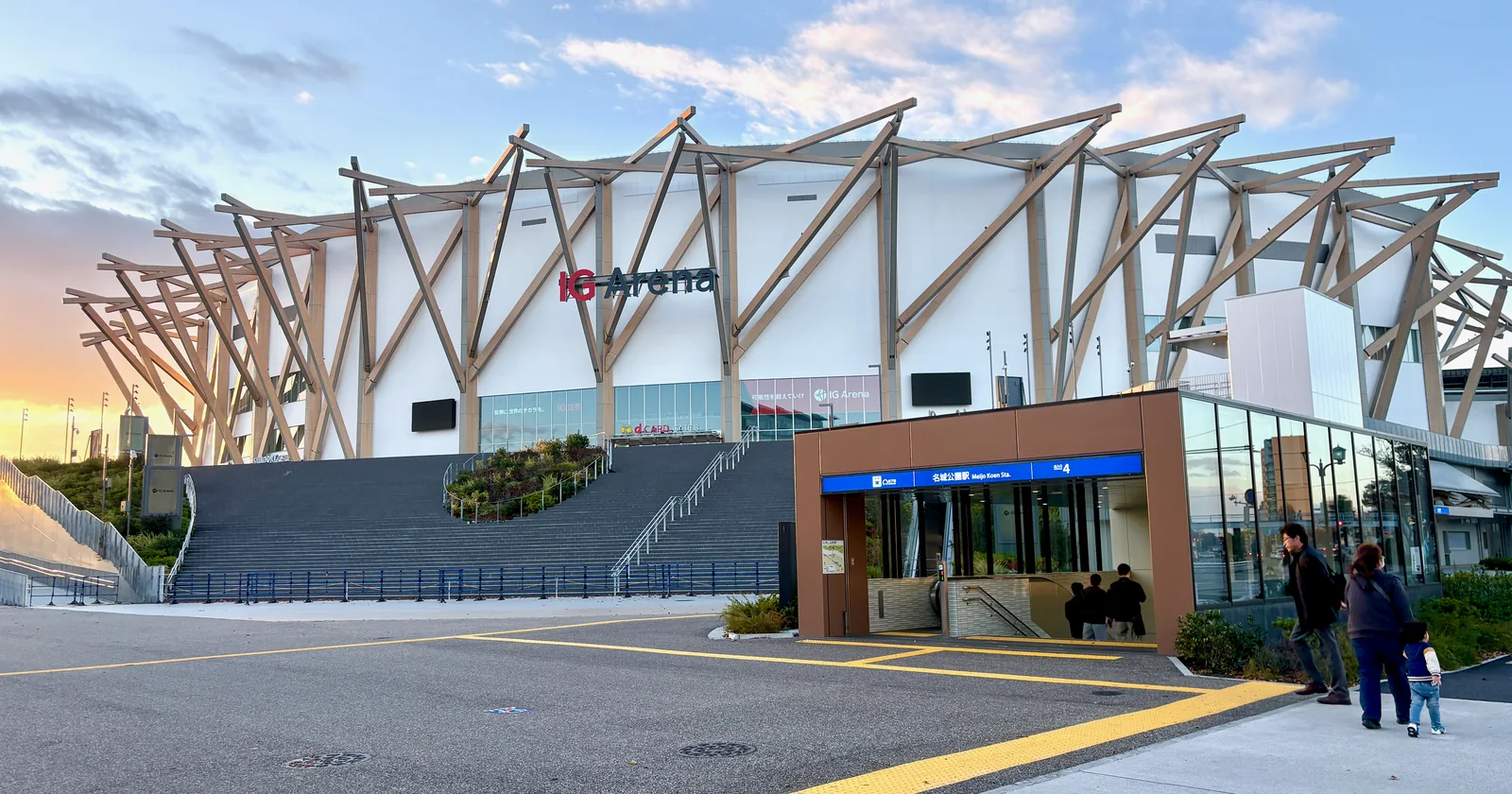
| Aichi International Arena (wheelchair basketball) | Meijo Line, Meijo-koen, Exit 4 | About 0 minutes — the arena is at the exit |
| Terraspo Tsuruma (blind football) | JR Chuo Line / Tsurumai Line, Tsurumai | About 5 min |
| Rainbow Hall (boccia) | JR Tokaido Line, Kasadera | About 5 min |
| Rainbow Pool (Para swimming) | JR Tokaido Line, Kasadera | About 7 min |
| Nagoya City Mizuho Park Athletic Stadium (ceremonies, Para athletics) | Meijo Line, Mizuho Undojo Higashi | About 5–10 min |
| Nagoya City Trade and Industry Center (Para powerlifting) | Sakura-dori Line, Fukiage, Exit 5 | About 10 min |
| Nagoya City Mizuho Park Gymnasium (Para taekwondo) | Meijo Line, Mizuho Undojo Higashi | About 10–15 min |
| Nagoya City Higashiyama Park Tennis Center (wheelchair tennis) | Meijo Line, Yagoto Nisseki, Exit 2 | About 15 min |
| Nagoya City Inae Sports Center (Para fencing) | Aonami Line, Noseki | About 15 min |
| Aichi Prefectural Martial Arts Hall (Para judo) | Aonami Line, Kohoku | About 15 min |
| SKY HALL TOYOTA (Para table tennis) | Meitetsu Mikawa / Toyota Line, Toyotashi, east exit | About 15 min |
Aichi International Arena is the easiest venue at these Games by a distance. It sits at Exit 4 of Meijo-koen station on the Meijo subway line, the station has a lift, and the walk is effectively nothing. It is also close to Nagoya Castle, so a wheelchair basketball day pairs naturally with our Nagoya Castle guide.
The athletic stadium can also be reached from Mizuho Undojo Nishi (Sakura-dori Line) or Aratamabashi (Sakura-dori and Meijo Lines), both about 10–15 minutes on foot. Aichi Prefecture warns that traffic restrictions may force a detour, and adds a general note for the Mizuho Park area that paths open at normal times may be closed during the Games — check where your entry gate is before you set off.
Almost none of these venues has spectator parking or bicycle parking. Inae Sports Center goes furthest, stating that nearby car parks are being used for Games operations and are not available to spectators at all. If you are moving around central Nagoya, our guide to getting around Nagoya covers the subway and day passes.
Venues that need a shuttle bus
| Venue (sport) | Shuttle from | Shuttle time |
|---|---|---|
| Okazaki Chuo Sogo Park (Para archery, sitting volleyball) | Meitetsu Nagoya Main Line, Higashi Okazaki | About 15 min |
| WING ARENA KARIYA (wheelchair rugby) | JR Tokaido Line / Meitetsu Mikawa Line, Kariya | About 15 min |
| Toyohashi Gymnasium (goalball) | JR / Meitetsu Toyohashi, near the west exit | About 20 min |
| Ichinomiya City Municipal Gymnasium (Para badminton) | Inari Park, north of Meitetsu Ichinomiya / Owari-Ichinomiya | About 35 min |
| Aichi Prefectural General Shooting Gallery (shooting Para sport) | Aichi Loop Line / Linimo, Yakusa | About 60 min |
All of these shuttles are free.
Two of them deserve a warning when you are building a day.
Ichinomiya City Municipal Gymnasium is about 35 minutes by shuttle from Inari Park, north of Meitetsu Ichinomiya station — and you still have to get from Nagoya to Ichinomiya before that. Para badminton is not a “quick trip out of Nagoya”.
The Aichi Prefectural General Shooting Gallery is the hardest venue to reach at these Games. The free shuttle from Yakusa station takes about 60 minutes, and varies with traffic. On competition days the roads around the venue are closed, and no arrival is possible other than by the shuttle bus or the accessible shuttle. Yakusa is on the Linimo line, the same line as Ghibli Park, but a 60-minute shuttle each way puts it well beyond a side trip.
Toyohashi Gymnasium has one of the very few car parks that takes spectators without a booking: the Kamome Hiroba car park is free and needs no reservation, while the Toyohashi Industrial Human Resources Development Center car park is free but must be booked. At Okazaki Chuo Sogo Park there is a park-and-bus-ride from Okazaki Castle Park’s multipurpose square, free and bookable in advance, with a shuttle of about 15 minutes.
The two venues that are not in Aichi
Read this before booking Para cycling The Izu Velodrome (track, October 19–20) and the Cycle Sports Center 5km circuit (road, October 21–23) are at 1826 Ono, Izu City, Shizuoka Prefecture — not Aichi. Access is a free shuttle bus or accessible shuttle of about 20 minutes from Shuzenji station on the Izuhakone Railway Sunzu Line, and getting there from Nagoya means a Shinkansen connection and a change onto the Izuhakone Railway — check the journey for yourself before you plan around it. Treat Para cycling as a separate day, not an add-on to a Nagoya itinerary. There is no spectator parking near the venues, and bicycle parking is limited.
Accessibility for spectators
Spectator accessibility is documented better at these Games than at most events I have written about, but the detail is spread across Japanese-language pages. Here is what the official sources say.
Wheelchair spaces exist at every session
The organizers state plainly that wheelchair accessible seating is available for all sessions. The wheelchair ticket covers:
- a wheelchair user and one companion, watching together
- the companion’s admission, included in the wheelchair ticket price
- a companion seat next to the wheelchair space
- entry and exit at the same time for both — the companion cannot come and go separately
Again: wheelchairs cannot be used in the disability-price seats or the Heartful seats. If you use a wheelchair, the wheelchair ticket is the one to buy.
The accessible shuttle
The accessible shuttle is run with universal-design taxis, and is free and reservation-based. It is confirmed on the prefectural pages for Higashiyama Park Tennis Center, Ichinomiya City Municipal Gymnasium, Okazaki Chuo Sogo Park, Toyohashi Gymnasium, SKY HALL TOYOTA, the Aichi Prefectural General Shooting Gallery, and the Izu Velodrome and Cycle Sports Center.
Venue by venue
Higashiyama Park Tennis Center runs a free shuttle bus from Yagoto Nisseki station, but it is specifically for spectators who would find the walk difficult — people with disabilities, older spectators and so on. It is not a general shuttle for everyone.
Rainbow Hall and Rainbow Pool set aside 25 spaces in the first car park of the Nagoya City General Gymnasium for wheelchair users and spectators with disabilities. Free, and booking is required.
Okazaki Chuo Sogo Park provides accessible parking for people who hold a wheelchair ticket and arrive by car; the ticket is checked at the entrance.
Aichi International Arena is at the station exit with a lift in the station, which makes it the lowest-effort venue to get into and out of on the whole programme.
What has not been announced yet
Some information a spectator genuinely needs had not been published by the organizers as of August 30, 2026. Several of those gaps have since been filled; the rows below that give newer information were checked against the official sources on October 17, 2026. Where the honest answer is still “we do not know”, this section says so.
| Question | Status |
|---|---|
| What time must I arrive for a ceremony? | By 4:00 p.m. for both ceremonies, according to the organizers’ visitor information published in October 2026. Opening Ceremony identity checks start at 1:30 p.m. and gates open at 2:00 p.m.; for the Closing Ceremony those two times are still listed as being arranged. |
| Which route and gate on ceremony day? | The organizers direct spectators to Nagoya City Mizuho Park Rugby Field for identity checks, with check-in and entry at Gate A by the Rugby Field car park. Gate C, on the stadium itself, also handles identity checks and is wheelchair accessible; wheelchair users can enter through either gate. Arriving by taxi or car, including drop-off and pick-up, is not permitted, and staff will be posted along the roads from the subway station to the stadium area. |
| What can I bring in? Are there bag checks? Can I re-enter? | Now published. Bags are checked on entry, and there are no cloakrooms, coin lockers or luggage checks at the venues. The main prohibited items include plastic and reusable bottles over 750 ml (one bottle per person is the limit), glass, cans and other hard containers, alcohol, monopods, tripods and chairs, and luggage bigger than a soft bag of 25 litres. Re-entry is not permitted at the ceremonies or at shooting Para sport; at other venues it generally needs your ticket plus the wristband handed out when you leave. The ceremonies have their own, longer list, which also bans umbrellas. |
| What time do gates open for a sports session? | Now published. The organizers’ Venue Opening Schedule lists a venue-open time for each session, and it varies by venue — boccia at Rainbow Hall, for example, opens at 7:30 a.m. for a 9:30 a.m. start. Check your venue’s page on the organizing committee’s site, as times may change. |
| Does a disability certificate issued abroad qualify for a discount? | The official wording is only “a valid disability certificate”. Nothing is published about certificates issued outside Japan. |
| Are there extra trains or a Games travel pass? | Nagoya City sells a commemorative Asian Para Games design of its all-line bus and subway one-day pass: adults only, ¥870, 20,000 printed, on sale from August 10, 2026 while stocks last, at all 87 subway stations and the Transportation Bureau service centres at Nagoya, Sakae and Kanayama (not from ticket machines). It is not valid on Meitetsu Bus, the Aonami Line, Linimo or SRT. We have not been able to confirm any extra train services for the Games. |
| Is my session sold out? | Availability moves. The “Sold Out” status was itself renamed “Currently Unavailable” on July 14, 2026. |
| How many athletes are coming, and from which teams? | The 45 participating countries and region are listed on the organizing committee’s site, and the participating teams and match-ups have been announced for some team sports, such as blind football (October 12) and wheelchair basketball (October 15). We could not find an official overall athlete count. |
| Can I watch the road race from the roadside? | The official statement stops at “no ticket sales”. Nothing is published about roadside viewing. |
The railway question deserves an extra line. On August 28, 2026 the organizing committee announced a sponsorship agreement with Nagoya Railroad (Meitetsu) — Tier 3 Official Sponsor for both Games, category Transportation (Rail), running to December 31, 2026. That is a sponsorship announcement, not a transport announcement. If you see a claim that Meitetsu is laying on special services for the Games, there is no official basis for it as of October 17, 2026.
All of these may be answered closer to the event on the official ticket information site, in the English ticketing guide, or on the organizing committee’s site. Check all three before you travel.
If you are also here for the Asian Games
The 20th Asian Games run from September 19 to October 4, 2026. The Asian Para Games run from October 18 to 24. There is a fortnight of nothing in between, so staying for both means a genuinely long trip.
What does carry over is the ground itself. Several venues are shared between the two events — Nagoya City Mizuho Park Athletic Stadium, the Nagoya City General Gymnasium (Rainbow Hall and Rainbow Pool) and Aichi International Arena among them. If you have already found your way to one of those in September, you already know the approach; our Asian Games venue and access guide covers those in detail.
The ticketing machinery is shared too: the same Supporter ID, the same e-tickets, the same official resale service, the same warning about unauthorized resellers.
The ceremony registration is the thing that does not carry over. Registering for an Asian Games ceremony does nothing for the Asian Para Games — different process, different dates, done again from scratch.
For accommodation across both windows, our where to stay guide for the Games covers the October dates as well.
October 17–18: a local festival on the same days
This is a festival site, so allow me one section that is not about sport.
Aichi Prefecture’s access page for SKY HALL TOYOTA, the Para table tennis venue, carries a warning that on October 17 the roads around Toyotashi station and the arena will be subject to traffic restrictions at certain times because of the Koromo Festival, and asks spectators to allow extra time.
In other words, one of the region’s big autumn float festivals is happening a short walk from a Para Games venue, on the same day.
The Koromo Festival in 2026 falls on Saturday October 17 (shingaku, the eve) and Sunday October 18 (hongaku, the main day). Laid against the Games schedule, it looks like this:
| Day | Asian Para Games | Koromo Festival, Toyota |
|---|---|---|
| Sat Oct 17 | Para table tennis, SKY HALL TOYOTA, from 9:30 a.m. | Shingaku — the eve |
| Sun Oct 18 | Opening Ceremony only, no competition | Hongaku — the main day |
Which gives you two ways to use the weekend.
On October 17, Para table tennis in the morning at SKY HALL TOYOTA — about 15 minutes on foot from the east exit of Toyotashi station — and then out into the festival for the eve. Bear in mind that October 17 is precisely the day the prefecture is warning about traffic restrictions, so leave yourself margin on the way in.
On October 18 there is no competition anywhere, and the Opening Ceremony does not start until 6:00 p.m. That leaves the whole day open. On the main day of the Koromo Festival eight floats are hauled into the grounds of Koromo Shrine at 10:00 a.m. and stand in a line from the hall to the torii until four in the afternoon — and then the hikidashi, the pulling-out, takes about thirty minutes to clear all eight floats from the precinct. That is the part people come for.
Watching the main day and getting back to Nagoya in time for the ceremony works on paper. Check the journey time between Toyota and central Nagoya for yourself when you plan it — and note that no Games-related extra services have been announced.
The full timetable, the floats and how to reach the festival are in our Koromo Festival guide.
Frequently asked questions
When are the Asian Para Games 2026?
The Games period is Sunday October 18 to Saturday October 24, 2026, seven days. Competition itself starts earlier, on Friday October 16, so the full run of sport is October 16 to 24.
Is it true that competition starts before the Opening Ceremony?
Yes. Para badminton, blind football, Para table tennis and wheelchair basketball are all played on October 16, and boccia and goalball join them on October 17. The Opening Ceremony is on October 18, and that day has no competition sessions at all.
How much are tickets?
Adult tickets start at ¥1,000 and children’s tickets, for under-15s on the day of the session, start at ¥500. The most expensive sports ticket is ¥3,500. The ceremonies are priced separately: the Opening Ceremony runs from ¥3,000 for a child ticket to ¥30,000 for an A seat, and the Closing Ceremony from ¥2,000 to ¥20,000.
Can I buy tickets from outside Japan?
Yes. General sale carries no eligibility restriction and explicitly includes international sales. Buying on the official sales site needs a free Supporter ID, but since August 18, 2026 there is also the Asian Para Q ticket, which needs no ID registration at all: unreserved seating only, admission first come first served, and not eligible for resale.
What is the cheapest way to watch?
An After 4 ticket for boccia at ¥800, valid for admission from 4:00 p.m., on October 19, 20, 22 and 23. That is the cheapest adult admission at these Games. Ordinary tickets start at ¥1,000. If your group of two to four includes someone aged 65 or over, or someone with a valid disability certificate, the Heartful ticket lets everyone in the group pay the child price.
Do I need to do anything special to attend the Opening Ceremony?
Yes. Advance spectator registration is compulsory, one registration per ticket, and identity is verified at the venue on the day. Without registration you will not be admitted. The Opening Ceremony window is September 25 at 12:00 to October 16 at 23:59, and the Closing Ceremony window is October 2 at 12:00 to October 22 at 23:59, both Japan Standard Time.
Can I buy a ceremony ticket on the day?
No. Opening Ceremony sales close at 23:59 on October 13 and Closing Ceremony sales at 23:59 on October 19, earlier than other sessions, in order to leave time for spectator registration.
What time do I need to arrive for the Opening Ceremony?
By 4:00 p.m. The organizers ask Opening Ceremony spectators to enter by 4:00 p.m., when the pre-show starts; identity checks begin at 1:30 p.m., gates open at 2:00 p.m. and the ceremony starts at 6:00 p.m. Identity checks are held at Nagoya City Mizuho Park Rugby Field, and the organizers expect heavy congestion, so allow time to queue. Entry is restricted from 4:00 p.m., and the ticketing guide warns that if you are caught by that you may not get in before the ceremony starts, with no refund.
What items are prohibited, and can I re-enter?
The organizers now publish a list. The main prohibited items include plastic and reusable bottles over 750 ml (one bottle per person is the limit), glass, cans and other hard containers, alcohol, monopods, tripods and chairs, and luggage bigger than a soft bag of 25 litres, and bags are inspected on entry. Re-entry is not permitted at the Opening and Closing Ceremonies or at Para shooting; at other venues it generally needs your ticket plus the wristband handed out when you leave. Umbrellas are not allowed inside the ceremony venue, so bring a rain poncho or raincoat.
Can I attend as a wheelchair user?
Yes. Wheelchair tickets are available for every session. They cover a wheelchair user and one companion watching together, with the companion’s admission included and the companion seated next to the wheelchair space. Note that wheelchairs cannot be used in the disability-price seats or the Heartful seats, so the wheelchair ticket is the one to choose.
Can I use a disability certificate issued in my own country?
Nothing official has been published on this. The wording used throughout is simply “a valid disability certificate”, with no guidance on certificates issued outside Japan. Ask the ticket centre directly at Aichi-Nagoya2026_support@pia.co.jp before you buy.
I bought a ticket and can no longer go. Can I resell it?
There is an official resale service, open until 23:59 three days before each session. But every wheelchair rugby session is excluded from it, as are After 4 tickets and Asian Para Q tickets. Do not use unofficial resale sites: tickets bought through unofficial channels are not accepted for entry, and unauthorized resale is a criminal offence in Japan.
Which venue is easiest to get to?
Aichi International Arena, where wheelchair basketball is played. It is at Exit 4 of Meijo-koen station on the Meijo subway line, effectively a zero-minute walk, and the station has a lift. It is also close to Nagoya Castle.
Can I watch Para cycling in Nagoya?
No. The Izu Velodrome and the Cycle Sports Center circuit are in Izu City, Shizuoka Prefecture, the only two of the nineteen venues outside Aichi. They are about 20 minutes by free shuttle from Shuzenji station, and getting there from Nagoya means a Shinkansen connection and a change onto the Izuhakone Railway, so check the journey for yourself before you plan around it.
About the Author
Yuu was born in Nagoya and has lived here for 35 years. These are the first Asian Para Games held in Japan, and they have not happened yet — so nothing on this page is written as though I have been there. What I can do is read the primary sources, which for anything to do with reaching a venue means a set of Japanese-language pages published by the Aichi Prefectural Government with no English original behind them, and put them into English accurately.
Every figure about the Games themselves was checked against those pages and the organizers’ own ticketing material on August 30, 2026. The festival section draws on the Koromo Festival’s own published timetable, checked separately. Where the organizers have published nothing, this guide says so rather than filling the gap with a plausible guess. He writes japanesefestival.net to give central Japan the English coverage it deserves.
Related Guides
- Asian Games 2026 Nagoya Guide — the hub for the September event
- Asian Games 2026 Tickets — the Supporter ID and buying flow, step by step
- Asian Games 2026 Venues & Access — several of these venues are shared
- Asian Games 2026 Transport Guide — moving around Aichi during a Games
- Where to Stay for the Games — covering the October dates too
- Koromo Festival Guide — the October 17–18 float festival in Toyota
- Autumn Festivals in Nagoya & Central Japan — what else is on in October
- Getting Around Nagoya — subway lines, day passes and the basics