Update: the Asian Games have ended
The 20th Asian Games Aichi-Nagoya 2026 ran from September 19 to October 4, 2026, and closed with the closing ceremony on October 4 [Source]. This page is now a record of how getting to the Games worked for visitors; the event-day arrangements described below — shuttle buses, park-and-ride, extra trains and traffic restrictions — are no longer current. The general information on Nagoya’s day passes, IC cards, the airport rail link and last trains is not tied to the Games and still applies, but fares and times were checked in August and September 2026, so confirm them with the operator before you travel. The Asian Para Games are still to come, from October 18 to 24, 2026 — see our Asian Para Games 2026 guide [Source].
During the Asian Games 2026 (September 19 to October 4), Nagoya’s subway and city buses carried most spectators, and the organisers asked visitors to leave the car at home and allow extra time at both ends of every session. For getting around Nagoya, the Bus & Subway All-Lines 1-Day Pass at ¥870 is still the default choice, and your Suica works here.
Quick Answer: Buy a Bus & Subway All-Lines 1-Day Pass (¥870 adult / ¥430 child) on competition days, or the Subway All-Lines 24-Hour Ticket (¥760 / ¥380) if your session ends late and you want to keep travelling the next morning. On Saturdays, Sundays and public holidays the Donichi Eco Kippu (¥620 / ¥310) does the same job for less. Your Suica, PASMO or ICOCA works on Nagoya subways and city buses, so you do not need a new card. During the Games, the organisers asked spectators to come by public transport and to allow extra time, because stations and shuttle stops near venues could get busy before and after sessions.
Last updated: August 20, 2026 | Written by Yuu, a Nagoya native of 35 years
This article may contain affiliate links. See our affiliate disclosure for details.
Table of Contents
- Which Nagoya day pass should you buy for the Asian Games?
- Do Suica and other IC cards work in Nagoya?
- What is the commemorative Asian Games day pass?
- How should you plan around crowds during the Games?
- Are there shuttle buses and park-and-ride at the venues?
- How do you travel between Centrair Airport and the city?
- How late do Nagoya subways run?
- Which station serves which venue?
- Frequently asked questions about Asian Games transport in Nagoya
- Final thoughts on getting around during the Games
- About the Author
- Related Guides
Which Nagoya Day Pass Should You Buy for the Asian Games?
The Asian Games ran from September 19 to October 4, 2026, and the organisers stated that spectators were encouraged to use public transport as their primary means of travel to and from the venues. In practice that meant the Nagoya municipal subway and city buses carried most spectators on competition days — and for getting around Nagoya, a day pass is still the single most useful thing you can buy on arrival [Source].
Nagoya sells four of them, and the differences matter more than the prices suggest. All four are listed on the transport bureau’s own day-pass page [Source].
| Pass | Adult | Child | Valid on | Valid when |
|---|---|---|---|---|
| Bus & Subway All-Lines 1-Day Pass | ¥870 | ¥430 | All city buses and all subway lines | Any day, first train to last train |
| Subway All-Lines 24-Hour Ticket | ¥760 | ¥380 | All subway lines (no buses) | 24 hours from the moment you first put it through a ticket gate |
| Donichi Eco Kippu | ¥620 | ¥310 | All city buses and all subway lines | Saturdays, Sundays, public holidays, and the 8th of each month |
| Bus All-Lines 1-Day Pass | ¥620 | ¥310 | City buses only | Any day, first bus to last bus |
The ¥870 pass is the default choice
The Bus & Subway All-Lines 1-Day Pass covers city buses and every subway line from the first service of the day to the last, on any day of the year. For a spectator that combination is exactly right: venues in Nagoya are reached by subway, several of them finish with a bus leg or a walk, and you will almost certainly want to move again after the session ends.
Whether it saves you money depends on how far you travel. Nagoya’s subway charges by distance band rather than by station, so a single adult ride costs between ¥210 and ¥340 [Source].
| Distance band | Adult | Child |
|---|---|---|
| Zone 1 — up to 3 km | ¥210 | ¥100 |
| Zone 2 — up to 7 km | ¥240 | ¥120 |
| Zone 3 — up to 11 km | ¥270 | ¥130 |
| Zone 4 — up to 15 km | ¥310 | ¥150 |
| Zone 5 — over 15 km | ¥340 | ¥170 |
Run the arithmetic against ¥870 and the picture is clear. If all your rides are the ¥210 minimum you need five of them to come out ahead; at ¥240 you need four; at ¥310 or ¥340 — the bands you hit travelling out to venues on the edge of the city — just three rides beat the pass. A competition day that involves getting to a venue, coming back into town, and going out again in the evening clears that bar comfortably.
Local tip: Check your exact fare on the Nagoya City Transportation Bureau’s own fare search rather than guessing from the distance bands — the bureau publishes fares by distance, not by station pair, and a route that looks short on the map can cross into the next band. If in doubt, the ¥870 pass removes the question entirely.
When the 24-hour ticket wins
The Subway All-Lines 24-Hour Ticket is the one most visitors overlook, and at these Games it has a specific use. It is valid for 24 hours from the moment it first goes through a ticket gate — not until the end of the calendar day. Start it at 5 p.m. on your way to an evening session and it is still working at lunchtime the next day.
That is a genuinely good fit for the Games rhythm: an evening final, a night out in Sakae, and a museum or a castle the following morning, all on one ¥760 ticket. The trade-off is that it covers subways only, so any bus leg is extra.
The cheaper weekend option
The Donichi Eco Kippu gives you exactly the same coverage as the ¥870 pass — all city buses, all subway lines — for ¥620, but only on Saturdays, Sundays, public holidays and the 8th of each month. On those days there is no reason to pay ¥870 for the same thing. Confirm that your specific travel date qualifies before you buy, because Japanese public holidays do not always fall where visitors expect.
The ¥620 Bus All-Lines 1-Day Pass, by contrast, is not for you. It does not touch the subway, and the subway is how you will reach the venues.
What these passes do not cover: all four are valid on Nagoya city buses and the municipal subway only. The Aonami Line out to the Kinjo-futo venues, JR to Kasadera, Meitetsu to the airport or to Toyota, and the Linimo are all separate operators with separate fares. Budget for those on top.
Do Suica and Other IC Cards Work in Nagoya?
Yes. Nagoya’s subway and city buses accept the full set of nationwide mutually compatible IC cards — Kitaca, PASMO, Suica, TOICA, PiTaPa, ICOCA, Hayakaken, nimoca and SUGOCA — alongside the local card, manaca. The transport bureau’s wording is that a single IC card lets you ride the railways and buses of every participating area, with the caveat that a small number of operators are not included.
So if you arrive in Japan through Tokyo and pick up a Suica there, it will tap you through the gates at Sakae and Meijo Koen without a second thought. There is no need to buy a Nagoya-specific card for the sake of it.
The one thing your Suica will not do
There is a catch worth knowing, because almost no English-language guide mentions it. The transport bureau states plainly that using another operator’s card on Nagoya buses and subways does not qualify you for manaca mileage points or the transfer discount. Those benefits belong to manaca alone. It also cannot be topped up with manaca-specific services: manaca cards themselves cannot be issued, re-registered, replaced or refunded outside the manaca area.
For a spectator making several bus-to-subway connections a day, that transfer discount is the reason a local card can beat a visiting one — but it is also the reason a day pass beats both. If you are buying passes anyway, the point is moot, and your Suica is perfectly fine for the odd extra journey.
You can now tap a credit card instead
From September 3, 2026 the transport bureau lets you ride the subway by tapping a contactless credit, debit or prepaid card — or a phone carrying one — on a reader at the gate, at every subway station. Visa, Mastercard, JCB, American Express, Diners Club, Discover and UnionPay are accepted [Source].
Read the limits before you rely on it. The bureau describes it as a service for riding the subway, and the scope it publishes is every subway station — nothing else. It charges the full adult fare only: no child fares, no transfer discount, no disability discount. It cannot be combined with a day pass, the 24-hour ticket or a commuter pass, and you must tap the same card or device on the way in and on the way out. A handful of gates had not been converted at launch; at those you go to the staffed window. Meitetsu is a separate story — it accepts the same tap at thirteen stations only, though those thirteen include Chubu Centrair Airport, Meitetsu Nagoya and Kanayama, which covers the airport run. For a spectator buying day passes it is a backup, not a plan.
Picking up a manaca card
If you do want one, manaca is sold at manaca counters and at compatible ticket machines, including at Meitetsu stations, for ¥2,000 — of which ¥500 is a refundable deposit, leaving ¥1,500 of travel credit. Meitetsu stations, Chubu Centrair International Airport Station included, accept the same ten nationwide cards.
Local tip: A physical card still beats a phone at a crowded gate. If your phone is also your ticket, your camera, your map and your translation app, a session-day battery failure at a station gate is a bad place to discover it. Keep a little cash and, if you have one, a physical IC card as backup.
What Is the Commemorative Asian Games Day Pass?
The Nagoya City Transportation Bureau is selling a commemorative Asian Games and Asian Para Games Bus & Subway All-Lines 1-Day Pass at ¥870 each — the same price as the ordinary version. In other words, you pay nothing extra for the souvenir design [Source].
The details, from the bureau’s own announcement:
- Price: ¥870 each, adult version only
- On sale: from Monday, August 10, 2026 to Thursday, December 31, 2026
- Where: all 87 subway stations, plus the transport bureau service centres at Nagoya, Sakae and Kanayama
- Payment: cash or transport IC card only — they cannot be bought from the ordinary ticket machines
- Quantity: 20,000 of each design
- Refunds: unused tickets only, with a ¥100 handling fee
Read this before you plan around it: the dates above are the sales period. The bureau’s announcement does not state a period during which the ticket may be used, so do not assume it will be valid on your competition day — ask at the station counter when you buy it. And with 20,000 of each printed and no restocking promised, treat it as a souvenir you might miss rather than a travel plan you can rely on.
The practical way to handle it: buy your travel pass the normal way, and if the commemorative version happens to be available at the station where you are standing, buy that instead. Same price, better keepsake, no risk.
How Should You Plan Around Crowds During the Games?
The only official guidance on crowding is refreshingly plain, and it is the whole of what anyone actually knows. Aichi Prefecture’s spectator FAQ said that in the hours before competition started and after it finished, the stations nearest the venues and the shuttle bus stops might become congested, and asked spectators to allow plenty of time when travelling to venues [Source].
That is close to all of it. The prefecture has since published a set of “congestion forecast areas”, but that document maps the roads where Games vehicles will be moving, not the crowds at stations. No official body has published a passenger forecast, a congestion percentage or an expected queueing time, and I am not going to invent one for you. What I will do is tell you what that sentence implies if you have used Japanese stations at capacity before.
Build a buffer into both ends of the session
The pinch points named by the prefecture are the arrival window and the departure window — and the departure one is worse, because everybody leaves at once. Two habits cover most of it:
- Arrive earlier than feels necessary. An hour before the session start is not excessive at a venue served by a single station. You can always drink coffee; you cannot always squeeze onto a train.
- Do not sprint for the exit. Sitting out the first twenty minutes after a session ends usually costs less time than joining the crush, and it is a great deal more pleasant.
Local tip: If your day includes a fixed commitment afterwards — a Shinkansen seat, an airport check-in, a dinner reservation — put an hour of slack between the end of the session and the thing you must not miss. This is the single change that saves the most stress at any large event in Japan.
Do not count on extra trains or later services
This is where I have to be careful with you rather than optimistic. As of September 4, 2026, the Nagoya City Transportation Bureau had announced no additional subway trains, extra services or extended last trains for the Games period — what it has published is the commemorative day pass and a set of city bus diversions. The Aonami Line was the exception: it published a September timetable of extra trains between Nagoya and Kinjo-futo, laid on to ease crowding. They did not run every day — each train had its own list of dates between September 14 and September 30 — and the operator warned they might be cancelled if a session was called off. Those dates have now passed; for any trip now, plan on the ordinary published timetable.
Road closures are a separate problem
Temporary traffic restrictions were announced for various locations across Aichi Prefecture in connection with the torch relay, the opening and closing ceremonies, and the road events — the marathon, race walk, cycling road race and triathlon. Nagoya’s own city portal, updated on August 28, 2026, confirms restrictions in connection with the torch relay and the marathon in some city wards, and the race walk in Naka Ward.
Those pages handed the detail off event by event. The Aichi Prefectural Police announced temporary restrictions for the opening ceremony and related events on Saturday, September 19 and Sunday, September 20. For the marathon, the city’s own portal pointed to a restriction page giving Saturday, September 26, roughly 6:45 a.m. to 11:20 a.m., with ward-by-ward maps, and warning that some public transport would be cancelled or delayed that morning. The transport bureau also flagged city bus diversions for the torch relay in Nakamura Ward on September 12 and Mizuho Ward on September 16. All of these dates have now passed. The general lesson still holds for any large road event in Nagoya: buses and taxis are the vulnerable modes, and the subway is not.
The organisers, for their part, asked visitors to refrain from using private vehicles and to help reduce congestion during the Games.
Are There Shuttle Buses and Park-and-Ride at the Venues?
During the Games, certain competition venues had shuttle buses, accessible shuttles, park-and-bus-ride services and parking — and the spectator shuttle buses were free to use. The operative words in every official sentence on this subject are “certain venues”. Neither the organising committee nor the prefecture promises shuttles everywhere, and it handles the detail venue by venue rather than in one place. Where a shuttle does run, that venue’s own access page on the prefecture’s site now carries the boarding and drop-off points, a walking map and the journey time. What none of them carries is a departure timetable: the PDFs I opened give a start window — “from about 90 minutes to two hours before the session” — and say services end after the last match, with a standing warning that the number of buses is limited and you may not get on the first one [Source].
And most venues have no shuttle at all. Of the venue access pages the prefecture publishes, only about twenty list a spectator shuttle bus, and inside Nagoya itself there is essentially one — the Higashiyama Park Tennis Center service from Yagoto-Nisseki, which the prefecture says is run for people who find the walk difficult. If your venue is Mizuho, Kinjo-futo, the Rainbow Hall or the Budokan, you are walking from the station. This is how the system was set up during the Games:
- Spectator shuttle buses run at some venues and are free of charge.
- Rain does not normally stop them. The prefecture states that shuttles operate in ordinary wet weather, though services may change depending on weather and traffic conditions — worth knowing in late September, which is still typhoon season here.
- Park-and-bus-ride means parking at a designated free car park and transferring to a shuttle. Those car parks are reservation-only as a rule, with a small number of venues offering car parks that need no reservation.
- Accessible shuttles — a universal-design taxi service for wheelchair users and visitors with disabilities — run at some venues, on a reservation basis, free of charge.
- Ordinary spectator parking mostly does not exist. The venue access pages published by the prefecture repeat the same line: no spectator car parking, no bicycle parking, please do not come by car or bicycle.
The prefecture published its spectator access information — venue locations, public transport access, shuttle buses, accessible shuttles, park-and-bus-ride and parking — at 10 a.m. on Wednesday, July 1, 2026, and opened reservations for the accessible shuttles and the car parks on a dedicated site at the same moment.
Parking during the Games: venue parking was the exception rather than the rule, what existed was largely reservation-only, road closures were announced for several days, and the organisers explicitly asked spectators not to drive. Our venue and access guide goes through the parking position venue by venue.
How Do You Travel Between Centrair Airport and the City?
Meitetsu’s μ-SKY runs from Chubu Centrair International Airport to Meitetsu Nagoya in about 29 minutes for ¥1,430 — that is the ¥980 base fare plus a ¥450 reserved-seat charge. The ordinary limited express covers the same route for the ¥980 base fare alone and takes about 36 minutes.
The reserved-seat ticket, the μ-ticket, is ¥450 per journey regardless of age — children pay the same ¥450, which catches a lot of families out. Buy it before boarding: settle on board instead and it becomes ¥500 [Source].
The μ-SKY runs a shorter day than you think
This is the detail that strands people. On the weekday timetable, the first μ-SKY from the airport towards Nagoya is at 07:03 and the last is at 22:07. In the other direction, the first μ-SKY from Meitetsu Nagoya towards the airport is at 06:00 and the last at 21:18 on weekdays (21:19 on Saturdays, Sundays and holidays).
If you land after the last μ-SKY you have not missed the train — you have missed the fast one. The final departure of the day from the airport is a 23:31 limited express, arriving at Meitetsu Nagoya at 00:06.
Check the timetable again before you travel. Treat the times above as the ordinary published timetable and reconfirm on Meitetsu’s own site for your date. Our Centrair airport to city guide covers the full set of options, including buses and taxis.
One venue is at the airport
Aichi Sky Expo, listed as the Games venue for breaking, BMX freestyle, esports, fencing and skateboarding, is a ten-minute walk from Chubu Centrair International Airport Station via the Access Plaza exit on the Terminal 2 side. It is in Tokoname City, next to the airport, not in central Nagoya.
How Late Do Nagoya Subways Run?
Late enough for an evening session, but not late enough to be careless about. Nagoya’s subway is not a night-owl system, and the last trains fall between roughly 23:25 and shortly after midnight depending on the line, direction and station.
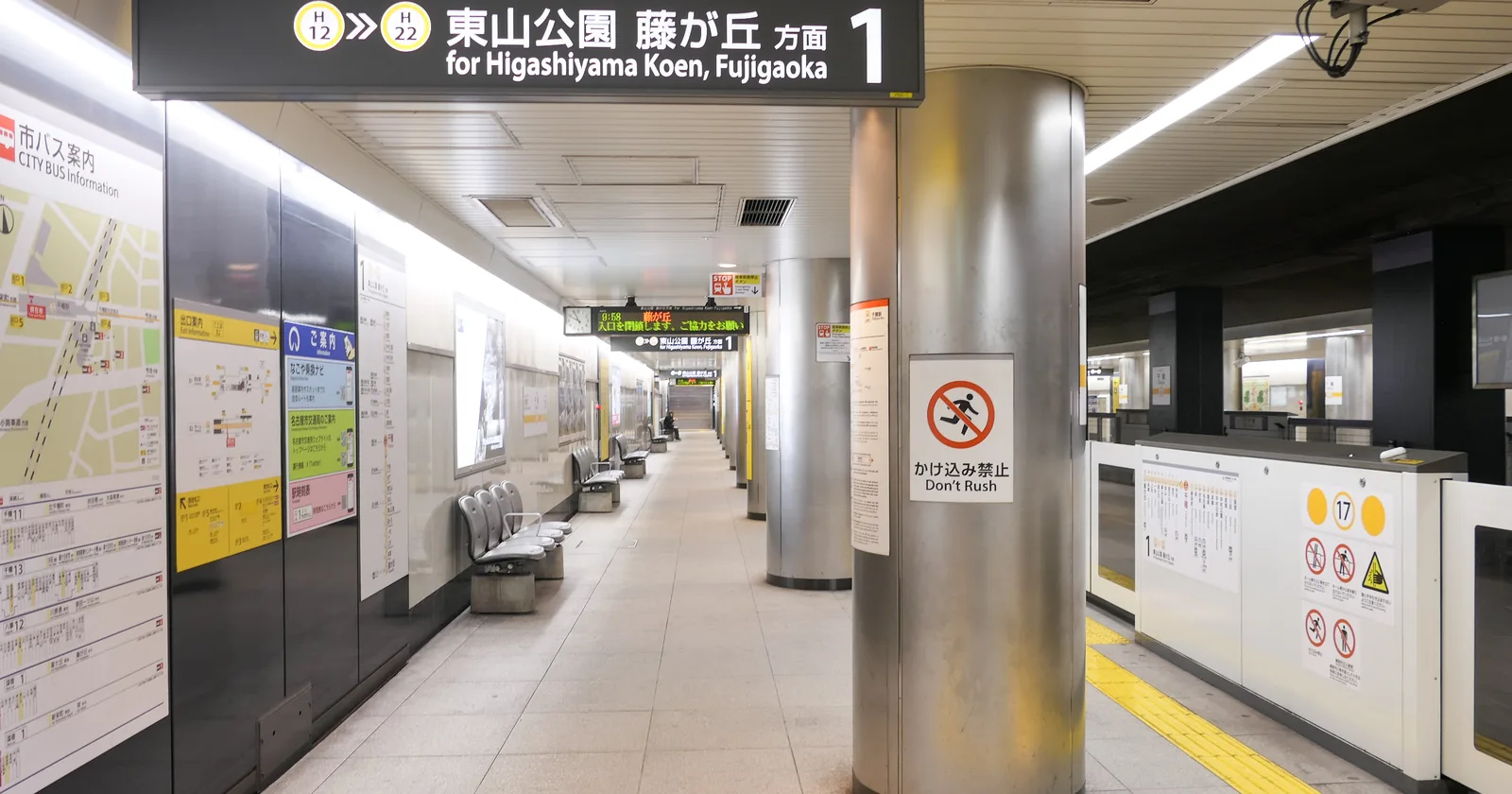
The Meijo Line is the one Games spectators should learn, because it is a loop that serves both the ceremonies stadium and the arena hosting basketball and judo. The operator’s official last-train page lists the very last counter-clockwise service via Ozone and Sakae towards Kanayama — the one bound for Aratamabashi — at these times [Source]:
| Station | Time as listed on the official last-train page |
|---|---|
| Ozone | 23:55 |
| Sakae | 00:10 |
| Kanayama | 00:18 |
The same page also lists two earlier services that run further round the loop: the last train bound for Mizuho-undojo-higashi (Sakae 00:02, Kanayama 00:10) and the last train that goes all the way round to Nagoya Dome-mae Yada (departing there at 23:25; Ozone 23:28, Sakae 23:42, Kanayama 23:50). If you are going beyond Aratamabashi, those are the times that apply. That page does not clearly separate weekday and weekend timetables, and these are single services on a loop line, so the last train in your direction from your station on your date is the number that matters — look it up rather than working backwards from this table.
On the Sakura-dori Line — which runs through Nagoya Station, Hisaya-odori and Imaike — the official page gives the last departure towards Tokushige as 23:52 from Nagoya Station (23:50 from Taiko-dori, arriving Tokushige at 00:26), and the last towards Taiko-dori as 23:53 from Tokushige. That page does not separate weekday and weekend timetables, so treat those figures as an indication of the shape of the evening and confirm the actual time for your date [Source].
The reliable move is to look it up: the transport bureau publishes searchable timetables by station and by line for all five subway lines — Higashiyama, Meijo and Meiko, Tsurumai, Sakura-dori, and Kamiiida [Source]. Check your own last train on the morning of an evening session, not on the platform afterwards.
Do not expect a later Friday train
Nagoya has a Friday-night late-train extension on the Higashiyama Line, and visitors who read about it in older guides tend to plan around it. As of October 17, 2026, the transport bureau’s own page for that service states that it is suspended until further notice, from August 7 (Friday) [Source]. The page describes the service as normally running on Fridays and the days before public holidays, excluding August 13 to 15, December 29 to January 3, and Saturdays, Sundays and public holidays.
Plan your Friday evenings on the ordinary last-train times, and if you need a later option, budget for a taxi.
Which Station Serves Which Venue?
Here are the stations for the venues most overseas spectators will use, with the walking times as published on the official access pages. The full list, including the venues elsewhere in Aichi, is in our Asian Games venues and access guide.
| Venue | Sports | Station and walk |
|---|---|---|
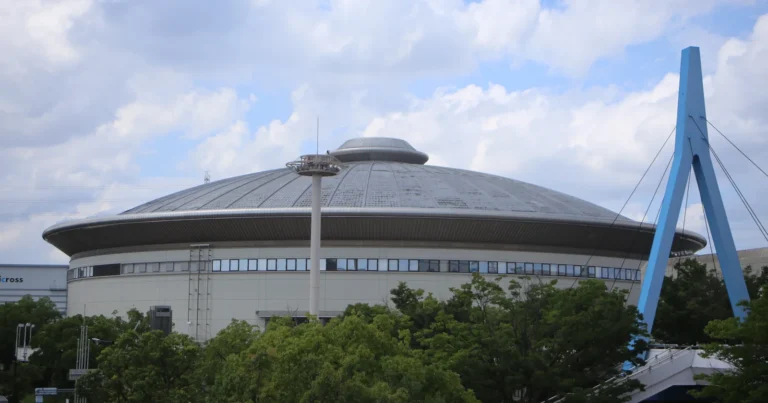
| Nagoya City Mizuho Park Athletic Stadium | Opening and closing ceremonies; athletics | Mizuho Undojo Higashi (subway Meijo Line), about 5–10 min; Mizuho Undojo Nishi (Sakura-dori Line) or Aratamabashi, about 10–15 min |
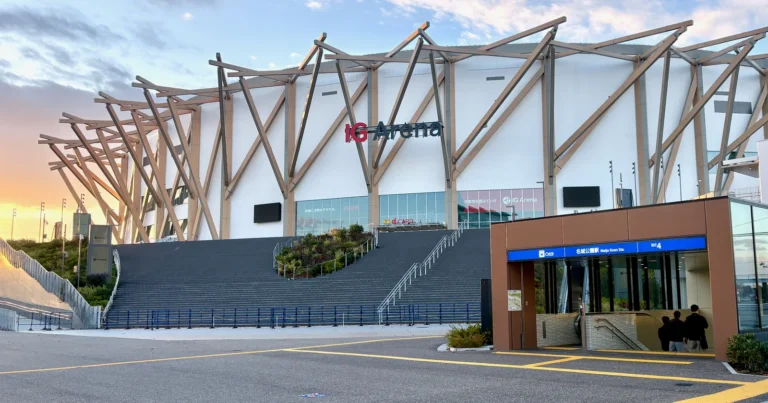
| Aichi International Arena | Basketball, judo | Meijo Koen (subway Meijo Line), exit 4 — the official page gives the walk as about 0 minutes; Joshin (Tsurumai Line) about 18 min |
| Nagoya City General Gymnasium [Rainbow Hall] | Gymnastics, rhythmic gymnastics, trampoline | Kasadera (JR Tokaido Line), about 5 min |
| Nagoya City General Gymnasium [Rainbow Pool] | Water polo | Kasadera (JR Tokaido Line), about 7 min |
| Nagoya International Exhibition Hall [Portmesse Nagoya] Hall 1 | Sport climbing | Kinjo-futo (Aonami Line), about 3 min |
| Nagoya Kinjo-Futo Arena | Squash | Kinjo-futo (Aonami Line), about 3 min |
| Kinjo Futo Station Square Venue | 3×3 basketball | Kinjo-futo (Aonami Line), about 1 min |
| Aichi Sky Expo | Breaking, BMX freestyle, esports, fencing, skateboarding | Chubu Centrair International Airport (Meitetsu Airport Line), about 10 min |
The two fares your day pass will not cover
Three of the venues above sit at Kinjo-futo, at the end of the Aonami Line — a separate railway, not part of the municipal subway, so your day pass does not cover it. From Nagoya Station the adult fare to Kinjo-futo is ¥360 (child ¥180). The same line serves Kohoku (¥270 / ¥130) for Aichi Prefectural Martial Arts Hall and Noseki (¥310 / ¥150) for Nagoya City Inae Sports Center [Source].
Football at Toyota Stadium is the other one to budget for: Meitetsu from Meitetsu Nagoya to Toyotashi is ¥900 with one change, taking a little under an hour — and then about a 20-minute walk at the far end. Give that trip a whole half-day.
Local tip: The Meijo Line did an unusual amount of work at the Games — ceremonies stadium, basketball and judo arena, and the tennis centre’s nearest station are all on it. If you learn one line before you arrive, learn that one. Our getting around Nagoya guide maps the whole network.
Frequently Asked Questions About Asian Games Transport in Nagoya
Which Nagoya day pass is best for Asian Games spectators?
The Bus & Subway All-Lines 1-Day Pass at ¥870 for adults and ¥430 for children on most days, because it covers both the subway and city buses from first service to last on any day of the year. On Saturdays, Sundays and public holidays, the Donichi Eco Kippu gives you identical coverage for ¥620 / ¥310. If your session finishes in the evening and you want to keep travelling the next morning, the Subway All-Lines 24-Hour Ticket (¥760 / ¥380) runs for 24 hours from the moment you first pass through a gate, rather than expiring at midnight. None of them covers the Aonami Line, JR or Meitetsu.
Does my Suica or PASMO work on the Nagoya subway?
Yes. Nagoya’s subway and city buses accept Kitaca, PASMO, Suica, TOICA, PiTaPa, ICOCA, Hayakaken, nimoca and SUGOCA as well as the local manaca card. The one limitation is that using another operator’s card here does not earn manaca mileage points or the bus-to-subway transfer discount, which are manaca-only benefits. For a visitor buying day passes anyway, that makes no practical difference.
Can I use the commemorative Asian Games day pass during the Games?
Do not assume so. The transport bureau’s announcement gives a sales period — August 10 to December 31, 2026 — at ¥870 each, adult version only, 20,000 of each design, sold at all 87 subway stations and the Nagoya, Sakae and Kanayama service centres, for cash or transport IC card only. It does not state a period during which the ticket is valid for travel. Ask at the counter when you buy, and do not build your travel budget around it.
Were there extra trains or later last trains during the Games?
Not on the subway, as of September 4, 2026. The Nagoya City Transportation Bureau has announced nothing about extra subway services or extended operating hours — its Games publications cover the commemorative day pass and city bus diversions. The Aonami Line, which serves the three venues at Kinjo-futo, published extra trains for September on selected dates between the 14th and the 30th, with the last extra service scheduled to leave Kinjo-futo at 22:37 and reach Nagoya at 23:00; those dates have now passed. Separately, the Higashiyama Line’s Friday late-train extension is currently suspended until further notice according to the bureau’s own page. Plan on the published timetable and check the operator’s site again shortly before you travel.
Are the shuttle buses free, and do I need to book?
During the Games, spectator shuttle buses were free, but only about twenty venues had one, and almost none of them were in Nagoya. Where one runs, that venue’s access page on the prefecture’s site gives the boarding point and the journey time, but no departure timetable — only that buses start roughly 90 minutes to two hours before the session, finish after the last match, and are limited in number. They operate in ordinary rain, though services can change with weather and traffic. Two things needed booking: the accessible shuttle for wheelchair users and visitors with disabilities, which is reservation-based and free, and the park-and-bus-ride car parks, which are reservation-only as a rule. Reservations for both opened on July 1, 2026.
Can I drive to the venues?
During the Games, you were asked not to. The organising committee requested that visitors refrain from using private vehicles and help reduce congestion, and the venue access pages state that there is no spectator car or bicycle parking. A limited number of free car parks exist, mostly reservation-only, and at Nagoya City General Gymnasium 25 spaces in the first car park are set aside for wheelchair users and visitors with disabilities, free but requiring a reservation. Add temporary road closures for the torch relay, marathon, race walk, cycling road race and triathlon, and a car became a liability.
Final Thoughts on Getting Around During the Games
Strip away the detail and the plan for a spectator in Nagoya is three decisions long. Buy the right day pass for the day of the week — ¥870 normally, ¥620 at weekends, ¥760 if your evening runs into the next morning. Keep whichever IC card you already own for everything the pass does not cover, and remember that the Aonami Line, JR and Meitetsu all charge separately. Then give yourself more time than you think you need at both ends of every session, because that is the one thing the official guidance actually tells you to do.
The rest is Nagoya being Nagoya: a subway that runs to the minute, signage in English at every station, and a network that reaches the city’s venues without ever needing a car. It is a good city to watch sport in.
For more on the Games themselves, see our complete Asian Games 2026 Nagoya guide, tickets, competition schedule and venues and access pages.
About the Author
Yuu was born in Nagoya and has lived here for 35 years. He wrote this page after reading the transport bureau’s own announcements alongside the prefecture’s spectator FAQ, which between them say far less about Games-period services than most English coverage assumes. The commemorative pass with no stated validity period, and the Friday late-train extension that is currently suspended, are both things that only appear in the Japanese pages.
Related Guides
- Asian Games 2026 Visitor Guide — venues, hotels, transport and what to do between sessions
- Asian Games 2026 Tickets — buying from overseas, the official resale service and what “currently unavailable” means
- Asian Games 2026 Schedule Guide — where the timetable actually lives and how to plan around it
- Asian Games 2026 Venues and Access — every venue, station and walking time
- Asian Games 2026 Spectator Itinerary — what to do with the rest of the day around your session
- Getting Around Nagoya — subways, buses and day passes in full
- Centrair Airport to the City — getting in from the airport