Okazaki’s fireworks ran on Saturday, August 1, 2026, from 19:00 to 20:30 over the Oto and Yahagi rivers. There is no free viewing area near the launch site — the whole riverbank is ticketed, and every seat sold out. Here is what the display is, what seats cost, where you can still watch for nothing, and when 2027 will be.
One sentence matters most here: Okazaki does not do what most Japanese fireworks festivals do. There is no stretch of grass where you can lay a sheet and watch for free. The organisers ticket the entire riverbank, publish a map of where you may not sit, and send everyone else to a park on the edge of town or a supermarket roof.
Written by Yuu — a Nagoya native of 35 years. Published August 15, 2026.
This article may contain affiliate links. See our affiliate disclosure for details.
All festival details verified from official sources on August 15, 2026.
On this page
What Do You Need to Know in One Minute?
The 78th Okazaki fireworks ran on Saturday, August 1, 2026, from 19:00 to 20:30, launched from the Oto River and the Yahagi River in central Okazaki. Every paid seat sold out two days beforehand. There is no free viewing area anywhere near the launch site.
| Item | Detail |
|---|---|
| Festival | Okazaki Joka Ieyasu-ko Natsumatsuri 78th Fireworks Festival (岡崎城下家康公夏まつり第78回花火大会). The City of Okazaki billed the 2026 edition as a 110th-anniversary project |
| 2026 date | Saturday, August 1, 2026, 19:00–20:30 — held as scheduled |
| Rule for future years | The first Saturday in August |
| Launch sites | Oto River (乙川) just downstream of Tonobashi bridge, and the Yahagi River (矢作川) |
| Free viewing area | None near the launch site. The whole riverbank is ticketed |
| Cheapest seat (2026) | ¥3,500 chair seat in Okazaki Castle Park’s multipurpose ground; ¥5,000 under Myojinbashi bridge |
| Dearest seat (2026) | ¥1,100,000 for one group of twenty inside the castle keep — a one-off anniversary seat |
| Shell count | Not disclosed. The organisers say so in writing |
| If it rains | Goes ahead in rain. Cancelled outright for warnings, high water or epidemic — no rain date |
| Nearest stations | Meitetsu Higashi-Okazaki (東岡崎) and Okazaki-koenmae (岡崎公園前); Aichi Loop Line Naka-Okazaki (中岡崎) |
| Road closures | 17:00–22:00 around the venue |
| Organisers | City of Okazaki and the Okazaki City Tourism Association, 0564-64-1637 |
| Next edition | 79th, 2027. Not announced as of August 15, 2026. The rule points to August 7, 2027 |
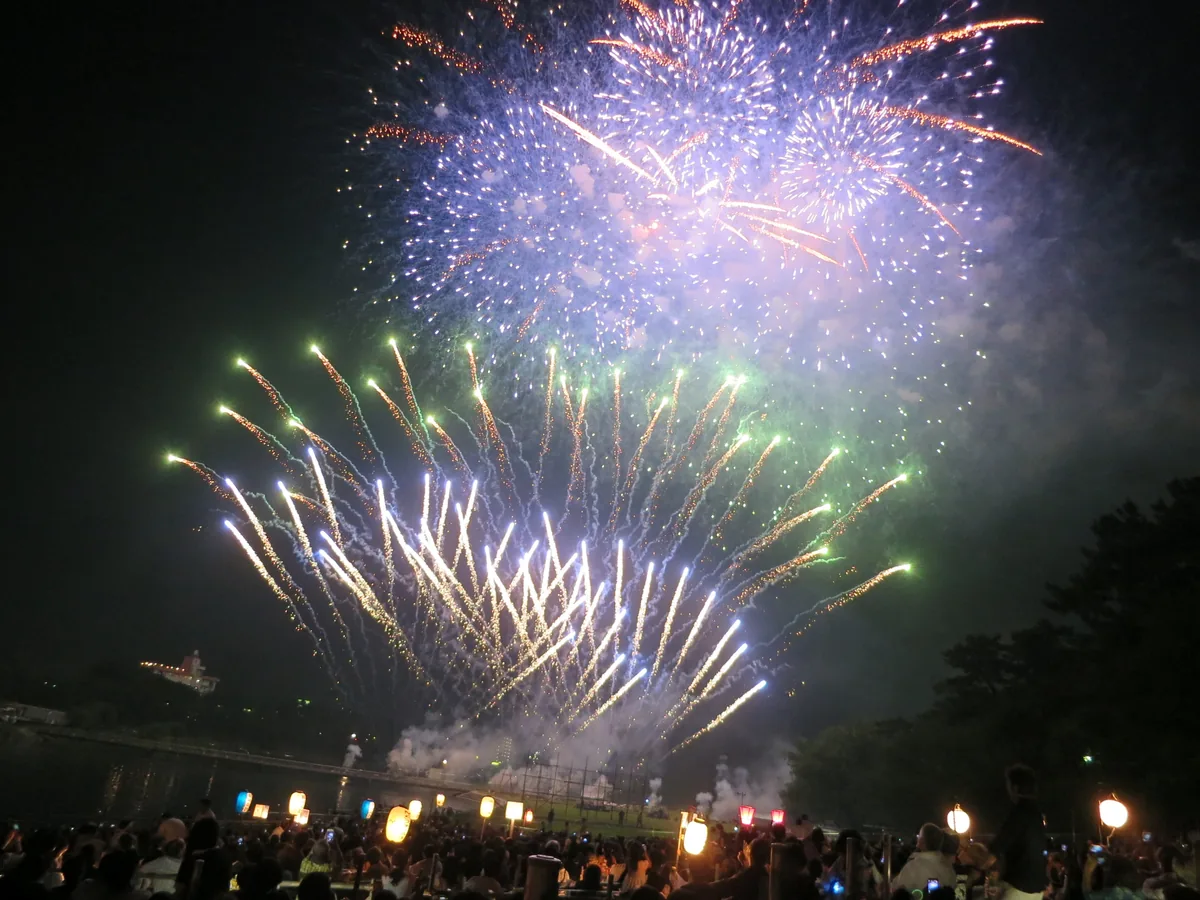

What Is the Okazaki Fireworks Festival?
It is a shrine rite that grew into a civic spectacle. The Okazaki City Tourism Association traces the display directly to the festival of Sugo Shrine (菅生神社), known since the Edo period for fireworks let off from lantern-hung boats floated on the river.
Its wording explains the shape of the whole evening: the Okazaki fireworks “grew out of the rite of Sugo Shrine, widely known since the Edo period as a fireworks festival with elegant hokobune boats floated on the river,” and today, paired with the Ieyasu-ko Summer Festival, it has become “a display gathering the finest of Mikawa fireworks, among the foremost in the country.” Two things matter in that sentence: Mikawa, and the boats.
Why Mikawa, of all places, makes fireworks
Mikawa (三河) is the eastern part of what is now Aichi Prefecture, and Okazaki is its old castle town. The tourism association’s history of Ieyasu and Okazaki Castle records his birth inside the castle, in the small hours of the 26th day of the twelfth month of 1542. According to the tourism association’s page on the origins of Mikawa fireworks, the craft exists here for a blunt political reason: the Tokugawa shogunate specially permitted the use of gunpowder in Mikawa, the province where Ieyasu was born, while restricting it elsewhere. Sugo Shrine puts it more plainly still, saying Ieyasu “limited the extraction of gunpowder and saltpetre to Mikawa alone, granting a privilege to his own countrymen.”
In the villages around Okazaki, the association writes, “when the rice harvest was finished in autumn, people threw themselves into making fireworks and competed with their skills at festivals.” That is the ancestry behind the city’s nickname for itself, shikake okoku (仕掛王国) — the kingdom of set-piece fireworks.
The boats, and the twelve and the three hundred and sixty-five
Sugo Shrine calls itself the oldest shrine in Okazaki, founded — by its own account — in the year 110 by Yamato Takeru, with Susanoo as its main deity. Its summer festival is a plea against plague and comes in three parts: the eve rite on July 19, the main rite on July 20, and, on the first Saturday of August, the hokobune shinji (鉾船神事), the boat rite with dedicated fireworks. That third part is the fireworks festival, and the shrine’s own page states it has been run jointly with the Ieyasu-ko Summer Festival’s display since 1948.
What happens on the water is more precise than most visitors realise. Two boats, Tenno-maru and Sugo-maru, carry a lantern tower with twelve lanterns standing for the twelve months of the year, and beneath them, spread like an umbrella, three hundred and sixty-five more for the days. From those boats, at about seven in the evening, tezutsu hand-held tubes, goldfish fireworks and scattering shells are sent up as offerings. The shrine dates the scene to 1818 — “two hundred years ago,” as its page says — and describes the whole picture: the shells staining the night sky with Okazaki Castle behind them, and the goldfish fireworks reflected in the river.
The rites begin in blazing daylight, hours earlier. At two in the afternoon the priests perform the boat-spirit rite and then the miyoshi-nagashi: a small reed boat carrying paper effigies, onto which June’s purification transferred the gods of pestilence, is floated downstream to carry the sickness away. At three the neighbourhood processions set off, and from about half past three until five, hand-held tubes are dedicated before the sanctuary.
One caution about arithmetic: the shrine dates the joint holding to 1948 and the 2026 display was the 78th. Those numbers do not line up, and nobody official explains the gap. Read “78th” as an edition count, not as seventy-eight consecutive summers.
Did the 2026 Okazaki Fireworks Go Ahead?
Yes. On the morning of August 1, 2026, the organisers posted that the 78th display would be held as scheduled, and the feature page now carries the closing notice: “the 78th fireworks festival has finished.” Aichi Prefecture’s tourism site also marks the event as over. Three details from the day are worth carrying into your own planning, because they will recur.
1. It sold out on July 30
Two days before the display, the tourism association announced that every paid seat had sold out and sent ticketless visitors to the satellite venues. General sale had opened on July 11 and was scheduled to run until 18:59 on the day — one minute before the first shell. It did not last that long.
2. The heat, and the instruction not to turn up early
The same notice warned that the day was forecast to be extremely hot, then said something you rarely hear from a Japanese festival organiser: do not come early. Every seat is numbered and allocated, so there is nothing to be gained by queueing.
「当日は非常に気温が高くなる予報です。観覧席は全席指定となっておりますので、お席を確保するために早くお越しいただく必要はございません。暑さを避け、開幕時間に合わせてゆっくりお越しください。」
(“The forecast for the day is extremely hot. All viewing seats are reserved, so there is no need to arrive early to secure a place. Avoid the heat and come at a relaxed pace, timed to the start.”)
The first week of August is the hardest week of the year here. Inland Okazaki holds heat after sunset in a way the coast does not, and a shadeless riverbank at six in the evening is still punishing. Take that instruction literally.
3. The trains stopped
Nineteen minutes into the display, Meitetsu’s official service-information account posted that trains on the Nagoya Main Line were suspended between Higashi-Okazaki and Shin-Anjo, after an accident involving a person on the line further west.
「名古屋本線 新安城駅~宇頭駅間 人身事故のため、名古屋本線 東岡崎駅~新安城駅間で運転を見合わせております。(2026/8/1 19:19)」
(“Because of an accident involving a person between Shin-Anjo and Uto on the Nagoya Main Line, we have suspended operations between Higashi-Okazaki and Shin-Anjo. 2026/8/1 19:19.”)
The organisers’ own page, still live in mid-August, records the recovery: as of 21:15, services toward Nagoya were running again, with delays and some cancellations. Nothing about that was foreseeable, but the lesson generalises: Okazaki gives you two railways, and you should know where the second one is before you need it.
How Many Fireworks Are There?
Nobody outside the organising committee knows, and that is not an accident. Asked in their own published FAQ how many shells go up, the organisers answered in three characters: hikokai — not disclosed. Listing sites print a number anyway. It does not come from the organisers.
This is unusual. Most Japanese fireworks festivals lead with their shell count — it is the statistic that gets a display ranked. Okazaki declines to give one:
「2.花火は何発ぐらい上がりますか? ⇒非公開です。」
(“2. Roughly how many fireworks are launched? — Not disclosed.”)
What they do publish is a composition, buried in the sponsorship prospectus the City of Okazaki releases each spring. The 2026 official outline document (PDF, Japanese) lists three lines under “fireworks overview”:
- Assorted aerial shells — a large number of 4-go to 10-go shells. The go number is the bore of the launch tube rather than the shell itself; the Japan Pyrotechnics Association puts a 10-go shell at about 28.5 cm across
- Assorted star-mines — about 20 batteries
- Framed set pieces — a maximum of 13, including one held by the organisers
You can also read the scale off the sponsorship price list, public because the display is sponsor-funded. A star-mine battery costs a sponsor ¥1,400,000 or more, a framed set piece ¥1,300,000 or more, a single sponsored shell ¥56,000. Twenty star-mines and thirteen set pieces at those floors come to roughly ¥45 million before an individual shell is counted — which tells you more than a round number would.
What Makes Okazaki’s Fireworks Different?
Three things: the framed set pieces that draw pictures in fire, the goldfish fireworks that skitter across the water, and a castle keep standing directly behind the launch site. Two of those three are visible only from a narrow band of seats.
Set pieces — the “kingdom” claim
A waku shikake hanabi (枠仕掛花火) is not an aerial shell. It is a wooden frame, built in advance, hung with lances of fire that ignite to draw a picture or write characters. The tourism association calls them “pictures and characters drawn in fireworks on a pre-assembled wooden frame,” redesigned every year, and “the true worth of Okazaki, the kingdom of set pieces.” Up to thirteen go up in an evening.
Goldfish fireworks, and the man who invented them
Kingyo hanabi (金魚花火) are a local speciality: small fireworks that dart and flick over the surface of the river like fish. Sugo Shrine credits their invention to a man called Kensen of Yukin-cho, and tells a story that says a lot about how seriously this town took its pyrotechnics — that to protect the secret, young men would dive into the river to retrieve the spent casings before anyone else could examine them.
The seats that see them, and the seats that do not
Here is the most useful sentence in this article for anyone buying a ticket. The organisers state it flatly:
「仕掛花火及び金魚花火等の特殊花火は「乙川マス席」「乙川南ー階段区画席」のみご覧いただけます。」
(“Special fireworks such as the set pieces and the goldfish fireworks can only be seen from the Otogawa box seats and the Otogawa South stepped blocks.”)
Everything else — the bridge tables, the chair seats, the castle park — sees the aerial shells and misses the two things Okazaki is famous for. The organisers add that from any seat other than the Otogawa boxes, “buildings, bridges, trees and so on will block some fireworks or make them appear cut off.”
The other axis is which river you see, because the display runs on two waterways at once. From the top of Sakurashiro bridge you get both. From the chair seats under Myojinbashi you get the Oto River to the east and the Yahagi to the west. From the castle park you get only the Oto River. It is a real choice: breadth from the bridge, or the specialities from the boxes.
How Do the Paid Seats Work, and What Do They Cost?
Seats run from ¥3,500 for one chair in the castle park to ¥51,000 for a six-person box on the riverbed, and in 2026 there was a one-off ¥1,100,000 seat for twenty people inside the castle keep. All seats are allocated by lottery, tickets are paper only, and fees are charged per person rather than per booking.
The full 2026 price list comes from the City of Okazaki’s press release of July 6, 2026. The 2025 price sits alongside because the document itself prints it, and the year-on-year rise is real.
| Seat | 2026 (incl. tax) | 2025 | Capacity per unit | Block total |
|---|---|---|---|---|
| Okazaki Castle keep seat (110th anniversary) | ¥1,100,000 / group | new | 20 people | 20 |
| Otogawa South stepped block (110th anniversary) | ¥36,000 | new | 4 | 264 |
| Otogawa South box A | ¥51,000 | ¥48,000 | 6 | 660 |
| Otogawa South box B | ¥45,000 | ¥42,000 | 6 | 300 |
| Under Sakurashiro bridge — premium table | ¥43,000 | ¥40,000 | 4 | 432 |
| Under Sakurashiro bridge — premium pair | ¥24,000 | ¥22,000 | 2 | 90 |
| On Sakurashiro bridge — premium table | ¥51,000 | ¥48,000 | 4 | 224 |
| On Sakurashiro bridge — premium pair | ¥28,000 | ¥26,000 | 2 | 92 |
| Under Myojinbashi bridge — premium table | ¥38,000 | ¥36,000 | 4 | 864 |
| Under Myojinbashi bridge — chair | ¥5,000 | ¥5,000 | 1 | 6,100 |
| Okazaki Castle Park multipurpose ground — chair | ¥3,500 | ¥3,000 | 1 | 4,240 |
Add the block totals and the ticketed capacity comes to 13,286 people. The organisers do not publish that sum — it is the arithmetic of their own table — but it is the closest thing to a size figure this festival has, since neither the city nor the prefecture publishes an attendance number.
The anniversary seats, and the ¥110 ticket
2026 was the 110th year since Okazaki became a city, and the organisers built two things around the number. The first was the castle keep seat: one group, twenty people, ¥1,100,000, credit card only. The second was quieter and far better value — 110 of the ¥3,500 castle-park chair seats were sold to Okazaki residents for ¥110 each. Both went in the residents’ pre-sale.
Practical rules that catch people out
- Fees are per head, not per booking. ¥165 booking fee plus ¥330 system fee per ticket, charged for every person in a group seat: a six-person box adds ¥2,970 on top of the ¥51,000.
- There are no e-tickets. The organisers state it explicitly — collect a paper ticket at a Seven-Eleven or by post before you travel.
- You cannot choose your seat number. All seats are reserved and numbers are drawn by lot, with no changes after purchase.
- Children from primary-school age up need their own ticket. Pre-school children may sit on a lap — two per box, table, pair or stepped block; one per chair seat.
- Wheelchairs are welcome, with one exception. Chairs and wheelchairs cannot be used inside the Otogawa box seats, because they block the view behind. (From the 2025 edition of the official FAQ, the most recent version publicly readable.)
- Where to buy. Ticket Pia online (credit card only), Seven-Eleven’s multi-copy machines, and — a very Japanese third option — some 1,500 Chunichi Shimbun newsagents across Tokai, about 30 in Okazaki.
The accessible box, and the shrine’s own boxes
Sixteen boxes in the Otogawa South block were reserved for disabled Okazaki residents at ¥32,000 with a parking space attached, and the quota was filled by 10:40 on the morning of June 6, 2026. The space came with a warning worth repeating for anyone driving near this event: with the closures in force you cannot move a car between 17:00 and about 22:00, so be parked by 16:30.
Separately, Sugo Shrine sells its own sajiki boxes on the riverbank — seats for those making an offering rather than a public sale. For 2026: ¥60,000 for a full box on the right bank, ¥40,000 for a half box, ¥50,000 for a full box on the left bank, ¥25,000 for a roomy pair box. House rules are strict: nothing that adds height, no watching while standing, no smoking, bring your own food and ground sheet — and, unlike the city’s tickets, no refund if the display is cancelled.
Can You Watch the Okazaki Fireworks for Free?
Not from anywhere near the river. The organisers ticket the entire riverbank and set up no free viewing area at all. What they offer instead is a satellite park, four shopping-centre rooftops and a scatter of parks and car parks — all of them well back from the launch sites, where you see the shells but hear none of the music.
This is the biggest difference between Okazaki and, say, the port festival in Nagoya or the fireworks closing the pottery festival in Seto, where you can simply turn up. Aichi Prefecture’s listing files the Okazaki position under “price”: “the Oto River banks around the venue are all designated as paid seating. (No free viewing area is set up.)” The city gives the reason as crowd management.
Where the organisers actually send you
- Okazaki Chuo Sogo Park (岡崎中央総合公園) — the official satellite venue. In 2026 it ran at reduced scale with food sales dropped, because of construction connected to the Asian Games and Asian Para Games.
- Four rooftop car parks, opened free — Aeon Mall Okazaki, Wing Town, LL Town and Piago Kamiwada. Entry is restricted once they fill.
- Three food-stall areas — the Libra library complex’s east car parks, the Civic Hall car park, and Mutsuna Park. The association lists these among the free viewing spots, and they are the only places it names where you can buy food.
- Two indoor “cool share” rooms — Libra Hall and Kabutoyama Kaikan. No food or drink.
On the evening itself the association runs a live congestion table on its free viewing page, updated through the display, and it covers more ground than the headline list: alongside the satellite park and the rooftops it tracks the Libra car parks and the riverside strip beside them, Mutsuna Park, Fukiyabashi Park, Hayakawa Park, Kagota Park and the roof of the city hall’s west multi-storey car park. The 2026 table is still up, frozen at its 20:00 update: the Libra car parks, the riverside strip, Fukiyabashi Park’s riverbed and the Aeon Mall roof were all showing “very crowded” while the display still had half an hour to run. It is the one page worth having open on your phone on the day.
Three things the free option costs you
First, you will not hear the show. The organisers state that from the free locations you can hear neither the venue announcements nor the music that the music star-mines and melody star-mines are choreographed to. A synchronised sequence watched in silence, from well back, is a different thing entirely.
Second, you cannot improvise a spot. Sitting down on roads and pavements is banned, reserving space in advance is banned, and sheets and other installations “will be removed as soon as they are found.”
Third, and the organisers flag this themselves: the last bus out of the satellite park leaves before the fireworks start. The final Meitetsu bus from the Chuo Sogo Park stop goes at 18:25, reaching Higashi-Okazaki at 18:53; the display begins at 19:00. There is a 20:00 departure from the Shimin Byoin (city hospital) stop, arriving 20:23, but that stop is a 25-minute walk away and it leaves half an hour before the finale.
How Do You Get to Okazaki, and How Do You Get Home?
From Nagoya, Meitetsu’s Nagoya Main Line runs to Higashi-Okazaki in 32 minutes for ¥750 with no change, and the prefecture’s listing puts the venue about ten minutes’ walk from there or from Okazaki-koenmae. But for 2026 the organisers actively steered people away from it, because Higashi-Okazaki is under construction, and pointed instead to Okazaki-koenmae and Naka-Okazaki.
Fares and journey times
| Route | Adult | Child | Time | Changes |
|---|---|---|---|---|
| Meitetsu Nagoya → Higashi-Okazaki (東岡崎) | ¥750 | ¥380 | 32 min | 0 — limited express, Toyohashi-bound |
| Meitetsu Nagoya → Okazaki-koenmae (岡崎公園前) | ¥750 | ¥380 | 40 min (fastest) | 1 |
| Meitetsu Nagoya → Okazaki-koenmae, through local train | ¥750 | ¥380 | 1 hr 19 min | 0 |
| Aichi Loop Line, Okazaki → Naka-Okazaki (中岡崎) | ¥270 | ¥140 | 2 stops, 3.4 km | 0 |
All fares checked on the operators’ own search tools on August 15, 2026. The limited express to Higashi-Okazaki is partly reserved, and the fare shown is the ordinary fare — ride the unreserved cars and no Mu-Ticket supplement is needed.
A thing that trips up visitors on Meitetsu generally: two stations on the same line, minutes apart, can be served by completely different trains. Higashi-Okazaki takes the fast ones. Okazaki-koenmae is a local-only stop, so a “direct” train there can mean seventy-nine minutes of stopping at everything, when the smart move is the express to Higashi-Okazaki and one stop back. Check the train type, not just the destination.
Which station for which seat
The organisers publish this pairing, and it is worth following:
- Otogawa box seats, the stepped blocks, and both Sakurashiro bridge areas → Higashi-Okazaki
- Under Myojinbashi bridge (tables and chairs) and Okazaki Castle Park multipurpose ground → Okazaki-koenmae, or Naka-Okazaki on the Aichi Loop Line
Their reason, in their own words: Higashi-Okazaki “is under construction, so severe congestion is expected.” The same advice went out to anyone heading for the Libra complex or the Civic Hall.
The second railway, and why it matters
Naka-Okazaki is on the Aichi Loop Line (愛知環状鉄道), a separate operator from Meitetsu, two stops and ¥270 from JR Okazaki Station. It has an attendant, a lift, an accessible toilet inside the gates and coin lockers, it interchanges on foot with Meitetsu’s Okazaki-koenmae, and Okazaki Castle Park is 500 metres east.
On the night of August 1, 2026, with Meitetsu stopped between Higashi-Okazaki and Shin-Anjo, that alternative was the obvious way out. Look at the Aichi Loop Line and the JR Tokaido Line on a map before you travel, even if you never intend to use them.
Road closures and parking
- Roads around the venue close from 17:00 and reopen at about 22:00. The regulation map also marks no-entry zones from 08:00 to 22:00 and stretches with an all-day parking ban.
- There is no festival car park. The organisers say so directly and ask everyone to come by public transport.
- Do not park at Comtown. The organisers name this Kamimutsuna shopping centre twice, asking visitors never to park there to watch — evidently a long-running problem.
- Temporary bus stops operate at Myodaiji-cho (southbound) and Kosei-cho (toward Daijuji and Iwazu).
- Public car parks close early, some the night before. In 2026: Libra’s main and east car park 1 from 21:00 on July 31, east car park 2 from 17:00; the Civic Hall car park all day; Okazaki Castle Park’s car park from 19:00 on July 31 until 08:30 on August 2; the Chuo Sogo Park’s sports facilities from 15:00, with part of its parking closed.
Ready to book a day trip?
Handy if you want to pair this with other sights the same day.
When Are the Next Okazaki Fireworks?
The 79th edition has not been announced. The organisers publish the rule rather than a date — the festival falls on the first Saturday in August — and applying that rule to 2027 gives Saturday, August 7. Treat that as an expectation, not a booking.
Judging by how 2026 unfolded, the cycle runs like this: the City of Okazaki issues its outline and sponsorship prospectus in mid-to-late April, which is where the date, the edition number and the fireworks composition first appear; seat details follow from late May; the residents-only lottery opens in early June; general sale opens in early July. In 2026 everything was sold out by July 30.
Two caveats. That timetable is observed from one year, not stated as policy. And the “first Saturday in August” rule is published as a description of when the festival is held, not as a promise about 2027. If you are building a trip around it, watch the tourism association’s feature page from April onwards — and note that its English, Chinese and Thai versions are machine translations, so changes land on the Japanese page first.
What Do Visitors Say About This Festival?
I have not attended this one, so I will not invent an evening for you, nor reproduce other people’s writing. What the evidence says is that demand outstrips supply: more than thirteen thousand ticketed places, at ¥3,500 to ¥51,000, sold out before the day.
Watch it rather than read about it
Okazaki is unusual in that the whole display is broadcast live by two outlets, both of which put material on YouTube — the most honest way to judge whether it is worth a ticket.
- Mics Network (ミクスネットワーク), the local cable operator, carries the display from start to finish. Its channel posted the 2026 stream as “岡崎城下家康公夏まつり 第78回花火大会|2026.8/1(土)18:45〜”. Embed candidate — attribution is the cable channel, not the city.
- TV Aichi, the terrestrial broadcaster on channel 10, runs a special programme. It calls that programme Okazakijo Dai-Hanabi (“Okazaki Castle Grand Fireworks”) — a broadcaster’s title, not the festival’s official name. Embed candidate.
- The Okazaki City Tourism Association on Instagram (@okazakiodekakenavi), the account most likely to post same-day conditions, and on Facebook and X. Embed candidate.
For a sense of the crowd rather than the sky, the organisers’ own documents tell you more: the map of streets where you may not sit, the plea not to park at a shopping centre, the instruction not to arrive early. Festivals only write rules like that about problems they have already had.
Frequently Asked Questions
When are the Okazaki fireworks held?
On the first Saturday in August. The 78th edition ran on Saturday, August 1, 2026, from 19:00 to 20:30, and went ahead as scheduled. The 2027 date has not been announced; the rule points to Saturday, August 7, 2027.
How many fireworks are launched at Okazaki?
The organisers do not disclose it. Asked in their own FAQ, they answered “not disclosed.” The only official breakdown is in the city’s sponsorship outline: 4-go to 10-go shells, about 20 star-mine batteries, and a maximum of 13 framed set pieces. Ignore the numbers on aggregator sites.
Is there a free viewing area at the Okazaki fireworks?
No. The entire Oto River bank around the venue is ticketed and no free area is set up. The official alternatives are Okazaki Chuo Sogo Park, the free rooftop car parks at Aeon Mall Okazaki, Wing Town, LL Town and Piago Kamiwada, and the parks and car parks the tourism association tracks on its live congestion page.
How much do Okazaki fireworks tickets cost, and where do you buy them?
In 2026, from ¥3,500 for a chair seat in Okazaki Castle Park to ¥51,000 for a six-person riverbed box, plus ¥495 per person in fees. Sold through Ticket Pia, Seven-Eleven kiosks and Chunichi Shimbun newsagents. Everything sold out on July 30, 2026.
Which seats see the set pieces and the goldfish fireworks?
Only the Otogawa box seats and the Otogawa South stepped blocks. The organisers state that from every other seat, buildings, bridges and trees block some fireworks or cut them off. Seats on Sakurashiro bridge and the chairs under Myojinbashi see both rivers.
What happens if it rains at the Okazaki fireworks?
The display goes ahead in rain. It is cancelled only for severe weather with warnings issued, high water in the rivers, or an epidemic — and there is no rain date. According to the 2025 edition of the official FAQ, the decision is made by 11:00 on the day and posted on the tourism association’s site.
Which station should you use for the Okazaki fireworks?
It depends on your seat. Otogawa boxes and the Sakurashiro bridge areas use Meitetsu Higashi-Okazaki, 32 minutes and ¥750 from Meitetsu Nagoya. Myojinbashi and castle park seats should use Okazaki-koenmae or Naka-Okazaki, because Higashi-Okazaki is under construction and badly congested.
Where Can You Check Official Information?
Everything above traces to these pages, all in Japanese. Dates, seat prices and road closures change every year, so check them again before you travel rather than trusting any English summary — including this one.
- Okazaki City Tourism Association — fireworks feature page. The primary source; same-day notices appear here, including the cancellation call.
- Access and traffic restrictions — station-by-seat pairing, closure times, and the official regulation map (PDF).
- Free viewing locations — satellite venues, live congestion table, last-bus times.
- On the origins of Mikawa fireworks — the association’s history page.
- City of Okazaki — official event page, and the outline and sponsorship prospectus (PDF) published each spring.
- Sugo Shrine — Sugo Matsuri: the boat rite, the lanterns, and the shrine’s own riverside boxes.
- Aichi Now — the prefecture’s tourism listing.
- Transport: Meitetsu for fares and live service information, and the Aichi Loop Line’s fare table.
- By phone: the tourism association on 0564-64-1637 (09:00–17:00, closed weekends and holidays), or the city’s Tourism Promotion Division on 0564-23-6384.
Related Festivals and Guides
- Central Japan festival calendar — month by month across Aichi, Gifu and Mie.
- Nagoya summer festivals — the July and August season around the city.
- Nagoya Minato Matsuri fireworks — the port display, and why 2026 had none.
- Atsuta Festival — June, at Nagoya’s oldest shrine, with fireworks and lantern towers.
- Owari Tsushima Tenno Festival — July, and Aichi’s closest match to Okazaki’s lantern-hung boats.
- Setomono Matsuri — September in the pottery town of Seto, with Saturday fireworks.
- Gujo Odori — the all-night dancing in Gifu, in the same weeks.
- Things to do in Nagoya — if this is one evening of a longer trip.