The KINTETSU RAIL PASS comes in four versions, and only two of them reach Nagoya. This guide covers the current prices, what each pass actually includes, the break-even maths for a trip to Ise-Shima or Osaka, and the one detail that catches almost everyone: Limited Express trains still cost extra.
Written by Yuu — a Nagoya native of 35 years. Published August 16, 2026.
This article may contain affiliate links. See our affiliate disclosure for details.
All details verified from official sources on August 16, 2026.
Kintetsu — 近鉄, short for 近畿日本鉄道, Kinki Nippon Railway — is the private railway that runs south-west out of Nagoya, and it owns the destinations most visitors from here want. Iseshi and Ujiyamada for the shrines. Toba. Kashikojima at the far end of the Shima Line. Its own through trains to Osaka-Namba and Kyoto.
So the pass matters. It is also the pass explained wrongly more often than any other, usually in one of three ways: people think the 5day and the 5day plus cover different rail territory (they do not), people think the pass lets them board a Limited Express (it does not), and people arrive expecting to buy it at a station window (they cannot). This guide is built around those three points, because getting them wrong costs either money or a train.
What Is the Kintetsu Rail Pass?
It is a set of four unlimited-ride tickets sold by Kintetsu Railway to overseas visitors, covering different slices of the network across Osaka, Nara, Kyoto, Mie and Nagoya. Kintetsu’s official English site lists exactly four, and no others exist.
The four, using the company’s own capitalisation, are KINTETSU RAIL PASS 1day, 2day, 5day and 5day plus. You will see them written elsewhere as “1-Day,” “5-Day PLUS” and so on; that is only formatting. What matters is that there is no “wide” version and no separate Ise-Shima-only pass in this family. Four products, sold all year round.
Who is allowed to buy one
This is a ticket for inbound travellers. Kintetsu’s official FAQ describes it as a value ticket for travellers visiting Japan for the purpose of sightseeing with the status of “Temporary Visitor” (短期滞在) as prescribed in Japan’s Immigration Control and Refugee Recognition Act. The Conditions of Purchase and Use page uses the broader phrase “a pass exclusively for foreign visitors to Japan.”
Both wordings are quoted here rather than merged, because they are not identical and Kintetsu has not published a reconciliation. What is unambiguous in both places: carry your passport whenever you are using the pass, so that you can show it if asked. The pass is valid for the holder only and cannot be transferred.
What it covers, in one sentence
Kintetsu lines, plus the Iga Tetsudo line (伊賀鉄道) on the 5day and 5day plus, plus certain designated bus services depending on which pass you hold. That is the entire scope. No JR trains, no Meitetsu, no subway. This catches people at the airport in particular: the train from Chubu Centrair to Nagoya is Meitetsu, and the pass does nothing for it. Ropeways are also excluded, though cable cars (ケーブルカー) are covered where they fall inside a designated zone.
Which Pass Should I Choose?
If you are starting from Nagoya, the choice is only ever between the 5day and the 5day plus. The 1day and 2day are Kansai-area products that do not reach Nagoya or Mie at all. Between the two five-day passes, the rail coverage is identical and the difference is buses.
Here is the whole line-up side by side, with prices as of August 2026.
| Pass | Adult | Child (6–11) | Validity | Rail coverage | Buses |
|---|---|---|---|---|---|
| KINTETSU RAIL PASS 1day | ¥1,900 | ¥950 | Date of use only | Designated Kintetsu sections only: Osaka-Namba to Kintetsu-Nara, Kyoto to Tsutsui, Nagata to Ikoma, Toriimae to Ikomasanjo | Nara Kotsu Bus: Nara Park, Nishinokyo, Horyuji |
| KINTETSU RAIL PASS 2day | ¥3,700 | ¥1,850 | 2 consecutive days | All Kintetsu lines within Osaka, Nara and Kyoto Prefectures | Nara Kotsu Bus: the above plus Asuka, Muro, Yamanobe-no-Michi |
| KINTETSU RAIL PASS 5day | ¥4,900 | ¥2,450 | 5 consecutive days | All Kintetsu lines plus the Iga Tetsudo line — Osaka, Nara, Kyoto, Nagoya and Mie | None |
| KINTETSU RAIL PASS 5day plus | ¥6,700 | ¥3,350 | 5 consecutive days | Identical to the 5day: all Kintetsu lines plus the Iga Tetsudo line | Nara Kotsu Bus, Mie Kotsu Bus and Toba City “Kamome” (Seagull) Bus, within designated zones |
Adult means age 12 and over; child means age 6 through 11; children under 6 travel free. All four are on sale year-round.
The mistake worth spelling out
The 5day plus does not take you anywhere by train that the 5day cannot. Both give unlimited rides on all Kintetsu lines and the Iga Tetsudo line. Kintetsu’s 5day page and its 5day plus page use the same sentence for the rail element. The extra ¥1,800 buys designated buses and nothing else.
The reverse error is just as common: assuming the plain 5day includes some buses. It includes none. The 5day page has no bus section at all, and Kintetsu’s FAQ on boarding buses names the 5day plus for Nara Kotsu, Mie Kotsu and the Toba City Kamome buses, and the 1day and 2day for Nara Kotsu only. The 5day is simply absent from that answer.
So which one
Work it backwards from your bus usage, since that is the only variable:
- 5day — you are doing rail-heavy travel between Nagoya, Osaka, Kyoto, Nara and the Kintetsu stations in Mie, and you are happy to pay bus fares as they come.
- 5day plus — your itinerary has real bus mileage in it: the Ise shrine shuttle between the outer and inner shrines, moving around Toba and Shima, or the Nara Kotsu routes out to Asuka and Muro.
- 1day or 2day — you are based in Kansai and not coming east. From Nagoya they are unusable.
How Much Does It Cost — and Is It Worth It?
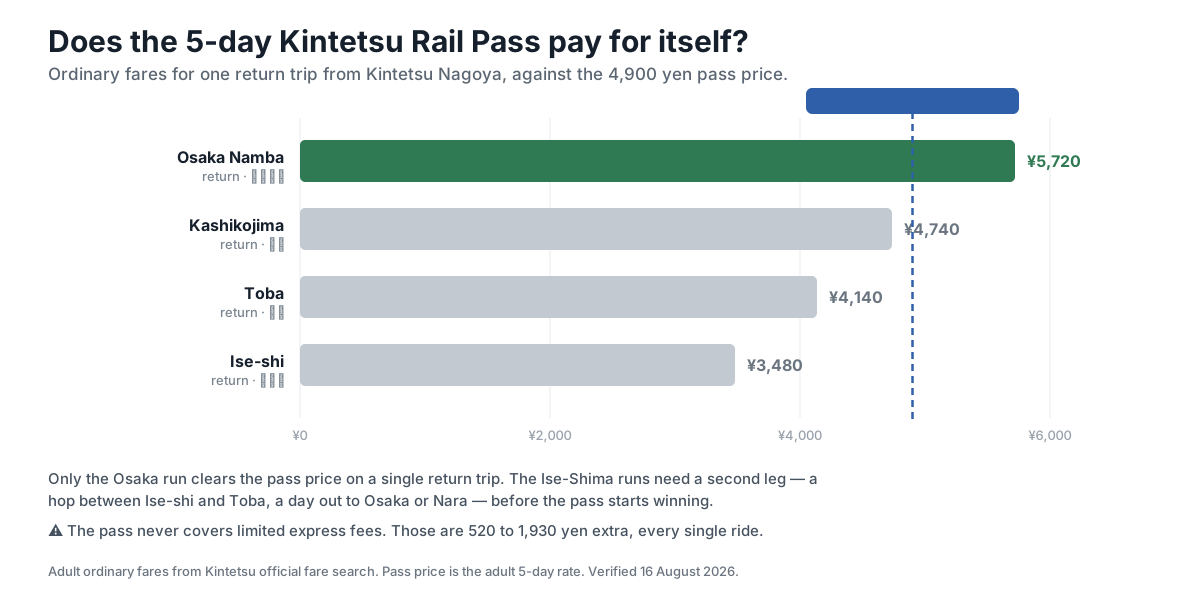
The 5day is ¥4,900 and pays for itself on a single Nagoya–Osaka round trip. A Nagoya–Ise-Shima round trip alone does not reach it. That asymmetry is the single most useful thing to know before you buy, and it surprises people, because Ise feels much further away than it is priced.
Kintetsu publishes its fare and Limited Express charge tables as PDFs. Below are the adult one-way figures for the routes a Nagoya-based traveller actually uses. The second column is the ordinary fare — what the pass replaces. The third is the Limited Express charge, which it never replaces.
| Route (one way) | Ordinary fare | Limited Express charge |
|---|---|---|
| Kintetsu-Nagoya – Osaka-Namba | ¥2,860 | ¥1,930 |
| Kintetsu-Nagoya – Iseshi / Ujiyamada | ¥1,740 | ¥1,340 |
| Kintetsu-Nagoya – Isuzugawa | ¥1,750 | ¥1,340 |
| Kintetsu-Nagoya – Toba | ¥2,070 | ¥1,340 |
| Kintetsu-Nagoya – Kashikojima | ¥2,370 | ¥1,640 |
| Kintetsu-Nagoya – Matsusaka | ¥1,530 | ¥1,340 |
| Kintetsu-Nagoya – Tsu | ¥1,210 | ¥920 |
| Kintetsu-Nagoya – Kintetsu-Yokkaichi | ¥760 | ¥520 |
| Kintetsu-Nagoya – Kuwana | ¥530 | ¥520 |
| Osaka-Namba – Kintetsu-Nara | ¥680 | ¥520 |
| Kyoto – Kintetsu-Nara | ¥760 | ¥520 |
| Kyoto – Osaka-Namba | ¥1,140 | ¥920 |
| Osaka-Namba – Iseshi | ¥2,170 | ¥1,340 |
| Kyoto – Iseshi | ¥2,430 | ¥1,640 |
| Osaka-Namba – Kashikojima | ¥2,770 | ¥1,640 |
| Kyoto – Kashikojima | ¥3,060 | ¥1,930 |
Where the 5day breaks even
Run the arithmetic on the ordinary fares only, since that is the part the pass covers.
Nagoya to Osaka-Namba and back is ¥5,720. One round trip, and you are ¥820 past the ¥4,900 price of the 5day. Everything else you ride in those five days is free of fare. This is the clearest win the pass offers, and it is why the 5day makes sense for anyone splitting a trip between Nagoya and Kansai.
Nagoya to Iseshi and back is ¥3,480. Toba and back is ¥4,140. Kashikojima and back is ¥4,740. All three sit below ¥4,900. If your plan is one day trip to the shrine and nothing else on Kintetsu, buying the pass loses you money — a straight return ticket is cheaper, and our Ise Grand Shrine day trip from Nagoya guide is costed on exactly that basis.
The gap closes fast once you add anything. Iseshi to Toba is ¥390 each way; a second day out to Yokkaichi, Kuwana or Tsu adds up quickly; and a single leg to Osaka or Kyoto ends the argument on its own. As a rule of thumb: one Kansai crossing, or three or more separate day trips, and the 5day is ahead.
Where the extra ¥1,800 for the 5day plus breaks even
The plus costs ¥6,700 against ¥4,900, a difference of ¥1,800 for an adult and ¥900 for a child. Since the rail coverage is the same, that ¥1,800 has to come back purely in bus fares.
The clearest benchmark is the Ise shrine shuttle. Mie Kotsu Bus charges ¥520 adult (¥260 child) one way from Geku-mae (外宮前) to Naiku-mae (内宮前), the standard link between the outer and inner shrines; Iseshi Station to Naiku-mae is the same ¥520. An outer-to-inner round trip is ¥1,040 — short of the ¥1,800 difference. Ride it four times over your trip and you reach ¥2,080, which clears it.
Add Toba and Shima buses on top and the plus wins comfortably, but no precise figure for those routes appears here: Kintetsu’s English page defines the covered area only as the “Matsusaka/Ise/Toba/Shima area,” and individual route fares are not verified against an operator source. Treat the ¥520 shrine shuttle as your unit of measurement and count how many bus rides your itinerary really contains.
The benefits are worth a look
Both five-day passes come with discounts at roughly 70 facilities across Osaka, Nara, Kyoto, Mie and Nagoya; the 1day and 2day cover roughly 40, in Kansai only. One use per facility, valid only within the pass period, not combinable with other coupons. From the official benefits list for the five-day passes, dated June 1, 2026:
- Mikimoto Pearl Island, five minutes’ walk from Toba Station: adult admission ¥1,650 down to ¥1,350, ages 7–15 ¥820 down to ¥675.
- Toba Sea-Folk Museum (海の博物館): ¥800 down to ¥720.
- Shima Spain Village Parque España: approximately 15% off the one-day passport, adults only, not applicable to the two-day or Moonlight passports.
- NINJA KINGDOM ISE: adult basic ticket ¥1,500 down to ¥1,200.
- HARUKAS 300 in Osaka: 10% off admission.
Two people using the Mikimoto discount recover ¥600 of the pass price in one stop — not decisive on its own, but enough to shift a marginal case.
Building more into the trip?
Handy if you want tours or day trips booked around your rail plans.
Do I Need Extra Tickets for Limited Express Trains?
Yes, always, on every version of the pass. Kintetsu states it in red on its own purchase page: the KINTETSU RAIL PASS alone does not allow you to board Limited Express trains, and you must additionally purchase a Limited Express ticket to do so.
Japanese rail fares split into two components — the basic fare (乗車券, joshaken) and the express charge (特急券, tokkyuken) — and the pass is a basic fare product. It buys the distance, not the train.
There is no unreserved-seat workaround
If you have used JR passes, you will have absorbed a habit: when the reserved seats cost extra, take the unreserved car. That does not exist on Kintetsu. The company’s Limited Express Tickets page is explicit that all seats in a Limited Express train are reserved and there are no unreserved seats, and that a Limited Express ticket is valid only for the designated train.
So the choice at Kintetsu-Nagoya is binary: pay the Limited Express charge and ride the fast train, or ride the express and local services, which the pass covers in full, and accept the longer journey.
What the charges actually run to
Limited Express charges are set by distance band. Across Kintetsu’s published tables for the main routes, the adult figures that appear are ¥520, ¥920, ¥1,340, ¥1,640 and ¥1,930 — so for planning purposes, budget somewhere between about ¥520 and ¥1,930 per Limited Express leg, on top of the pass. Nagoya to Ise is ¥1,340. Nagoya to Osaka-Namba is ¥1,930. Child charges are half the adult figure, rounded up to the nearest ¥10.
Two named trains cost more again, because they carry a special-car charge (特別車両券, tokubetsu-sharyo-ken) on top of the Limited Express ticket:
- Hinotori (ひのとり), the flagship on the Osaka-Namba–Kintetsu-Nagoya run: ¥200 for a Regular car seat, ¥900 for a Premium car seat. With a pass covering the fare, a Premium seat between the two cities therefore costs ¥1,930 plus ¥900.
- Shimakaze (しまかぜ), the sightseeing train to Ise-Shima: from Kintetsu-Nagoya, ¥840 to Iseshi, Ujiyamada or Toba, and ¥1,050 to Kashikojima. Private compartments cost a further ¥1,050 per room. Kintetsu states it operates only one round trip a day between Osaka-Namba, Kyoto and Kintetsu-Nagoya and Ise-Shima, so treat a seat on it as something to plan around rather than turn up for.
How pass holders buy the express ticket
Kintetsu’s online booking system has two separate flows, and pass holders want the first: “Purchase Limited Express Ticket Only.” The page notes that a basic fare ticket is also required, and lists the Kintetsu Rail Pass first among the things that qualify. That flow is English-only, lets you pick your seat and section, and allows up to three train changes free of charge. Tickets go on sale one month before the travel date, from 10:30.
The second flow bundles a fare ticket with the express ticket. Skip it — you would be paying twice for the fare you already hold.
Station ticket windows and the Limited Express vending machines sell the same tickets, which is the simpler route for a same-day decision. One rule worth knowing on longer journeys: if you change between Limited Express trains at a junction such as Yamato-Yagi, Kashiharajingu-mae or Ise-Nakagawa and your connection is under 30 minutes, a single Limited Express ticket is issued for the whole journey, with the charge calculated on total distance rather than as two legs.
How Do I Buy and Use It?
Two channels, and only two: online, or from a travel agency outside Japan. Kintetsu’s Purchase Guidance lists nothing else. There is no station window that sells it and no voucher to exchange, because the pass is a digital ticket from end to end.
That deserves emphasis, because a great deal of older advice still describes collecting a paper pass at an airport or a major station. That process no longer applies. The official Purchase Guidance page gives two options: purchase online, via an external sales site it links to directly, or purchase at a local agency outside Japan that sells the pass — for which Kintetsu tells you to contact that agency for details.
Third-party resellers such as Klook also list the pass. Their prices and conditions are not quoted here, because they cannot be verified against a first-party source and Kintetsu’s own page does not name them. Whatever channel you use, treat the Kintetsu figures above as the price of record.
Before you buy
The published operating constraints are specific enough to matter:
- Maximum four tickets per reservation. A group of six needs two bookings.
- One reservation per device is recommended. Plan who is holding what before you check out.
- Supported environments are iOS 15 or later with the latest Safari, and Android 10.0 or later with the latest Chrome.
Starting the pass
On the day you want to begin, you tap the “Activate Tickets” button. The validity period runs from that moment — the date of use for the 1day, two consecutive days for the 2day, five consecutive days for both five-day passes. Kintetsu’s guidance places the words “Cancellation is not allowed” directly after that instruction, so treat activation as the irreversible step and do not tap it on the platform the evening before.
Three device settings will break the ticket if you leave them on, and Kintetsu names all three: browser auto-translation, dark mode, and screen auto-rotate. Turn them off before you reach the gate. And note this one, which trips people up daily: a screenshot of the QR code will not work at the gate. The live ticket screen is the ticket.
At the gate and on the bus
Use a ticket gate that accepts digital tickets and the Tap to Ride service. At stations or gates that do not, show your ticket screen to station staff instead, and show it to train crew if you are asked on board. On covered buses, show the pass — the screen with the date of use on it — to the driver as you get off; on rear-boarding buses, take a numbered ticket when you board as usual.
If you travel beyond the valid zone, buy a basic fare ticket for the extra section. Refunds are limited: passes bought online or through an agency cannot be refunded at a Kintetsu station ticket office, and no refund is given for train delays or for the closure of facilities offering benefits, whatever the cause.
Where Can It Take Me?
From Nagoya, the five-day passes open up two very different directions on one ticket: south into Mie and Ise-Shima, and west into Nara, Osaka and Kyoto. Being able to do both without buying a second product is the real argument for the pass.
South: Mie and Ise-Shima
This is Kintetsu’s home turf. Iseshi and Ujiyamada are the stations for Ise Jingu (伊勢神宮); Toba is where Mikimoto Pearl Island sits, five minutes’ walk from the station; Kashikojima is the last stop on the line. Kuwana, Kintetsu-Yokkaichi, Tsu and Matsusaka are all covered along the way.
For the shrine itself, our Ise Grand Shrine day trip guide walks through the outer-to-inner shrine sequence and the timings that make a single day work. For the coast beyond it, the Toba and Shima guide covers where the buses go once the train line runs out — which is precisely the territory the 5day plus is designed for, since its designated bus zone is described as the Matsusaka, Ise, Toba and Shima area, plus the Toba City Kamome buses.
The plus also covers three bus pockets that are easy to miss: Nabari and the Akameguchi–Akame Falls route, the Aqua Ignis to Kintetsu Yunoyama-Onsen to Gozaisho area, and Kuwana and Kintetsu-Nagashima out to Nabana no Sato — for which Kintetsu notes the departure stop varies by season.
West: Nara, Osaka, Kyoto
Kintetsu-Nara, Osaka-Namba and Kyoto are all on the network, so a Nara–Kyoto–Osaka triangle is entirely doable on the pass, with only Limited Express charges to add where you want speed. Osaka-Namba to Kintetsu-Nara is ¥680 in ordinary fare, Kyoto to Kintetsu-Nara ¥760, Kyoto to Osaka-Namba ¥1,140 — modest sums individually, which is why a Kansai-only week rarely justifies the 5day on fares alone.
One thing to be clear about: Kintetsu’s Nagoya–Osaka route is a conventional railway on its own alignment, not a Shinkansen line, and the pass covers no JR services at all. If your itinerary is Shinkansen-shaped, our JR pass guide for Central Japan is the comparison to read, and for a wider view of a day’s range, see best day trips from Nagoya.
The Iga detour
Both five-day passes also include the Iga Tetsudo line (伊賀鉄道), a short local railway in western Mie that most itineraries never touch — the kind of branch line worth a morning only when the ride is already paid for.
What Should I Know Before I Tap In?
Book Limited Express seats early for Ise in peak season, keep your phone charged, and remember that the pass covers Kintetsu and nothing else. Most problems with this pass come from those three places rather than from anything complicated.
Plan the express tickets separately from the pass. They are different purchases on different systems, and buying the pass does not put you on a train. Tickets open one month ahead at 10:30, and on New Year, Golden Week and the shrine’s busiest weekends that matters.
Arriving at Chubu Centrair, the pass is not your airport transfer. Centrair to Nagoya is Meitetsu. Budget it separately, and start counting your five days from the day you actually begin using Kintetsu.
Battery is a ticketing issue now. A digital-only pass with a live QR screen means a dead phone is a lost ticket at the gate. Carry a battery pack — doubly so for whoever is holding four tickets for the group.
Watch which shrine station you pick. Iseshi and Ujiyamada are both ¥1,740 from Nagoya and Isuzugawa is ¥1,750 — a ¥10 gap without a pass, and no gap at all with one. On the pass, get off at whichever suits your route.
Prices move. Kintetsu revised these pass prices in April 2024 and announces revisions on its own site in advance. Every figure here was checked against official pages on August 16, 2026, and re-checked quarterly. If your trip is months away, confirm on the official pages before you budget.
Frequently Asked Questions
How much does the Kintetsu Rail Pass cost?
As of August 2026, the KINTETSU RAIL PASS 1day is ¥1,900 for an adult and ¥950 for a child, the 2day is ¥3,700 and ¥1,850, the 5day is ¥4,900 and ¥2,450, and the 5day plus is ¥6,700 and ¥3,350. Adult means age 12 and over, child means age 6 through 11, and children under 6 travel free. All four are sold year-round.
What is the difference between the 5day and the 5day plus?
Buses, and only buses. Both passes give unlimited rides on all Kintetsu lines and the Iga Tetsudo line for five consecutive days, so the rail coverage is identical. The 5day plus adds designated Nara Kotsu Bus, Mie Kotsu Bus and Toba City Kamome Bus services for ¥1,800 more. The plain 5day includes no bus services at all.
Can I ride Limited Express trains with the Kintetsu Rail Pass?
Not on the pass alone. Kintetsu states that the pass by itself does not allow you to board Limited Express trains and that you must additionally purchase a Limited Express ticket. Every seat on a Kintetsu Limited Express is reserved, with no unreserved cars, so there is no cheaper way onto the train. The pass does count as the basic fare ticket when you buy the express ticket online.
Does the Kintetsu Rail Pass cover Nagoya to Ise?
The 5day and 5day plus do, because they cover all Kintetsu lines. The 1day and 2day do not: the 1day is limited to designated sections around Osaka, Nara and Kyoto, and the 2day covers Kintetsu lines within Osaka, Nara and Kyoto Prefectures only. Neither reaches Nagoya or Mie, so from Nagoya only the five-day passes are usable.
Is the Kintetsu Rail Pass worth it from Nagoya?
It depends on whether you cross to Kansai. Nagoya to Osaka-Namba is ¥2,860 one way, so a single round trip is ¥5,720 and already beats the ¥4,900 price of the 5day. A round trip to Iseshi is only ¥3,480, to Toba ¥4,140 and to Kashikojima ¥4,740, so a single Ise-Shima return does not pay for the pass on its own without extra journeys.
Where can I buy the Kintetsu Rail Pass?
Kintetsu lists two channels: online through the external sales site linked from its official Purchase Guidance page, or at a travel agency outside Japan that sells the pass. It is a digital ticket, so there is no paper voucher to exchange and no station window or airport counter purchase in Japan. It is sold to overseas visitors, and you should carry your passport while using it.
Can I use the Kintetsu Rail Pass on buses?
Only with certain passes. The 5day plus covers designated Nara Kotsu Bus, Mie Kotsu Bus and Toba City Kamome Bus services, including the Matsusaka, Ise, Toba and Shima area. The 1day and 2day cover designated Nara Kotsu Bus routes only. The plain 5day covers no buses. Show the pass screen to the driver as you get off.
Related Guides
- Ise Grand Shrine Day Trip from Nagoya — the single-day version, costed without a pass.
- Toba and Shima Guide — where the 5day plus bus coverage earns its keep.
- JR Pass Guide for Central Japan — the other half of the rail-pass question.
- Best Day Trips from Nagoya — what is reachable in a day, by every operator.
- Things to Do in Nagoya — the base city itself.
- Central Japan Festival Calendar — for timing a trip around a matsuri.
- Nagoya Meshi Food Guide — eat well between trains.