Toba and Shima are the sea-facing half of Ise-Shima National Park, 1 hour 38 minutes from Nagoya by Kintetsu limited express. This is where you meet ama divers, visit the island where cultured pearls began, eat oysters from a sheltered bay and look out over Ago Bay. It is also where several popular travel-blog claims quietly fall apart.
Written by Yuu — a Nagoya native of 35 years. Published August 16, 2026.
This article may contain affiliate links. See our affiliate disclosure for details.
All details verified from official sources on August 16, 2026.

What are Toba and Shima?
Toba and Shima are coastal cities in Mie Prefecture, inside Ise-Shima National Park — 55,544 hectares designated on November 20, 1946. Toba is the port city of aquariums and pearls; Shima is the deeply indented ria coast around Ago Bay. The 2016 G7 summit was held in this area.
From Nagoya, this is the standard direction for salt water. Most overseas visitors go as far as Ise, see the Grand Shrine and turn round — a good day out, covered in our Ise Grand Shrine day trip guide, but it stops short of what the region is built on. Ise is the shrine; Toba and Shima are the sea that has fed it.
The Ministry of the Environment describes the park with the phrase satoyama satoumi (里山里海): landscapes shaped by human work rather than left alone. The pearl farms, the oyster rafts, the ama (海女) diving for abalone — none is wilderness, none is staged for visitors. They are industries that happen to be beautiful, and most of what is worth doing here means walking into one.
The other date locals mention is May 26 and 27, 2016, when the G7 leaders met here: Japan, Italy, Canada, the United Kingdom, France, the United States, Germany and the European Union. The Ministry of Foreign Affairs records the venue simply as Ise-Shima, Mie Prefecture — several English guides name a hotel and island that the official summit site does not.
What can I do in Toba?
Two major attractions sit within a ten-minute walk of Toba Station: Mikimoto Pearl Island, 1,650 yen with ama demonstrations included, and Toba Aquarium, 2,800 yen with about 1,200 species. Meoto Iwa, usually bundled into Toba itineraries, is actually in Ise City.
Mikimoto Pearl Island, and the demonstration that is included
Mikimoto Pearl Island (ミキモト真珠島), five minutes on foot from Toba Station, is where Kokichi Mikimoto succeeded in culturing pearls — a small island museum complex joined to the mainland by a bridge. Admission is 1,650 yen for adults and 820 yen for elementary and junior high school students, and — the question I see asked most — the ama diving demonstration is included in that price.
Demonstrations run at 9:30, 10:30, 11:30, 13:30, 14:30, 15:30 and 16:30. Read that list again: there is no 12:30 session, so an itinerary built around arriving over lunch has a hole in it. From November 27 to December 22, when the island closes at 16:30, the last demonstration is 15:30.
Closing time moves seasonally between 16:30 and 17:30, ticket sales stop 60 minutes before closing, and the island shuts for three days from the second Tuesday of December. Inside, the Pearl Museum is described by the operator as Japan’s first museum devoted to pearls, its best-known exhibit the Yaguruma obi ornament shown at the 1937 Paris International Exposition; the memorial hall next door covers Mikimoto himself, born the son of a Toba udon shop and dead at 96.
Toba Aquarium, described accurately
Toba Aquarium (鳥羽水族館), about ten minutes on foot from the station, opened on May 15, 1955, holds about 6,000 tonnes of water, and keeps roughly 1,200 species and 25,000 animals across 12 themed zones with no fixed route — you wander. Admission is 2,800 yen for adults, 1,600 yen for elementary and junior high school students and 800 yen for children aged three and over. Standard hours are 9:30 to 17:00, last admission 16:00, extended to 9:00–17:30 during Golden Week, the summer peak and Silver Week. It opens year-round, with occasional one-off closures.
Two claims need care. The aquarium’s own English pages say it keeps more species than any other aquarium in Japan; the Japanese facility page gives about 1,200 species with no ranking. So “most in Japan” is the operator’s own statement about species count, not an independent measurement — and not a claim about size.
The second is the animal everyone comes for. The Japanese official site states that Toba is the only aquarium in Japan keeping a dugong, and the only one in the world displaying a dugong alongside an African manatee; the dugong, Serena, passed 39 years in residence in April 2026. Show and feeding times I deliberately do not list — the official schedule renders dynamically and I could not confirm a single time from it, so check the show page on the morning of your visit.
| Ticket | Covers | Adult |
|---|---|---|
| Toba W Coupon | Toba Aquarium + Mikimoto Pearl Island | 4,000 yen instead of 4,450 yen |
| Pearl Cruise | Toba Bay Cruise and Dolphin Island + Mikimoto Pearl Island | 3,600 yen instead of 4,050 yen |
| Toba Marumie Passport | Toba Bay Cruise, Dolphin Island, Toba Aquarium and Mikimoto Pearl Island | 5,700 yen instead of 6,850 yen |
Meoto Iwa is in Ise, not Toba
The Wedded Rocks, Meoto Iwa (夫婦岩), stand off Futami in Ise City, on the way between Ise and Toba. Almost every itinerary files them under Toba; the shrine’s address is Futami-cho, Ise City. Get this right and the logistics follow, because the rocks sit on the Ise side of the bus network.
The larger rock is properly Tateiwa (立岩), 9 metres high and 44 metres round; the smaller rock (根尻岩) is 4 metres high and 10 metres round. The rope between them is 35 metres long in total — 16 metres wound on the large rock, 10 on the small one and 9 metres spanning the gap — and is replaced three times a year: May 5, September 5, and an auspicious day in December set by the tide rather than announced far ahead.
The most useful fact here is seasonal. Futami Okitama Shrine states that the sun rises dead centre between the rocks at the summer solstice, which it gives as June 21, and that the sunrise is visible between them across May, June and July. Outside that window the classic photograph is not available. The grounds are open around the clock, so a pre-dawn visit in June is possible; the amulet counter opens 7:00 to 16:45, closing earlier from November through February.
The shrine also explains that the rocks are a gateway for worshipping Okitama-shinseki, a sacred rock offshore, and that the name Meoto Iwa dates only from the Meiji era; before that they were simply Tateishi, “the standing stone”.
Can I meet real ama divers?
Yes — at an ama hut in Osatsu, where working divers grill shellfish over a charcoal hearth and talk to you while you eat. Two separate operators run huts there: Hachiman Kamado, from 2,900 yen and reservation-only, and Osatsu Kamado, with lunch at 4,500 yen. Neither involves diving.
Ama (海女) are women who free-dive without air for abalone, turban shell and seaweed, and their technique here was designated a national Important Intangible Folk Cultural Property on March 3, 2017, the Agency for Cultural Affairs noting that this coast has the largest number of practising divers in Japan. On March 14, 2017 the ama fishery and pearl cultivation of Toba and Shima was also certified as a Japan Nationally Important Agricultural Heritage System. Neither is a UNESCO listing: Toba City’s own page describes work aimed at a future UNESCO inscription, which is a plain statement that it has not happened.
The numbers, and why they are the reason to go now
| Year | Total | Toba | Shima |
|---|---|---|---|
| 1949 | 6,109 | — | — |
| 1972 | 4,124 | 2,068 | 2,056 |
| 2010 | 973 | 565 | 408 |
| 2017 | 660 | 430 | 230 |
| 2022 | 514 | 373 | 141 |
The 2022 count — 514 divers, 373 in Toba and 141 in Shima — was carried out by the Sea-Folk Museum with Mie University’s Ama Research Center, and is the most recent published figure. The same survey recorded how few days they now work: the busiest divers in Toba managed 60 days and the least busy five, with Shima ranging from 12 to 67. Working days fell by nearly half against 2017, which the researchers attribute to isoyake (磯焼け) barren grounds, typhoons and red tides.
That explains the ama hut better than any brochure: if a diver works a few dozen days a year, the hut is part of how the practice survives. The Agency for Cultural Affairs makes the same point culturally — the ama hut (海女小屋) carries a large share of the transmission of technique, because it is where knowledge of the fishing grounds is exchanged, along with customs like the seiman and doman protective marks.
What the experience is — and is not
Osatsu Kamado states it plainly in its own FAQ: this is a meal in the hut where divers warm up after fishing, not an experience of entering the sea to fish. You get a charcoal hearth, shellfish grilling in front of you, and an hour with women who dive.
| Hachiman Kamado | Osatsu Kamado | |
|---|---|---|
| Operator | Yukichiya Ltd | Osatsu Ama Culture Management Council |
| Huts | One | Two — Mae-no-Hama and Ozegosan |
| Booking | Reservation-only, by two days before | Meals prepared for bookings; walk-ins taken if a hut has space in opening hours |
| Cheapest option | Course A, tea-time, 50 minutes, 2,900 yen adult and 1,450 yen child | Tea time, 1 hour, 2,500 yen — but four people minimum |
| Main meal | Course B, 1 hour 15 minutes, 4,700 yen adult and 2,600 yen child | Lunch 11:30–14:00, about 1 hour, 4,500 yen adult and 1,800 yen child |
| Top of the range | Up to 50,000 yen for the offering course | Lobster or abalone added at market price |
| Solo travellers | Yes, from one person | Yes for lunch; tea time needs four |
| Facilities | Barrier-free throughout, Wi-Fi, cards and IC, prayer rooms for men and women | Mae-no-Hama has washlet and barrier-free toilets and Wi-Fi; Ozegosan has a bio-toilet only |
Three things English-language sources get wrong. First, Hachiman Kamado asks for bookings two days before your visit, not two weeks; only the 50,000 yen offering course needs about a month. Second, “Ozegosan” is not a third ama hut — it is one of the two run by Osatsu Kamado, the other being Mae-no-Hama by the fishing harbour, and booking platforms list it under its own name as though it were a separate business. Third, the 2,500 yen tea time at Osatsu Kamado starts at four people, while Hachiman Kamado’s 2,900 yen Course A takes a single guest. And Ise lobster is not supplied between June 1 and August 15.
Getting to Osatsu without a car
Osatsu (相差) is about 16 kilometres from Toba Station, roughly 25 minutes by road. Hachiman Kamado runs its own shuttle, the ama bus, which requires a reservation and makes one round trip: 12:45 from Toba Station, 15:15 back from the hut, about 30 minutes each way, with a wheelchair lift at the rear. That timetable sets your afternoon, so book hut and shuttle together.
By public bus, take the Mie Kotsu service for Kuzaki (国崎) from the Toba bus terminal and get off at Adakoguchi (畔蛸口), about 42 minutes; the hut will collect you from the stop if you call ahead. Osatsu also puts you 900 metres — ten minutes on foot — from Shinmei Shrine, known as Ishigami-san, the other reason people come to this village.
If you would rather have transport and interpretation handled, the tour marketplaces list Ise-Shima and ama-culture experiences from Nagoya and Toba.
Building more into the trip?
Handy if you want tours or day trips booked around the wider Central Japan route.
What should I see in Shima?
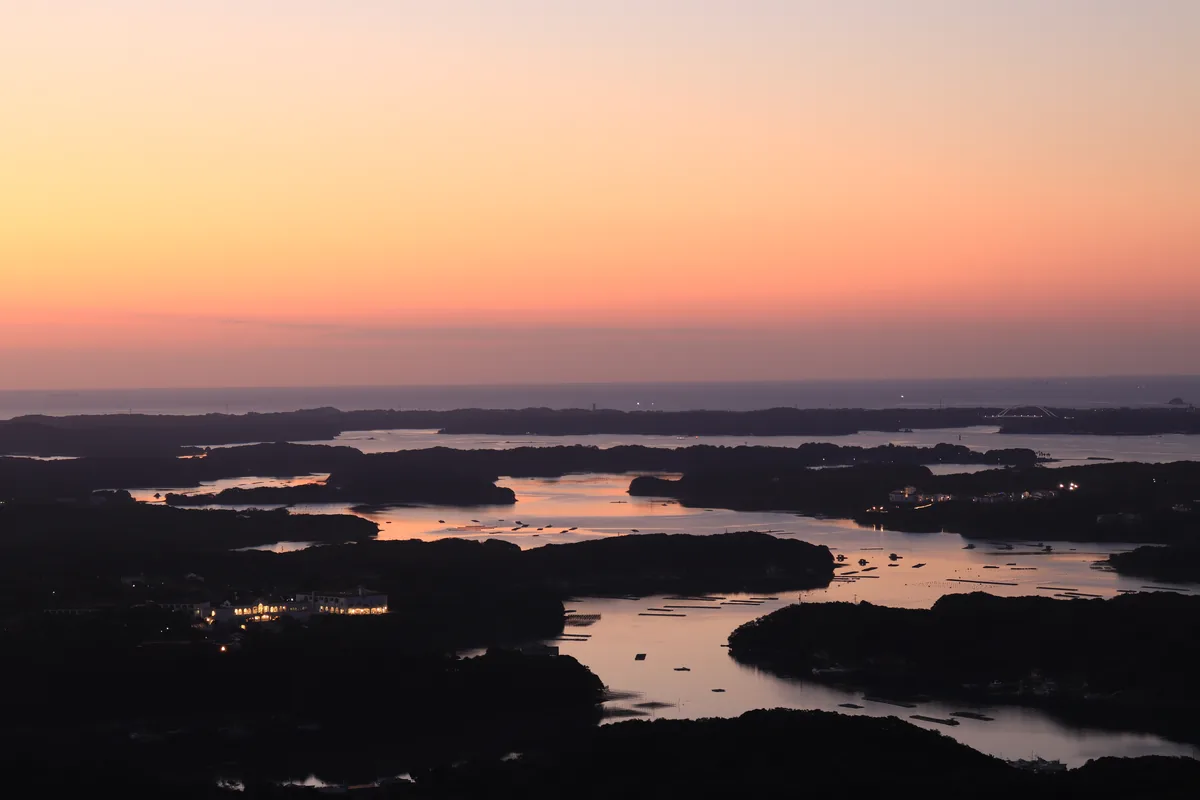
Yokoyama Observatory, looking down on Ago Bay and its scatter of wooded islets and pearl rafts. Parking is free, the observatory itself has no set opening or closing time, and — contrary to a great deal of published advice — you cannot watch the sunset from it.
Deal with the sunset first, because it is the most repeated error about this place. The Ministry of the Environment’s Chubu Regional Environment Office, which manages the site, answers it in its own FAQ: the sun sets on the mountain side, so the sunset cannot be seen from the observatory. Ago Bay at golden hour is spectacular and this is one of the best daytime views in central Japan, but joining those two statements will cost you an evening. For sunset over the bay, take it from the water — the Shima tourism association promotes evening and stargazing cruises.
There is no gate and no ticket barrier, and the park office publishes no opening hours for the viewing decks — only a request to avoid the site at night and before daybreak, because lighting is limited. The Tenku Cafe Terrace, with rest area, toilets and a takeaway counter using local ingredients such as aosa seaweed, and the Yokoyama Visitor Center both open 9:00 to 16:30 year-round.
Parking is free, and here is the catch: the nearest car park, P2, holds 26 standard cars and two light cars. When it fills you park at P1 or P3 and walk up a steep mountain path for 15 to 20 minutes. Wheelchair users are better served than the terrain suggests: a ramp runs from P2 to the Tenku Cafe Terrace and on to the Komorebi Terrace.
Ugata Station is the practical gateway — limited expresses stop there. The park office quotes about ten minutes by taxi and roughly 1,500 yen one way, with the rank at the south exit and no guarantee of a car waiting. Rental e-bikes, which must be booked ahead, take about 15 minutes, but bicycles and motorcycles cannot enter or park at the observatory car park, and you may not wheel one up: leave it at the visitor center rack and walk. From Shima-Yokoyama Station, next to Ugata, allow about 35 to 45 minutes on foot depending on route, with traffic and no pavement in places. By car it is about 35 minutes from Toba Station or 40 from Iseshi; set navigation to the visitor center, which some systems otherwise route down farm lanes.
Kashikojima (賢島) is the end of the Kintetsu line, 29 minutes from Toba by limited express or 39 by local train — the bay being the heart of the pearl-farming industry Mikimoto’s work created.
When is oyster season?
Uramura oysters are landed from around October and appear in shops and restaurants from around mid-October, filling out between the New Year and February. Individual oyster huts advertise the winter season as roughly November to late March, with some continuing into April, Golden Week or June.
Uramura oysters (浦村かき) are farmed in Ono-ura Bay (生浦湾) on the Toba coast, and the local point of pride is that they are one-year oysters. Nutrient-rich water from Ise Bay and a sheltered inlet grow them to harvest size within a year, which the Toba tourism association credits for their mild flavour and soft texture. The white arched bridge over the bay shows the whole scene at once: rafts from shore to shore. The road linking Toba to Shima here is the Pearl Road, and its second, unofficial name tells you what to expect — the Oyster Road.
This is where visitors get caught out. All-you-can-eat huts charge 2,800 to 4,000 yen for an adult, with a limit of 60 to 90 minutes at most places — one, Yamayasu Suisan, advertises no limit. Almost all run timed sittings in the middle of the day, with slots starting from about 10:30 through the early afternoon, and several open only when booked. An oyster hut is a lunch, not a dinner. The other split worth knowing is the cooking: at some you grill your own over the coals, at others the staff grill and bring them out, and the tourism association’s listing says which is which.
On raw oysters I will report the rule rather than make a promise: Mie Prefecture requires oysters sold for raw consumption to undergo an 18-hour purification in ultraviolet-sterilised seawater, and in 2003 the prefecture added a quality-standards scheme, the Mie Oyster Safety System, on top of it. That is a regulation, not a personal guarantee — and grilled and steamed options are the majority of what is served anyway.
How do I get there and around?
Kintetsu limited express from Kintetsu Nagoya to Toba takes 1 hour 38 minutes and costs 3,410 yen; to Kashikojima it is 2 hours 12 minutes and 4,010 yen. Between Toba and Shima, local trains are the sensible choice. Buses link Ise, Futami and Toba only.
| Journey | Limited express | Without limited express |
|---|---|---|
| Kintetsu Nagoya to Toba | 1 hr 38 min, 3,410 yen (2,070 fare + 1,340 surcharge) | 2 hr 07 min, 2,070 yen, one transfer |
| Kintetsu Nagoya to Toba by Shimakaze | 1 hr 29 min, 4,250 yen | — |
| Kintetsu Nagoya to Kashikojima | 2 hr 12 min, 4,010 yen (2,370 fare + 1,640 surcharge) | — |
| Kintetsu Nagoya to Kashikojima by Shimakaze | 2 hr 02 min, 5,060 yen | — |
| Toba to Kashikojima | 29 min, 1,080 yen | 39 min, 560 yen |
| Toba to Ugata | 24 min, 1,040 yen | 34 min, 520 yen |
| Kashikojima to Ugata | 4 min, 780 yen | 5 min, 260 yen |
| Ujiyamada to Toba | 11 min, 880 yen | 14 min, 360 yen |
Two observations from that table. The limited express surcharge changes with your destination, not the train: get off at Toba and it is 1,340 yen, ride on to Ugata or Kashikojima and it is 1,640 yen. And the Shimakaze figures include its special-carriage charge on top of the express surcharge, with compartments extra; it does not run on every service.
Once inside the region, stop paying for limited expresses: Toba to Kashikojima saves ten minutes for 520 yen, and Kashikojima to Ugata saves a single minute for the same 520 yen. Ride the Shima Line locals and spend the difference on oysters. And if you are already at the shrine, Ujiyamada to Toba is 14 minutes and 360 yen. For how these routes fit together, see getting around Nagoya and the best day trips from Nagoya.
Buses: what the CAN Bus does and does not cover
The CAN Bus, run by Mie Kotsu, is the sightseeing loop between Ise, Futami and Toba: Isuzugawa Station, Naiku-mae, Futamiura Omotesando, the Meoto-Iwa Higashiguchi stop, the Toba bus centre and the Toba Aquarium and Mikimoto Pearl Island stop — nine services a day on weekdays and weekends alike, the 8:35 from Isuzugawa reaching the aquarium at 9:30.
What it does not do is go to Shima. If you read that one bus ticket covers “Ise-Shima”, that is wrong — the loop stops at Toba. Note the last departure back from the aquarium stop, too: 16:50 on weekdays and 17:19 at weekends. Stay until the aquarium’s 17:00 closing on a weekday and you have missed it.
For passes, the Ise-Toba Michikusa Kippu costs 1,300 yen for one day or 1,900 yen for two across Mie Kotsu buses in the Ise and Toba area. The only pass reaching Shima is the Michikusa Kippu Wide at 2,600 yen — sold as a two-day ticket only, so no use on a day trip — covering Ise, Toba, Shima and Minami-Ise including Toba municipal buses. The discounts published with the Michikusa Kippu are small: 150 yen off Mikimoto Pearl Island, 100 yen off the Toba Bay Cruise and Dolphin Island, 10 percent off the Sea-Folk Museum. Toba Aquarium is not on the discount list, and some routes are excluded, differently on the one-day and two-day versions.
What can I check before I go?
Check the live camera at Yokoyama Observatory for cloud, the aquarium’s show page on the day, and the Toba tourism association’s news feed in October for the oyster season announcement. The operators here run official social accounts; I am pointing you at those rather than quoting reviews.
To be straightforward about method: I have not embedded traveller reviews, nor summarised the tone of posts I did not read. What I can tell you is which official channels exist, because the useful updates here are operational.
The Ministry of the Environment publishes a live video feed from Yokoyama Observatory, linked from the observatory’s own site — for a viewpoint whose entire value is visibility, that is the most useful pre-departure check available, and the visitor center keeps a Facebook page for closures. Hachiman Kamado embeds its own Instagram on its homepage, and those posts — guests from Indonesia and Thailand, the prayer rooms — show how the hut handles international visitors. Toba Aquarium keeps a directory of its official accounts, and the Toba Sea-Folk Museum, the institution behind every ama figure here, posts as @sea_folk_museum.
What else do visitors ask about Toba and Shima?
These are the questions where a wrong answer changes your day, not merely your expectations.
How do I get from Nagoya to Toba?
Take a Kintetsu limited express from Kintetsu Nagoya direct to Toba: 1 hour 38 minutes for 3,410 yen, made up of a 2,070 yen fare and a 1,340 yen limited express surcharge. Without the limited express the fare alone is 2,070 yen but the trip takes 2 hours 07 minutes with one transfer. The Shimakaze sightseeing express covers it in 1 hour 29 minutes for 4,250 yen.
Is the ama diving demonstration at Mikimoto Pearl Island a separate ticket?
No. It is included in the admission price of 1,650 yen for adults and 820 yen for elementary and junior high school students. Demonstrations run at 9:30, 10:30, 11:30, 13:30, 14:30, 15:30 and 16:30, with no session at 12:30, and the last moves to 15:30 on days when the island closes at 16:30.
How far ahead do I need to book an ama hut?
Hachiman Kamado is reservation-only and asks for bookings by two days before your visit, not two weeks as some English sources state; only its 50,000 yen offering course needs about a month. Osatsu Kamado prepares meals for booked guests but takes walk-ins if a hut has space. Solo travellers can book Hachiman Kamado’s 2,900 yen tea-time course.
Do ama hut experiences involve diving with the divers?
No. Osatsu Kamado states on its own FAQ that this is a meal in the hut where divers warm up after fishing, not an experience of entering the sea to fish. You sit at a charcoal hearth, shellfish are grilled in front of you, and you talk with women who dive, all of them working ama living in Osatsu.
Can I see the sunrise between the Meoto Iwa rocks?
Only from May to July. Futami Okitama Shrine states that the sun rises at the very centre of the gap at the summer solstice, which it gives as June 21, and that the sunrise is visible between the rocks across those three months. The grounds are open all day, so a pre-dawn visit is possible. The rocks are in Futami, Ise City, not Toba or Shima.
Can I watch the sunset from Yokoyama Observatory?
No. The Ministry of the Environment office that manages the site states that the sun sets on the mountain side, so the sunset cannot be seen from the observatory; it is a daytime viewpoint over Ago Bay. Parking is free, but the nearest car park holds only 26 standard cars, and from the overflow car parks it is a steep 15 to 20 minute walk uphill.
When can I eat Uramura oysters?
Uramura oysters are landed from around October and reach shops and restaurants from around mid-October, growing largest between the New Year and February. Individual huts list their winter season as roughly November to late March, with some running into April, Golden Week or June. All-you-can-eat huts charge 2,800 to 4,000 yen, run timed sittings at midday, and generally require a booking.
Where is the official information?
Every figure here comes from the operator, the shrine, the city or the ministry responsible.
| What you need | Official source |
|---|---|
| Pearl island hours, admission and combination tickets | Mikimoto Pearl Island, opening information |
| Ama demonstration times | Mikimoto Pearl Island, demonstration schedule |
| Aquarium hours and access | Toba Aquarium, hours and access |
| Aquarium show and feeding times on the day | Toba Aquarium, shows and feeding |
| Ama hut courses, prices and the shuttle | Hachiman Kamado, course list |
| The second operator’s huts, lunch and tea time | Osatsu Kamado, menu |
| What the ama hut experience is, and reservations | Osatsu Kamado, FAQ |
| Ama cultural designation and heritage status | Toba City, ama fishing culture |
| Diver population figures | Toba Sea-Folk Museum, ama culture |
| 2022 survey and diving days | Mie University Ama Research Center |
| Meoto Iwa dimensions, rope and sunrise months | Futami Okitama Shrine, FAQ |
| Observatory hours, parking, access and the sunset answer | Ministry of the Environment, Yokoyama FAQ |
| National park designation and area | Ministry of the Environment, Ise-Shima National Park |
| Oyster season, huts, prices and sittings | Toba Tourism Association, Uramura oysters |
| Bus loop timetable | Mie Kotsu, CAN Bus |
| Bus passes and discounts | Mie Kotsu, value tickets |
| Rail fares and limited express surcharges | Kintetsu, fare and surcharge table |
| 2016 summit dates and participants | Ministry of Foreign Affairs, G7 Ise-Shima Summit |
Which related guides should I read next?
Toba and Shima work best attached to something — the shrine before them, a Nagoya base behind them.
- The Ise Grand Shrine day trip from Nagoya is the natural pairing: from Ujiyamada it is 14 minutes and 360 yen to Toba.
- The best day trips from Nagoya sets Ise-Shima against the other directions out of the city.
- Getting around Nagoya covers the Kintetsu, JR and subway split and the IC cards.
- Things to do in Nagoya is where to look if the coast has to wait a day.
- The two-day Nagoya weekend itinerary shows how a coastal overnight slots into a short stay.
This guide will be revised in October 2026, when the Toba tourism association publishes the coming oyster season, and again when prices, hours and fares are reverified in November 2026.