A hanabi taikai is not just fireworks. Japanese shells are spherical, so they open as perfect circles, and each one carries a name. This guide covers what you are watching, how paid seating works, what to bring, and three Central Japan displays that follow completely different rules.
Written by Yuu — a Nagoya native of 35 years. Published August 16, 2026.
This article may contain affiliate links. See our affiliate disclosure for details.
All festival details verified from official sources on August 16, 2026.
Every August somebody asks me whether you can just turn up to a Japanese fireworks display. It depends on which one. Among the three big Central Japan events, one sells nearly every riverbank seat, one bans folding chairs and picnic sheets, and one sells no seats at all — and that third one did not fire in 2026.
What Makes Japanese Fireworks Special?
Japanese shells are spherical, so they burst as a symmetrical globe rather than a fan. The Japan Pyrotechnics Association (日本煙火協会) points to three defining traits: a perfectly round opening, stars that change colour in flight, and two or three concentric cores nested inside a single shell.
That roundness follows from geometry. Japanese shells are built as spheres; European and North American shells are basically cylindrical, and a cylinder cannot scatter stars evenly in every direction, so it cannot open as a true circle. The association says the gap grows obvious from 5-go (about 14.4 cm) upward, and calls Japan’s cored chrysanthemum the most refined shell in the world — its own assessment.
The habit is old. The Ryogoku Kawabiraki fireworks on the Sumida River grew through the nineteenth century into a fixture of the Edo calendar, and the association treats it as the root of the modern summer festival; two houses that flourished then, Kagiya Yahei and Tamaya Ichirobei, are why older spectators still shout “Kagiya!” and “Tamaya!” at a good shell. How many displays run each summer has no honest answer: the association publishes a nationwide schedule of roughly 220, states that the list is not exhaustive, and no government body publishes a total.
The three families of shell
- Warimono (割物), bursting shells. A charge throws the stars outward in every direction at once: kiku, botan, kamuro-giku, yashi, katamono.
- Pokamono (ぽか物). The shell splits neatly in two at altitude and releases its contents rather than blasting them: signal reports, small flowers, yanagi, smoke dragons. Yanagi belongs here, not among the bursting shells.
- Hanwarimono (半割物). The shell opens in the dark and then, a beat later, a mass of small flowers blooms at once: senrin, kowari.
Shell names you will hear
Each design has a gyokumei (玉名), printed in the program at larger festivals.
- Kiku (菊) and botan (牡丹). Kiku, chrysanthemum, opens round with every star trailing a charcoal-coloured tail; botan, peony, is the opposite, no tails, colour from the instant the stars appear.
- Kamuro-giku (冠菊) and shin-iri (芯入). Kamuro-giku draws long tails downward that hang there. Shin-iri is a second flower inside the first: two cores is yae-shin, three mie-shin, and five-core shells now exist.
- Yashi (椰子), katamono (型物), yanagi (柳), senrin-giku (千輪菊). Golden palm fronds; shaped shells such as hearts and smiley faces; massed stars trailing downward; and a large shell packed with small ones that bloom on a delay. Senrin-giku is also called hyakkaen (百花園) — exactly what Okazaki’s organisers list on their program.
Star-mine is a way of firing, not a kind of firework
There are three launch methods: single shots, sequential shots, and star-mine (スターマイン), or rapid-fire barrage — shells loaded into many mortars of assorted calibres and fired in quick succession so the burst reads as one composed effect. It is a technique, not a shell type, which English writing loses by translating it as “finale.” It is fired by electric remote ignition, with computer control running the sequence in time with music, and the association notes it is now the main program at many festivals. Which is why free viewing areas are a different product: if the music is the structure, being out of earshot removes it.
Not everything flies. Shikake-hanabi (仕掛花火), set pieces, covers framed pictures, the rope-hung “Niagara Falls” and water effects such as suichu-kingyo, “underwater goldfish.”
The four things a Japanese fireworks fan is judging
This almost never reaches English guides. The association sets out four checkpoints for whether a shell was well made and well fired.
- Tama no suwari (玉の座り), the seat of the shell. It bursts at the exact top of its climb, neither still rising nor already falling.
- Bon (盆), the tray. It opens truly round, at a spread appropriate to its calibre.
- Kata (肩), the shoulder. The stars fly dead straight along their radii, so the outline is a clean circle.
- Kiekuchi (消え口), the extinction. Every star’s tip goes out at the same instant, as if switched off.
Start with the fourth: once you have seen all the stars die together, you cannot stop noticing the ones that straggle.
How Big Are Japanese Fireworks?
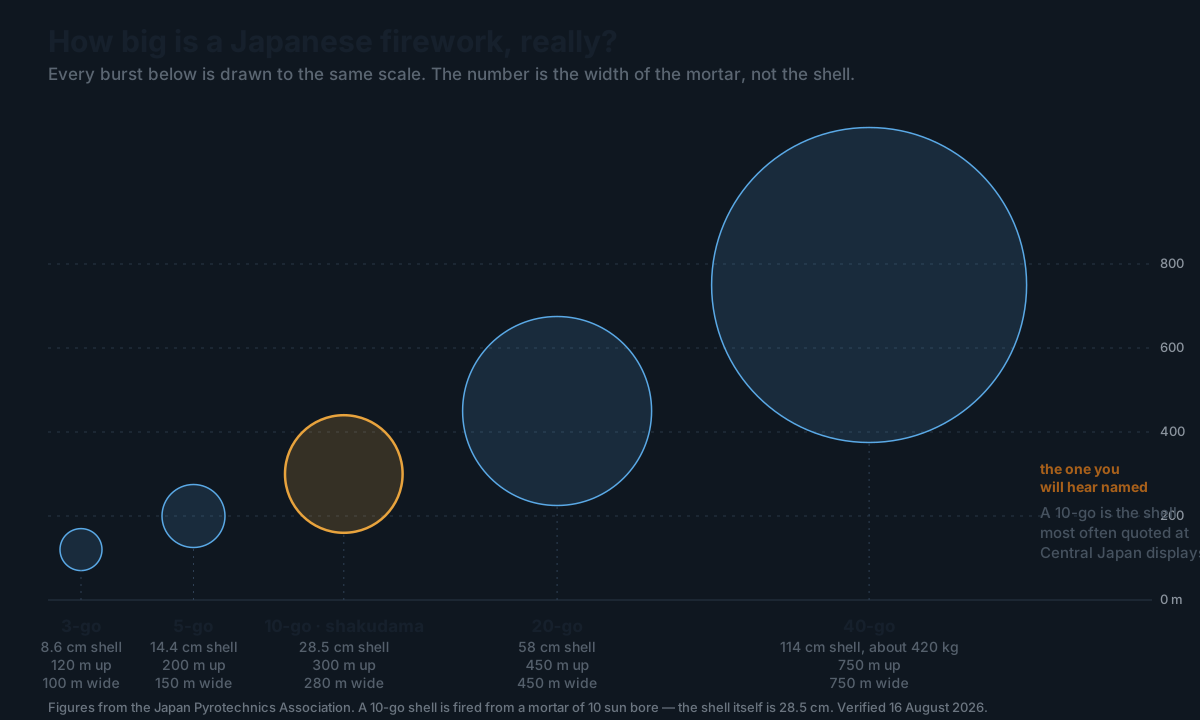
Size is quoted in go (号), which is the bore of the launch tube, not the width of the shell. A 10-go shell, the shaku-dama (尺玉), measures about 28.5 cm across, opens roughly 300 metres up, and spreads to about 280 metres.
Worth stating twice: the number is the mortar, not the shell. A 3-go shell leaves a tube of about 9.1 cm bore and is itself about 8.6 cm.
| Shell size (go) | Shell diameter, approx. (cm) | Burst height, approx. (m) | Burst diameter, approx. (m) |
|---|---|---|---|
| 2.5-go | 6.9 | 80 | 50 |
| 3-go | 8.6 | 120 | 100 |
| 4-go | 11.5 | 150 | 120 |
| 5-go | 14.4 | 200 | 150 |
| 6-go | 17.3 | 220 | 180 |
| 7-go | 20.0 | 250 | 200 |
| 8-go | 23.0 | 280 | 250 |
| 10-go (shaku-dama) | 28.5 | 300 | 280 |
| 20-go | 58.0 | 450 | 450 |
| 30-go | 86.0 | 600 | 600 |
| 40-go | 114.0 | 750 | 750 |
Source: Japan Pyrotechnics Association, Hanabi Nyumon (Introduction to Fireworks), Reiwa 8 edition, section 6. Japan’s largest shell is the 40-go at roughly 114 cm and about 420 kg; anything from 30-go upward weighs over 200 kg and must be craned into its mortar.
The consequence for choosing a spot: a shaku-dama opening 300 metres up and 280 metres wide reads well from a distant hillside or a shopping-centre roof. What does not carry is everything near the ground. At Okazaki the organisers state that set pieces and goldfish fireworks are visible only from two specific blocks on the riverbank, and that other paid seats have portions blocked by buildings, bridges and trees. Aerial size buys distance; ground-level work does not.
Where Should I Watch From?
It depends entirely on the festival. Central Japan has all three patterns: no ticketed seating at all, nearly every riverbank seat ticketed, and paid seats alongside free areas. One rule is constant across all three — saving a spot in advance is banned.
| Model | Example | What it means for you |
|---|---|---|
| No ticketed seating | Umi-no-Hi Nagoya Minato Festival | Viewing zones marked on the site map, but no seats sold. Nothing to book, nothing to miss out on. |
| Almost entirely ticketed | Okazaki Castle Town Ieyasu Summer Festival | The riverbank near the launch site is all paid seating. Free viewing only at satellite sites. |
| Paid seats plus free areas | Gifu Nagara-gawa Fireworks Festival | Eighteen seat grades on sale, plus free areas where some effects and the music are missing. |
Saving a spot in advance does not work here
The dawn raid with a roll of gum tape is out of date here. Nagoya Minato refuses unattended spot-saving and taping off ground; Okazaki bans advance spot-saving and sitting on roads and pavements, and removes sheets on sight; Gifu refuses spot-saving before the day inside its permitted areas. Okazaki went further in 2026: every seat is reserved, so avoid the heat and come at the start time rather than early.
How paid seats actually work
Okazaki, 2026. Ten categories, from a 3,500 yen chair seat at Okazaki Castle Park to a 51,000 yen six-person masu (floor box) on the Otogawa. General sale ran from 10:00 on July 11 to 18:59 on August 1, a minute before the first shell, through Ticket Pia online, Seven-Eleven copy machines, or about 1,500 Chunichi Shimbun agents. Fees are per ticket, not per booking: 165 yen issuing plus 330 yen system fee each. Seats are reserved but the number is drawn by lottery, and — the detail that catches overseas visitors — there are no electronic tickets, so you must collect paper in Japan beforehand.
Gifu Nagara-gawa, 2026. Paid seats are ouen-seki (応援席), “support seats” — the committee’s name for asking attendees to support the festival so it keeps running. Eleven reserved grades ran 7,000 to 90,000 yen and seven unreserved grades 4,000 to 13,000, tax included, fees on top. Selling began with the city’s hometown-tax scheme in late April, then a residents-only lottery in May, a presale for JR Central Express Reservation and Smart EX members in June, and general sale from July 8. You cannot pick your position, and there are no changes or refunds after payment.
The organiser is not always the only seller: at Okazaki, Sugo Shrine sells its own sajiki (桟敷) boxes the same evening, 25,000 to 60,000 yen in 2026, as seats for shrine donors rather than a general sale.
Not all seats see the same show
Read the seat map before the price. Okazaki states that set pieces and goldfish fireworks are visible only from the Otogawa masu seats and the south stepped-block seats; Gifu notes that its stepped embankment seats give better forward visibility, and confines tripods to one area, one per person.
Watching for free
Free viewing is real, but it is not the same product. Okazaki has no free area near the launch site at all, so free viewers use the satellite venue at Okazaki Chuo General Park or four shopping centres opening their rooftop car parks — where, the official notice says, the venue announcements and the music for the music and melody star-mines cannot be heard. Gifu does have designated free areas, with the same caveat, and asks ticketless spectators to use them rather than the bridges.
What Should I Bring?
A hat and glasses, water, cash and a hand fan. Organisers at Nagoya Minato warn that burnt fragments can drift down on the wind. Do not assume a folding chair or a picnic sheet is welcome, because Gifu Nagara-gawa bans both outright.
What the organisers themselves ask for
The Nagoya Minato leaflet is unusually practical, and its requests double as a packing list: a hat and glasses, because depending on wind direction spent fragments can fall on the crowd; water against heatstroke; a hand on children at all times; and a meeting point agreed in advance, because there is no public-address paging service. After thirty-five summers here I would add cash, and more water than you think. Nagoya’s summer nights stay humid and do not cool the way visitors from drier climates expect, so a folding fan is equipment, not a souvenir.
What you cannot bring
Here generic advice becomes actively harmful. Gifu Nagara-gawa’s 2026 prohibited list covers your own fireworks, pets, anything rod-shaped over 40 cm, camping gear including folding chairs, drones, mats large enough for two or more people, and bicycles, carts and scooters; strollers cannot enter the viewing areas at all. The standard advice to pack a picnic blanket and a folding stool would have you turned away. Sugo Shrine’s boxes at Okazaki likewise forbid anything that adds height. Check your festival’s list: it is always published, and always different.
Food, drink, toilets and access
Do not assume rows of yatai food stalls either. Gifu states that its free areas have no stalls at all, only kitchen cars, and that you should bring your own water because supply is limited; last orders are 20:30, and your own food and drink are allowed. Okazaki publishes three catering zones, all outside the paid seating and listed on its official page among the free viewing locations, and nothing about toilets or stalls inside the ticketed area. Gifu does install numerous portable toilets and allows re-entry with the wristband issued on entry. On access, Okazaki permits wheelchairs but not inside the Otogawa masu boxes, where they block the view behind; Gifu designates part of the unreserved area as its wheelchair zone and warns that the venue sits inside the levee with many steps.
Getting home
The trip out is fine. The trip back is the event. In 2025, Nagoya Minato’s fireworks ran 19:30 to 20:10 while road closures ran 14:30 to 22:00, nearly two hours after the last shell, with subway stations worked as one-way systems — at Tsukijiguchi, two exits sealed from 19:45 and the other two made entry-only and exit-only. That arrangement will not necessarily repeat, but the shape of it tells you what to expect. Okazaki’s 2026 restrictions ran 17:00 to 22:00 with no dedicated parking.
For Gifu, the bus operator publishes the most useful planning numbers in the region: shuttles at 250 yen one way for adults, plus a warning that every year waits of up to about 50 minutes to board are possible from 17:00, and that queueing after 18:00 may mean missing the start. Gates open at 17:00, or 16:00 with an early-entry ticket. In Nagoya itself the bus and subway one-day ticket is 870 yen for adults and 430 for children, and the weekend Donichi Eco Kippu 620 and 310 — but they cover city buses only, not Meitetsu buses and not the Aonami Line.
Which Fireworks Festivals Should I Visit in Central Japan?
Three, and they work nothing alike. Nagoya Minato is free but cancelled its 2026 display. Okazaki sells almost every seat and sits in Japan’s old gunpowder country. Gifu’s Nagara-gawa mixes paid seats with free riverbank. Pick by how you like to watch.
Umi-no-Hi Nagoya Minato Festival Fireworks
The city’s harbour display, held on Marine Day in July at Garden Pier. The essential fact for planning: in 2026 the 80th edition cancelled the fireworks. Because of the 20th Asian Games and 5th Asian Para Games, the committee announced, securing viewing and staging areas was not feasible, so it cancelled the fireworks, the parade and other Garden Pier events. The festival itself went ahead on July 20 in reduced form, and many English round-ups still list the display as running.
When it does run it is the free model at its purest: neither the official site nor the leaflet advertises paid seats or viewing tickets of any kind, and nobody — not the committee, not the port authority, not the city — publishes a shell count or an attendance figure, so any number quoted is an estimate. One charming mechanism does exist: through the Memorial Fireworks scheme the public sponsor individual shells — in the 2025 edition, from 5,000 yen up to 50,000 yen for a 10-go shaku-dama — with no refund if weather cancels the display. Full detail: our Nagoya Minato Festival fireworks guide.
Okazaki Castle Town Ieyasu Summer Festival Fireworks
Held on the first Saturday of August on the Otogawa and Yahagi rivers, about 40 minutes from Nagoya; the 2026 edition ran on August 1, 19:00 to 20:30, as scheduled. It goes ahead in rain, but severe weather or river flooding can cancel it outright, with no rain date, and the 2025 guidance was that the decision comes by 11:00 on the day.
Okazaki is also where you learn where shell counts come from, because its organisers refuse to give one. Asked in their own official FAQ how many shells are launched, the answer is: not disclosed. The only published breakdown is the program — many 4-go to 10-go aerial shells, around 20 star-mine sequences and up to 13 framed set pieces, the listed types being set pieces, hyakkaen and goldfish fireworks. Any figure you find came from somebody other than the people firing them. Full detail: our Okazaki fireworks guide.
Why Mikawa is fireworks country
Okazaki being a fireworks town is no coincidence. The association’s history section explains that the Mikawa district of Aichi was Tokugawa Ieyasu’s home ground, with a gunpowder works under his direct control and a base for his matchlock corps, which is why fireworks took root there. Mikawa is where Ieyasu was born, and the summer festival carries his name.
The inheritance is measurable. The association says the main production area for domestically made consumer fireworks is the belt centred on Okazaki, where the shogunate’s gunpowder works stood, and that this area alone accounts for around 40 percent of national output — a figure about consumer fireworks, not the aerial shells fired at festivals, whose makers are concentrated in Akita, Niigata, Nagano, Shizuoka and Aichi. Either way Aichi is on both lists, in an industry of only about 300 member companies. Mikawa’s other export is tezutsu hanabi (手筒花火), hand-held tube fireworks, where a performer clamps a tube of spouting composition under one arm and lets sparks roar past his face. It is performed at shrine rituals, not at these three modern displays, so to see it you go to a shrine festival rather than a hanabi taikai.
Reaching Okazaki, Gifu or the port on a festival evening means committing to a fixed timetable. If you would rather have the logistics handled, guided day tours from Nagoya are one way to do it.
Building more into the trip?
Handy if you want tours or day trips booked around the festival dates.
Gifu Nagara-gawa Fireworks Festival
The youngest of the three in its present form, on the Nagara River in Gifu City with Mount Kinka behind it; the 4th edition ran on August 8, 2026, 19:30 to around 20:40. It goes ahead in light rain and moves to August 22 in severe weather or high water, and if August 22 also fails there is no second postponement.
Its cancellation policy confuses overseas visitors most. The committee assesses conditions at set times over the two days before and at 09:00, 12:00, 15:00 and 17:00 on the day, and announces only if the event is postponed or cancelled. If it is going ahead, they announce nothing: silence is the confirmation, and the official Facebook page is where to look. The money rules are just as sharp — no refunds after payment, none for postponement, and only outright cancellation brings a partial refund. Unauthorised paid transfer is prohibited and such tickets are void at the gate, though the official resale site is permitted. The organisers expect around 120,000 people and do not disclose ticket numbers; NHK reported 120,000 watching roughly 10,000 shells in 2026, which is press reporting, not an organiser figure. Full detail: our Gifu Nagara-gawa fireworks guide.
What Are the Etiquette Rules at a Japanese Fireworks Festival?
Do not save a spot in advance, do not sit on the roadway, do not fly a drone, do not watch from a bridge, take your rubbish with you, and stay seated so that the people behind you can see the display too.
Most of what passes for fireworks etiquette in Japan is not unwritten. It is written, on the organisers’ own pages, and enforced.
- No advance spot-saving. Nagoya Minato refuses unattended claims and gum-tape occupation, Okazaki removes sheets on sight, Gifu refuses spot-saving before the day.
- Do not sit down on roads or pavements. Okazaki bans this explicitly: these are live pedestrian arteries, and a seated group is a crush risk, not a picnic.
- Stay off the bridges, and leave the drone at home. Gifu screens sections of two bridges’ parapets to stop people stopping there; Nagoya Minato refuses drone flights at the venue and around it, and Gifu lists drones among prohibited items.
- Do not stand in front of seated people. Sugo Shrine’s boxes at Okazaki prohibit watching while standing, and that logic applies at any seated venue.
- Take your rubbish with you. The Nagoya Minato site map marks rubbish collection points alongside the toilets and AED locations. And respect the exclusion zones: Okazaki’s run 08:00 to 22:00, long before the crowds arrive.
- Hold on to your children. Nagoya Minato asks parents not to let go of children’s hands and points out there is no paging service.
One more, less a rule than a courtesy: if the person beside you says “Tamaya” when a shell opens especially cleanly, that is not random noise. Somebody just judged a kiekuchi.
What Do the Organisers and Regulars Actually Say?
The most useful voices here are the organisers’ own notices. They tell you not to arrive early, not to join the shuttle queue after 18:00, and that silence on the day means the display is going ahead as planned.
- Okazaki tourism association, 2026: all seats are reserved, so there is no need to come early to secure a place — avoid the heat and arrive around the start time.
- Gifu Bus, on its own shuttle: every year waits of up to about 50 minutes to board are possible from 17:00, and joining the queue after 18:00 may mean missing the start.
- Gifu Nagara-gawa committee: announcements are made only for postponement or cancellation, so check the official Facebook page on the day, because the website news feed is not updated.
- Nagoya Minato organising committee: depending on wind direction burnt fragments may fall, so protect yourself with a hat and glasses; and event content and timings may change without notice.
I have not sat in these particular seats myself, so nothing above is written from memory: every detail traces to an official page, and where officials publish nothing, this guide says so. What I can offer as a local is the shape of the season — from mid-July through August the regional calendar is dense with these events, almost all on a river or a harbour, and they assume you already know the local rules.
Where to check official information
- Japan Pyrotechnics Association: the nationwide schedule of around 220 displays, and Hanabi Nyumon section 8 on the four checkpoints.
- Umi-no-Hi Nagoya Minato Festival official site — leaflets, maps and the 2026 cancellation notice.
- Okazaki tourism association, free viewing locations, and its news feed for on-the-day decisions.
- Gifu Nagara-gawa Fireworks Festival official FAQ — postponement rules, prohibited items, accessibility.
- Gifu Bus fireworks shuttle information — fares and the queue warning.
Frequently Asked Questions
How high do Japanese fireworks go?
It depends on the calibre. According to the Japan Pyrotechnics Association’s published table, a 10-go shell, the shaku-dama, is fired to a burst height of about 300 metres and opens to a diameter of about 280 metres. A 5-go bursts at about 200 metres and spreads about 150 metres, and the 40-go, Japan’s largest, bursts at about 750 metres.
Do I need a ticket to watch a fireworks festival in Japan?
It varies completely by festival, so check each one. Nagoya Minato does not advertise paid viewing seats at all. Okazaki ticketed essentially the whole riverbank near the launch site in 2026 and sold out on July 30, with free viewing only at satellite venues. Gifu Nagara-gawa sold eighteen grades of paid seat but also designated free viewing areas.
Can I save a spot on the riverbank in advance?
No. All three Central Japan festivals covered here explicitly ban it. Nagoya Minato refuses unattended spot-saving and taping off ground, Okazaki bans advance spot-saving and removes sheets on sight, and the Gifu committee refuses spot-saving before the day. Okazaki’s organisers add that because all paid seats are reserved, arriving early gains you nothing.
What should I bring to a Japanese fireworks festival?
The Nagoya Minato organisers ask visitors to bring a hat and glasses, because spent fragments can fall depending on wind direction, and to keep drinking water against heatstroke. Cash and a fan are sensible additions. Do not assume a folding chair or a picnic sheet is allowed: Gifu Nagara-gawa prohibits camping gear including folding chairs, and mats for two or more people.
What happens if it rains?
There is no single national rule, and postponement is not the default. Okazaki goes ahead in rain but cancels outright in severe weather with no rain date, and its 2025 guidance put the decision at 11:00 on the day. Gifu Nagara-gawa goes ahead in light rain and moves to a set rain date in severe weather, with no second postponement, and announces only if it is postponed or cancelled. Silence means it is running.
How many shells are launched at a Japanese fireworks display?
Often nobody official will tell you. Okazaki’s organisers answer their own FAQ on shell counts with the word undisclosed, publishing only a program breakdown of 4-go to 10-go shells, around 20 star-mine sequences and up to 13 set pieces. Nagoya Minato publishes neither a shell count nor an attendance figure. For Gifu in 2026, the 10,000-shell figure came from NHK, not the organisers.
Which fireworks festival near Nagoya is best for a first visit?
If you want a guaranteed seat and can collect a paper ticket inside Japan, Okazaki is the most structured option, and the old Tokugawa gunpowder district gives it the deepest history. If you would rather buy a cheaper unreserved seat, or watch free, Gifu Nagara-gawa offers both. Confirm dates on the official sites first: as of August 16, 2026 no 2027 dates had been announced.
Related Guides
- Umi-no-Hi Nagoya Minato Festival Fireworks — the harbour display with no ticketed seating, and the one that cancelled its fireworks in 2026.
- Okazaki Castle Town Ieyasu Summer Festival Fireworks — seat categories, the paper-ticket problem and the satellite venues, in full.
- Gifu Nagara-gawa Fireworks Festival — eighteen seat grades, shuttle bus timings and postponement rules.
- Nagoya Summer Festivals — what else is on in the city between June and August.
- Central Japan Festival Calendar — the year-round overview, for readers still choosing a season.