The 41st Shirakawa-go Light-Up Event lights the Ogimachi gassho-zukuri village on four evenings in January 2027. Entry is by advance reservation only, with no same-day admission. Booking details and prices had not been published as of August 16, 2026; the tourist association says they arrive in early September.
Written by Yuu — a Nagoya native of 35 years. Published August 16, 2026.
This article may contain affiliate links. See our affiliate disclosure for details.
All festival details verified from official sources on August 16, 2026.
.jpeg)
What is the Shirakawa-go Winter Light-Up?
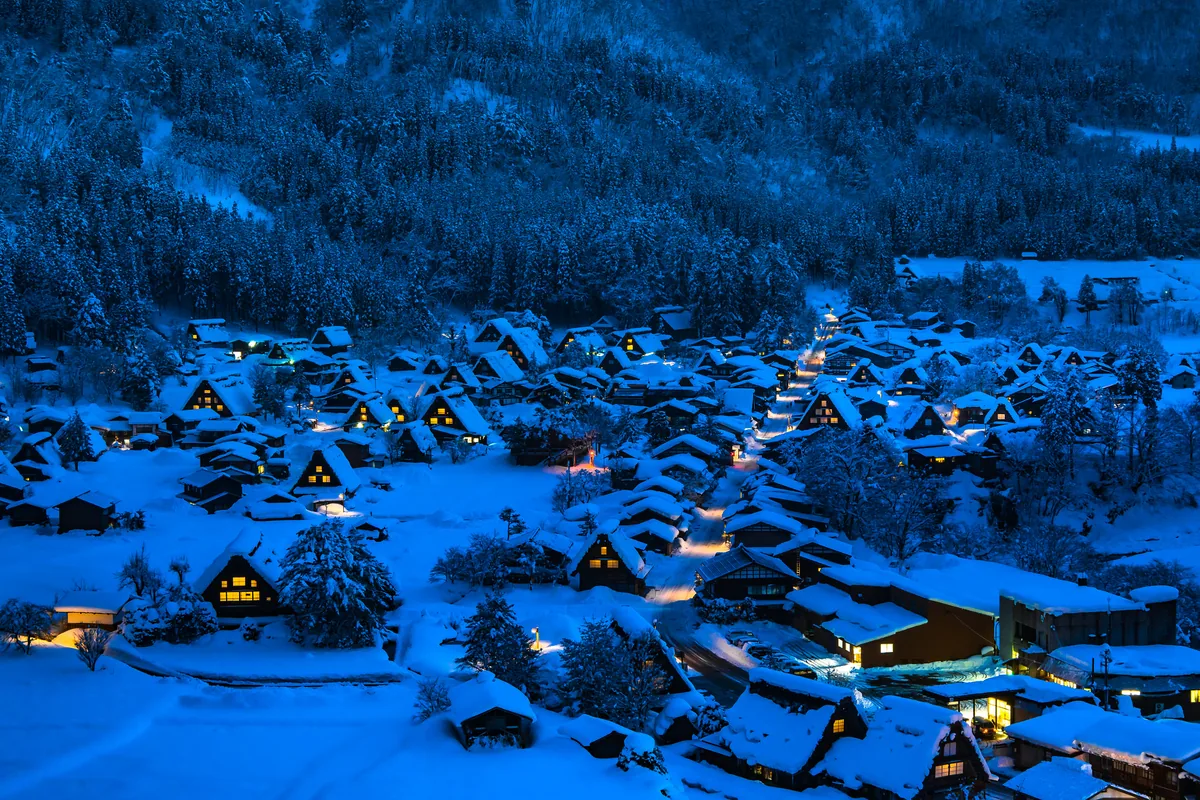
The Shirakawa-go Light-Up Event (白川郷ライトアップ) is an evening illumination of the Ogimachi gassho-zukuri settlement in Shirakawa Village, Gifu Prefecture. It is held on a small number of set dates each winter, and admission is by advance reservation only.
Two names get used interchangeably and it causes real confusion when you are booking. Shirakawa-go is the broad name for the area of Shirakawa Village (白川村) in Ono District, Gifu. The World Heritage settlement that everybody photographs is Ogimachi (荻町), a single village of steep thatched farmhouses on the floor of the Shogawa valley. When an event page says “Shirakawa-go”, the venue it means is Ogimachi, and the official notice for the 2027 event states the location simply as “within the Ogimachi district of Shirakawa Village”.
Those farmhouses are gassho-zukuri (合掌造り), literally “prayer-hands construction”, named for roofs pitched at close to sixty degrees so that heavy snow slides off instead of crushing the frame. The Shirakawa-go Tourist Association’s English site describes the World Heritage settlement as having over 100 large and small gassho-zukuri buildings. In December 1995 the site was inscribed on the UNESCO World Heritage List as the gassho-zukuri villages of Shirakawa-go and Gokayama, Japan’s sixth World Heritage property. Gokayama, across the prefectural border in Toyama, is part of the same listing, so Shirakawa-go was never registered on its own.
The official notice for the event is issued by the Shirakawa-go Light-Up Committee, which sits inside the Shirakawa-go Tourist Association and takes enquiries about it. The 2027 edition is the 41st. The official notice, dated July 1, 2026, lists five lighting areas spread across the settlement, including the area around Wada House (和田家) and the area around Myozenji (明善寺). Two of the five are small local place names with no established English reading, so I am not going to invent one for you.
One rule that catches photographers out: drone filming is strictly prohibited during the event, and the Tourist Association separately states that the World Heritage gassho settlement is a no-drone area all year round. That is not a light-up restriction you can talk your way around.
Scale matters for context. Shirakawa Village recorded 2,083,442 tourist visits in 2024, of which 1,114,244 were foreign visitors. Roughly 500 people still live in Ogimachi. Those two numbers together explain almost every rule you are about to read.
When is the Shirakawa-go Light-Up in 2027?
The 41st Shirakawa-go Light-Up Event runs on four evenings: January 11, 17, 24 and 31, 2027, each from 17:30 to 19:30. Entry is reservation-only. As of August 16, 2026, booking methods and prices were still unannounced.
| Round | Date | Day | Lighting hours |
|---|---|---|---|
| 1st | January 11, 2027 | Monday, national holiday | 17:30-19:30 |
| 2nd | January 17, 2027 | Sunday | 17:30-19:30 |
| 3rd | January 24, 2027 | Sunday | 17:30-19:30 |
| 4th | January 31, 2027 | Sunday | 17:30-19:30 |
Note the first round. The committee itself flags it: January 11 alone falls on a Monday because of the three-day weekend, so do not assume the light-up is a Sunday-only event and book your return travel accordingly. The other three rounds are Sundays. Two hours is the whole window, from 17:30 to 19:30, and that is the same window the 40th edition used in 2026 on January 12, 18 and 25 and February 1.
What is already confirmed for 2027
Viewing is completely reservation-based, operated as an admission ticket system. The stated reasons are relieving road congestion and securing safety inside the venue. The committee is unusually blunt about the consequence: participation requires a reservation, and you cannot take part on the day. That applies whether you arrive by scheduled route bus, by private car, rental car or taxi, or by chartered bus of microbus size and above. No category of arrival gets you in without a booking.
The committee has also published how chartered bus places will work. Bus reservations are to be accepted by individual businesses in the village, on the condition that every passenger makes a paid use of a service at a participating facility in Shirakawa Village on the day. Those places are not first-come, first-served, and because each business already has travel agencies it works with year-round, the committee states plainly that a brand-new booking for a light-up-only bus is currently very difficult. Bus parking for the light-up also cannot be booked through the Shirakawa Village parking reservation site.
The other confirmed item is the cancellation condition, and it is narrow. The official notice says the event may be cancelled when a nationwide severe cold wave threatens large-scale transport disruption. There is no published rain policy, no published snow policy and no published refund rule. Do not read “it will run in any weather” into that silence.
What is not announced yet
This is where most English-language guides quietly guess, so here is the honest position as of August 16, 2026.
| Item | Status |
|---|---|
| 2027 dates and hours | Confirmed on July 1, 2026 |
| Reservation-only, no same-day entry | Confirmed |
| Ticket price | Not announced |
| Booking opening date and sales channel | Not announced |
| How admission places are allocated, including whether any ballot is used | Not announced |
| Parking arrangements on light-up evenings | Not announced |
| Observation deck access on light-up evenings | Not announced |
The Tourist Association says details of the event and of each type of reservation, including sale dates and sales methods, will be published on its own website around the beginning of September 2026, with the bus-related detail going onto a page about the light-up event outline in early September. That is the page to watch. I will update this guide once it appears.
You will find plenty of sites confidently explaining that you get in via one of three routes: a bus tour, an overnight stay in the village, or a reserved parking slot. I am not repeating that here, because when I checked on August 16, 2026, the previous season’s detail pages had been removed from the Tourist Association site and no live official page set out that breakdown. What the officials currently commit to is the reservation-only rule and the chartered-bus conditions above. Anything more specific is somebody’s memory of last year.
What makes these four evenings different from a normal visit?
Ogimachi is a village people live in, not an attraction with opening hours. Official rules limit sightseeing to 08:00 until 17:00, and after dark the settlement is open only to people staying overnight in it. The light-up is the rare, ticketed exception.
The village’s own parking reservation system puts it more bluntly than any guidebook would. Viewing hours are 08:00 to 17:00 and viewing after 17:00 is not possible. The Ogimachi World Heritage settlement is not a theme park or a reconstruction, so the concept of business hours does not apply; an area where more than 500 residents still live is opened to tourism during daytime only, with living time and tourism time clearly separated. Night-time sightseeing is for guests staying in the settlement, and other visitors are not accepted. The Tourist Association adds that parking a bus or car on the road to sightsee after 17:00 is firmly refused, because it disrupts residents’ lives.
Put those two facts side by side and the light-up stops being just a pretty illumination. For 361 or so evenings a year, if you are not sleeping in Ogimachi you are not standing in it after dark. On four evenings, with a ticket, you can. That is the entire proposition, and it explains why the committee runs a hard reservation gate rather than a rope line.
What the lighting actually covers
The official 2027 notice lists five lighting areas rather than a single stage. Two of them are the area around Wada House and the area around Myozenji, both of which sit on the main axis of the settlement. Wada House is the largest class of gassho-zukuri in the World Heritage area and the only nationally designated Important Cultural Property among them; in normal operation it admits visitors from 09:00 to 17:00 for 400 yen for adults and 200 yen for elementary school children, with irregular closing days. Being lit from outside on a light-up evening is not the same as being open, and no official source says the interiors can be entered at night, so plan around exteriors.
The winter reality, stated honestly
I should say this outright: I have not attended the light-up myself. I have driven and ridden up the Tokai-Hokuriku Expressway into the Shogawa valley in winter many times, and that part I can speak to. Nagoya at sea level can be dry and merely cold while the valley at the far end of that drive is under snow, and the change happens somewhere around the Hirugano plateau. Shirakawa Village describes itself as a heavy-snow area, which is exactly why the roofs are shaped the way they are. It publishes no snow-depth figure, so I am not going to quote you a number of metres the way other guides do.
What you can plan around is the shape of the evening: two hours, after dark, in January, on foot, in a place where the village warns that meltwater refreezes on the road surface even when no new snow has fallen. The village publishes no official clothing or footwear guidance. Draw your own conclusion from those facts rather than from a tour operator’s packing list. If you want to see the current conditions with your own eyes before you decide, the village runs a live camera and a congestion forecast calendar, both linked at the foot of this guide.
How do you get to Shirakawa-go, and what should you know before you go?
From Nagoya, the direct highway bus from the Meitetsu Bus Center reaches Shirakawa-go in about 2 hours 42 minutes for 3,600 to 4,700 yen depending on the date, and seats must be booked in advance. Booking that bus is not the same as holding a light-up ticket.
That last sentence is the one I would put on a sticker. The committee lists arrival by scheduled route bus among the ways that still cannot get you in without an admission reservation. Sort the ticket question first; sort the transport second.
| Route | Operator | Adult one-way | Journey time | Reservation |
|---|---|---|---|---|
| Nagoya (Meitetsu Bus Center) to Shirakawa-go | Gifu Bus, Meitetsu Bus and Hokutetsu, jointly operated | 3,600 to 4,700 yen, by date band | 2 hr 42 min out, 2 hr 46 min back | Required |
| Takayama (Nohi Bus Center) to Shirakawa-go | Nohi Bus | 2,800 yen | About 50 min | All services reservation-only |
The Nagoya fare is a calendar fare, not a fixed one. Gifu Bus prices the route in five date bands: 4,700 yen, 4,200 yen, 4,000 yen, 3,800 yen and 3,600 yen. Which band a January Sunday falls into is not something I could confirm for 2027, so treat 3,600 to 4,700 yen as the range and check the fare calendar when you book. Intermediate stops are Meitetsu Bus Center, Kosoku Kakamigahara, Kosoku Seki, Gujo Hachiman Interchange, Kosoku Hirugano Kogen and Shirakawa-go (Ogimachi). Reservations go through Highwaybus.com or the highway bus reservation centre on 058-201-0489. The Tourist Association’s own access page rounds the Nagoya trip to about 2 hours 30 minutes; where the operator and the association disagree, I have used the operator’s timing.
The trap in the daytime schedule
Here is the detail that breaks the itinerary most people sketch out. On the four light-up dates, daytime sightseeing buses may enter only until 14:00 and must be out by 16:00, and those daytime buses need a separate booking through the Shirakawa Village parking reservation service. After 14:00, nothing but reserved light-up buses gets in, and a bus that turns up will simply have to go home again. So “spend the day in the village, then stay on for the illumination” is not a plan you can assume works by coach. Whether the same clock applies to private cars on light-up days has not been published for 2027.
Driving, and where you park
Shirakawa Village advises winter tyres from early December until late March, and warns that meltwater refreezes on the road surface early in the season even before real snow arrives. Japanese rental cars do not always come with winter tyres as standard, so confirm it at the time of booking rather than at the counter.
In normal daytime operation, the village-run Seseragi Park lot (せせらぎ公園) charges 2,000 yen for a car or kei car, 10,000 yen for a large bus or microbus and 500 yen for a motorcycle. It opens 08:00 to 17:00 with last entry at 16:30, and holds 200 cars, 40 large vehicles and 40 motorcycles, taking cash, credit cards, electronic money and code payments. Those are the regular figures, and the light-up-evening parking arrangements for 2027 have not been published, so do not budget on them.
Two parking changes are worth knowing about even so. From December 1, 2026, bus parking spaces at the Seseragi Park Oro lot move to advance reservation only, with no same-day booking; reservations for that opened on June 1, 2026 through the official Shirakawa-go Parking site. That system starts before the January 2027 light-up dates, but it is not the channel for light-up bus parking, which the committee handles separately. For ordinary cars, the same site offers optional reservations: free one-time user registration, up to three vehicles per booking, a permit issued ten days ahead and shown on the day, last entry 16:30 and gates closed at 17:00, which means a booking whose stay would run past 17:00 cannot be made at all. Nothing official says car parking reservations are compulsory.
The observation deck, and why it is a daytime thing
The Shiroyama (Ogimachi Castle Ruins) Observation Deck is the source of the classic postcard view. A shuttle runs from beside Hakusuien (白水園), three minutes’ walk south of the Shirakawa-go bus terminal, at 20-minute intervals, uphill during the 09:00 to 15:00 hours and downhill during the 09:00 to 16:00 hours. It costs 300 yen one way for adults and junior-high students, and 150 yen for children and disabled passengers, paid on board; pets have not been allowed since March 1, 2024. Note that the last downhill service is in the 16:00 hour, which is before the light-up even starts. Whether the deck is reachable at all on light-up evenings is not published, so I am not going to promise you an aerial view of the illumination.
Tours from Nagoya
Because chartered bus places are, in the committee’s own words, very difficult to obtain as a new booking, the practical route for most independent travellers is a tour product that includes admission. One is documented on an operator’s own site: in the 2026 season Meitetsu Kanko Bus ran an English-staffed tour departing from the fourth floor of the Meitetsu Bus Center at 25,000 yen including tax, covering the bus fare, dinner, sightseeing maps and the admission fee for the light-up event, on January 12, 18 and 25 and February 1, 2026. Its itinerary did not include the observation deck. As of August 16, 2026, no 2027 dates were listed. Several booking platforms also carried Nagoya-departure light-up tours for the 2026 season; expect 2027 products to appear after the Tourist Association’s September announcement, and most likely from around December.
Building the trip around this?
Handy if you want tours or day trips booked around the wider Central Japan route.
If the light-up is not going to work for your dates, Shirakawa-go in daylight is still worth the trip, and my Takayama and Shirakawa-go day trip guide covers the standard 08:00 to 17:00 version from Nagoya. For the wider picture of what a winter week in the region looks like, see Nagoya in winter and my roundup of the best day trips from Nagoya.
What can you actually check before you commit to a date?
More than you might expect. Shirakawa Village and the Tourist Association publish a live camera, a congestion forecast calendar and a responsible tourism site, and their social accounts are where a weather cancellation would surface first. Those beat any second-hand review for a decision this weather-dependent.
I have not attended the light-up, and I am not going to paraphrase other people’s reviews as if I had. What I can tell you is which official channels are genuinely useful in the days before a trip, and what the village asks of you once you are there.
- The live camera on the village’s SHIRAKAWA-Going site shows you current conditions in the settlement, which is far more use in January than any photograph taken last February.
- The same site runs a congestion forecast calendar, worth checking if you are combining the trip with daytime sightseeing.
- The Tourist Association’s Instagram and Facebook accounts are the natural place for a same-day announcement if the severe-cold-wave cancellation condition is ever triggered.
- Shirakawa Village runs a dedicated responsible tourism site. Ogimachi is a lived-in settlement of about 500 people, and the committee gives its reasons for the reservation system plainly: relieving road congestion and securing safety inside the venue, not manufacturing scarcity.
Two of the behaviour requests are official rules rather than etiquette: do not fly a drone, and do not park on the road to sightsee after 17:00. The rest is ordinary decency in a place where people live, starting with not photographing residents’ homes as if they were exhibits. None of this is unique to the light-up, but on a dark, crowded, icy evening it matters more.
What else do travellers ask about the Shirakawa-go Light-Up?
The questions below come up constantly, and several have answers that changed recently or have not been published yet. Where an official source has not stated something, I say so rather than filling the gap with a plausible guess.
When is the Shirakawa-go Light-Up in 2027?
The 41st Shirakawa-go Light-Up Event is held on four evenings: Monday January 11, 2027, which is a national holiday, and Sundays January 17, January 24 and January 31, 2027. Each round runs from 17:30 to 19:30. The dates were announced by the Shirakawa-go Light-Up Committee on July 1, 2026.
Do you need a reservation for the Shirakawa-go Light-Up?
Yes. Viewing is completely reservation-based, run as an admission ticket system, and you cannot take part on the day. That applies whether you arrive by scheduled route bus, by private car, rental car or taxi, or by chartered bus of microbus size and above. The committee gives road congestion and safety inside the venue as the reasons.
How much do Shirakawa-go Light-Up tickets cost?
Not announced. As of August 16, 2026 the Shirakawa-go Tourist Association had published the 2027 dates only, and stated that details of the event, sale dates and sales methods would be posted on its own website around the beginning of September 2026. Any price you see quoted for 2027 before then is not coming from an official source.
Can you visit Shirakawa-go at night without the light-up?
Only if you are staying overnight in the settlement. Official rules limit sightseeing to 08:00 until 17:00, and night-time sightseeing is for guests staying in Ogimachi, with other visitors not accepted. Parking on the road to sightsee after 17:00 is also firmly refused. That is what makes the four light-up evenings unusual.
How do you get to Shirakawa-go from Nagoya?
The direct highway bus from the Meitetsu Bus Center takes about 2 hours 42 minutes outbound and 2 hours 46 minutes back, and seats must be booked in advance. The adult one-way fare is a calendar fare of 3,600 to 4,700 yen depending on the date. Holding a bus seat is not the same as holding a light-up admission reservation.
Can you spend the day in Shirakawa-go and stay on for the light-up?
Not by sightseeing coach. On the four light-up dates, daytime sightseeing buses may enter only until 14:00 and must leave by 16:00, and after 14:00 only reserved light-up buses are admitted. Daytime buses also need a separate booking through the Shirakawa Village parking reservation service. The equivalent rule for private cars has not been published for 2027.
Is the Shirakawa-go Light-Up cancelled in bad weather?
The only cancellation condition the committee publishes is a nationwide severe cold wave that threatens large-scale transport disruption, in which case the event may be cancelled. No rain policy, no snow policy and no refund rule has been published. Check the Tourist Association’s official channels on the day if the forecast looks severe.
Where can you check official Shirakawa-go Light-Up information?
Go to the Shirakawa-go Tourist Association first, because the light-up committee sits inside it and publishes there before anyone else. Shirakawa Village’s own site and the village parking system cover access, and the bus operators cover fares. Everything below is a primary source.
| What you need | Official source |
|---|---|
| 2027 dates, reservation rules, September booking announcement | Shirakawa-go Tourist Association event notice |
| English summary of the schedule | Shirakawa-go Tourist Association, English |
| Access and journey times | Tourist Association access page |
| World Heritage background, gassho-zukuri numbers, heavy-snow setting | Shirakawa Village official site |
| Village tourism statistics | Shirakawa Village tourism figures |
| Parking reservations, viewing hours, bus parking rules | Shirakawa-go Parking reservation system |
| Winter tyres, live camera, congestion calendar | SHIRAKAWA-Going, Shirakawa Village |
| Nagoya highway bus fares and timings | Gifu Bus, Nagoya to Shirakawa-go |
| Takayama to Shirakawa-go bus | Nohi Bus, Shirakawa-go line |
| Responsible tourism guidance | Shirakawa-go Responsible Tourism |
Telephone enquiries go to the Shirakawa-go Light-Up Committee secretariat, inside the Shirakawa-go Tourist Association, on 05769-6-1013, open 09:00 to 17:00 every day of the year, with a fax line on 05769-6-1716. The association is at 1086 Ogimachi, Shirakawa Village, Ono District, Gifu 501-5627, inside the Shirakawa-go bus terminal.
Which related guides should you read next?
If the light-up is out of reach for your dates, or you are building a wider winter itinerary out of Nagoya, these four cover the ground around it: the standard daytime version of this trip, the rest of the region in winter, the other day trips within reach of the city, and a hot spring town on the same side of the mountains.
- Takayama and Shirakawa-go day trip from Nagoya covers the daytime, no-ticket-required version of this journey, including the 08:00 to 17:00 settlement hours that shape the whole day.
- Nagoya in winter sets out what the season is actually like on the plain, which is a very different climate from the Shogawa valley.
- The best day trips from Nagoya puts Shirakawa-go alongside the other options within a comfortable radius.
- Gero Onsen guide is the natural pairing if you want a hot spring night on the Gifu side after a cold day out.
This guide will be revised as soon as the Shirakawa-go Tourist Association publishes the 2027 booking details, which it says will be around the beginning of September 2026.