Nagoya has real hot spring water inside the city limits. Five day spas draw their own: Canal Resort, Ryusenji no Yu Moriyama, RAKU SPA GARDEN, Urban Quar and Midori Raku no Yu. Only one hotel taps a Nagoya source, only one lets you bathe without staying, and only one bathhouse accepts tattoos without conditions.
Last updated: August 2026 | Written by Yuu, a Nagoya native of 35 years
This article may contain affiliate links. See our affiliate disclosure for details.
Every price, opening hour and tattoo rule below was read off the operator’s own Japanese-language pages on August 20, 2026. Where an operator does not publish something — a towel price, a walking distance, a spring quality — this guide says so rather than filling the gap with a number from a booking site.
Most English-language advice about hot springs near this city sends you out of it: Gero, Yunoyama, Gamagori. That advice is not wrong, and if you want a hot spring town, our guide to hot spring towns near Nagoya is the page you want instead.
This page is for the other situation. It is 9 p.m., you are in Nagoya, you want to get into hot water tonight, and you are not going to spend three hours on trains to do it. Thirteen places in this city can take you — nine day spas you can walk into, and four hotels with a large communal bath. What separates them is not luxury. It is whether the water is really from the ground, whether you can reach it without a car, and whether they will let you in with a tattoo.
Is there real onsen water inside Nagoya city?
Yes, with a caveat. Under Japan’s Hot Spring Act, water counts as an onsen if it comes out of the ground at 25°C or hotter, or if it carries designated minerals above a set level. Nagoya’s built-up wards look nothing like a hot spring valley — but drill deep enough and, in several places, water that meets that definition is down there.
The numbers make it concrete. Canal Resort pumps 48.8°C water at 240 litres a minute from between 1,000 and 1,200 metres down — a sodium chloride spring. RAKU SPA GARDEN Nagoya draws an alkaline simple spring at 30.5°C from 1,500 metres. Nagoya Crown Hotel takes a simple spring from 1,350 metres under its own site, heats it, and runs it free-flowing through the bath. Ryusenji no Yu Moriyama has an alkaline simple spring at 33.2°C, Urban Quar 25.1°C from 800 metres, and Midori Raku no Yu a well sunk on its own grounds.
So Nagoya’s hot springs are not a valley where scalding water rises by itself. They are urban hot springs: drilled deep, brought up cool, and heated. Once you know that, the source temperatures of 25 to 33°C at most of these places stop looking like a disappointment and start looking like an explanation.
The part nobody writes down: where the hotel water actually comes from
There is one more thing worth saying plainly. Most of the “natural hot spring” water in Nagoya’s hotels is trucked in from outside the prefecture. Hotel LiVEMAX PREMIUM Nagoya Marunouchi uses the Jindai no Yu source in Naka-Izu, Shizuoka. Super Hotel Nagoya Shinkansenguchi and Dormy Inn PREMIUM Nagoya Sakae both use the Ikeda Sakura Onsen source in Gifu. Dormy Inn says so on its own website, in as many words: the spring water is brought over from Gifu every day by large tanker truck.
Trucked water is not bad water. It is analysed, it is real, and being able to soak in it a few minutes from Nagoya Station or Sakae is genuinely useful. But if what you want is water that came out of the ground under Nagoya, in a hotel you are sleeping in, there is exactly one address: Nagoya Crown Hotel.
The reverse trap exists too. Some places have “onsen” in their name and no hot spring behind it. Sanno Onsen Kita no Yu states openly that its water is an artificial hot spring — ordinary water with hot spring minerals blended in. Ozone Onsen Yu no Shiro and Yu-topia Takara publish no spring quality and no source anywhere on their sites. All three are well-equipped places to bathe. Just go in knowing what is in the tub.
Local Tip from Yuu
When someone from Nagoya says “let’s go to an onsen,” they usually mean leaving the city — Gero, Yunoyama, somewhere with a town around it. The places on this page are not treated as a trip. They are where people go to get clean and warm on an ordinary evening. That changes the feel of a Sunday at 6 p.m. here: it is a neighbourhood crowd, not a tourist crowd.
Which Nagoya baths allow tattoos?
One, without conditions. Of the thirteen places in this guide, only SaunaLab Nagoya has no tattoo restriction at all; its official FAQ states there are no particular usage restrictions regarding tattoos. One more, Ryusenji no Yu Moriyama, admits tattooed guests conditionally. The remaining eleven do not admit them.
Ryusenji no Yu’s condition is unusually specific, and worth reading properly before you travel across the city for it. The default answer is no. But if your tattoo can be covered by two of the shop’s own cover seals — 9.5 × 14.0 cm each, sold at ¥200 a sheet — you may bathe with them applied. If the tattoo is bigger than the seals will cover, or if you refuse to use the seals, you are turned away. In practice that means up to two palm-sized pieces is a realistic proposition; a sleeve is not.
This is the first section of this guide rather than the last because it decides where you can go. Everything else — price, water, sauna — only matters after this question is answered.
Tattoo policy, water type and price at a glance
| # | Facility | Ward | Water (operator’s own wording) | Adult, weekday | Tattoos |
|---|---|---|---|---|---|
| 1 | Canal Resort (キャナルリゾート) | Nakagawa | Natural hot spring | ¥900 | No (stickers included) |
| 2 | Tenku SPA HILLS Ryusenji no Yu Nagoya Moriyama (天空SPA HILLS 竜泉寺の湯 名古屋守山本店) | Moriyama | Natural hot spring | ¥850 | Conditional — two official cover seals |
| 3 | RAKU SPA GARDEN Nagoya | Meito | Natural hot spring | ¥2,100 | No (sticker tattoos included) |
| 4 | Urban Quar SPA & LIVING (天然温泉アーバンクア) | Naka | Natural hot spring | ¥1,050 (3 hours) | No |
| 5 | Midori Raku no Yu (天然温泉 みどり楽の湯) | Midori | Natural hot spring, spring quality not published | ¥950 | No (stickers and paint included) |
| 6 | Ozone Onsen Yu no Shiro (大曽根温泉 湯の城) | Higashi | No spring quality published | ¥800 | No |
| 7 | Yu-topia Takara (湯~とぴあ宝) | Minami | Describes itself as a super sento | ¥2,400 | No (stickers included) |
| 8 | Sanno Onsen Kita no Yu (山王温泉 喜多の湯) | Nakagawa | Artificial hot spring (stated officially) | ¥880 | No |
| 9 | SaunaLab Nagoya | Naka (Sakae) | Not a hot spring — sauna only | ¥2,700 (3 hours) | No restriction |
| 10 | Nagoya Crown Hotel (名古屋クラウンホテル) | Naka (Sakae) | Natural hot spring — Sanzo Onsen, on site | Free for hotel guests | No |
| 11 | Hotel LiVEMAX PREMIUM Nagoya Marunouchi | Naka | Natural hot spring, sourced in Naka-Izu, Shizuoka | ¥1,000 day-use | No |
| 12 | Super Hotel Nagoya Natural Hot Spring Shinkansenguchi | Nakamura | Natural hot spring, sourced in Gifu | Hotel guests only | No |
| 13 | Dormy Inn PREMIUM Nagoya Sakae | Naka (Nishiki) | Natural hot spring, tankered in from Gifu | Hotel guests only | No |
Three etiquette points that actually matter here
The universal rules — wash before you get in, keep your towel out of the water, tie long hair up — are covered in our onsen guide for the wider region. These three are the ones that catch people at city facilities specifically.
- Declare a tattoo at the door, not in the changing room. Midori Raku no Yu states that if a tattoo is discovered, the guest is asked to leave immediately. Being turned away at reception costs you nothing. Being walked out of a changing room costs you your evening.
- Some tickets are timed, not all-day. Urban Quar sells a three-hour course, SaunaLab sells three-hour and two-hour slots, RAKU SPA has a 90-minute course. Admission does not automatically mean you can stay until closing.
- Late-night age limits are real. RAKU SPA does not admit under-18s between 23:00 and 5:00 even with a parent, and Yu no Shiro bars under-18s after 23:00 under the Aichi prefectural youth ordinance. A late-night bath is not a family plan here.
Which day spas and super sento should you pick?
Start with how you will get there, not with the water. Yu no Shiro, SaunaLab, Kita no Yu and Yu-topia Takara are all a short walk from a station. Canal Resort, Ryusenji no Yu, RAKU SPA and Midori Raku no Yu assume a free shuttle, a city bus or a car. That single fact reshuffles the ranking for most visitors.
1. Canal Resort — free shuttle from Nagoya Station
For an international visitor, this is the easiest genuine hot spring in the city to reach, purely because of the bus. Free shuttles run from four points: Nagoya Station (beside Midland Square, in front of the sphere monument), Fushimi Station Exit 5, Kanayama Station north exit and Rokuban-cho Station. Departures from Nagoya Station are at :25 past the hour, thirteen runs from 8:25 to 20:25, calling at Fushimi at :35 and reaching Canal Resort at :55. The return bus leaves the facility on the hour from 10:00 to 21:00.
The water is Tamagawa Natural Hot Spring, a sodium chloride spring (hypotonic, weakly alkaline, high-temperature) at a source temperature of 48.8°C, 240 litres a minute, from 1,000 to 1,200 metres down. The outdoor area includes a cold pool you can swim in and a carbonated cold pool you can duck under; the saunas are a high-temperature Finnish löyly sauna — water ladled onto hot stones for a burst of steam — and a salt sauna, with FUNKY, TENT and BARREL saunas in the south zone.
- Admission: adult (junior high school age and up) ¥900 weekday, ¥1,000 weekend and holiday. Child (4 to elementary school age) ¥350 / ¥400. Age 3 and under free. The TERA SPA rock sauna is separate: adult ¥950 weekday, ¥1,100 weekend and holiday.
- Hours: Mon–Thu 9:00–1:00, Fri and the day before a holiday 9:00–3:00, Sat 8:00–3:00, Sun and holidays 8:00–1:00. Last admission is 40 minutes before closing. Open year-round.
- Watch out: towels are not included and cost extra, and the price is not published. Do not plan to turn up empty-handed unless you are willing to buy on the spot.
- Tattoos: not permitted, cover stickers included.
- Address: 4-1-1 Tamagawa-cho, Nakagawa-ku, Nagoya 454-0058. Tel 052-661-9876.
Local Tip from Yuu
The shuttle timetable PDF for the Kanayama and Rokuban-cho stops still carries the column headings from the Nagoya Station version, and the times in it contradict the Nagoya and Fushimi sheet. Until the operator fixes it, board at Nagoya Station or Fushimi, where the published times and the headings agree. This guide deliberately does not print the Kanayama or Rokuban-cho times.
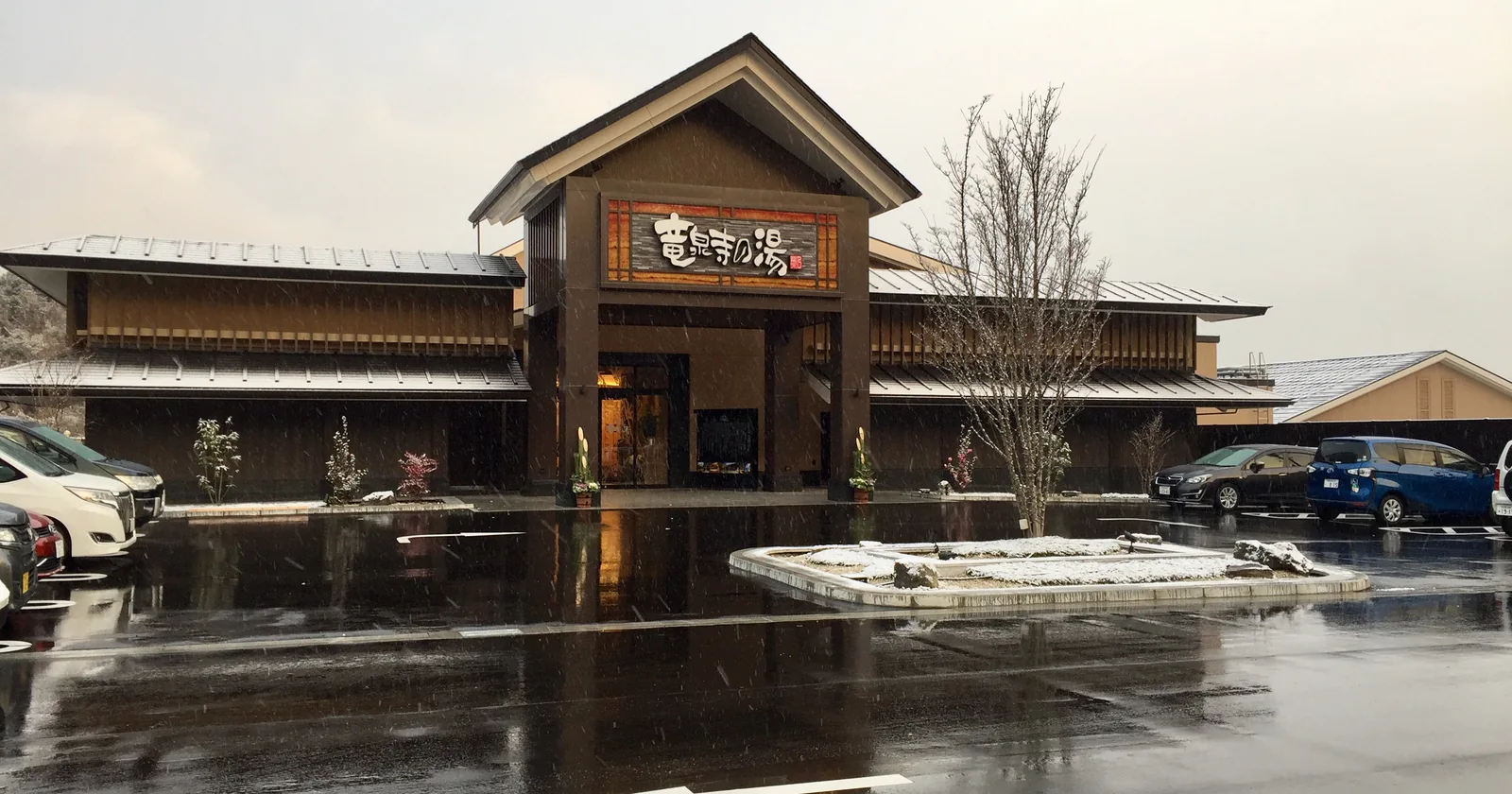
2. Tenku SPA HILLS Ryusenji no Yu Nagoya Moriyama — the only tattoo-conditional hot spring
A large facility that bills itself as the birthplace of the super sento and of the carbonated bath. The hot spring is officially the Ryusenji Onsen source, an alkaline simple spring (alkaline, hypotonic, low-temperature) at 33.2°C. Its famous high-concentration carbonated bath is, by the operator’s own statement, artificially carbonated — carbon dioxide dissolved into the water. That kind of candour is a good sign in this business.
There are 13 baths, including the hilltop open-air Tenku Hotaru no Yu and a sub-10°C plunge pool. Saunas are the Bazooka löyly sauna, a medi-sauna on the men’s side and a salt sauna on the women’s side; löyly sessions start at :00 and :30 every hour, and sauna use is junior high school age and up. The Forest Villa rock sauna area has six rooms.
- Weekday: adult (junior high and up) morning bath ¥750, standard bathing ¥850, Forest Villa ¥600. Elementary school children ¥300. Preschool free.
- Weekend and holiday: morning bath ¥850, bathing ¥950, Forest Villa ¥800, children ¥400. Forest Villa cannot be used on its own and is closed to elementary school children and younger.
- Hours: bathing 6:00–2:30 (last admission 1:45); Forest Villa 6:00–2:00 (last admission 1:00). The morning-bath rate applies to entry between 6:00 and 9:00. Open year-round apart from maintenance days.
- Peak pricing: special-day rates apply at times such as Obon. In 2026 the period from August 11 to 16 was priced at ¥950 morning bath, ¥1,050 bathing and ¥900 rock sauna. That period has ended.
- Tattoos: conditional. Up to two of the shop’s own cover seals (9.5 × 14.0 cm, ¥200 each).
- Access: from JR Ozone, take the Nagoya Guideway Bus (Yutorito Line) to Ryusenji; the facility is right there.
One thing to know before you choose a side. The operator states that the view from the women’s open-air bath is more limited than from the men’s. If the hilltop panorama is your reason for going, set expectations accordingly. The rental towel set is paid, and the price is not published.
3. RAKU SPA GARDEN Nagoya — all-in pricing, but check the clock
This is the bundled type: the standard admission includes a towel set, loungewear and the rock sauna. The hot spring is an alkaline simple spring at 30.5°C, 40 litres a minute, from 1,500 metres down, feeding the open-air rock bath and the carbonated bath. That hot spring was out of service because of a failing pump and only restarted on August 20, 2026.
There are 12 baths and saunas — carbonated bath, electric bath, carbonated cold bath, a salt sauna on the women’s side only, a high-temperature sauna and more — plus five rock sauna rooms, all unisex, closed to elementary school children and younger.
- Standard: Free Time admission, weekday adult ¥2,100 / child ¥660; weekend and holiday adult ¥2,750 / child ¥770. All tax included.
- Other tickets: night rate (from 21:00, adults only) ¥1,800 weekday / ¥2,450 weekend; morning bath (weekends and holidays, 5:00–8:00) ¥850; 90-minute course ¥1,050 weekday / ¥1,300 weekend. On the morning bath and 90-minute course, towels and loungewear cost extra.
- Price warning: RAKU SPA adds season rates at peak times — from July 18 to August 31, 2026, for example, the weekend and holiday price plus ¥110 applied on every day of the week. Check the operator’s current price page before you go.
- Hours: Sun–Thu and holidays 9:00–2:00 (last admission 1:00); Fri, Sat and the day before a holiday 9:00–8:00 (last admission 1:00); morning bath weekends and holidays 5:00–8:00 (last admission 7:30).
- Time trap: on Friday, Saturday and the night before a holiday you can stay until 8:00 the next morning, but between 2:00 and 5:00 only the fifth floor is open and the baths are closed. Bathing resumes at 5:00. Staying past 2:00 also adds a late-night charge of ¥2,000. This is not an all-night soak.
- Tattoos: not permitted at all. Sticker tattoos are also refused and there is no cover-seal exception.
- Access: 3 minutes on foot from the 光ヶ丘 (Hikarigaoka) city bus stop, 12 minutes from 猪高車庫 (Idaka Shako), or 20 minutes on foot from Jiyugaoka subway station. Free shuttles run from Hoshigaoka (about 15 minutes), Chikusa (about 30) and Sakae (about 45).
Local Tip from Yuu
The free shuttle is harder than it sounds for a first-time visitor. The operator’s own instruction is that there is no sign at the stop, and that you should raise your hand as the bus approaches. Standing at an unmarked spot and flagging a bus down is not obvious behaviour if nobody has told you — and if you do not do it, the bus goes past.
4. Urban Quar SPA & LIVING — towels and loungewear included, in Naka-ku
In Fujimi-cho, Naka-ku: reception is on the third floor of the Castle Town Kinenbashi building, with the baths and rock sauna on the fifth. The water rises from 800 metres and is a hypotonic, weakly alkaline, low-temperature spring at 25.1°C. The source bath runs at around 28°C with no water added, which the operator states explicitly — good news if you like sitting in tepid water for a long time. There is an open-air bath called Tenku no Yu, plus a carbonated bath, an electric bath and bubble pot baths.
- Rates (non-member): three-hour bathing course ¥1,050 weekday / ¥1,300 weekend and holiday. Onkatsu three-hour with rock sauna ¥1,250 / ¥1,500. Onkatsu Free ¥1,650 / ¥1,900. Members pay less; as a visitor you pay the non-member rate, and every figure in this guide is the non-member one.
- Late-night surcharge: on Friday, Saturday and the day before a holiday, staying between 1:30 and 10:00 adds ¥2,180.
- Hours: Mon–Thu 6:00–1:30; Fri 9:00–10:00 (opens 6:00 on holidays); Sat 6:00–10:00; Sun and holidays 6:00–1:30. Last admission 1:00. Open year-round.
- The good part: bath towel, face towel and loungewear are all included in the price. Most Nagoya day spas charge separately, so this matters if you are travelling light.
- Tattoos: not permitted.
- Watch out: the official site gives neither a nearest station nor a walking time, so this guide cannot give you a walking route. There is a free shuttle section on the access page, but no departure points and no times are published. Plan on a taxi or a car.
5. Midori Raku no Yu — its own well, deep in the suburbs
Out in Tokushige, Midori-ku. The operator describes the water as a natural spring drilled on its own grounds — its own well, in other words — though the spring quality, the depth and the flow rate are not published. The men’s open-air bath is Ryujin no Yu and the women’s Getto no Yu, with a three-tier bath, pot baths, a hinoki bath and a waterfall. A container sauna was completed in the men’s outdoor area in November 2025.
- Rates (non-member): adult (junior high and up) ¥950 weekday / ¥1,000 weekend and holiday; elementary school children ¥400; toddlers (age 4 to pre-school-age) ¥200. The Saikanbo rock sauna room is ¥550 for non-members, including yukata and mat rental, and requires a bathing ticket as well.
- Hours: every day 8:00–24:00 (last admission 23:30); rock sauna 8:00–23:30. Open year-round apart from a few maintenance days a year. On December 31 only, closing is 21:00 (last admission 20:00).
- Towels: paid. Face towel for sale ¥250; rental set (face and bath towel) ¥350. Shampoo, conditioner and body soap are provided.
- Tattoos: not permitted — ink, stickers and paint alike. The operator states that anyone found with one is asked to leave immediately.
- Access: about 15 minutes on foot from Tokushige on the subway Sakura-dori Line. By city bus, take a 地下鉄徳重 service bound for みどりが丘公園 and get off at 鳴海町笹塚.
This is a neighbourhood facility rather than a tourist one. Tokushige is the terminus of the Sakura-dori Line, so it is a single ride with no change from Nagoya Station — but budget the fifteen-minute walk at the far end into your plan, especially on the way back at night.
6. Ozone Onsen Yu no Shiro — the easiest one to reach on foot
Five minutes’ walk from the south exit of JR Ozone (seven from the north exit), and seven minutes from the Meijo Line, Meitetsu and Yutorito Line stations of the same name. That makes it one of the two or three most station-convenient day spas in the city, and at ¥800 on a weekday it is also among the cheapest. It is run by the same Castle Town group as Urban Quar.
There are twelve baths, including the carbonated Jinju no Yu, the open-air rock bath Kihin no Yu, pot baths, a lying-down bath and a high-oxygen bath. The high-temperature sauna runs above 90°C with an automatic löyly every 30 minutes between 7:00 and 24:00. The Iyashi no Shiro rock sauna is junior high school age and up, at extra cost.
- Rates (non-member): adult ¥800 weekday / ¥900 weekend and holiday; child ¥300 / ¥350; toddler ¥100. Rock sauna ¥600 / ¥650. Bathing plus rock sauna together ¥1,350 weekday / ¥1,500 weekend.
- Hours: 6:00–1:00 (last admission 0:30). For a limited period, Friday, Saturday and the day before a holiday run until 2:00 (last admission 1:30). The operator labels that extension as limited-period, so do not treat it as permanent.
- Towels: rental set (bath and face towel) ¥300.
- Tattoos: not permitted. After 23:00, under-18s may not use the facility under the Aichi prefectural youth ordinance.
- About the water: the name says Ozone Onsen, but the official site contains no mention of a hot spring, a spring quality or a source. The only water description it offers is “nano-yu”. Do not come here expecting a natural hot spring. No regular closing day is stated either.
One more thing: there is a separate facility called Ogaki Natural Hot Spring Yu no Shiro over in Ogaki, Gifu. The names are close enough to catch people out when searching.
7. Yu-topia Takara — the expensive all-inclusive one
By some distance the priciest day facility in the city at ¥2,400 for an adult on a weekday — but towels and loungewear come with that, and the sheer number of baths is on another scale. Kino-yu and Ishino-yu each have eight indoor baths, seven outdoor baths and four saunas, and the men’s and women’s sides swap monthly. Between the two you get a freezing sauna, auto löyly, self löyly, mist, far-infrared, mugwort and a tower sauna.
- Rates: standard plan (5:00–2:00) adult ¥2,400 weekday / ¥2,800 weekend and holiday, child ¥600. The evening half-price plan (17:00–2:00) is ¥1,200 weekday / ¥1,400 weekend, excluding certain special days. Morning bath (5:00–11:00) ¥900 / ¥1,000. Late-night surcharge from 2:00, ¥2,400.
- Towels and loungewear: included in the adult standard plan. Children pay ¥330 extra. The evening half-price plan includes towels but charges ¥230 for loungewear; the morning bath plan charges ¥330.
- Time trap: the building is open 24 hours, year-round — but the baths run 5:00 to 1:00, and are closed from 1:00 to 5:00 for cleaning. If you are landing late and planning a 3 a.m. soak, this is not the place.
- Tattoos: not permitted, stickers included.
- Access: about 7 minutes on foot from JR Kasadera — roughly 11 minutes from Nagoya Station on the JR Tokaido Main Line, or 6 from Kanayama. There is also a free shuttle from Kanayama, but the timetable is not something this guide has been able to verify; check on the day.
- About the water: the operator describes the place as a super sento, and publishes no natural hot spring, spring quality or source anywhere on the site.
On staying overnight: Yu-topia Takara has the Nagoya Kasadera Hotel attached (check-in 14:00, check-out 10:00). That is an adjoining hotel, not a bathhouse you can sleep in — a distinction worth having straight before you book.
8. Sanno Onsen Kita no Yu — three minutes by train, but artificial water
About five minutes’ walk from Sanno station, which is roughly three minutes from Meitetsu Nagoya. In pure travel time it is one of the shortest hops from the station area of anywhere in this guide. But the water is not a natural hot spring. The operator states plainly that its water is an artificial hot spring made by blending hot spring minerals into the water, and describes it as an artificial alkaline simple spring. With “onsen” in the name, this is an easy thing to misread.
The baths are a high-concentration carbonated bath, a hydrogen bath, a “bihada” bath, bubble pot baths, a circuit bath and a seated bath, plus a high-temperature sauna. The rock sauna has six rooms: Ganenbo, Nekkibo (in talking and meditation versions), Iwamushibo (women only), Rakuyubo and Hyodanbo.
- Rates: adult (junior high and up) ¥880 weekday / ¥980 weekend and holiday; child ¥400; toddler ¥300; age 3 and under free. Rock sauna adult ¥700 / ¥800, junior high and up only, including the dedicated wear and a large mat towel, with a bathing ticket required as well.
- Hours: baths Sun–Thu 9:00–24:00 (last admission 23:00); Fri, Sat and the day before a holiday 9:00–1:00 (last admission 24:00). Rock sauna 9:00–23:00 (last admission 22:00). Open year-round, with occasional closures for equipment inspection.
- Towels: rental set ¥350; for sale, face towel ¥150 and bath towel ¥550.
- Tattoos: not permitted.
- Parking: Times car park, six hours free with use of the facility.
9. SaunaLab Nagoya — not an onsen, but the only tattoo-friendly option
Seven minutes’ walk from Exit 8 at Sakae, on the eighth floor of the Grand Building. This is a dedicated sauna facility, not a hot spring — and it is the one place among these thirteen whose official FAQ says there are no particular usage restrictions regarding tattoos. If you have ink and you still want to experience Japanese sauna culture, this is the only address in Nagoya this guide can recommend without a caveat.
It is a mixed-gender facility with both shared saunas and single-sex ones. The shared saunas that can be confirmed by name on the official pages are the Forest Sauna and Unkai. There are also rest spaces — the Forest Library and the Mountain Library — set up for reading or working.
- Rates: 3 hours ¥2,700 weekday / ¥3,300 weekend, holiday and special days. Free plan (weekdays only) ¥4,500. Night sauna, 2 hours from 18:00 to close, ¥2,000 / ¥2,500. KIDSAUNA (elementary school children) ¥500. Extensions ¥500 per 30 minutes.
- Hours: Wed–Mon 12:00–21:00, sauna use until 20:30. Closed Tuesdays (since March 2026). Note that the official FAQ gives last admission as 20:00 while the venue page says sauna use runs to 20:30 — the two do not agree, so leave yourself margin.
- What is provided: face towel, bath towel, poncho gown, wrap cloth, sauna hat and swimwear (adult sizes only). Extra rentals are chargeable. Children must bring their own swimwear.
- Booking: advance reservation is preferred, and the three-hour plan is booked through the reservation form. Walk-ins are possible if a locker is free.
Which Nagoya hotels have a real onsen bath?
Four hotels, and only one of them lets non-guests in. If you are searching for a “Nagoya onsen hotel,” you are probably asking one of two questions: which hotels have a hot spring if I stay, and is there one I can use without staying? The answer to the first is four. The answer to the second is one.
| Hotel | Where the water comes from | Day-use bathing | Nearest station |
|---|---|---|---|
| Nagoya Crown Hotel | Its own Nagoya well — Sanzo Onsen, 1,350 m | Not published by the hotel | Fushimi, 5 min |
| Hotel LiVEMAX PREMIUM Nagoya Marunouchi | Jindai no Yu, Naka-Izu, Shizuoka | Yes — adult ¥1,000 | Hisaya-odori, 3 min |
| Super Hotel Nagoya Natural Hot Spring Shinkansenguchi | Ikeda Sakura Onsen, Gifu | No — hotel guests only | Nagoya Station, Shinkansen exit, 7 min |
| Dormy Inn PREMIUM Nagoya Sakae | Ikeda Sakura Onsen, Gifu, by tanker truck | No — hotel guests only | Fushimi, 3 min |
Nagoya Crown Hotel — the only hotel with its own Nagoya source
Drilling began on the hotel’s own site in 1990 and reached 1,350 metres; the spring, named Sanzo Onsen, opened in 1991. The water is a simple spring, and the communal bath is heated and free-flowing. This is the only hotel in central Nagoya where the water under your feet is the water in the tub. It is a large property — 613 rooms — five minutes’ walk from Fushimi.
- Bathing for hotel guests: free.
- Bath hours: 15:00 to 10:00 the following morning, excluding cleaning from 0:00 to 0:30. The two baths, Ichi-no-Yu and Ni-no-Yu, swap between men and women depending on the time of day.
- Stated benefits: neuralgia, muscle pain, joint pain, frozen shoulder, motor paralysis, joint stiffness, bruises, sprains, chronic digestive complaints and haemorrhoids.
- Towels: there are no towels in the bath area. Bring them from your room. Yukata may be worn anywhere in the building except the lounge.
- Where it is: the bath is in the annex. You go down to the first floor and across.
- Tattoos: not permitted.
- Restaurant: the in-house restaurant Shiki remains closed for the time being; breakfast is still served to hotel guests.
This guide covers the Crown Hotel as a hot spring for people staying there. The hotel publishes no day-use information at all — no price, no hours, no statement that it is possible — so no day-use price appears here. Figures you will find on third-party sites are not from the hotel.
Hotel LiVEMAX PREMIUM Nagoya Marunouchi — day-use bathing for ¥1,000
The only hotel in Nagoya that officially advertises day-use bathing. It is ¥1,000 for an adult and ¥500 for an elementary school child, available from 6:00 to 10:00 and from 15:00 to 25:00 (that is, to 1:00 the following morning). The hotel is about three minutes’ walk from Hisaya-odori on the subway Sakura-dori and Meijo lines.
The water comes from the Jindai no Yu source in Naka-Izu, Shizuoka: a sodium-calcium sulphate spring (hypotonic, alkaline, high-temperature) with a source temperature of 56.3°C. That is an unusually hot source for water you can get into in Nagoya.
- What is in the bath area: the official page lists a large communal bath and a sauna. Nothing beyond that appears in the operator’s current description, so nothing beyond that is claimed here.
- Tattoos: not permitted.
- Watch out: how towels and loungewear work for day-use visitors is not stated on the official site. Bring a towel to be safe.
Want the bath included with the bed?
Filter by district first, then check the nearest station before you book — Fushimi, Hisaya-odori and Sakae put you within a few minutes of three of the four hot spring hotels.
Super Hotel Nagoya Natural Hot Spring Shinkansenguchi — seven minutes from the station
Seven minutes on foot from the Shinkansen exit of JR Nagoya Station. The communal bath, Meijo Kinshachi no Yu, is separated by gender and runs from 15:00 to 9:30 the next morning. The water is the Ikeda Sakura Onsen source in Gifu: a sodium bicarbonate spring (alkaline, hypotonic, low-temperature) at pH 8.5. The hotel opened on August 5, 2021, so the building is new.
- Day-use bathing: not possible. The chain’s FAQ states that the only property where the bath can be used on its own is Yumoto Hananoi, Super Hotel Osaka Natural Hot Spring.
- Getting there in your room clothes: pyjamas or yukata plus slippers are fine for the walk to the bath.
- Tattoos: not permitted, paint included.
- Watch out: whether there is a sauna or an outdoor bath is not stated on the official pages, so this guide says neither that there is nor that there is not.
Dormy Inn PREMIUM Nagoya Sakae — trucked-in spring water, openly stated
The gender-separated communal bath, Kinshachi no Yu, is on the second floor. The hotel states on its own site that the water is Gifu’s Ikeda Sakura Onsen, brought over daily by large tanker truck. Being upfront about trucked water is exactly what you want from an operator, and anyone who cares about hot spring labelling should give the chain credit for it. The spring is an alkaline hypotonic spring, described in the body text as a bicarbonate spring.
- What is in there: one indoor hot bath; a high-temperature dry sauna with a television, two tiers; a chilled cold bath; one outdoor bath; and relaxation chairs, four on the men’s side and three on the women’s. This is the one hotel bath in the city where an outdoor bath and a sauna are both officially confirmed.
- Hours: 15:00 to 10:00 the next morning — but the sauna alone is out of service from 1:00 to 5:00.
- Day-use bathing: not possible. The chain’s FAQ lists the eight properties that accept day visitors, and Nagoya Sakae is not one of them.
- Towels and loungewear: there are no towels in the changing room, so bring them from your room. Loungewear is provided in the room and may be worn to the bath and to the restaurants.
- Tattoos: not permitted.
- Access: about five minutes from Exit 8 at Sakae, or about three minutes from Exit 2 at Fushimi.
What about the international-brand hotels?
Several international-brand hotels around Nagoya Station and Sakae have bathing facilities that are not hot springs, whatever the name suggests. The Nagoya Marriott Associa has a bath and sauna inside the 18th-floor fitness club, and TIAD, Autograph Collection has a sixth-floor thermal bath area; neither operator’s own wording uses the words hot spring, natural or daiyokujo. The individual reviews cover them properly. As a rule, Japanese business hotel chains are the ones that build a communal bath into the room rate — our budget hotels guide and family hotels guide compare those.
Which one is right for your trip?
Pick by constraint, not by ranking. Almost nobody visiting Nagoya has the time to try more than one or two of these, so the useful question is which single constraint is binding for you — ink, luggage, budget, the clock, or the train.
| If this is you | Go here | Why |
|---|---|---|
| Shortest public-transport trip from Nagoya Station | Sanno Onsen Kita no Yu (Sanno, 5 min walk) or Hotel LiVEMAX PREMIUM (Hisaya-odori, 3 min walk) | Sanno is about three minutes from Meitetsu Nagoya — but the water there is artificial |
| Real hot spring, walkable from a station | Hotel LiVEMAX PREMIUM Nagoya Marunouchi | ¥1,000 day-use, three minutes from the subway. The only place that combines both |
| Free bus from Nagoya Station | Canal Resort | Departs Nagoya Station at :25 past the hour, arrives about 30 minutes later |
| You want the water to be genuinely local | Nagoya Crown Hotel (as a staying guest) | The only Nagoya-sourced, heated free-flowing hotel bath in the city |
| You are here for the sauna | Ryusenji no Yu Moriyama (hourly löyly), Yu-topia Takara (four saunas on each side), Dormy Inn Nagoya Sakae (chilled cold bath, as a guest) | All three publish their sauna set-up officially |
| You have tattoos | SaunaLab Nagoya (no restriction) or Ryusenji no Yu Moriyama (up to two cover seals) | The other eleven do not admit tattooed guests |
| You do not want to carry a towel | Urban Quar, RAKU SPA standard rate, Yu-topia Takara adult standard plan | Towels — and loungewear — are in the price |
| Cheapest hot water | Ozone Onsen Yu no Shiro (¥800 weekday) or Ryusenji no Yu morning bath (¥750 weekday) | The lowest admissions among the thirteen |
| You just want a cheap bath, any bath | A neighbourhood sento | Public bathhouses in Aichi run at a fixed prefecture-wide rate: ¥550 adult, ¥200 elementary, ¥100 under school age |
| Early morning | Ryusenji no Yu, Yu no Shiro and Urban Quar (from 6:00), Yu-topia Takara (from 5:00) | Several also sell a discounted morning-bath ticket |
What should you know before you go?
Three things move the price and the plan: the season, whether towels are bundled, and how far out of the city centre you are travelling. None of them is obvious from a facility’s front page, and all three are cheap to get wrong.
Prices move with the season, not just the weekday
Nagoya day spas price in two tiers, weekday and weekend/holiday — but peak periods add a third tier on top. Ryusenji no Yu Moriyama applied special-day rates over Obon in 2026, from August 11 to 16. RAKU SPA GARDEN Nagoya ran a season rate from July 18 to August 31, 2026: the weekend and holiday price plus ¥110, on every day of the week. Look at the operator’s price page before you set out. It is the only version that is current.
There is a second pricing quirk. Some facilities publish a member price alongside a general price — Urban Quar, Midori Raku no Yu and Yu no Shiro all do. A visitor pays the general price, and every figure in this guide is the general one.
Towels: included at some, extra at others
Included: Urban Quar (loungewear too); RAKU SPA at the standard and night rates (loungewear and rock sauna too); Yu-topia Takara on the adult standard plan.
Charged separately: Canal Resort (price not published); Ryusenji no Yu Moriyama (price not published); Midori Raku no Yu (¥350 rental); Yu no Shiro (¥300); Kita no Yu (¥350).
Hotels work differently again. At both Nagoya Crown Hotel and Dormy Inn PREMIUM Nagoya Sakae there are no towels in the changing room at all; you carry your room towels down with you. It feels wrong the first time and is completely normal here.
How much does getting there cost?
Ordinary Nagoya subway fares for an adult are ¥210 up to 3 km, ¥240 to 7 km, ¥270 to 11 km, ¥310 to 15 km and ¥340 beyond that. If you are making two or three stops in a day, a pass wins. The bus and subway all-line one-day ticket is ¥870 for an adult, the subway all-line 24-hour ticket ¥760, and the Donichi Eco Kippu — valid on Saturdays, Sundays, public holidays and the 8th of every month — ¥620.
If your plan involves Tokushige for Midori Raku no Yu, or Meito-ku for RAKU SPA, the 24-hour ticket or the Donichi Eco Kippu takes the arithmetic out of the day entirely. For everything else about moving around the city, see our guide to getting around Nagoya.
One note on the station names in this guide. Nagoya’s transport bureau does not run an English-language website; the only official multilingual material is a route-map PDF. Every English station name used here — Ozone, Tokushige, Fushimi, Hisaya-odori, Sakae, Kanayama, Hoshigaoka, Chikusa, Jiyugaoka, Kasadera, Sanno, Rokuban-cho — is taken from that PDF rather than romanised by guesswork, because signage and search results follow it.
Frequently Asked Questions
Is there real onsen water inside Nagoya city?
Yes. Several facilities inside the city meet the Hot Spring Act definition, and five of them are day spas you can walk into: Canal Resort, Ryusenji no Yu Nagoya Moriyama, RAKU SPA GARDEN Nagoya, Urban Quar and Midori Raku no Yu. All draw water from deep underground, with source temperatures ranging from 25 to 48.8 degrees Celsius. Sanno Onsen Kita no Yu, however, states officially that its water is an artificial hot spring, and neither Ozone Onsen Yu no Shiro nor Yu-topia Takara publishes a spring quality or a source. A place with “onsen” in its name is not automatically a natural hot spring here.
Can I use a Nagoya bathhouse if I have tattoos?
Only one of the thirteen admits tattooed guests without conditions: SaunaLab Nagoya, whose official FAQ states there are no particular usage restrictions regarding tattoos. Ryusenji no Yu Nagoya Moriyama admits them conditionally, if the tattoo can be covered by two of the shop’s own cover seals, sold at 200 yen each and measuring 9.5 by 14.0 centimetres. Anything larger, or a refusal to use the seals, means no entry. The other eleven facilities do not admit tattooed guests at all, and Midori Raku no Yu states that anyone found with a tattoo is asked to leave immediately.
Is there an onsen hotel in Nagoya I can use without staying the night?
One. Hotel LiVEMAX PREMIUM Nagoya Marunouchi officially offers day-use bathing at 1,000 yen for an adult and 500 yen for an elementary school child, from 6:00 to 10:00 and from 15:00 to 25:00. It is about three minutes on foot from Hisaya-odori subway station. Super Hotel Nagoya Shinkansenguchi and Dormy Inn PREMIUM Nagoya Sakae both state in their chain FAQs that bathing is for hotel guests only. Nagoya Crown Hotel publishes no day-use information at all, so the day-use prices circulating on third-party sites should not be relied on.
Can I take a bath in the middle of the night in Nagoya?
Sometimes, but never assume that a 24-hour facility means a 24-hour bath. Yu-topia Takara’s building is open around the clock, yet the baths run only from 5:00 to 1:00 and are closed between 1:00 and 5:00 for cleaning. RAKU SPA GARDEN Nagoya lets you stay until 8:00 the next morning on Fridays, Saturdays and the night before a holiday, but from 2:00 to 5:00 only the fifth floor is open and the baths are shut, reopening at 5:00. For genuinely late bathing, Ryusenji no Yu Moriyama runs to 2:30, Canal Resort to 3:00 on Fridays and Saturdays, and Urban Quar to 10:00 the next morning on Fridays and Saturdays. Several facilities restrict under-18s after 23:00.
Which Nagoya onsen is easiest to reach from Nagoya Station?
On public transport alone, either Hotel LiVEMAX PREMIUM Nagoya Marunouchi, three minutes on foot from Hisaya-odori with day-use bathing at 1,000 yen, or Sanno Onsen Kita no Yu, five minutes on foot from Sanno station and roughly three minutes by train from Meitetsu Nagoya. Kita no Yu is an artificial hot spring, though. For genuine hot spring water, Canal Resort runs a free shuttle from beside Midland Square at Nagoya Station, departing at 25 past each hour and arriving at 55 past. Yu-topia Takara, about 11 minutes by JR to Kasadera and 7 minutes on foot, is another option.
Do I need to bring my own towel?
It depends where you go. Urban Quar, RAKU SPA at the standard and night rates, and Yu-topia Takara’s adult standard plan all include towels, and in most cases loungewear too. Canal Resort, Ryusenji no Yu Moriyama, Midori Raku no Yu, Ozone Onsen Yu no Shiro and Sanno Onsen Kita no Yu charge separately. Rentals typically run 300 to 350 yen, though Canal Resort and Ryusenji no Yu Moriyama do not publish their prices. Hotel baths work differently again: at Nagoya Crown Hotel and Dormy Inn PREMIUM Nagoya Sakae there are no towels in the changing room, so you bring them from your room.
How is a Nagoya city onsen different from an onsen town like Gero?
In one line: the city is a place to get into hot water, an onsen town is a place to stay. City facilities are urban hot springs, drilled deep, brought up cool and heated, costing roughly 800 to 2,800 yen for the day and reachable by subway or bus. Onsen towns such as Gero, Yunoyama and Gamagori give you a hot spring town instead, with ryokan, public baths to walk between and a landscape around them, in exchange for a train journey each way. They are two different experiences, so choose whichever fits the shape of your trip.
About the Author
I’m Yuu, born and raised in Nagoya, where I have lived for 35 years. This is a city where “going to the onsen” usually means leaving town, so the places on this page tend to be written about badly in English, or not at all — and the gap between what a facility’s name promises and what is actually in the water is wider here than almost anywhere else in Japan.
Every price, opening hour, spring quality and tattoo rule above was read off the operator’s own Japanese-language pages on August 20, 2026, not from aggregator sites. Where an operator does not publish something, this guide says so instead of guessing: that is why you will not find a towel price for Canal Resort, a walking distance for Urban Quar, or a day-use price for the Nagoya Crown Hotel anywhere on this page. Prices and hours here change more often than you would expect, so check the official page before you set out. Read more about my background on the About page.
Related Guides
If you want a hot spring town rather than a city bathhouse — Gero, Yunoyama, Gamagori, Toba, Takayama, Okuhida — start with the sister guide below.
- Onsen near Nagoya — the eight hot spring destinations reachable from the city, ranked for day trips and overnights.
- Ryokan near Nagoya — for when the plan is to sleep next to the water rather than commute to it.
- Where to stay in Nagoya — which district to base yourself in, and what each one costs.
- Getting around Nagoya — subway, bus, and whether a day pass is worth it.
- Budget hotels in Nagoya — the chains that build a communal bath into the room rate.
- Family hotels in Nagoya — rooms and baths that work with children in tow.
Affiliate disclosure: this article includes affiliate links to hotel booking partners. If you book through them we earn a small commission at no extra cost to you. It never changes which facility we recommend. See our full affiliate disclosure for details.