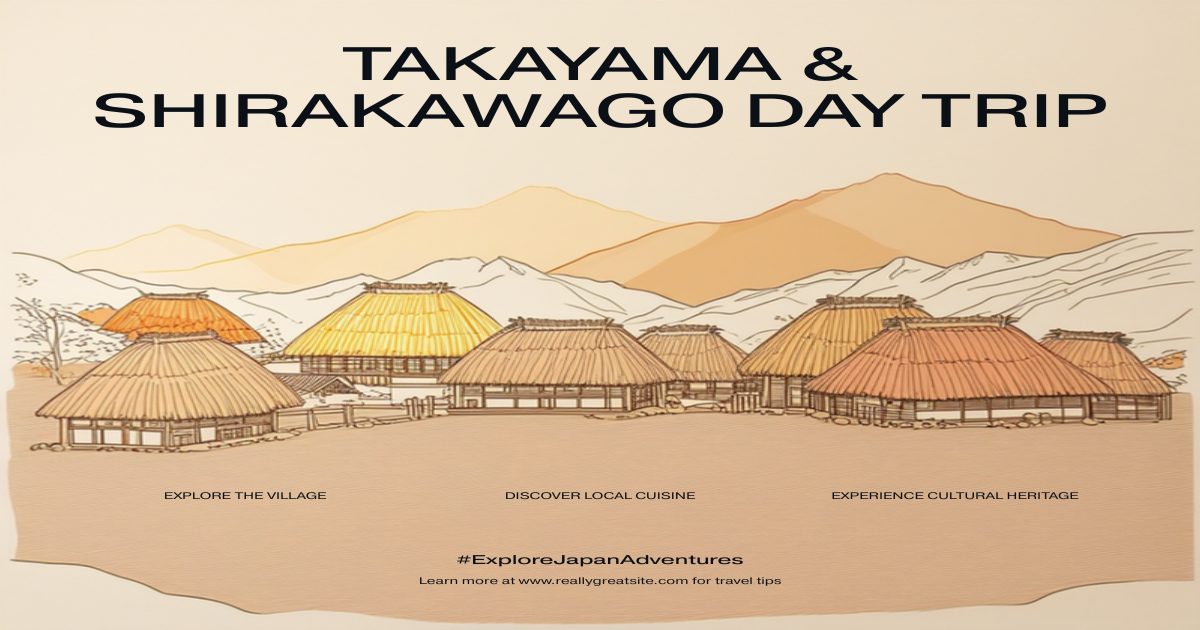
# Nagoya to Takayama & Shirakawago: The Complete Day Trip Guide for 2026
A day trip from Nagoya to Takayama and Shirakawago is one of the best excursions in Central Japan. You can visit both destinations in a single day by guided bus tour (easiest, ¥8,000-15,000), DIY highway bus (cheapest, ¥9,600 round trip), or JR train plus bus combo (best for JR Pass holders). The journey takes you from modern Nagoya to an Edo-period mountain town and a UNESCO World Heritage thatched-roof village.
Last updated: March 29, 2026 | Written by a Nagoya local with 10+ years of experience
Table of Contents
Why Is This Day Trip Worth Your Time? {#why-worth-it}
In a single day, you travel from a modern Japanese metropolis to a beautifully preserved Edo-period mountain town, then onward to a remote UNESCO World Heritage village of thatched-roof farmhouses. The contrast is extraordinary — and the scenery along the way, especially the mountain passes and river valleys, is some of the most dramatic in Japan.
I have made this trip more times than I can count over the past decade, in every season, by every mode of transport. It never gets old. The first time you round a mountain bend and see Shirakawago’s farmhouses spread across a green valley floor, you understand immediately why UNESCO designated this place. And Takayama — with its dark wooden merchant houses, the smell of grilling Hida beef, and sake breweries inviting you in for a tasting — feels like the Japan most visitors dream about but rarely find in the big cities.
This is genuinely one of the top three day trips you can do from Nagoya, alongside Ghibli Park and Inuyama Castle and Meiji Mura.
What Is Takayama and Why Should I Visit? {#what-is-takayama}
Takayama (officially Hida-Takayama) is a small mountain city in northern Gifu Prefecture known for its remarkably well-preserved old town, premium Hida beef, sake breweries, and daily morning markets. It is often called “Little Kyoto” — but in my experience, it actually feels more authentic and less touristy than Kyoto’s most popular districts.
The old town, called Sanmachi Suji, consists of three parallel streets of dark-timbered merchant houses dating from the Edo period (1600s-1800s). Unlike many “preserved” districts in Japan that have been heavily reconstructed, Sanmachi Suji retains an organic, lived-in quality. Local families still operate sake breweries, miso shops, and craft studios in buildings their ancestors built centuries ago.
Distance from Nagoya: 160 km | Travel time: 2-2.5 hours by bus or train | Elevation: 573 meters | Population: ~85,000 | Famous for: Hida beef, sake, morning markets, Edo-period old town, Takayama Festival (spring & autumn)
What Is Shirakawago and Why Is It Famous? {#what-is-shirakawago}
Shirakawago (Shirakawa-go) is a remote mountain village in northwestern Gifu Prefecture, designated a UNESCO World Heritage Site in 1995. It is famous for its gassho-zukuri farmhouses — steep thatched-roof structures whose rooflines resemble hands pressed together in prayer (gassho means “praying hands”).
These farmhouses were designed to withstand the region’s extreme snowfall, which can exceed 2 meters per winter. The steep 60-degree roof angles allow snow to slide off naturally. Some of these structures are over 250 years old and remain standing through traditional community maintenance practices where the entire village comes together to re-thatch roofs.
The main village, Ogimachi, contains approximately 110 gassho-zukuri houses. Some remain private residences, while others serve as museums, guesthouses (minshuku), shops, and restaurants. The village sits in a valley surrounded by mountains, with the Shogawa River flowing alongside — creating what is arguably the most iconic rural landscape in Japan.
Shirakawago is beautiful in every season, but each season delivers a completely different experience. Winter snow cover is the most famous view, but I personally find autumn (late October to mid-November) to be the most stunning, with fiery red and gold foliage surrounding the dark wooden farmhouses.
How Do I Get from Nagoya to Takayama and Shirakawago? {#getting-there}
You have three main options for this day trip. Each has distinct advantages depending on your budget, comfort preference, and whether you hold a rail pass.
| Option | Best For | Round Trip Cost | Total Travel Time | Stress Level |
|---|---|---|---|---|
| Guided Bus Tour | First-time visitors, non-Japanese speakers | ¥8,000-15,000 (all-inclusive) | N/A (managed for you) | Very Low |
| DIY Highway Bus | Budget travelers, independent explorers | ~¥9,600 (transportation only) | ~6 hours total transit | Moderate |
| JR Train + Bus | JR Pass holders, scenic train lovers | ~¥2,600 (bus only, train covered by pass) | ~5.5 hours total transit | Low |
Should I Take a Guided Tour or Go Independently? {#tour-vs-diy}
This is the most common question I get from visitors planning this trip. Here is my honest assessment after doing it both ways many times.
Guided Bus Tour from Nagoya (Easiest Option)
A guided tour handles all logistics — bus reservations, timing, route optimization — so you can focus entirely on enjoying Takayama and Shirakawago. Several reputable operators run daily tours from Nagoya Station.
What a typical guided tour includes:
1. Pickup at Nagoya Station (usually 7:00-7:30 AM)
2. Drive to Takayama (comfort stop along the way)
3. 2-3 hours free time in Takayama old town and morning market
4. Lunch break (sometimes included, sometimes at your own expense)
5. Drive to Shirakawago (about 50 minutes)
6. 1.5-2 hours in Shirakawago village
7. Return drive to Nagoya Station (arrive 6:30-7:30 PM)
Approximate cost: ¥8,000-15,000 per person depending on operator and inclusions
[AFFILIATE: Viator Takayama Shirakawago Tour]
[AFFILIATE: GetYourGuide Takayama Tour]
[AFFILIATE: Klook Shirakawago Tour]
When to Choose a Guided Tour
– You do not speak Japanese and are uncomfortable navigating Japanese bus booking systems
– You want zero planning stress on a packed travel itinerary
– You are traveling in peak season (October-February) when independent bus seats sell out quickly
– You prefer having a guide explain cultural and historical context
When to Go Independent
– You want to control your own schedule and linger where you choose
– You are on a tight budget and have a JR Pass
– You are an experienced Japan traveler comfortable with public transit
– You want to stay overnight in Takayama (highly recommended if time allows)
Choose tours that depart early (7:00-7:30 AM). Tours leaving after 8:30 AM typically sacrifice time at one or both destinations. Also avoid tours that add a third stop (like Gujo Hachiman) — you want maximum quality time in Takayama and Shirakawago, not a rushed overview of three places.
What Is the Best DIY Highway Bus Route? {#highway-bus}
If you prefer independent travel, highway buses offer the most flexible and affordable way to cover this route.
Complete Bus Route and Schedule
| Leg | Route | Duration | Cost (2026) | Operator | Reservation Required? |
|---|---|---|---|---|---|
| 1 | Nagoya → Takayama | 2 hrs 30 min | ¥3,100 | Meitetsu Bus / Nohi Bus | Recommended |
| 2 | Takayama → Shirakawago | 50 min | ¥2,600 | Nohi Bus | Required |
| 3 | Shirakawago → Nagoya | 3 hrs | ¥3,900 | Gifu Bus | Required |
Total round trip transportation cost: approximately ¥9,600
Departure Points in Nagoya
All highway buses depart from the Meitetsu Bus Center, located on the 3rd and 4th floors of the Meitetsu Department Store building directly connected to Nagoya Station. Use the JR Central Exit (Sakura-dori Exit) and follow signs for “Meitetsu Bus Center.” The ticket counters and waiting area are on the 3rd floor.
Reserve Nohi Bus tickets at nouhi-bus.co.jp (English supported). The Takayama-Shirakawago route in particular sells out during autumn foliage and winter snow season. Book at least 2 weeks ahead during October through February. Payment by credit card is accepted for online bookings.
Recommended DIY Itinerary (Detailed)
| Time | Activity | Details |
|---|---|---|
| 6:50 AM | Arrive at Meitetsu Bus Center 3F | Buy a coffee and snack from the convenience store downstairs |
| 7:00 AM | Depart Nagoya → Takayama | Highway bus with rest stop. Sit on the left side for mountain views |
| 9:30 AM | Arrive Takayama Bus Terminal | 5-minute walk to the old town |
| 9:30-10:30 | Miyagawa Morning Market | Browse stalls, try mitarashi dango, buy pickles |
| 10:30-11:30 | Sanmachi Suji (Old Town) | Walk the three streets, visit a sake brewery, browse craft shops |
| 11:30-12:15 | Lunch | Hida beef sushi + skewers from street stalls, or a sit-down restaurant |
| 12:15-12:50 | Walk back to bus terminal | Optional: grab a sake tasting on the way |
| 13:00 | Depart Takayama → Shirakawago | Nohi Bus, stunning mountain road scenery |
| 13:50 | Arrive Shirakawago | Bus stop is at the village edge |
| 13:50-14:20 | Walk to Shiroyama Observation Deck | 15-minute uphill walk or ¥200 shuttle bus |
| 14:20-14:40 | Observation deck photos | THE iconic panoramic view |
| 14:40-15:40 | Village exploration | Wada House (¥300), souvenir shops, Deai Bridge |
| 15:40-16:00 | Snack break | Try gohei-mochi or a warm drink at a local café |
| 16:10 | Depart Shirakawago → Nagoya | Gifu Bus direct to Nagoya |
| 19:10 | Arrive Nagoya | Head to dinner — you have earned some Nagoya-meshi! |
Should I Take the JR Hida Train Instead? {#jr-train}
If you hold a JR Pass or Takayama-Hokuriku Area Tourist Pass, the JR Hida Limited Express train is an excellent choice for the Nagoya-to-Takayama leg.
JR Hida Limited Express Details
– Route: Nagoya Station → Takayama Station
– Duration: 2 hours 20 minutes
– Cost: ¥6,140 (covered by JR Pass or Takayama-Hokuriku Pass)
– Departures: Roughly every 1-2 hours starting from 7:43 AM
– Platform: JR Nagoya Station, usually Platform 11 or 12
Why the Train Ride Is Special
The JR Hida train journey is one of the most scenic rail rides in Central Japan. After leaving the Nagoya suburbs, the train follows the Hida River through increasingly dramatic mountain gorges. In autumn, the valley walls blaze with red and gold foliage. In winter, snow blankets the mountains and frost clings to the river rocks.
Sit on the left side (window seat in row D) for the best river valley views. The most scenic stretch is between Gero and Takayama, roughly 45 minutes before arrival. The train also passes through Gero Onsen, one of Japan’s top three hot spring towns — worth a separate day trip if you enjoy onsen.
From Takayama Station, the Nohi Bus to Shirakawago departs from bus stop #2 at the Takayama Nohi Bus Center, directly across the street from the station’s east exit. The ride takes 50 minutes and costs ¥2,600.
Important: The JR Pass does not cover the Takayama-Shirakawago bus. You must purchase this ticket separately. The Takayama-Hokuriku Area Tourist Pass, however, does cover this bus route.
Is the Takayama-Hokuriku Area Tourist Pass Worth It? {#tourist-pass}
The Takayama-Hokuriku Area Tourist Pass is a regional rail and bus pass that can save significant money — but only if your itinerary matches its coverage area.
Pass Details (2026)
| Feature | Details |
|---|---|
| Price | ¥19,800 (adult) / ¥9,900 (child 6-11) |
| Validity | 5 consecutive days |
| JR Trains Covered | Nagoya ↔ Takayama ↔ Toyama ↔ Kanazawa (non-reserved seats on limited express) |
| Buses Covered | Nohi Bus: Takayama ↔ Shirakawago ↔ Kanazawa route |
| NOT Covered | Shinkansen, Nagoya subway, buses outside the specified routes |
When the Pass Pays for Itself
The pass is worth buying if your itinerary includes both Takayama and Kanazawa. A typical value calculation:
– Nagoya → Takayama (JR Hida): ¥6,140
– Takayama → Shirakawago (bus): ¥2,600
– Shirakawago → Kanazawa (bus): ¥2,600
– Kanazawa → Nagoya (JR via Toyama): ¥7,920
– Total without pass: ¥19,260
At ¥19,800, the pass essentially breaks even on this route alone — and you get 5 days of unlimited travel within the covered area. If you add any additional travel within those 5 days, the savings increase.
When the Pass Is NOT Worth It
If you are only doing a Nagoya → Takayama → Shirakawago → Nagoya day trip without visiting Kanazawa or Toyama, the regular highway bus (¥9,600 total) is significantly cheaper.
[AFFILIATE: Klook Takayama-Hokuriku Pass]
For a detailed itinerary combining Takayama with Kanazawa, see our Nagoya to Kanazawa day trip guide.
What Should I Do in Takayama with Limited Time? {#what-to-do-takayama}
With 2-3 hours in Takayama on a day trip, you need to be strategic. Here are the essential experiences, ranked by priority.
1. Sanmachi Suji Old Town (Must-Do)
Sanmachi Suji is Takayama’s historic heart — three parallel streets of dark-timbered merchant houses from the Edo period. Walking these streets is the single best experience in Takayama. The buildings house sake breweries (look for the sugidama cedar ball hanging outside), miso shops, traditional craft stores, and small cafes.
When I walk through Sanmachi Suji, I always start at the southern end of Kami-Sannomachi and work my way north. The southern end is less crowded in the morning, and you pass several of the best sake breweries along the way. The street is narrow and atmospheric — early morning light filtering through the dark wooden eaves is genuinely beautiful.
Time needed: 45-60 minutes at a relaxed pace.
2. Miyagawa Morning Market (Highly Recommended)
The Miyagawa Morning Market operates every morning from approximately 7:00 AM to 12:00 PM along the east bank of the Miyagawa River. Local farmers and artisans sell seasonal produce, homemade pickles (Takayama’s red turnip pickles are excellent), handmade crafts, and snacks.
The market is best between 8:00 and 10:30 AM when all stalls are active and produce is fresh. By 11:30, vendors begin packing up. Buy a bag of sarubobo charms — these traditional Takayama good-luck dolls make excellent souvenirs and cost ¥300-500 each.
Time needed: 30-45 minutes.
3. Sake Brewery Tasting (Recommended)
Takayama has seven sake breweries within the old town, and several offer free tastings. The cold mountain water and clean air produce distinctive, smooth sake.
Best breweries for visitors:
– Funasaka Brewery — English-friendly, wide selection of tasting options, beautiful traditional interior
– Harada Brewery — Small and intimate, staff happy to explain the brewing process
– Hirata Brewery — Known for their seasonal limited-edition sake
Free tastings are small cups (about 30ml each). It is polite to purchase at least one small bottle (¥300-1,500) if you taste several varieties. Breweries are generally open 9:00 AM to 5:00 PM. During the Sanmachi Suji walk, you will pass at least three breweries naturally.
4. Takayama Jinya (If Time Allows)
Takayama Jinya is the only surviving Edo-period government outpost in Japan. Admission is ¥440, and a quick walkthrough takes 30-40 minutes. It is beautifully maintained but may be difficult to fit into a tight day-trip schedule.
What Should I Eat in Takayama? {#eat-in-takayama}
Takayama’s food scene is exceptional for a small mountain city. On a day trip, you have limited time, so here are the must-try items ranked by efficiency and flavor.
Hida Beef — Takayama’s Star Attraction
Hida beef (Hida-gyu) is a premium wagyu brand raised in the mountainous Hida region of Gifu Prefecture. It ranks alongside Kobe beef and Matsuzaka beef as one of Japan’s finest wagyu brands.
| How to Eat It | Where | Price (2026) | Time Needed |
|---|---|---|---|
| Hida Beef Sushi (street style) | Stalls along Sanmachi Suji | ¥700-900 for 2 pieces | 5 minutes (standing) |
| Hida Beef Skewers | Street grills on Sanmachi Suji | ¥500-800 per skewer | 5 minutes (standing) |
| Hida Beef Croquette | Various shops on main streets | ¥300-400 | 2 minutes (walking) |
| Sit-down Hida Beef Lunch | Restaurants near old town | ¥2,000-5,000 | 30-60 minutes |
| Hida Beef Ramen | Ramen shops near station | ¥1,000-1,300 | 15-20 minutes |
For a day trip, the street food approach is by far the smartest strategy. The Hida beef sushi is served directly onto your hand (no plate), and it is genuinely outstanding — rich, buttery, and melts on your tongue. The most popular stall, Sakaguchi, usually has a 10-15 minute line. The neighboring stalls are nearly as good with shorter waits.
Other Must-Try Takayama Foods
– Mitarashi Dango — Grilled rice dumplings with sweet soy glaze. Takayama’s version is savory-sweet and slightly charred. About ¥100-200 per skewer at the morning market.
– Takayama Ramen — Thin curly noodles in a soy-based broth. A local comfort food available at shops near the station. ¥800-1,000.
– Gohei-Mochi — Grilled rice cakes with walnut-miso paste. A mountain region specialty sold at several stalls.
– Local Sake — Free tastings at breweries, small bottles from ¥300.
What Should I Do in Shirakawago? {#what-to-do-shirakawago}
With 1.5-2 hours in Shirakawago, you can see the highlights comfortably. Here is my recommended walking route.
Step 1: Shiroyama Observation Deck (30 Minutes)
Go here first. The Shiroyama Observation Deck provides the famous panoramic view of the entire Ogimachi village with mountains behind it — the image you have seen in every Japan travel poster. A 15-minute uphill walk from the village center takes you there, or a shuttle bus runs for ¥200 one way.
I always hike up and take the shuttle down to save my knees and time. The view is breathtaking in every season. In my experience, the light is best in the afternoon when the sun illuminates the farmhouse roofs from the west.
The observation deck has a small souvenir shop and restrooms. Grab a warm can of corn soup from the vending machine — it is surprisingly delicious and perfect on a cold mountain day. The deck gets crowded between 2:00 and 3:00 PM when most tour groups arrive, so earlier is better.
Step 2: Village Walk and Farmhouse Museums (45-60 Minutes)
Walk through the village at a relaxed pace. Cross the Deai Bridge (a distinctive suspension bridge over the Shogawa River) and wander through the narrow lanes between farmhouses. Key stops:
– Wada House (¥300) — One of the largest gassho-zukuri houses, designated an Important Cultural Property. The upper floors reveal the ingenious structural engineering. Allow 15-20 minutes.
– Kanda House (¥300) — Another large, well-preserved farmhouse with excellent English signage explaining construction techniques and daily life.
– Myozenji Temple — A small temple with its own gassho-zukuri bell tower. Free to visit.
Gassho-zukuri farmhouses have no nails in their thatched roof structure — the entire framework is held together with rope and wooden pegs. The steep 60-degree roof angle is engineered to shed heavy snow naturally. Upper floors were traditionally used for silk cultivation, which required ventilation provided by the unique roof design.
Step 3: Souvenirs and Snacks (15-20 Minutes)
The village has several small shops selling local crafts, snacks, and Shirakawago-branded souvenirs. Notable items:
– Doburoku — A milky, slightly sweet unfiltered sake traditional to this area. Small bottles from ¥500.
– Sarubobo Charms — Traditional good-luck dolls. ¥300-500.
– Local Honey — Mountain flower honey from local beekeepers. ¥800-1,200.
Try the gohei-mochi at the shop near the bus stop — it is freshly grilled and delicious, and the perfect snack while waiting for your return bus.
What Is the Best Season to Visit? {#best-season}
Each season transforms Takayama and Shirakawago into a different experience. Here is an honest comparison based on my visits across all seasons.
| Season | Dates | Takayama | Shirakawago | Crowds | My Rating |
|---|---|---|---|---|---|
| Winter | Dec-Feb | Snowy old town, hot sake, warm ramen | Snow-covered farmhouses, light-up events | High (especially light-up dates) | ★★★★★ |
| Spring | Mar-May | Cherry blossoms, Spring Festival (Apr 14-15) | Fresh green valley, comfortable temps | Moderate to High | ★★★★ |
| Summer | Jun-Aug | Lush green, tanabata decorations | Vivid green rice paddies, fireflies | Moderate | ★★★ |
| Autumn | Sep-Nov | Peak foliage, Autumn Festival (Oct 9-10) | Red/gold foliage, dramatic valley colors | Very High | ★★★★★ |
Winter: The Most Magical (But Plan Ahead)
Winter transforms Shirakawago into a real-life snow globe. The thatched roofs piled with thick white snow against a grey sky is hauntingly beautiful. Takayama in winter has its own charm — steam rising from sake breweries, warm bowls of ramen, and far fewer tourists than autumn.
The famous Shirakawago Light-Up Events happen on 6-8 select evenings in January and February. The farmhouses are illuminated from below while snow falls gently — it is genuinely one of the most beautiful scenes I have ever witnessed in Japan.
Autumn: The Most Photogenic
Late October through mid-November brings spectacular fall foliage to both Takayama and Shirakawago. The mountain valleys explode with red, orange, and gold against dark wooden buildings. The JR Hida train ride during autumn is one of the most beautiful rail journeys in Japan.
If you visit during the Takayama Autumn Festival (October 9-10), you will see stunning yatai festival floats paraded through the old town — it is one of Japan’s three most famous festivals. However, Takayama is extremely crowded during the festival, and accommodation sells out months ahead. For a more relaxed autumn experience, aim for late October.
How Much Does This Day Trip Cost? {#budget-breakdown}
Here is a detailed cost comparison of the three main approaches for 2026.
| Expense | DIY Highway Bus | Guided Tour | JR Train + Bus (with Pass) |
|---|---|---|---|
| Transportation | ¥9,600 | Included in tour price | ¥2,600 (bus only; train covered by pass) |
| Tour Fee | — | ¥8,000-15,000 | — |
| Hida Beef Street Food | ¥1,500-2,000 | ¥1,500-2,000 (or included) | ¥1,500-2,000 |
| Sake Tasting + Bottle | ¥500-1,500 | ¥500-1,500 | ¥500-1,500 |
| Shirakawago Museum Entry | ¥300-600 | Sometimes included | ¥300-600 |
| Observation Deck Shuttle | ¥200 | Usually included | ¥200 |
| Snacks & Drinks | ¥500-800 | ¥500-800 | ¥500-800 |
| Total Estimate | ¥12,600-14,700 | ¥10,500-19,300 | ¥5,600-7,700 |
If you hold a JR Pass or Takayama-Hokuriku Pass, this day trip is extraordinarily affordable. The train to Takayama is covered, and you only pay for the ¥2,600 bus to Shirakawago plus food and small entry fees. Even without a rail pass, the highway bus approach keeps transportation under ¥10,000, making this one of the best-value day trips in Central Japan.
What Practical Tips Should I Know? {#practical-tips}
After doing this trip in every season and by every mode of transport, here are the practical details that make the difference between a smooth experience and a stressful one.
Cash Is Essential
Many shops and restaurants in both Takayama and Shirakawago are cash-only. Withdraw yen at a 7-Eleven ATM before leaving Nagoya. I recommend carrying at least ¥10,000-15,000 in cash for the day (transportation + food + shopping + museum entry).
What to Wear
– Comfortable walking shoes — Takayama’s old town has some cobblestone streets. Shirakawago has unpaved paths.
– Layers — Mountain weather changes quickly. Even in summer, mornings can be cool at elevation.
– Winter gear — From November through March, bring a warm jacket, gloves, and waterproof boots. Shirakawago temperatures regularly drop below -5°C in winter.
Luggage Strategy
Leave large bags in coin lockers at Nagoya Station (¥400-700 per locker) or at your hotel. The Nagoya Station lockers near the Shinkansen gates (Taiko-dori side) have the most large-size lockers. You do not want to haul luggage through narrow old-town streets and mountain village paths.
Internet and Navigation
Mobile reception is spotty in the mountains between Takayama and Shirakawago. Download offline Google Maps for the Gifu Prefecture region before departing. Having an eSIM or pocket Wi-Fi is highly recommended for Japan travel in general.
[AFFILIATE: Klook Japan eSIM]
Accessibility Notes
Takayama’s old town is mostly flat with paved streets, though some shops have steps. Shirakawago has uneven, unpaved paths. The observation deck shuttle bus is accessible, but the hiking path to the deck is steep and not wheelchair-friendly. Both Takayama and Shirakawago bus terminals have accessible restrooms.
Overnight Stay Option
If your schedule allows, spending one night in Takayama transforms this trip from “excellent” to “unforgettable.” You get to experience the morning market at its freshest (7:00-8:00 AM), enjoy the old town in the atmospheric evening when day-trippers have left, and dine at a proper Hida beef restaurant. Takayama has excellent ryokan (traditional inns) from ¥8,000-25,000 per night.
If you stay overnight, I recommend a ryokan with a private onsen bath. Soaking in hot spring water after a day of mountain exploration is the perfect end to the day. The ryokan breakfast — a traditional Japanese multi-course meal — is also worth experiencing.
For information about where to base yourself in Nagoya for this and other day trips, see our where to stay in Nagoya guide. For getting around the city efficiently, check our Nagoya transit guide.
Frequently Asked Questions {#faq}
Can I Visit Both Takayama and Shirakawago in One Day from Nagoya?
Yes, you can visit both in a single day. A guided tour departing at 7:00 AM returns to Nagoya by 7:00 PM with 2-3 hours in Takayama and 1.5-2 hours in Shirakawago. Independent travel by highway bus follows a similar 12-hour schedule.
That said, this is a full and somewhat tiring day. You will spend roughly 6 hours on buses or trains and 5-6 hours exploring. The key to a successful day trip is departing early — the 7:00 AM bus from Nagoya is ideal. If you take a later departure, you sacrifice time at one or both destinations and risk missing the last return bus from Shirakawago. I have done this day trip at least 15 times, and the early departure consistently produces the best experience. If you have two days available, spending a night in Takayama is vastly superior — you get unhurried time in both places and can experience Takayama’s atmospheric evening old town.
What Is the Best Way to Get from Nagoya to Takayama?
The two main options are the JR Hida Limited Express train (2 hours 20 minutes, ¥6,140, scenic mountain ride) and the highway bus (2 hours 30 minutes, ¥3,100, comfortable and budget-friendly). JR Pass holders should take the train. Budget travelers without a pass should take the bus.
The train is the more enjoyable option for the journey itself. The scenic stretch through the Hida River valley is genuinely spectacular, especially in autumn. The train has reserved seating, onboard restrooms, and a smoother ride than the bus. However, the bus is nearly half the price and drops you at the same location — the Takayama Bus Center, which is a 5-minute walk from the old town. Both the train station and bus center are adjacent, so the walking distance to attractions is identical. If cost is not a concern, take the train outbound for the scenery and the bus from Shirakawago back to Nagoya for the direct route.
What Should I Eat in Takayama on a Day Trip?
Hida beef is the must-eat food in Takayama. Try Hida beef sushi from a street stall (¥700-900 for 2 pieces), Hida beef skewers (¥500-800), and mitarashi dango at the morning market (¥100-200). These street foods are delicious, fast, and let you eat while exploring.
For a day trip with limited time, street food is the smart approach. A sit-down Hida beef lunch takes 30-60 minutes and costs ¥2,000-5,000 — lovely if you have time, but it eats into your exploration hours. The Hida beef sushi is the single best food experience in Takayama. It is served on your hand (not a plate), and the warm, slightly seared beef melts on contact with your tongue. I have tried every Hida beef sushi stall on Sanmachi Suji, and they are all excellent. The most famous one, Sakaguchi, has the longest line (10-15 minutes), but the neighboring stalls are equally good with waits of 2-3 minutes. Also make time for a free sake tasting at one of the old-town breweries — Funasaka Brewery is my top recommendation for English-speaking visitors.
Is the Shirakawago Winter Light-Up Worth the Effort?
The winter light-up events are absolutely spectacular — snow-covered gassho-zukuri farmhouses illuminated against the dark sky create one of the most magical scenes in Japan. However, entry requires winning a competitive lottery months in advance. Daytime winter visits are nearly as beautiful and require no special booking.
The light-up events run on 6-8 select evenings in January and February. The lottery registration typically opens in August or September on the official Shirakawa Village tourism website. Demand far exceeds capacity — the village limits visitors to prevent overcrowding. If you win the lottery, you will have a designated viewing time and area. If you do not win, do not despair. I have visited Shirakawago in winter during daytime at least five times, and the snow-covered village is breathtaking even without the illumination. Fresh snowfall creates a hushed, magical atmosphere. The farmhouses look like something from a Ghibli film. My honest opinion: the daytime winter experience is 90% as magical as the light-up, with 10% of the stress.
Do I Need to Book Shirakawago Buses in Advance?
Yes, advance reservation is strongly recommended for all bus routes involving Shirakawago. The Takayama-Shirakawago and Shirakawago-Nagoya routes frequently sell out during peak seasons, particularly October through February. Book at least 2 weeks ahead through the Nohi Bus website.
The Nohi Bus website (nouhi-bus.co.jp) supports English reservations and accepts credit card payment. For the Nagoya-Takayama highway bus, reservation is recommended but not always required — seats occasionally remain available on the day. However, for the Takayama-Shirakawago and Shirakawago-Nagoya legs, I have personally been turned away twice when I tried to buy same-day tickets during autumn. These routes use smaller buses with limited seating. During winter light-up dates and peak autumn foliage weekends, buses can sell out weeks in advance. My rule: book as soon as your travel dates are confirmed. Cancellation policies are generally flexible up to 2 days before departure.
Is the Takayama-Hokuriku Area Tourist Pass Worth Buying?
The pass (¥19,800 for 5 days) is excellent value if your itinerary includes both Takayama and Kanazawa or Toyama. It covers JR trains and Shirakawago buses on the Takayama-Kanazawa route. For a Nagoya-Takayama-only day trip, regular highway bus tickets are more cost-effective.
The break-even calculation is straightforward. A Nagoya-Takayama-Shirakawago-Kanazawa-Nagoya loop costs approximately ¥19,260 without the pass. At ¥19,800, the pass essentially pays for itself on a single loop, and any additional travel within the 5-day window is free. If you are spending a week in Central Japan and plan to visit Takayama, Shirakawago, and Kanazawa, this pass is a no-brainer. Buy it through Klook for easy English booking, or purchase at JR ticket offices in major stations. The pass also covers the scenic JR Hokuriku Line along the Japan Sea coast, so you can add stops at Fukui or Tsuruga at no extra cost. For our recommended Kanazawa itinerary, see our Nagoya to Kanazawa day trip guide.
Central Japan Travel Guide Team — We are a team of writers and editors based in Nagoya, Japan. With over 10 years of experience living in and exploring Central Japan, we provide practical, honest, and locally-informed travel guides. We visit every destination we write about, pay our own way, and update our guides regularly. We have made the Nagoya-Takayama-Shirakawago trip dozens of times across every season and by every mode of transport.
Related Guides for Your Central Japan Trip
– Ghibli Park complete guide — tickets, access, and all 5 areas
– The best things to do in Nagoya — our complete activity guide
– Nagoya food guide: every Nagoya-meshi dish you need to try
– Where to stay in Nagoya — neighborhood guide and hotel picks
– Getting around Nagoya — subway, bus, and transit pass guide
– Day trip to Kanazawa from Nagoya
– Day trip to Inuyama Castle and Meiji Mura
– Nagoya 3-day itinerary for first-time visitors
– Japan travel essentials for Central Japan