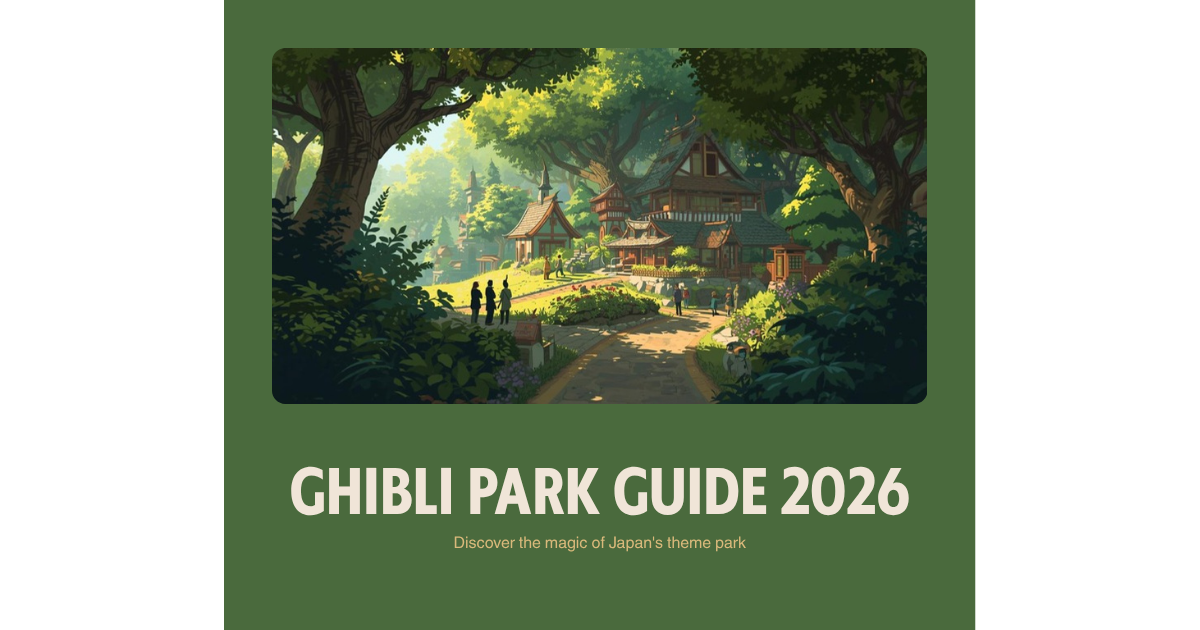
# Ghibli Park Guide 2026: Tickets, Getting There & All 5 Areas Fully Explained
Ghibli Park is an immersive theme park in Nagakute City, Aichi Prefecture, featuring life-sized recreations of iconic Studio Ghibli film scenes across five themed areas. Tickets must be purchased in advance online — there are no walk-ins. International visitors can buy tickets through the official Boo-Woo Ticket site or Klook, with sales opening on the 10th of each month at 2:00 PM JST.
Last updated: March 29, 2026 | Written by a Nagoya local with 10+ years of experience
Table of Contents
What Is Ghibli Park and Why Is It Different? {#what-is-ghibli-park}
Ghibli Park is not a conventional theme park with roller coasters and character meet-and-greets. It is a carefully crafted series of life-sized, walk-through recreations of beloved Studio Ghibli film scenes set within the grounds of Expo 2005 Aichi Commemorative Park (Moricoro Park) in Nagakute City, about 40 minutes east of central Nagoya.
When I first visited on opening day in November 2022, I expected something like a smaller version of Tokyo Disneyland. What I found instead completely surprised me. Ghibli Park is quiet, contemplative, and deeply respectful of the source material. You walk through Howl’s Moving Castle at your own pace. You step inside Satsuki and Mei’s house and notice the hand-painted wallpaper. There are no blaring loudspeakers or costumed mascots following you around.
How Ghibli Park Compares to Other Ghibli Attractions
| Feature | Ghibli Park (Nagoya) | Ghibli Museum (Tokyo) |
|---|---|---|
| Location | Nagakute, Aichi Prefecture | Mitaka, Tokyo |
| Size | 5 themed areas across a large park | Single indoor building |
| Focus | Life-sized film recreations, immersive walk-throughs | Animation process, behind-the-scenes exhibits |
| Time Needed | 3-7 hours depending on ticket type | 2-3 hours |
| Outdoor Areas | Extensive, spread through forest and park | Small rooftop garden only |
| Rides/Attractions | Cat Bus APM, carousel, flying ride | Cat Bus play area (children only) |
| Dining | Multiple cafes and restaurants | Straw Hat Cafe |
| Ticket Difficulty | Moderate — sells out but not instantly | Very difficult — extreme demand |
Both attractions are worth visiting. If you only have time for one and you are a visual person who wants to walk inside Ghibli worlds, choose Ghibli Park. If you care more about how Ghibli films are made and want to see original artwork, the Ghibli Museum is the better choice.
The park was designed under the direct supervision of Studio Ghibli and uses traditional Japanese craftsmanship throughout. Every wooden beam, every tile, every painted detail was created by hand. This is what sets Ghibli Park apart from any other theme park in Japan — the authenticity is extraordinary.
How Do I Buy Ghibli Park Tickets as a Foreign Tourist? {#how-to-buy-tickets}
Buying Ghibli Park tickets is the single most important step in planning your visit. Tickets are never sold at the park — advance online reservation is the only way in. In my experience, this is where most international visitors run into trouble, so I am going to walk you through every detail.
Key Ticket Facts You Must Know
1. Advance reservation only — no walk-ins, no ticket counters at the park
2. Tickets go on sale on the 10th of each month at 2:00 PM JST for dates two months ahead (e.g., tickets for June go on sale April 10th)
3. Two main channels for international visitors: the official Boo-Woo Ticket international site and Klook
4. Maximum 6 tickets per transaction
5. ID verification required at entry — bring the passport used during booking
Step-by-Step: Official Boo-Woo Ticket (International)
1. Visit the official Ghibli Park ticket page at ghibli-park.jp/en/ticket/
2. Create a Boo-Woo Ticket account at least one week before the sale date
3. On the 10th at 2:00 PM JST, access the ticket page
4. You will enter a virtual waiting room — this can take 5 to 45 minutes
5. Select your preferred date, time slot, and ticket type
6. Complete payment by credit card (Visa, Mastercard, JCB accepted)
7. Receive a QR code ticket via email — save it to your phone
I recommend using multiple devices simultaneously when tickets go on sale. Have your laptop, phone, and tablet all accessing the queue at 2:00 PM. Complete the purchase on whichever device gets through the waiting room first. This dramatically improves your chances.
Step-by-Step: Klook (Easier English Interface)
Klook is an authorized reseller that offers Ghibli Park tickets and bundled tour packages with a fully English-friendly interface.
1. Visit the Klook Ghibli Park page
2. Select your date and ticket type
3. Pay by credit card, PayPal, or other methods
4. Receive a voucher — exchange details provided via email
[AFFILIATE: Klook Ghibli Park Tickets]
Klook tickets are typically slightly more expensive than the official site (roughly ¥500-1,000 markup), but the booking process is significantly smoother for English speakers. If the official site feels intimidating, Klook is money well spent for the convenience.
What Are the Ghibli Park Ticket Types and Prices for 2026? {#ticket-types-prices}
Ghibli Park offers three main ticket types. Understanding the differences is critical because you cannot upgrade your ticket once you are inside the park.
| Pass Type | Weekday Price (Adult) | Weekend/Holiday Price (Adult) | Areas Included |
|---|---|---|---|
| O-Sanpo Day Pass Premium | ¥7,300 | ¥7,800 | All 5 areas + all buildings (full access) |
| O-Sanpo Day Pass Standard | ¥3,300 | ¥3,800 | Grand Warehouse + Mononoke Village + Valley of Witches |
| Grand Warehouse Area Pass | ¥2,000 | ¥2,000 | Grand Warehouse only |
– Children ages 4-12: Half price for all ticket types
– Children 3 and under: Free entry
– Seniors (65+): Same as adult pricing
Which Ticket Should You Choose?
If this is your first visit and you love Ghibli films, get the O-Sanpo Day Pass Premium without hesitation. The Hill of Youth and Dondoko Forest (exclusive to the Premium pass) contain some of the park’s most emotionally resonant spaces. Satsuki and Mei’s house alone is worth the upgrade.
If you are on a tight budget or visiting with young children who may tire quickly, the Standard pass offers excellent value. The Grand Warehouse alone can keep a family entertained for two to three hours.
What Should I Do If Ghibli Park Tickets Are Sold Out? {#sold-out-backup}
Do not panic. I have helped several friends secure tickets after their first attempt failed. Here are proven backup strategies, ranked by reliability.
1. Check Klook daily — they receive separate allocation and sometimes release inventory days after the official sale
2. Try the official site at off-peak times — cancellations create openings, especially 2-3 weeks before the visit date
3. Book a guided tour package — both Klook and Viator offer tour packages that include admission, often with availability after individual tickets sell out
4. Aim for weekdays — Tuesday through Thursday tickets are significantly easier to secure
5. Consider the Grand Warehouse-only pass — these rarely sell out completely and the Grand Warehouse is the best single area
[AFFILIATE: Viator Ghibli Park Tour]
The domestic Boo-Woo Ticket site sometimes has availability when the international site shows sold out. If you are already in Japan and have a Japanese phone number for SMS verification, try the domestic route at boo-woo-ticket.com. You will need a friend who reads Japanese to help navigate.
How Do I Get to Ghibli Park from Nagoya Station? {#getting-there}
Getting to Ghibli Park is straightforward once you know the route. The journey involves two trains and a short walk — about 50 minutes total from Nagoya Station.
The Standard Route (Recommended)
1. Nagoya Station → Fujigaoka Station — Take the Higashiyama Subway Line (yellow line) heading toward Fujigaoka. Use the East Exit ticket gates and follow signs for the Higashiyama Line. The ride takes 28 minutes and costs ¥310.
2. Fujigaoka Station → Ai-Chikyuhaku-Kinen-Koen Station — Transfer to the Linimo (Aichi High-Speed Transit). Follow the clearly marked transfer signs. The Linimo is a magnetic levitation train — one of only a few commercial maglev lines in the world. The ride takes 13 minutes and costs ¥370.
3. Ai-Chikyuhaku-Kinen-Koen Station → Ghibli Park Entrance — Walk approximately 7 minutes through the park grounds. Signs in English and Japanese guide you to each area.
Total time: Approximately 50 minutes door-to-door
Total cost: ¥680 one way (¥1,360 round trip)
Sit at the very front of the Linimo for an unobstructed view through the driver-less cockpit window. Children especially love this. The maglev sensation is subtle but noticeable — the train glides silently without the usual railway vibrations.
Useful Transit Passes
| Pass | Price | Covers | Worth It? |
|---|---|---|---|
| Nagoya Subway One-Day Pass | ¥760 | All Nagoya subway lines (not Linimo) | Yes, if exploring Nagoya the same day |
| Donichi Eco Ticket | ¥620 | All Nagoya subways + city buses (weekends/holidays only) | Best value for weekend visitors |
| Manaca IC Card | ¥2,000 deposit (¥500 refundable) | Pay-as-you-go for all transit including Linimo | Recommended for all visitors |
Get a Manaca card at any subway station ticket machine. It works on every train, bus, and the Linimo. Tap in, tap out — no fumbling with individual tickets. It also works at convenience stores and vending machines throughout Nagoya. For details on getting around the city, see our complete Nagoya transit guide.
How Do I Get to Ghibli Park from Centrair Airport? {#from-centrair}
If you are flying into Chubu Centrair International Airport, you can reach Ghibli Park in about 90 minutes.
1. Centrair Airport → Nagoya Station — Take the Meitetsu Limited Express (mu-seat reserved: ¥1,250 / non-reserved: ¥890). The ride takes 28-35 minutes.
2. Nagoya Station → Ghibli Park — Follow the standard route above (Higashiyama Line + Linimo, 50 minutes, ¥680).
Total time: About 90 minutes
Total cost: About ¥1,570-1,930 one way
If you are arriving on the morning of your Ghibli Park visit, use the coin lockers at Nagoya Station (sizes from ¥400-700) to store your luggage. The lockers near the Sakura-dori Exit (south side) are the largest and least crowded. Do not bring large suitcases to Ghibli Park — there is no luggage storage at the park itself.
By Car or Taxi
Driving is not recommended due to limited parking that fills up by mid-morning on weekends. If you must drive, the park address for navigation is: Ibaragabasama-otsu 1533-1, Nagakute, Aichi 480-1342. Parking costs ¥500 per day at the Expo Park North Parking Lot.
Taxis from Nagoya Station cost approximately ¥5,000-7,000 and take 40-50 minutes depending on traffic. From Centrair Airport, expect ¥15,000-20,000.
What Are the Five Areas of Ghibli Park? {#five-areas}
Ghibli Park consists of five distinct themed areas, each inspired by different Studio Ghibli films. The areas are spread across the expansive Expo 2005 Aichi Commemorative Park, connected by walking paths and the Cat Bus APM shuttle. Here is a detailed breakdown of each area.
What Is Inside Ghibli’s Grand Warehouse? {#grand-warehouse}
Ghibli’s Grand Warehouse (Ghibli no Dai-Souko) is the park’s largest and most content-rich area. It is a massive indoor facility housed in a former swimming complex from Expo 2005, completely transformed into a treasure trove of Ghibli worlds.
Highlights Inside the Grand Warehouse
– Recreated film sets — Walk through scenes from Spirited Away (the food stall street), Arrietty (the tiny Borrower world made life-sized), and Howl’s Moving Castle (Howl’s bedroom)
– Cinema Orion — A small theater showing exclusive Ghibli short films not available anywhere else, rotating every few months. Screenings are included with your ticket.
– Exhibition galleries — Rotating exhibits exploring Ghibli’s animation techniques, character design, and world-building
– Children’s play area (Neko-neko Bus) — A giant, soft Cat Bus that children can climb inside. Ages 12 and under only.
– Ghibli Park exclusive shop — The largest selection of Ghibli Park-only merchandise, including items you will not find at any other Ghibli store in Japan
– Straw Hat Cafe — Themed dishes and drinks in an atmospheric setting
The Grand Warehouse uses timed entry slots. Always choose the earliest time available. When I visited at the 10:00 AM slot, I had 30-40 minutes of relatively uncrowded exploration before the later slots arrived. By 1:00 PM, the popular photo spots have 15-20 minute waits.
Time needed: 2-3 hours minimum. Ghibli superfans can easily spend 4 hours exploring every detail.
What Can I See at the Hill of Youth? {#hill-of-youth}
The Hill of Youth (Seishun no Oka) is themed after Whisper of the Heart and The Cat Returns. It sits on an elevated area near the park’s north entrance.
The centerpiece is a meticulous recreation of the antique shop from Whisper of the Heart, including the Cat Bureau from The Cat Returns tucked inside. The interior detail is breathtaking — I spent 20 minutes just examining the miniature violin workshop and the mechanical clock. From the hilltop, you get a lovely panoramic view over the surrounding park and forest.
This area is compact and takes 30-45 minutes to explore. It is exclusively available with the Premium pass, and in my opinion, it is the most underrated area in the park. The intimate scale and quiet atmosphere make it feel like a personal discovery rather than a tourist attraction.
Whisper of the Heart (1995) tells the story of a bookish girl who discovers a mysterious antique shop run by an elderly craftsman. If you have not seen this film, I highly recommend watching it before your visit — it transforms this area from “interesting architecture” to “emotionally moving experience.”
What Is Dondoko Forest Like? {#dondoko-forest}
Dondoko Forest (Dondoko Mori) brings My Neighbor Totoro to life with the full-scale recreation of Satsuki and Mei’s house — the iconic rural home from the 1988 film.
Inside Satsuki and Mei’s House
The house is not a replica. It is a genuine, livable Japanese home built using traditional construction methods from the 1950s era depicted in the film. When I walked through, I was stunned by the period-accurate kitchen utensils, the aged wood, the family’s belongings scattered naturally as if the Kusakabe family just stepped out. You can open drawers, peer into the well, and climb the stairs to the attic.
The house sits within a forested hillside that perfectly captures the rural Saitama countryside from the film. Surrounding trails lead through the woods where you half-expect to encounter Totoro behind a camphor tree.
The Cat Bus APM (Ghibli Park Shuttle)
A dedicated Ghibli-themed shuttle train connects Mononoke Village with Dondoko Forest. The 10-minute ride costs ¥1,000 per person and travels through the forest with Ghibli-themed scenery along the route. It is worth riding for the experience itself, though you can also walk between areas in about 20 minutes.
Visit Dondoko Forest either first thing in the morning or as your last stop. The house has limited capacity and operates on a flow-through basis. During peak hours around noon, I have waited 25-30 minutes to enter. Early morning waits are typically under 10 minutes.
Time needed: 45 minutes to 1.5 hours including the walk through the forest trails.
What Can I Do at Mononoke Village? {#mononoke-village}
Mononoke Village (Mononoke no Sato) draws its inspiration from Princess Mononoke and features a recreation of the Tatara-ba ironworks from the film. The area is smaller than you might expect, but it offers something no other area does — a hands-on cultural experience.
Gohei-Mochi Making Experience
You can make gohei-mochi here — a traditional Aichi Prefecture rice cake grilled on a wooden skewer and coated with a sweet miso-walnut sauce. This is a real local delicacy from the mountainous areas of Aichi and Gifu, not something invented for the park. The experience costs ¥500 and takes about 20 minutes. In my experience, this is one of the most fun activities in the entire park, especially for families.
Gohei-mochi connects the fictional world of Princess Mononoke — which depicts an ancient ironworking community — with the real food culture of this mountainous region. It is a thoughtful touch that reflects Ghibli Park’s philosophy of connecting animation with reality.
Time needed: 30-60 minutes.
What Is in the Valley of Witches? {#valley-of-witches}
The Valley of Witches (Majo no Tani) is the newest, largest, and most visually spectacular area. It opened in November 2023 and draws from three films: Howl’s Moving Castle, Kiki’s Delivery Service, and Earwig and the Witch.
Howl’s Moving Castle
This is the star attraction of the entire park. A life-sized Howl’s Moving Castle stands approximately 20 meters tall, constructed with extraordinary mechanical detail. The interior recreates Howl’s living room, Calcifer’s fireplace, and Sophie’s workspace. When I stood inside for the first time, looking up at the impossibly cluttered shelves and the light filtering through stained glass, I genuinely got emotional. It is that impressive.
Okino Residence and Guchokipan Bakery
From Kiki’s Delivery Service, you can visit the Okino family home and the Guchokipan bakery where Kiki works. The bakery interior smells like fresh bread (intentionally), and the upstairs room where Kiki stays is faithfully recreated. Small details like the radio on the windowsill and Jiji’s bed are all present.
Witch’s House and Earwig’s Room
The house from Earwig and the Witch is the newest addition and features interactive elements designed for children. The “witch’s workshop” has playful mechanical displays.
Rides and Attractions
– Merry-Go-Round — A whimsical carousel with Ghibli-themed seats (¥500 per ride)
– Flying Machine Ride — A gentle aerial ride themed after the flying scenes in various Ghibli films (¥500 per ride)
The Valley of Witches has the best restaurant in the park — the Hatter’s Cafe, themed after the world of Howl’s Moving Castle. I recommend the “Howl’s Bacon and Egg Plate” (¥1,500) — it recreates the famous breakfast scene from the film. Arrive before 11:30 AM or after 2:00 PM to avoid the lunch rush.
Time needed: 1.5-2.5 hours.
Where Should I Eat at Ghibli Park? {#food-and-dining}
Food at Ghibli Park is decent but not exceptional — and lines can be punishing during peak hours. Here is an honest breakdown of your dining options.
| Restaurant | Location | Specialty | Price Range | Wait Time (Peak) |
|---|---|---|---|---|
| Straw Hat Cafe | Grand Warehouse | Themed set meals, drinks | ¥800-1,500 | 20-40 minutes |
| Hatter’s Cafe | Valley of Witches | Western-style meals, Howl’s breakfast | ¥1,200-2,000 | 30-60 minutes |
| Milk Stand | Grand Warehouse | Drinks, light snacks | ¥300-600 | 5-15 minutes |
| Gohei-Mochi Stand | Mononoke Village | Grilled rice cakes | ¥500 | 10-20 minutes |
My honest recommendation: eat a proper meal before or after Ghibli Park, and stick to light snacks inside. The food is fun but overpriced for the quality, and the time spent waiting in restaurant lines is better spent exploring. If you want the themed dining experience at Hatter’s Cafe, aim for an early lunch at 11:00 AM.
For a far better food experience, explore Nagoya’s legendary food culture. Our Nagoya food guide covering all the essential Nagoya-meshi dishes will point you to the best local specialties — from miso katsu to hitsumabushi eel.
What Are the Best Times to Visit Ghibli Park? {#best-time-to-visit}
The timing of your visit significantly affects your experience. After visiting across multiple seasons, here is my honest assessment.
| Period | Crowd Level | Weather | Recommendation |
|---|---|---|---|
| Weekdays (Tue-Fri) | Low to Moderate | Varies by season | Best overall — shorter lines, more relaxed |
| Weekends | High | Varies by season | Expect 20-40 min waits at photo spots |
| Spring (Mar-Apr) | Moderate to High | Cherry blossoms, pleasant temps | Beautiful park grounds, especially Dondoko Forest |
| Golden Week (late Apr-early May) | Extremely High | Pleasant | Avoid if possible |
| Summer (Jun-Aug) | High | Hot, humid (35°C+) | Grand Warehouse is air-conditioned — good refuge |
| Obon (mid-Aug) | Extremely High | Hot | Avoid if possible |
| Autumn (Oct-Nov) | Moderate to High | Cool, beautiful foliage | Ideal for outdoor areas |
| Winter (Dec-Feb) | Low to Moderate | Cold but clear | Shortest lines all year |
A weekday visit in late October or early November combines comfortable weather, autumn foliage in the park grounds, and manageable crowds. This is the sweet spot I recommend to every friend who asks.
What Practical Tips Should I Know Before Visiting? {#practical-tips}
After multiple visits across different seasons, these are the practical details that make or break a Ghibli Park trip.
What to Bring
– Comfortable walking shoes — The park is spread across a large area. Expect 8,000-12,000 steps.
– Cash — Some shops and the gohei-mochi experience are cash-only. Bring at least ¥3,000-5,000 in cash.
– Portable battery — You will take hundreds of photos. My phone dropped to 20% by mid-afternoon.
– Water bottle — Especially in summer. Refill stations are available.
– Rain gear — The outdoor areas remain open in light rain. An umbrella or poncho keeps you comfortable.
What NOT to Bring
– Large backpacks or suitcases — No luggage storage at the park
– Selfie sticks — Prohibited inside buildings
– Tripods — Prohibited inside buildings (handheld photography is fine)
– Food and drinks from outside — Allowed in outdoor areas only
How Long to Spend
– O-Sanpo Day Pass Premium (all 5 areas): 5-7 hours
– O-Sanpo Day Pass Standard (3 areas): 3-4 hours
– Grand Warehouse only: 2-3 hours
Park Hours
– Opening: 10:00 AM (weekdays), 9:00 AM (weekends and holidays in peak season)
– Closing: 5:00 PM (last entry 4:00 PM)
– Closed: Tuesdays (except during peak periods and national holidays)
How Can I Combine Ghibli Park with Other Nagoya Attractions? {#combine-nagoya}
Since you are already making the trip to Nagoya, it would be a shame to leave without exploring the city itself. Nagoya is wildly underrated by international tourists and offers world-class food, historic sites, and cultural experiences.
Recommended Multi-Day Itinerary
Day 1: Arrive in Nagoya, explore the city center — Nagoya Castle, Osu Shopping District, Atsuta Shrine. See our complete guide to things to do in Nagoya.
Day 2: Ghibli Park (full day with Premium pass).
Day 3: Day trip to Takayama and Shirakawago or Inuyama Castle and Meiji Mura.
For a detailed day-by-day breakdown, see our Nagoya 3-day itinerary.
Where to Stay in Nagoya for Ghibli Park Access
Staying near Nagoya Station gives you the best transit access to Ghibli Park (direct Higashiyama Line). The Sakae area is also convenient and puts you closer to Nagoya’s nightlife and dining scene.
[AFFILIATE: Booking.com Nagoya Hotels]
For detailed neighborhood comparisons, read our where to stay in Nagoya guide.
Other Day Trips from Nagoya
If you have extra days, consider these popular day trips from Nagoya:
– Takayama and Shirakawago — UNESCO World Heritage mountain village and Edo-period old town
– Kanazawa — Kenrokuen Garden, samurai districts, and fresh seafood
– Inuyama Castle and Meiji Mura — Japan’s oldest original castle and an open-air museum of Meiji-era architecture
For essential travel preparation including rail passes, SIM cards, and luggage tips, see our Japan travel essentials for Central Japan.
Frequently Asked Questions About Ghibli Park {#faq}
How Do I Buy Ghibli Park Tickets as a Foreign Tourist in 2026?
International visitors can purchase tickets through the official Boo-Woo Ticket international site or through Klook. Sales open on the 10th of each month at 2:00 PM JST for dates two months ahead. You must create an account before sale day.
The most common mistake I see is waiting until the sale day to create an account. The registration process requires email verification and can take 10-15 minutes. If you start at 2:00 PM, you have already lost critical time. Set up your account at least a week early. Have your passport details and credit card information ready. On sale day, I suggest opening the ticket page on multiple devices at 1:55 PM JST. The virtual waiting room assigns random positions, so more devices mean more chances. Weekday tickets are significantly easier to secure than weekends. If your travel dates are flexible, aim for Tuesday through Thursday.
How Do I Get to Ghibli Park from Nagoya Station?
Take the Higashiyama Subway Line to Fujigaoka Station (28 minutes, ¥310), transfer to the Linimo maglev to Ai-Chikyuhaku-Kinen-Koen Station (13 minutes, ¥370), then walk 7 minutes to the entrance. Total: 50 minutes, ¥680 one way.
The transfer at Fujigaoka Station is well-signed in English. Follow the “Linimo” signs after exiting the subway gates. The Linimo platform is on the second floor of the same building. During morning rush hours on weekdays (8:00-9:00 AM), the Higashiyama Line can be very crowded between Nagoya and Sakae stations — stand near the doors and hold the handrails. After Sakae, the train empties considerably. The Linimo is rarely crowded and offers a pleasant, quiet ride through the eastern suburbs. I always recommend sitting at the very front for the driverless cockpit view.
Is Ghibli Park Worth Visiting If I Am Not a Studio Ghibli Fan?
Ghibli Park is primarily designed for Ghibli fans. Non-fans may appreciate the architecture, craftsmanship, and park setting, but much of the emotional impact comes from recognizing beloved scenes. I recommend watching at least two Ghibli films before visiting.
That said, I have brought non-fan friends who were impressed by the sheer quality of the construction and design. The Grand Warehouse works well as a general attraction because the recreated sets are visually stunning regardless of whether you know the source material. Howl’s Moving Castle in the Valley of Witches is architecturally extraordinary by any standard. However, you will see families and couples having deeply emotional reactions to small details — a specific doorknob, a particular view from a window — and those moments only happen when you know the films. At minimum, watch My Neighbor Totoro, Spirited Away, and Howl’s Moving Castle before your visit. These three films connect to the majority of the park’s content.
How Long Should I Spend at Ghibli Park?
With an O-Sanpo Day Pass Premium, plan 5-7 hours to comfortably see all five areas. The Standard pass takes 3-4 hours. Grand Warehouse only requires 2-3 hours. Weekdays allow a more relaxed pace with shorter queues.
My typical visit with the Premium pass follows this pattern: arrive at 10:00 AM, start with the Grand Warehouse (2-2.5 hours), walk to the Hill of Youth (30-45 minutes), take the APM to Dondoko Forest and visit Satsuki and Mei’s house (1 hour), ride back to Mononoke Village for gohei-mochi (30-45 minutes), then finish with the Valley of Witches including Howl’s Castle and a late lunch at Hatter’s Cafe (2 hours). This puts me at the exit around 4:30-5:00 PM, comfortably filling the entire day without feeling rushed. If you move quickly, you can do it in 5 hours. Photographers and detail-oriented fans should allow the full 7 hours.
Can I Visit Ghibli Park as a Day Trip from Tokyo or Osaka?
Yes, a day trip is possible but tiring. From Tokyo, take the Tokaido Shinkansen to Nagoya (1 hour 40 minutes, ¥11,300) then 50 minutes to the park. From Osaka, it is about 50 minutes by Shinkansen (¥6,680) plus 50 minutes.
The math works if you take an early Shinkansen. A 7:00 AM departure from Tokyo gets you to Nagoya by 8:40 AM and to Ghibli Park by 9:30 AM — in time for a 10:00 AM entry. Returning, a 6:00 PM departure from the park puts you at Nagoya Station by 7:00 PM and back in Tokyo by 8:40 PM. It is a long day but entirely doable. However, I strongly recommend staying at least one night in Nagoya. The city has some of the best food in Japan — Nagoya-meshi cuisine alone is worth an extra day. Plus, you will be less exhausted and can enjoy the park at a relaxed pace.
What Is the Difference Between Ghibli Park and the Ghibli Museum in Tokyo?
The Ghibli Museum in Mitaka is a compact indoor museum focused on animation artistry, requiring 2-3 hours. Ghibli Park is a large outdoor experience with five areas of life-sized film recreations, requiring a half to full day. They complement rather than replace each other.
The Ghibli Museum shows you how Ghibli films are made — original storyboards, animation cells, Miyazaki’s workspace, and the creative process. Ghibli Park shows you what Ghibli films look like brought to life at full scale. The Museum has a more intimate, behind-the-scenes feel. The Park is about immersion and walking through familiar worlds. If you are visiting both Tokyo and Nagoya on the same trip, I recommend doing both. They are completely different experiences that complement each other beautifully. The Museum tickets are actually harder to get than Ghibli Park tickets, so plan that booking carefully as well.
Central Japan Travel Guide Team — We are a team of writers and editors based in Nagoya, Japan. With over 10 years of experience living in and exploring Central Japan, we provide practical, honest, and locally-informed travel guides. We visit every attraction we write about, pay our own way, and update our guides regularly. Our goal is to help international visitors discover the best of this underrated region.
Related Guides for Your Central Japan Trip
– The best things to do in Nagoya — our complete activity guide
– Nagoya food guide: every Nagoya-meshi dish you need to try
– Where to stay in Nagoya — neighborhood guide and hotel picks
– Getting around Nagoya — subway, bus, and transit pass guide
– Day trip to Takayama and Shirakawago from Nagoya
– Day trip to Kanazawa from Nagoya
– Day trip to Inuyama Castle and Meiji Mura
– Nagoya 3-day itinerary for first-time visitors
– Japan travel essentials for Central Japan